Author: arino

  • How Many Times Can You Steep Japanese Green Tea? A Guide to Second and Third Infusions

    How Many Times Can You Steep Japanese Green Tea? A Guide to Second and Third Infusions

    Disclosure: This post contains affiliate links. If you buy through one of them, I may earn a small commission at no extra cost to you.

    For my first few months with loose-leaf sencha, I brewed one pot and threw the leaves away. It felt natural – that’s how tea bags work. It took me a while to learn that in Japan, good green tea is expected to give you at least two or three cups from the same leaves, and the second cup is often the one people like best. Throwing the leaves out after one pot means paying for three cups and drinking one.

    The Problem You’re Actually Trying to Solve

    Most people either don’t re-steep at all, or try it once, use the same timing as the first pot and end up with a bitter or watery cup – and decide it doesn’t work. The trick is that each infusion needs different handling. Once the leaves have opened, they release flavor much faster, so the second steep needs to be far shorter than the first.

    Who This Article Is NOT For

    • If you’re brewing matcha, there’s nothing to re-steep – you drink the whole powdered leaf.
    • If you haven’t got your first infusion right yet, start with my green tea temperature guide. Re-steeping builds on a good first cup.
    • If you’re using tea bags, you can re-steep, but finely cut leaf gives up most of its flavor the first time, so expect a weak second cup.

    How Many Infusions, by Tea

    TeaTypical good infusionsNotes
    Gyokuro3-4Rich, small cups; often the best tea for re-steeping
    Sencha3Second cup is often the favorite
    Kabusecha3Like sencha, with more sweetness in later cups
    Bancha3-4Forgiving; mild to the end
    Kukicha2-3Flavor drops after the first
    Fukamushi sencha2Fine leaf extracts very fast
    Genmaicha1-2The roasted rice gives most of its flavor up front
    Hojicha1-2Strong first cup, lighter second

    These are starting points, not rules. Higher-quality leaf generally gives more good infusions, and how long you wait between steeps matters too.

    How Each Infusion Should Be Brewed

    The pattern for most Japanese green teas looks like this:

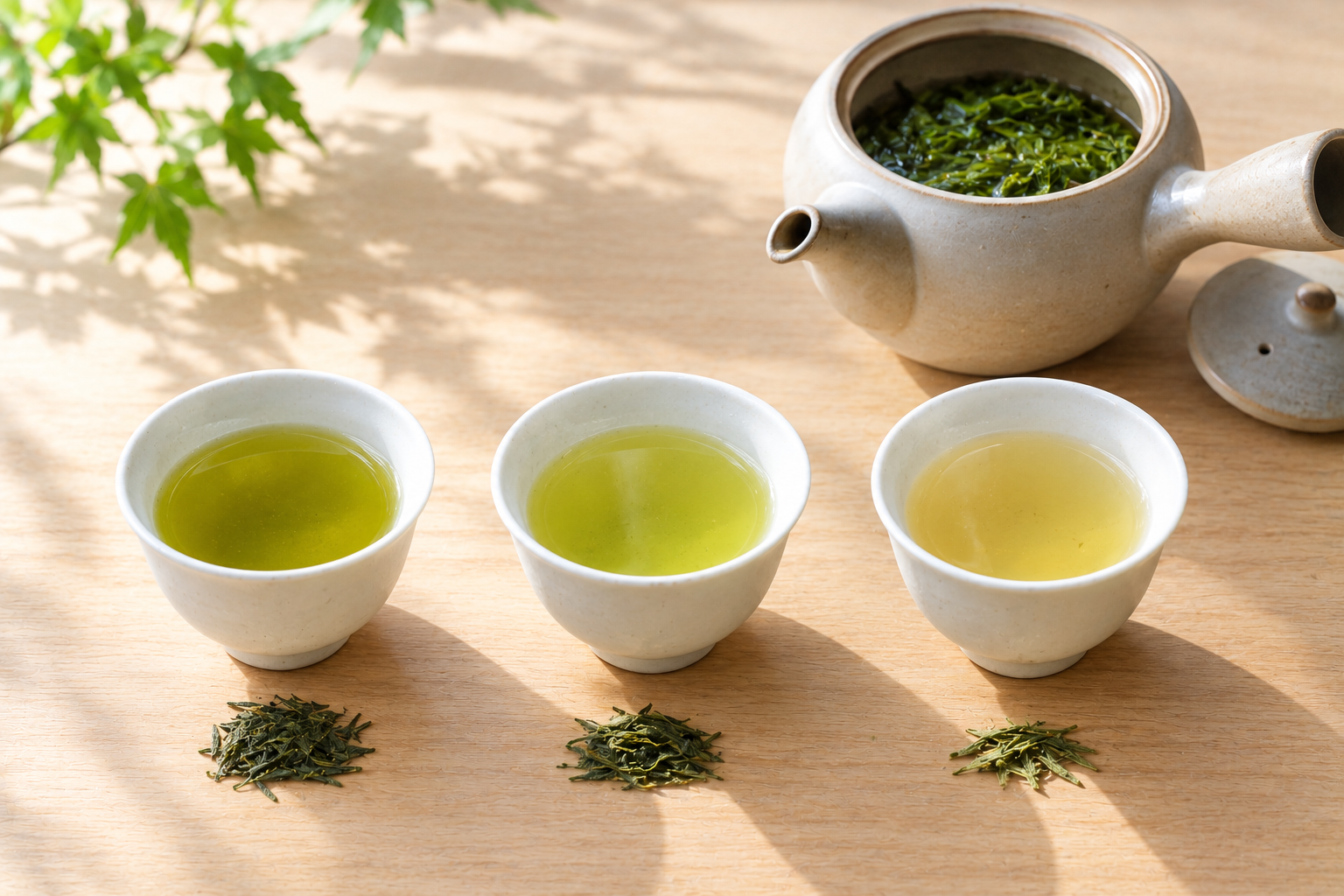
    First infusion. Brew as normal – for sencha, around 70-80°C for about 60 seconds. This cup has the most umami and sweetness, because the compounds behind them dissolve easily and come out first.

    Second infusion. Use water about the same temperature or a little hotter, and steep for a much shorter time – anywhere from a few seconds to about 30 seconds. The leaves are already open and hydrated, so they release flavor almost immediately. This cup is often brighter and more refreshing, with a little more bite.

    Third infusion. Use hotter water, around 10°C higher than the second, and a longer steep, about 45-90 seconds, to pull out what’s left. It’ll be lighter, sometimes with a pleasant, slightly astringent finish.

    Fourth and beyond. For gyokuro and good sencha, a fourth cup with very hot water and a longer steep can still be enjoyable. When the cup tastes like warm water with a hint of tea, you’re done.

    Gyokuro is different

    Gyokuro starts much cooler – around 50-60°C – and stays cool for the second infusion, around 60-65°C, before you raise the temperature for later cups. Because it’s brewed with a lot of leaf and very little water, it can give three or four small but rich cups.

    Fukamushi needs speed

    Deep-steamed fukamushi sencha has fine, broken leaf that extracts very quickly. Pour the second infusion almost immediately – a few seconds is enough – or it’ll turn bitter and murky.

    A Quick Reference for the First Three Cups

    These are good starting points for a small kyusu (about 150-200ml of water). Adjust by taste – if a cup is bitter, cool the water or shorten the time; if it’s thin, do the opposite.

    Tea1st infusion2nd infusion3rd infusion
    Sencha70-80°C, 60 sec80°C, 5-15 sec90°C, 45-60 sec
    Fukamushi sencha70°C, 30-45 sec80°C, 0-5 secUsually done
    Gyokuro50-60°C, about 2 min60-65°C, 30-60 sec70-80°C, about 1 min
    Kabusecha70°C, 60 sec75-80°C, 10-20 sec90°C, 45 sec
    Bancha80-90°C, 30-60 sec90°C, 15-30 secNear boiling, 60 sec
    HojichaNear boiling, 30 secNear boiling, 30-60 secUsually done
    Genmaicha80-95°C, 30-60 sec90°C+, 30-60 secUsually done

    Notice the pattern: the second steep is short for leaf teas (because the leaves are already open), while the roasted teas – hojicha and genmaicha – keep similar times and simply fade faster.

    Walking Through One Pot of Sencha

    Here’s what a full session looks like with ordinary sencha, so you can see how the steps fit together:

    1. First cup. Put about 5g of leaf (roughly two teaspoons) in the kyusu. Pour about 150ml of water at 70-80°C and wait a full minute. Pour out completely, shaking the last drops into the cup. Take the lid off.
    2. Second cup. A few minutes later, pour in water at about 80°C – this time, start pouring it out almost straight away, after 5-15 seconds. It’ll look brighter and taste fresher, with a little more edge than the first.
    3. Third cup. Use water around 90°C and leave it for 45-60 seconds. It’ll be lighter and slightly more astringent, a nice cup to finish on or to have with a sweet.

    From one teaspoonful of leaf, you’ve had three quite different cups – which is exactly why Japanese tea drinkers rarely stop at one.

    Three Habits That Make Re-Steeping Work

    1. Pour every last drop. After each infusion, drain the pot completely, shaking out the final drops. Any water left sitting in the pot keeps steeping the leaves and turns the next cup bitter. The last drops are also the richest part of the cup.

    2. Leave the lid open or slightly ajar. Between infusions, let steam escape. A tightly closed lid traps heat and moisture, which effectively “cooks” the wet leaves and dulls the next cup.

    3. Don’t wait too long. Wet leaves deteriorate quickly. Try to make your next infusion within an hour or two. Never leave wet leaves in the pot overnight and brew them the next day – by then they can start to spoil.

    Sharing a Pot: Pour Back and Forth

    If you’re pouring for more than one person, the Japanese way is to fill the cups a little at a time, going back and forth between them – for two cups, a bit into cup A, then cup B, then B again, then A, and so on until the pot is empty. Tea gets stronger toward the end of the pour, so this evens out both strength and volume, and nobody gets the weak first splash while someone else gets the strong last drops. It’s a small habit, but it makes every infusion taste the same in every cup.

    How to Tell the Leaves Are Done

    You don’t need to count infusions. The leaves will tell you:

    • The color fades. The brew turns noticeably paler and more yellow than green.
    • The aroma is gone. Lift the lid and smell the wet leaves; if they smell like cooked greens rather than fresh tea, they’ve given most of what they have.
    • Hotter water doesn’t help. If raising the temperature and lengthening the steep still gives a thin cup, it’s time for fresh leaf.

    At that point, the leaves are still useful – in cooking, as below, or even scattered in the garden.

    What About the Caffeine?

    Caffeine dissolves easily, so most of it comes out in the first infusion and each following cup has noticeably less. If you’re watching your caffeine, the second and third cups are gentler – though not caffeine-free.

    After the Last Cup: Eat the Leaves

    Even after three infusions, good sencha and gyokuro leaves are tender and edible. In Japan, spent gyokuro leaves are sometimes dressed with a little ponzu or soy sauce and eaten as a side dish. My guide to cooking with sencha has a few simple ways to use them.

    A Few Things People Ask Me

    Why is my second cup bitter? Almost always because it steeped too long, or water was left in the pot after the first pour. Shorten the second steep to a few seconds and drain the pot fully every time.

    Why is my second cup weak? Either the leaf is finely cut (tea bags, fukamushi) and gave most of its flavor first, or the steep was too short for that tea. Try a little hotter water or a few more seconds.

    Can I re-steep cold-brewed tea? Yes. Cold-brew leaves usually give one more, lighter batch with fresh cold water.

    What’s the best tea for multiple infusions? Gyokuro, without question – Nio Teas’ gyokuro collection includes an affordable karigane that re-steeps well. A Japanese kyusu with a fine filter on Amazon also helps a lot, because it lets you pour out every last drop.

    Where I Landed

    Re-steeping changed how I think about the price of tea. A bag of good sencha that seemed expensive for one pot looks much more reasonable at three pots, and the second cup – brighter and more refreshing – is now often my favorite. Keep the second steep short, pour out every drop, leave the lid open, and don’t let wet leaves sit too long. Your tea will go a lot further, and taste better doing it.
  • Why Is My Green Tea Cloudy? Good Cloudiness, Bad Cloudiness, and How to Tell

    Why Is My Green Tea Cloudy? Good Cloudiness, Bad Cloudiness, and How to Tell

    Disclosure: This post contains affiliate links. If you buy through one of them, I may earn a small commission at no extra cost to you.

    The first time I brewed fukamushi sencha, I almost poured it out. Instead of the clear, pale yellow-green cup I was used to, it came out thick, cloudy and almost opaque green, with a fine sediment settling at the bottom. I assumed I’d done something wrong. I hadn’t – for that tea, the cloudiness was exactly the point. But a few weeks later, a different cup of iced sencha turned hazy and dull in the fridge, and that time something really had changed.

    Cloudy Japanese green tea isn’t automatically good or bad. It depends on why it’s cloudy, and the causes are easy to tell apart once you know what to look for.

    The Problem You’re Actually Trying to Solve

    Most people searching this have just poured a cup that looks different from what they expected – murky instead of clear, or hazy after cooling – and want to know whether the tea is stale, whether they brewed it wrong, or whether it’s even safe to drink. In almost every case, it’s safe. The real question is whether the cloudiness is part of the tea’s character, or a sign you should change your water, your brewing or your tea.

    Who This Article Is NOT For

    • If your matcha looks cloudy, that’s simply how it works: matcha is powdered leaf suspended in water, not an infusion, so it’s always opaque.
    • If your tea is brown rather than cloudy and you’re drinking hojicha, that’s normal too – roasted tea is meant to be brown.
    • If you suspect your tea has actually gone moldy (a musty smell, visible growth, or tea left out for a long time), don’t drink it. That’s a different problem from cloudiness.

    Quick Diagnosis

    What you seeMost likely causeGood or bad?
    Opaque green, fine sediment at the bottom, rich tasteFine leaf particles (fukamushi, konacha)Good – it’s the tea’s style
    Cloudiness only in the last pour from the potFine particles collected in the final dropsGood – often the richest part
    Clear when hot, hazy after cooling or in the fridge“Tea cream” forming as the tea coolsHarmless – mostly cosmetic
    Grayish haze, an oily-looking film on topHard waterChange the water
    Dull brown-yellow, flat taste, papery or hay-like smellOld or badly stored teaTime for fresh tea

    Good Cloudiness: Fine Leaf Particles

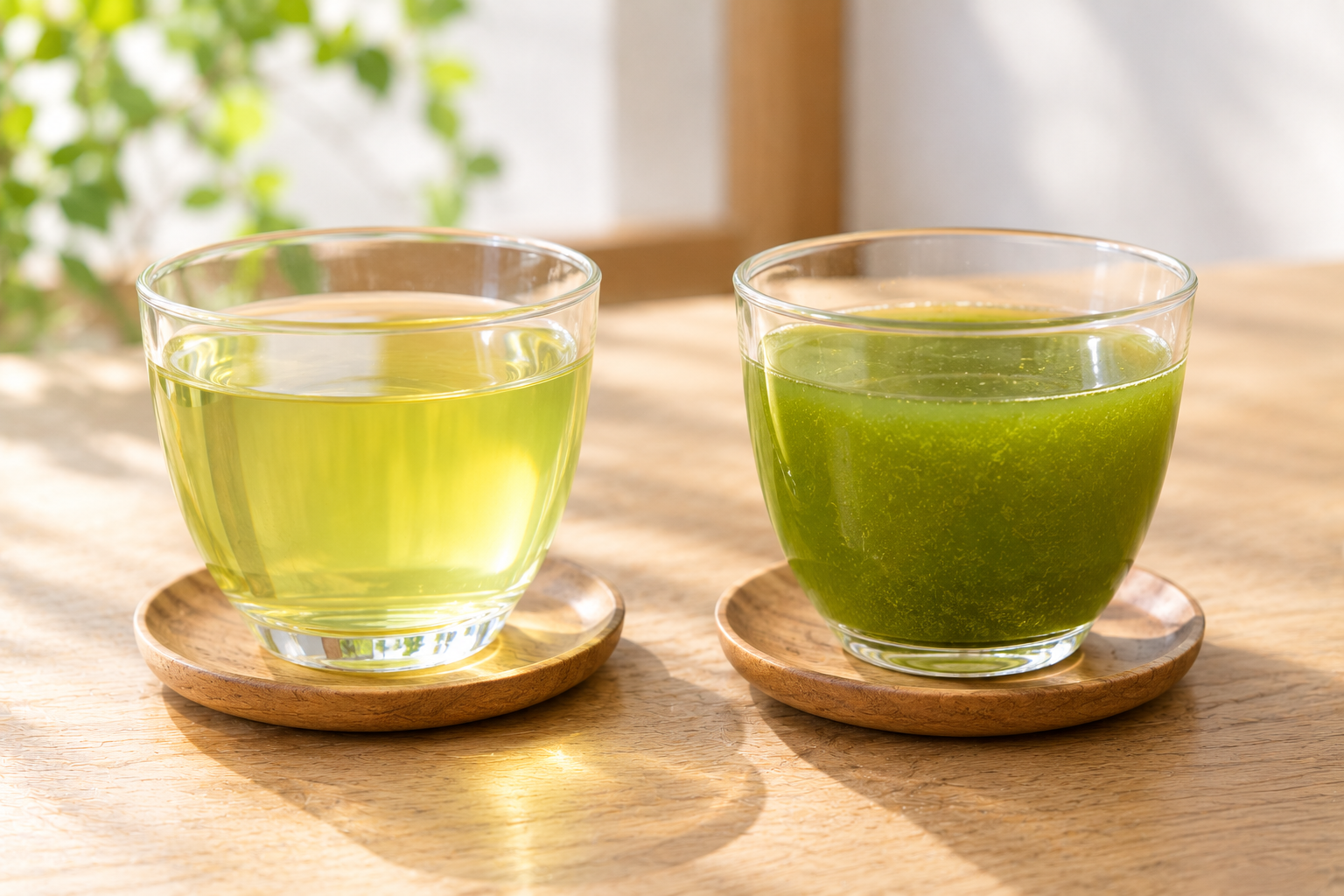
    The most common reason Japanese green tea looks cloudy is the leaf itself. Fukamushi sencha – deep-steamed sencha – is steamed two to three times longer than standard sencha, which makes the leaves softer and more fragile. They break into fine particles during rolling, and those particles pass through the teapot’s filter into your cup. The result is a deep green, cloudy brew with a fuller, smoother body and less bitterness than regular sencha. My fukamushi sencha guide explains the process in more detail.

    You’ll see the same thing with konacha, the small leaf fragments served at sushi restaurants, and to a lesser extent with any sencha that has a lot of broken leaf.

    This kind of cloudiness isn’t a defect. The fine particles carry flavor and are part of why these teas taste so rich. A few tips:

    • Pour all the way to the last drop. The final drops from the pot often carry the most particles and flavor.
    • Expect sediment. It settles at the bottom of the cup; drink it or leave it, either is fine.
    • Use a fine filter. A kyusu with a fine mesh or ceramic filter keeps most of the leaf in the pot while letting the cloudy, flavorful liquid through.

    Harmless Cloudiness: Tea Cream When It Cools

    If your tea looks clear while it’s hot but turns hazy as it cools – especially in the fridge – you’re seeing what tea scientists call “tea cream.” When tea is brewed, polyphenols (including catechins) and caffeine dissolve into the hot water. As it cools, these compounds bind together into larger clusters that the water can no longer keep dissolved, and they show up as a visible haze.

    It’s harmless. A few things make it worse or better:

    • Stronger tea clouds more. More leaf means more of the compounds that form haze.
    • Hot-brewed tea that’s later chilled clouds most. That’s why hot tea poured over ice or put in the fridge often turns murky.
    • Cold brewing avoids most of it. Tea brewed in cold water extracts far fewer catechins, so it tends to stay clear. If you want clear iced tea, cold brewing is the most reliable fix.
    • Reheating clears it temporarily, but it’ll cloud again when it cools.

    Bad Cloudiness: Hard Water

    If your tea has a grayish haze, a dull look, or an oily-looking film or “scum” on top, the water is the likely cause. Hard water contains a lot of calcium and magnesium, which react with the tea’s polyphenols and form fine particles – the same chemistry that leaves scale in your kettle. Hard water also mutes green tea’s flavor, making it taste flat.

    The fix is simple: use softer water. A filter that reduces minerals, or a soft bottled water, usually solves both the cloudiness and the dull taste. My guide to water and Japanese tea explains which water works best and why.

    Bad Cloudiness: Old Tea

    Stale tea doesn’t usually turn cloudy so much as dull. Instead of a fresh yellow-green, the brew looks flat brown-yellow, and the leaves smell dusty, papery or like hay rather than fresh and grassy. That’s oxidation from months of exposure to air, light, heat or moisture.

    It’s not harmful, but the tea has lost most of what made it good. Store opened tea in an airtight, opaque container somewhere cool, and finish it within a few weeks to a couple of months.

    A Few Things People Ask Me

    Is cloudy green tea safe to drink? Yes, in nearly every case. Fine particles, tea cream and hard-water haze are all harmless. The only time to throw tea out is if it smells sour or musty, or has been left out for a long time – especially brewed tea at room temperature.

    Does cloudy tea mean low quality? No. Fukamushi sencha is cloudy by design, and some very good teas brew opaque. Clarity tells you about the style of tea and your water, not its grade.

    Why does my tea look clear in the pot but cloudy in the cup? Often it’s the last pour: the final drops carry the most fine particles. It can also be tea cream forming as the tea cools in a cold cup.

    What tea should I try if I want that rich, cloudy cup? A fukamushi sencha from Shizuoka or Kagoshima is the classic choice – Nio Teas’ sencha collection includes several. If hard water is your problem, a mineral-reducing water filter pitcher on Amazon is the simplest upgrade.

    Where I Landed

    Cloudy green tea taught me to look past appearance. A thick, opaque fukamushi is often the richest cup you’ll make, and a little haze in iced tea is just chemistry, not a mistake. The cloudiness worth fixing is the dull, gray kind from hard water, and the flat, brown look of old tea. Get those two right – soft water and fresh leaves – and you can enjoy every other kind of cloudy cup without a second thought.

  • Tea Ceremony Etiquette for Guests: What to Do (and What Not to Worry About)

    Tea Ceremony Etiquette for Guests: What to Do (and What Not to Worry About)

    Disclosure: This post contains affiliate links. If you buy through one of them, I may earn a small commission at no extra cost to you. Etiquette differs between tea schools – the steps below are the common basics, and your host’s instructions always come first.

    The first time I sat in on a tea ceremony as a guest, I spent most of it worrying. Which way do I turn the bowl? Do I eat the sweet now or later? Is it rude to finish everything? I was so focused on not making a mistake that I barely tasted the tea. Later, the host told me something I wish I’d known before I walked in: nobody expects a first-time guest to know the steps. What matters is attention and respect – and a few basic gestures, which are easy to learn in advance.

    The Problem You’re Actually Trying to Solve

    Most people reading this have booked a tea ceremony experience in Kyoto, Tokyo or Kamakura, or have been invited to one, and want to avoid embarrassing themselves. Online guides tend to either overwhelm you with every movement of a formal ceremony or skip the practical questions: what to wear, what to say, and what to actually do when the bowl is placed in front of you.

    Who This Article Is NOT For

    • If you want to host a simple tea ceremony yourself, my guide to a tea ceremony you can do at home covers the host’s side.
    • If you want to know what all the tools in the room are, my tea ceremony utensils guide explains each one.
    • If you’re formally studying with a school, follow your teacher. The Urasenke, Omotesenke and Mushakōjisenke schools – and many others – differ in details, and your instructor’s way is the right way.

    Before You Go: What to Wear and Bring

    Clothing. You don’t need a kimono. For tourist experiences, clean, comfortable clothes are fine. Choose loose trousers or a skirt long enough to cover your knees when kneeling, since you’ll likely sit in seiza on tatami. Avoid very short skirts and tight jeans.

    Socks. Wear or bring clean socks – white is traditional. Bare feet on tatami are generally considered inappropriate, and some hosts ask guests to change into fresh socks before entering, so a spare pair is a good idea.

    Jewelry and watches. Take off rings, bracelets and watches before entering. Tea bowls can be old and valuable, and metal can scratch them.

    Perfume. Skip it. Strong scents interfere with the aroma of the tea and incense.

    What to bring (for more formal gatherings): kaishi, a small pad of folded paper used as a plate for sweets and for wiping, and a kashikiri, a small pick for cutting sweets. Tourist experiences usually provide these.

    The Sweets Come First

    You’ll be served a Japanese sweet (wagashi) before the tea. Eat it before the matcha arrives – its sweetness is meant to balance the tea’s bitterness, and it’s considered part of the experience, not a dessert afterward.

    • Say “Osaki ni” (“excuse me for going first”) with a small bow to the guest next to you before you start.
    • Place the sweet on your kaishi, hold it in your left hand, and cut soft sweets into small pieces with the pick.
    • Fold any used paper and take it home with you rather than leaving it behind.

    Receiving and Drinking the Tea

    This is the part people worry about most. A common sequence looks like this:

    1. Acknowledge the next guest. Before drinking, a small bow and “Osaki ni” to the person after you.
    2. Thank the host. Bow and say “Otemae chōdai itashimasu” (“I gratefully receive your tea”), or simply a respectful “Itadakimasu.”
    3. Pick up the bowl with your right hand and place it on your left palm. Rest your right hand lightly on its side. Always use two hands.
    4. Turn the bowl clockwise, usually twice. The bowl is served with its most beautiful side – the “front” – facing you. Turning it means you don’t drink from the front, a gesture of humility and respect for the host and the bowl.
    5. Drink in a few sips. Three to four sips is typical for thin tea. In some schools, the last sip is drawn in with a light, audible slurp to show you’ve finished and enjoyed it.
    6. Wipe the rim. Gently wipe where your lips touched with your right thumb and finger, then wipe your fingers on your kaishi.
    7. Turn the bowl back. Rotate it in the opposite direction so the front faces the host again, and set it down in front of you.

    If you lose track of the turns, don’t panic. Turning the bowl in roughly the right direction, with care, is what counts.

    Admiring the Bowl and the Room

    After drinking, it’s polite to look at the bowl before it’s returned. Place it in front of you, bow slightly, and lift it low – keeping your elbows on your knees, close to the tatami, so it can’t fall far. Look at its shape, glaze and the base, then set it down and turn it so the front faces the host.

    The same goes for the hanging scroll, the flowers and the other utensils: they’re chosen for the season and the occasion, and noticing them is part of being a good guest. Admire them with your eyes, and touch nothing unless invited.

    Things First-Time Guests Worry About Too Much

    • Sitting in seiza. Hosts know it’s hard. Many tourist experiences offer chairs (ryūrei style) or let you shift your legs. Ask if you need to.
    • Getting the words wrong. A sincere bow and “thank you” (arigatō gozaimasu) cover almost everything.
    • Not liking the taste. Matcha can be bitter. Finishing the bowl is polite, but no one will judge your face.
    • Doing it “wrong.” Different schools do things differently. Watch the guest before you, and follow your host.

    A Few Things to Avoid

    • Taking photos without asking first – ask on arrival what’s allowed
    • Talking loudly or checking your phone
    • Touching or picking up utensils unless invited
    • Stepping on the edges of the tatami mats, if you can avoid it
    • Leaving food or paper behind

    A Few Things People Ask Me

    Do I need to know Japanese? No. Tourist experiences usually explain everything in English, and a few phrases – osaki ni, itadakimasu, arigatō gozaimasu – are more than enough.

    Which way do I turn the bowl? Clockwise before drinking, usually twice, and back again afterward. Some schools differ slightly; follow the host’s demonstration.

    Do I have to finish the tea? Finishing it is the polite norm, and the portions of thin tea are small. If you truly can’t, that’s understandable – just drink what you can with care.

    How can I practice before I go? Making matcha at home a few times helps more than anything – you’ll know what the bowl and whisk feel like. Nio Teas’ matcha tools have a good starter set, and a pad of kaishi paper on Amazon is useful if you’re attending a more formal gathering.

    Where I Landed

    The rules of a tea ceremony look complicated from the outside, but most of them come down to the same few ideas: respect for the host, care for the utensils, and attention to the moment. Learn the basic steps – sweets first, a word to the next guest, turn the bowl, drink, wipe, turn it back – and then let go of worrying. My best tea ceremony was the one where I stopped thinking about the rules and actually tasted the tea.

  • Obukucha: Kyoto’s New Year “Good Fortune Tea” and How to Make It at Home

    Obukucha: Kyoto’s New Year “Good Fortune Tea” and How to Make It at Home

    Disclosure: This post contains affiliate links. If you buy through one of them, I may earn a small commission at no extra cost to you.

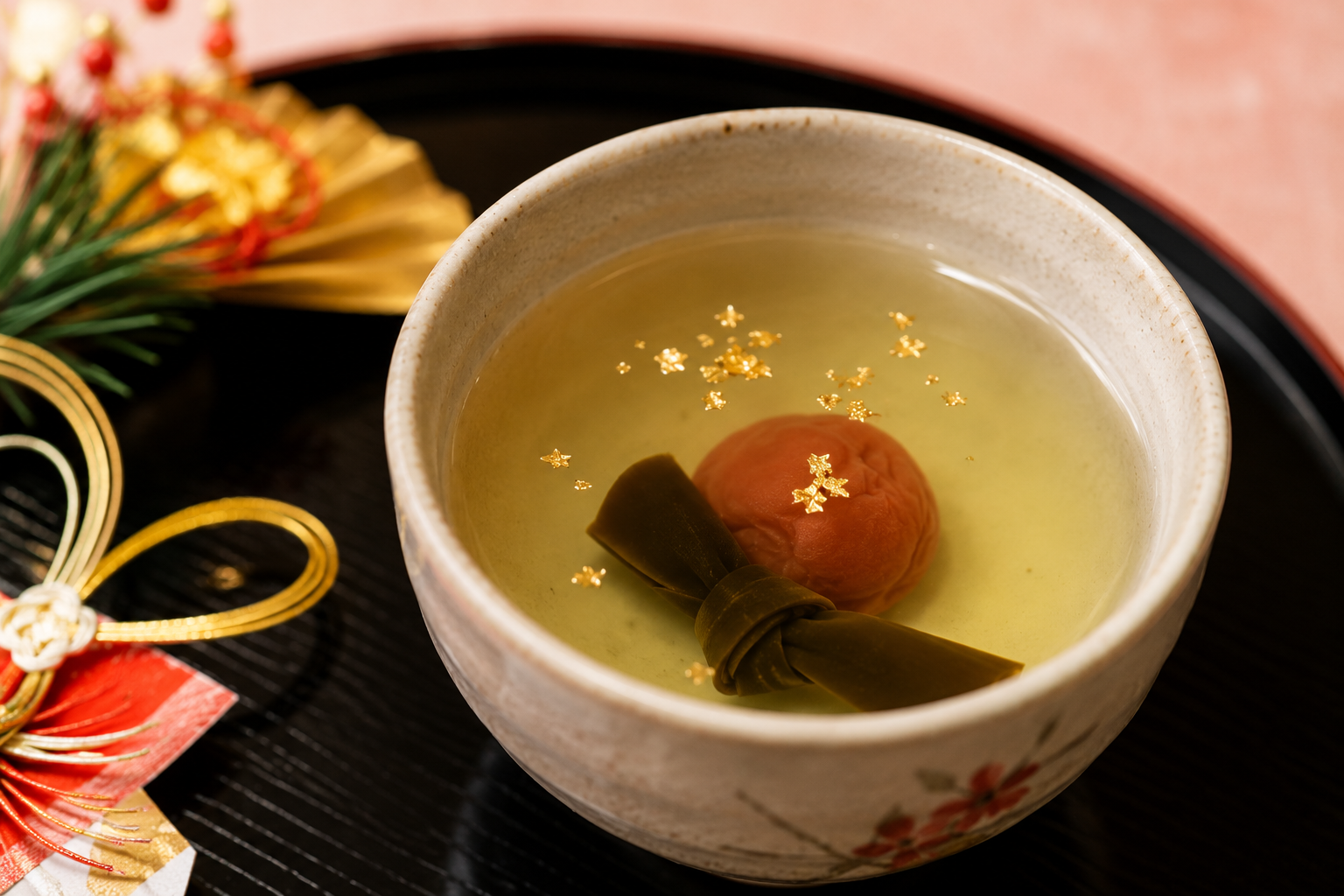
    In parts of Japan, especially Kyoto and the surrounding Kansai region, the first cup of tea of the year isn’t an ordinary one. On New Year’s morning, families pour green tea over a pickled plum and a small knot of kelp, and drink it for good health and good fortune in the year ahead. It’s called obukucha (大福茶), “great fortune tea,” and it comes with a story that goes back more than a thousand years.

    The Problem You’re Actually Trying to Solve

    Most people come across obukucha in one of two ways: a tea shop’s limited “New Year tea” listing in December, or a mention in a guide to Japanese New Year customs. Neither usually explains what’s actually in the cup, why those ingredients, or how to make it if you can’t buy the seasonal blend. The good news is that it’s simple, and almost everything you need is easy to find.

    Who This Article Is NOT For

    • If you’re looking for a new kind of tea leaf, obukucha isn’t one. It’s a way of serving a mild green tea – most often sencha, bancha or genmaicha – for a special occasion. If you need a good base tea, my sencha brand comparison is a good starting point.
    • If you’re looking for a remedy, the healing story below is a legend. Obukucha is a celebratory drink, not a medicine.
    • If you can’t have salty foods, note that umeboshi and kombu both add salt to the cup.

    The Story Behind It

    The tradition is usually traced to Rokuharamitsuji, a temple in Kyoto, and to its founder, the Buddhist priest Kūya. According to the legend, an epidemic swept through the capital in 951. Kūya served tea with pickled plum to the sick, and it was said to help them recover. Emperor Murakami is said to have drunk the same tea himself, and to have made drinking it at New Year a custom.

    The name has a nice twist. It was originally written with characters meaning “the emperor drank” (皇服茶, kōfukucha), and because kōfuku also sounds like the word for happiness, the name later came to be written as 大福茶 – “great fortune tea.” Today, Rokuharamitsuji still serves it at New Year, and many Kyoto tea shops sell special obukucha blends each winter.

    What Goes in the Cup, and Why

    Each ingredient was chosen for what it represents:

    IngredientWhat it addsWhat it symbolizes
    Green tea (sencha, bancha or genmaicha)A mild, clean baseThe first tea of the year
    Umeboshi (pickled plum)Sour, salty notesLong life and good health – the wrinkled plum is linked to living to old age, and plum trees are the first to bloom in spring
    Musubi kombu (knotted kelp)Savory umami and saltJoy and family ties – kombu echoes yorokobu, “to be happy,” and the knot represents “tying” good fortune together
    Gold leaf (optional)No flavorCelebration and prosperity

    Some families add roasted brown rice, which is one reason genmaicha is a popular base. Ippodo, for example, releases its own obukucha each winter as a premium genmaicha. If you’re choosing a genmaicha to use as your base, my genmaicha brand comparison explains what to look for.

    How to Make Obukucha at Home

    You’ll need (per cup):

    • 1 cup of mild green tea – sencha, bancha or genmaicha
    • 1 umeboshi (pickled plum)
    • 1 small piece of kombu, tied in a knot (or a small strip if knotting is fiddly)
    • Edible gold leaf, optional

    Method:

    1. Place the umeboshi and the knotted kombu in the bottom of the cup.
    2. Brew your green tea as usual. Sencha around 70-80°C, genmaicha a little hotter.
    3. Pour the tea over the plum and kelp.
    4. Sprinkle a few flakes of gold leaf on top if you’re using it.
    5. Let it sit for a minute so the plum and kombu flavor the tea, then drink.

    The result tastes like green tea with a sour, salty and savory edge – more interesting than it sounds, and very warming on a cold New Year’s morning. The plum can be eaten at the end.

    Small tips:

    • Soak dried kombu in a little water for a few minutes first. It softens enough to tie, and it’s easier to knot thin strips.
    • Choose a milder umeboshi if you can. Traditional ones are very salty and sour; honey-pickled versions are gentler.
    • Use a mild base tea. A delicate, expensive gyokuro would be wasted under the plum and kelp.

    When It’s Drunk

    Obukucha is traditionally the first tea drunk on New Year’s Day, and some families continue for the first few days of January. Because of its lucky associations, it’s also served at other celebrations, including weddings and birthdays, and it’s a popular New Year gift. Similar “fortune tea” customs exist elsewhere in Japan, with local variations in what goes into the cup.

    A Few Things People Ask Me

    Is obukucha a type of tea? Not exactly. It’s a traditional way of serving green tea, with plum and kelp added. Shops sell “obukucha” blends, but you can make it with tea you already have.

    What does it taste like? Like light green tea with a sour, salty and slightly savory note from the plum and kelp. If you’ve had umeboshi or kombu tea, you’ll recognize both.

    Can I make it with genmaicha? Yes – it’s one of the most common bases, and the toasty rice pairs nicely with the plum.

    Where can I buy the ingredients? For a base tea, Nio Teas’ genmaicha works beautifully. Umeboshi is easy to find at Japanese grocery stores or as umeboshi pickled plums on Amazon, and dried kombu is usually stocked right next to it.

    Where I Landed

    What I love about obukucha is how little it asks of you. There’s no special leaf and no special equipment, just a plum, a knot of kelp and a cup of ordinary green tea – and a thousand-year-old story to go with it. If you want a small, meaningful way to start the new year, make a cup on the morning of January 1st. It takes five minutes, and it’s one of the easiest Japanese traditions to bring home.

  • Konacha: The Green Tea Sushi Restaurants Serve (and What “Agari” Means)

    Konacha: The Green Tea Sushi Restaurants Serve (and What “Agari” Means)

    Disclosure: This post contains affiliate links. If you buy through one of them, I may earn a small commission at no extra cost to you.

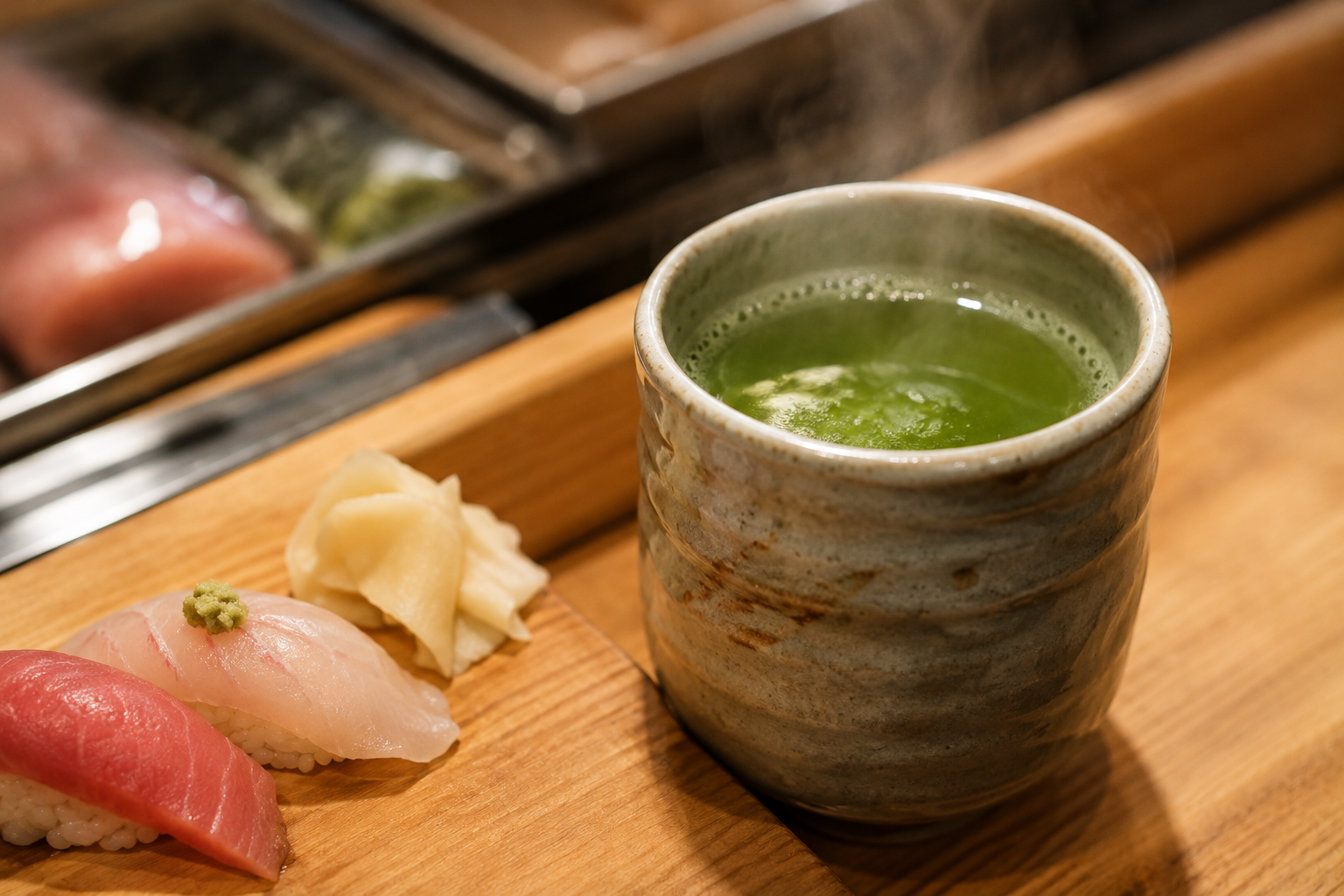
    Anyone who has eaten at a sushi restaurant in Japan knows the tea: a big, heavy cup, almost too hot to hold, filled with a cloudy, deep green tea that tastes stronger and grassier than the sencha you’d brew at home. For years I assumed it was some special “sushi tea.” It’s actually konacha – literally “powder tea” – and it’s one of the cheapest teas in Japan. It just happens to be exactly right for sushi.

    The Problem You’re Actually Trying to Solve

    People usually look this up after a sushi meal, trying to recreate that tea at home – and then get confused, because konacha looks like matcha in the bag, some shops sell a soluble green powder under similar names, and recipes online mix the three up. They’re not the same thing, and making them the same way gives very different results.

    Who This Article Is NOT For

    • If you’re actually after matcha – the bright green, whisked tea – konacha won’t replace it. My matcha vs. green tea comparison explains why the two are made and prepared so differently.
    • If you want a mild, sweet everyday green tea, konacha’s punchy, slightly bitter character may be too much. A gentler tea like bancha, which many sushi restaurants outside Japan serve instead, may suit you better.
    • If you’re looking for a premium tea to drink on its own, konacha isn’t trying to be that. It’s an everyday tea built for food.

    What Konacha Actually Is

    When sencha and gyokuro are processed, the leaves are sorted and sifted. Along the way, small fragments, buds and fine particles fall out. Those leftovers are konacha. Konacha made from gyokuro is sometimes sold as gyokuro-konacha.

    Because it’s a byproduct, konacha is much cheaper than sencha – one reason restaurants that serve free tea all day choose it. But cheap isn’t the same as bad. The small particles have a lot of surface area, so they release flavor fast, giving a strong, deep green cup with a bold, grassy taste from very little leaf.

    Konacha vs. Matcha vs. Funmatsucha

    These three are easy to confuse, especially in a bag:

    KonachaMatchaFunmatsucha
    What it isSmall leaf particles left over from sencha/gyokuroShade-grown tencha, stone-ground into fine powderOrdinary leaf tea ground into powder
    How you make itSteep, then strain out the particlesWhisk into water; you drink it allStir into water; you drink it all
    TasteStrong, grassy, can turn bitterSweet, rich, umamiLike strong, astringent sencha
    PriceLowHighLow
    Where you’ll meet itTraditional sushi restaurantsTea ceremony, cafésMany conveyor-belt sushi restaurants

    The last row is worth knowing. At many conveyor-belt (kaiten) sushi restaurants, you’ll find a jar of green powder and a hot water tap at your seat. That’s usually powdered tea that you stir straight into the cup – closer to funmatsucha than to konacha, which needs to be steeped and strained. When buying, check whether the product says it dissolves (powdered/instant) or needs to be brewed in a teapot (konacha).

    Why Sushi Restaurants Serve It

    Sushi restaurants serve their tea very hot, and the reason is practical. Hot green tea helps rinse oils from fatty fish out of your mouth, so you can taste the next piece cleanly – the same job as the pickled ginger (gari) on the side. Konacha’s strong flavor holds up against fish and soy sauce where a delicate tea would disappear, and it brews quickly, which matters when you’re pouring cup after cup all day. And because it’s inexpensive, the restaurant can refill your cup as often as you like.

    What “Agari” Means

    In sushi restaurants, tea is often called agari. There are two common explanations for the word. One links it to the verb agaru, “to finish,” since tea traditionally comes at the end of the meal. The other traces it to the teahouses of the Edo period, where the first tea served to a guest was called odebana and the last agaribana. Sushi restaurants later picked up the term and shortened it.

    A small etiquette tip: agari, like gari for ginger or murasaki for soy sauce, is restaurant staff jargon. Many people in Japan feel it sounds a little off when customers use it themselves. Simply asking for “ocha” (tea) is always correct.

    How to Brew Konacha at Home

    • Leaf: about 4g (roughly 2 teaspoons) per 120ml of water
    • Water: around 80°C (176°F)
    • Steep: 30 seconds at most – it extracts very quickly
    • Strain: use a fine-mesh strainer or a kyusu with a fine filter, since the particles are tiny

    The sushi-restaurant version is hotter and stronger, which is great with food but turns bitter on its own. At home, start with the recipe above. If you want the full sushi-bar effect, use hotter water and a bigger cup, and drink it alongside something oily or salty.

    Konacha’s fine particles can clog the filter of some teapots. Many people find it easiest to brew in a disposable tea filter bag, or to use konacha already packed in tea bags.

    A Few Things People Ask Me

    Is konacha the same as matcha? No. Matcha is shade-grown tea leaf stone-ground into a powder that you whisk and drink entirely. Konacha is small leftover leaf particles that you steep and strain, like regular green tea.

    Why does my konacha taste bitter? It’s probably steeping too long or with water that’s too hot. Konacha extracts much faster than whole-leaf sencha, so keep it to about 30 seconds.

    Can I use konacha for cooking? Yes. Its strong flavor works well in cooking, for example as a quick, strong green tea for ochazuke.

    Where can I buy it? Look for “konacha” or “sushi tea” – konacha on Amazon is easy to find, in loose form or tea bags. Because the particles are so fine, a fine-mesh tea strainer on Amazon makes brewing much easier.

    Where I Landed

    Konacha is a good example of how Japanese tea culture works: the leftovers of expensive tea become a cheap, strong tea that turns out to be perfect for one specific job. It isn’t something to sip slowly on its own, but with sushi – very hot, in a big cup, refilled often – it’s hard to beat. Brew it short at home, and you’ll have the closest thing to a sushi-bar cup outside Japan.

  • Sakurayu: Japan’s Salted Cherry Blossom Tea, and Why It’s Served at Weddings

    Sakurayu: Japan’s Salted Cherry Blossom Tea, and Why It’s Served at Weddings

    Disclosure: This post contains affiliate links. If you buy through one of them, I may earn a small commission at no extra cost to you.

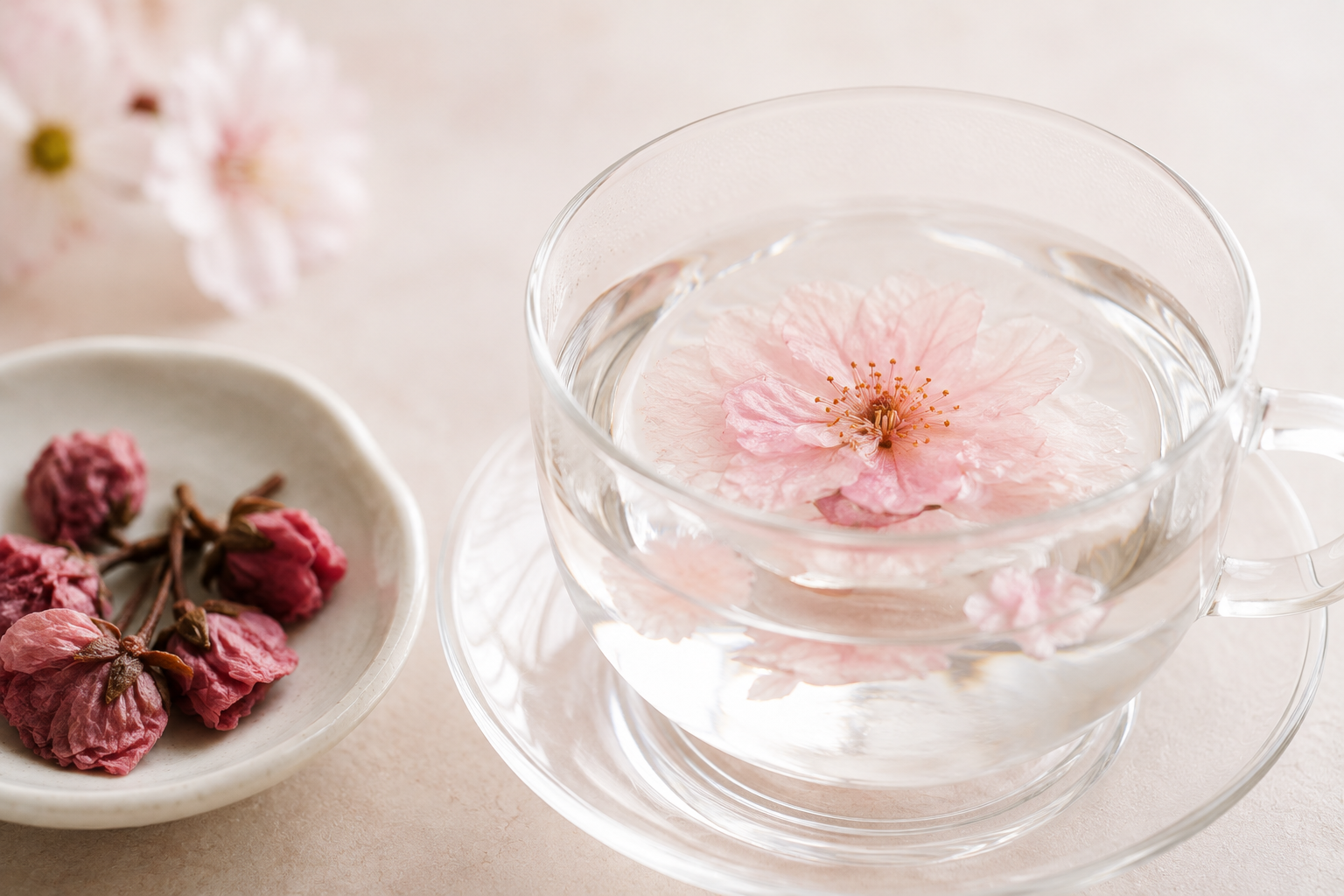
    The first time I was served sakurayu, it arrived in a small cup of what looked like plain hot water, with a single pink flower sitting at the bottom. As I watched, the petals slowly opened and the blossom floated up to the surface. Then I took a sip and was surprised again: it was salty. Sakurayu – “cherry blossom water” – is one of the few Japanese drinks people photograph before they drink it, and one of the few that’s tied so closely to a single moment in life: celebrations, and above all weddings.

    The Problem You’re Actually Trying to Solve

    Most people who come across sakurayu have either seen a jar of pickled pink flowers in a Japanese shop and wondered what to do with it, or have been served it at a celebration and wondered why it tasted of salt instead of flowers. It’s a simple drink, but there are two things almost nobody explains: why it’s salty, and how to make it taste less salty if that’s not what you want.

    Who This Article Is NOT For

    • If you’re looking for a sweet, fruity “cherry blossom tea,” sakurayu probably isn’t it. Many Western “sakura teas” are flavored green or black teas; true sakurayu is salty and floral, not sweet.
    • If you want a caffeine-free drink for everyday use, the grain teas are more practical. My caffeine-free Japanese tea guide compares sakurayu with mugicha, sobacha and others.
    • If you need to keep your salt intake low, rinse the blossoms well (see below), or treat sakurayu as an occasional drink.

    What Sakurayu Actually Is

    Sakurayu is made by pouring hot water over cherry blossoms that have been pickled in salt and plum vinegar and then dried. There are no tea leaves in it, so pure sakurayu has no caffeine. It’s also sometimes called sakura-cha, though that name is also used for modern blends of sencha with cherry blossom or cherry flavoring, which do contain caffeine.

    The blossoms used are usually yaezakura, double-flowered cherries that bloom a week or two after the familiar pale Somei Yoshino. Their many layered petals hold their shape and color well when preserved, which is why they open so beautifully in the cup. Most of Japan’s supply comes from Hadano in Kanagawa Prefecture, which is often credited with around 80% of national production.

    How the Blossoms Are Made

    The process is simple, but it takes weeks:

    1. The blossoms are picked in mid-to-late April, when they’re about half open.
    2. They’re layered with salt overnight, often under a weight, to draw out moisture.
    3. They’re soaked in umezu, the plum vinegar left over from making umeboshi. It often contains red shiso, which helps set the pink color.
    4. They cure for about three to four weeks, then are dried and sealed.

    That’s where the flavor comes from: salt first, a faint tart, plum-like note from the vinegar, and a delicate floral finish. Once sealed, the blossoms keep for months, so sakurayu can be served year-round, not just in spring.

    Why It’s Served at Weddings

    Sakurayu is a traditional drink at weddings and engagement ceremonies (yuino), and it often appears at other happy occasions too. There are two reasons people usually give.

    The first is symbolic: cherry blossoms opening in the cup represent new beginnings, and the drink is considered auspicious.

    The second is linguistic, and it’s the one people remember. In Japanese, ocha wo nigosu – literally “to make the tea cloudy” – means to be evasive or to gloss over something. That’s not a phrase anyone wants associated with a marriage, so ordinary green tea is traditionally avoided at weddings, while sakurayu, which stays clear in the cup, is served instead. Kombu tea is another celebratory drink for a similar wordplay reason.

    How to Make Sakurayu

    • Blossoms: 1-2 per cup (one for a delicate cup, two for more flavor and a fuller look)
    • Rinse first: soak them briefly in a little water to remove excess salt – a quick 10-second rinse for a mildly salty cup, or a few minutes’ soak for a gentler one. Keep the soaking water if you want to add saltiness back later.
    • Water: around 70-80°C (158-176°F) – hot but not boiling
    • Steep: 2-5 minutes, until the blossom has fully opened
    • Serve: in a clear glass or a white cup, so you can see the flower

    That rinsing step is the answer to the most common complaint about sakurayu. Unrinsed blossoms make a very salty cup; rinsed ones make a light, floral, faintly savory one. Adjust to taste.

    Other Ways to Use Salted Cherry Blossoms

    The same pickled blossoms are used in Japanese sweets and cooking, especially in spring:

    • On bread and sweets: the famous sakura anpan – a sweet bean bun with a salted blossom pressed into the top – is a well-known example from Tokyo’s bakeries. The saltiness balances the sweet filling.
    • In rice: rinse a few blossoms, chop them and mix them into freshly cooked rice for a pale pink, gently salty sakura rice.
    • On wagashi and desserts: a single rinsed blossom makes an easy, beautiful garnish for mochi, jelly, or ice cream. If you serve matcha with sweets, my seasonal wagashi pairing guide has more ideas for spring.

    Don’t confuse these with the leaves used to wrap sakura mochi. Those are salted cherry leaves, not blossoms, and they have a different, more herbal aroma.

    A Few Things People Ask Me

    Does sakurayu have caffeine? Pure sakurayu – just blossoms and hot water – has none. Blends labeled “sakura sencha” or “sakura green tea” contain tea leaves and do have caffeine.

    Why is my sakurayu so salty? Because the blossoms are preserved in salt. Rinse or soak them before brewing, and add some of the soaking water back if it ends up too mild.

    Can I eat the blossom? Yes. It’s edible, though most people simply enjoy looking at it.

    Where can I buy it? Look for “salted cherry blossoms” or “sakurazuke” – salt-pickled cherry blossoms on Amazon are the easiest to find. A heat-resistant clear glass teacup on Amazon makes all the difference to the presentation.

    Where I Landed

    Sakurayu isn’t really a tea you drink for flavor alone. It’s a drink for a moment – a wedding toast, a spring visit, a quiet celebration – and much of its appeal is watching the blossom open. Rinse the blossoms so the salt doesn’t overwhelm it, serve it in clear glass, and you’ll see why it’s been part of Japan’s happiest occasions for so long.

  • Mizudashi: How to Cold Brew Japanese Green Tea (and Why It Tastes So Different)

    Mizudashi: How to Cold Brew Japanese Green Tea (and Why It Tastes So Different)

    Disclosure: This post contains affiliate links. If you buy through one of them, I may earn a small commission at no extra cost to you.

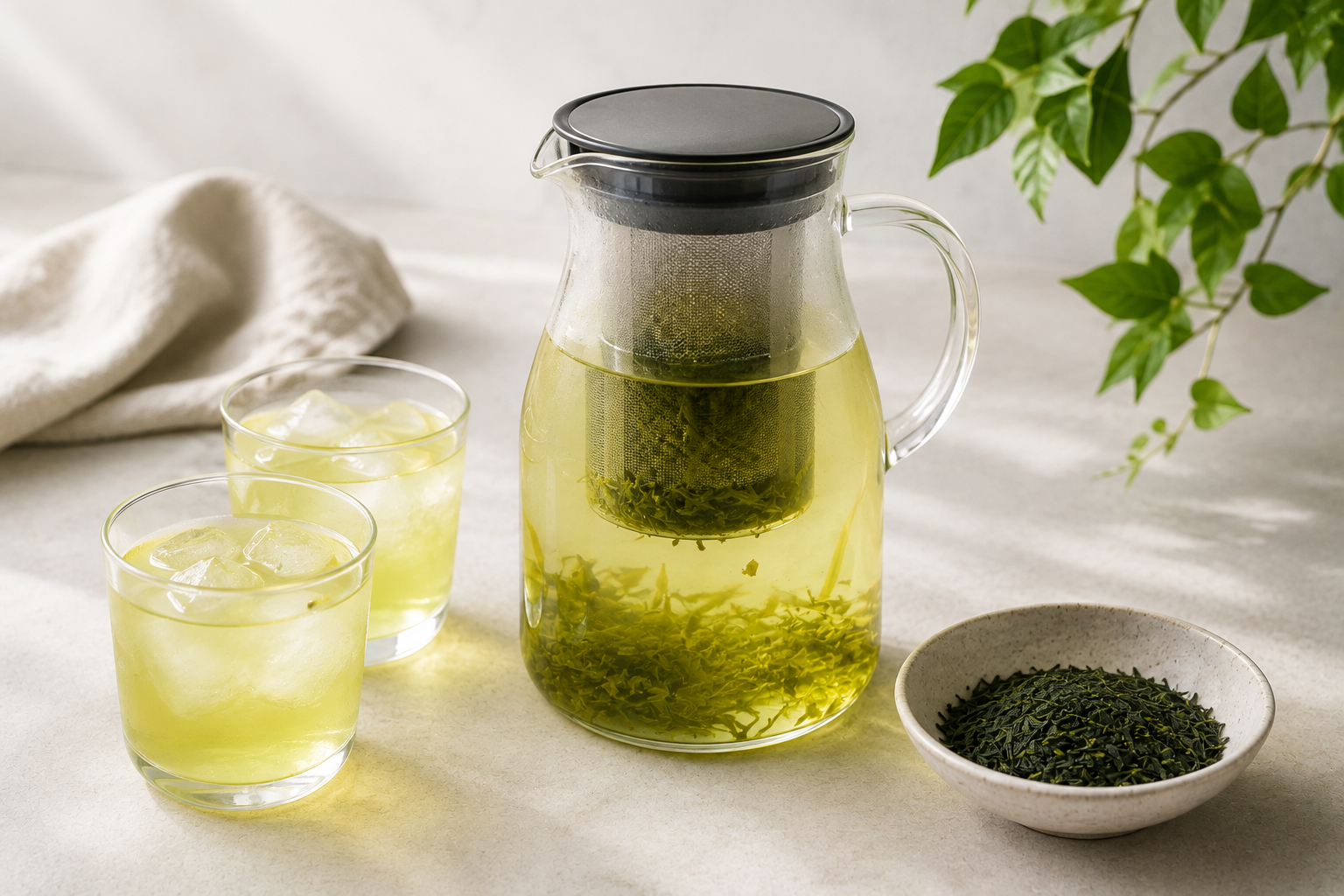
    The first time I made cold-brewed sencha, I expected a weaker, iced version of my usual cup. What came out of the fridge the next morning was something else: pale, clear and noticeably sweet, with almost none of the slight bitterness I was used to from hot sencha. I hadn’t changed the tea at all – only the water temperature. In Japan this method is called mizudashi, literally “water extraction,” and it’s one of the easiest ways to make even an ordinary bag of sencha taste better.

    The Problem You’re Actually Trying to Solve

    Most people who make iced green tea do it by brewing hot tea and pouring it over ice, then wonder why it tastes thin or bitter. Others leave a tea bag in cold water overnight and end up with something murky and grassy. Cold brewing loose Japanese green tea works beautifully, but only with the right ratio, the right timing and one rule most guides skip: take the leaves out when it’s ready.

    Who This Article Is NOT For

    • If you want cold matcha, this isn’t the method – matcha powder is whisked or shaken, not steeped. My cold brew matcha guide covers that separately.
    • If you want the sharp, brisk bite of hot sencha, cold brewing will feel too mellow. That softness is the whole point.
    • If you’re avoiding caffeine completely, cold brewing reduces it but doesn’t remove it. A caffeine-free drink like mugicha is the better choice.

    Why Cold Water Changes the Taste

    Green tea gets its flavor from a few groups of compounds that dissolve at very different temperatures:

    • Theanine, the amino acid behind green tea’s sweetness and umami, dissolves readily even in cold water.
    • Catechins, which bring bitterness and astringency, extract poorly in cold water. Their extraction becomes much more active above roughly 60°C (140°F).
    • Caffeine also extracts more slowly in cold water, so cold-brewed tea is usually noticeably lower in caffeine than the same tea brewed hot.

    So cold water doesn’t just make tea colder. It changes the balance: more of the sweet, savory side and much less of the bitter side. That’s why a tea that tastes a little harsh hot can taste smooth and sweet cold.

    The Basic Mizudashi Method

    • Tea: 10-15g of loose-leaf sencha per 1 liter of cold water (roughly 2-3 tablespoons). Use 10g for a lighter cup and 15g for more body.
    • Water: Cold, filtered water if possible.
    • Time: 3-6 hours in the fridge.
    • Then: Strain or remove the leaves, and keep the tea refrigerated.

    Start tasting at about three hours. When it tastes right to you, take the leaves out. Leaving them in overnight is the most common mistake: extraction keeps going, and the tea slowly turns bitter and cloudy.

    Water quality matters more than you’d think with cold brew, because there’s no heat to mask off-flavors. Chlorinated tap water, in particular, comes through clearly. My guide to water and Japanese tea explains why soft, filtered water works best.

    Times for Different Teas

    TeaApprox. cold brew timeWhat to expect
    Fukamushi senchaAbout 3-5 hoursBrews quickly; deep green, rich and sweet
    SenchaAbout 4-6 hoursThe classic: clear, sweet, refreshing
    GenmaichaAbout 4-6 hoursToasty and mellow
    HojichaAbout 6-8 hoursSoft, roasty, very little bitterness
    Gyokuro / kabusechaBetter as koridashi (below)Very sweet and savory

    Fukamushi sencha is a particularly good choice for beginners: its finer, more broken leaf extracts faster and gives a fuller, greener cup in less time.

    Koridashi: Ice Brewing for Gyokuro

    For high-theanine teas like gyokuro and kabusecha, there’s an even slower method called koridashi (also written kooridashi), or ice brewing. Instead of cold water, you let ice melt over the leaves:

    • Put about 15-20g of leaves (for roughly a liter of ice) in a small teapot or bowl
    • Cover the leaves with ice cubes
    • Let the ice melt slowly at room temperature, about 30 minutes to 2 hours
    • Swirl gently and pour

    What you get is a small amount of very concentrated, almost syrupy tea – intensely sweet and savory, more like a broth than a drink. It’s not an everyday method, but it’s one of the best ways to taste what makes gyokuro special.

    Flash Chilling: When You Want Aroma

    If you want iced tea quickly, or you want more of green tea’s bright aroma than cold water gives, brew hot – around 80-90°C – and pour it straight over plenty of ice. Hot water pulls out aroma compounds that cold water leaves behind, and the instant chill helps keep them. It’s brighter and more fragrant than mizudashi, but with more bitterness. Many people keep both in rotation: mizudashi for smooth everyday tea, flash-chilled for a crisper glass.

    Keeping It Fresh

    • Remove the leaves once it’s ready
    • Use a sealed glass container, away from strong-smelling food in the fridge
    • Drink it within a day or two – ideally the same day or the next
    • Re-steep once if you like – the same leaves usually give a second, lighter batch with fresh cold water

    A Few Things People Ask Me

    Can I cold brew tea bags? Yes, but loose leaf gives a cleaner, sweeter result. If you use bags, check the timing carefully, since finely cut leaf extracts fast and turns bitter sooner.

    Does cold-brewed green tea have less caffeine? Usually, yes – caffeine extracts more slowly in cold water. How much less depends on the tea and how long you steep it, so treat it as “lower,” not “low.”

    Can I use cheap sencha? Absolutely. Cold brewing is one of the kindest methods for everyday sencha, because it softens the bitterness that cheaper teas often have when brewed hot.

    What do I need to start? A filter-in bottle makes this almost effortless – you put leaves in the built-in mesh, add water and pull the filter out when it’s done. A cold brew tea bottle with a built-in filter on Amazon works well, and Nio Teas’ sencha collection includes fukamushi senchas that are especially good for mizudashi.

    Where I Landed

    Mizudashi is the method I’d recommend to anyone who thinks they don’t like green tea. It takes almost no skill – leaves, cold water, a few hours, then take the leaves out – and it shows green tea at its sweetest and gentlest. Keep a bottle in the fridge for everyday drinking, try koridashi once with a good gyokuro, and flash-chill when you want something brighter. Same leaves, three very different glasses.

  • How to Choose a Chazutsu: The Japanese Tea Canister Guide

    How to Choose a Chazutsu: The Japanese Tea Canister Guide

    Disclosure: This post contains affiliate links. If you buy through one of them, I may earn a small commission at no extra cost to you.

    For my first year of drinking good sencha, I kept it in the bag it came in, folded over and clipped shut. Then I left a half-finished bag on the counter for three weeks and opened it to tea that smelled like cardboard. That’s when I bought my first chazutsu – a plain Japanese tea canister – and noticed the difference within a single bag. Tea doesn’t need anything fancy to stay fresh, but it does need a container that keeps out air, light and moisture, and the traditional Japanese canister is very good at exactly that.

    The Problem You’re Actually Trying to Solve

    Green tea loses its aroma quickly once opened. The four things that damage it are oxygen, light, heat and moisture, and a resealable bag only handles some of those, imperfectly. A good chazutsu handles all four. The tricky part is that “Japanese tea canister” covers everything from a few-dollar washi-covered tin to a hand-made copper heirloom, and the difference in price doesn’t always match the difference in how well they keep tea.

    Who This Article Is NOT For

    • If you want the full storage rules – how long sencha and gyokuro last, and whether to use the fridge – my green tea storage guide covers that in detail.
    • If you’re mainly storing matcha, the rules are a bit stricter because the powder oxidizes faster. My matcha storage guide explains what changes.
    • If you’re looking for the lacquered natsume used in tea ceremony, that’s a different object made for serving matcha, not for storing it long-term.

    What Makes a Good Chazutsu

    Before choosing a material, check three things:

    1. An airtight lid. The best canisters have either a very precisely fitted lid or a double lid – an inner lid (nakabuta) under the outer one. Both reduce the amount of air that reaches the tea.
    2. Opaque walls. Light fades green tea’s color and aroma. Clear glass jars look nice on a shelf, but they’re one of the worst places to keep it.
    3. The right size. A canister that’s mostly empty holds a lot of air. Match it to how you buy – most loose-leaf tea comes in 50g, 80g, 100g or 200g bags – and pick a canister that holds one bag.

    The Four Main Types

    TypeMade fromAirtightnessPriceBest for
    Washi-covered tinTin-plated steel wrapped in Japanese paperGood, usually with an inner lidLowEveryday use, first canister
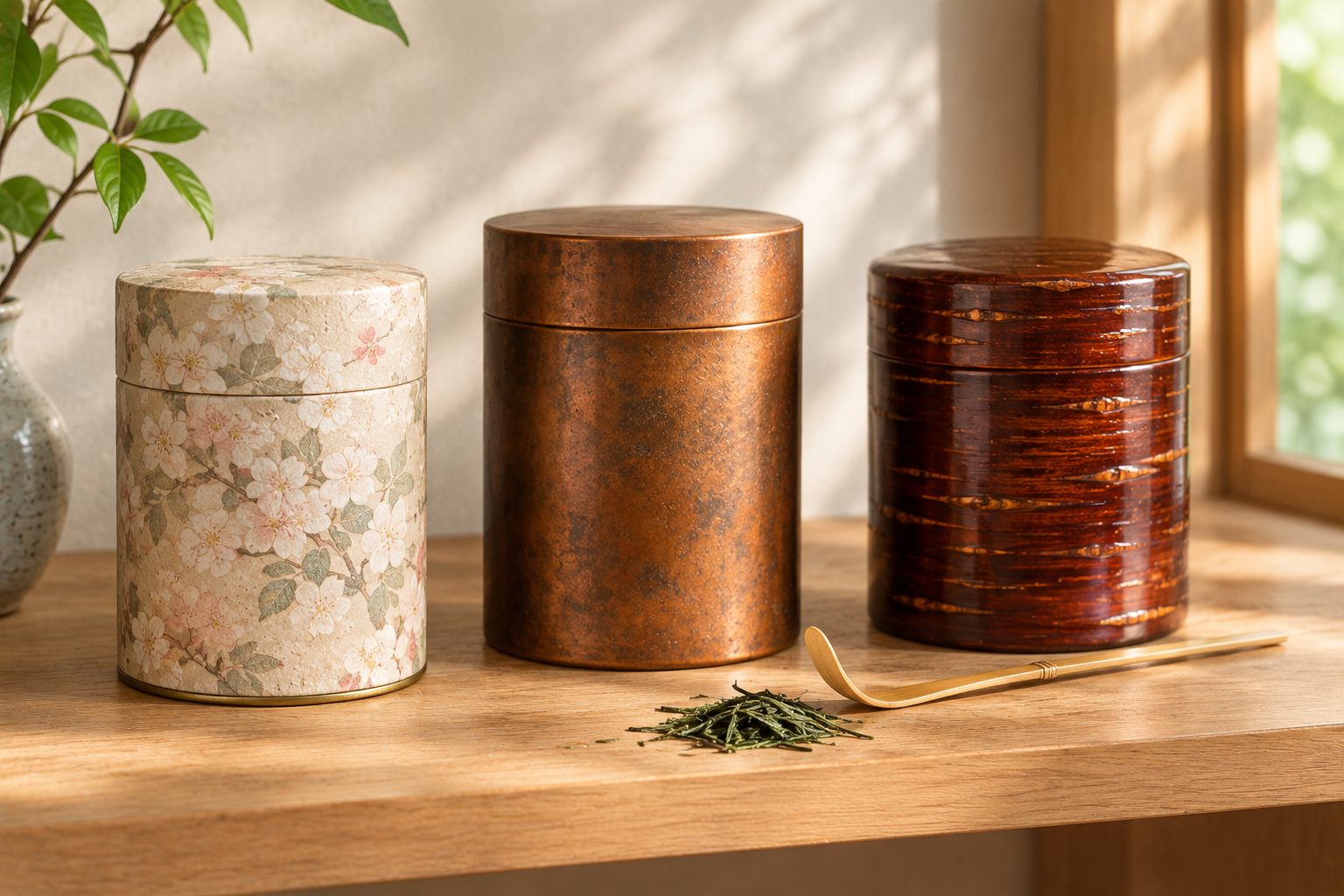
    Hand-made metal (e.g. Kaikado)Copper, brass or tinExcellentHighA long-term, lifetime piece
    KabazaikuWild cherry bark over woodGoodMid to highBeauty, craft and humidity buffering
    Plain stainless or tinMetalVaries a lotLow to midFunction first

    Washi-Covered Tins: The Sensible First Canister

    This is the canister most Japanese households actually use: a tin body wrapped in printed washi paper, usually with an inner lid under the outer cap. It’s inexpensive, light, opaque and does a good job of keeping air out. The paper comes in hundreds of patterns, which makes them a popular, affordable gift too.

    The downsides are durability and moisture. The paper can wear or stain over years of daily handling, and it shouldn’t get wet. Wipe it with a dry cloth rather than washing it.

    Pick one if: you want a reliable canister for everyday tea without spending much.

    Kaikado: The Canister That Lasts a Lifetime

    Kaikado has been making hand-made tea canisters in Kyoto since 1875, and its process – around 130 to 140 steps, essentially unchanged since then – is the reason these canisters are famous. They’re made from copper, brass or tin, with a double-walled construction and a lid machined so precisely that, once you line it up, it slides down smoothly by itself, gently pushing excess air out as it closes.

    The other thing people love about them is how they age. With handling, the surface slowly darkens and gains character: copper changes in a matter of months, brass over a year or two, and tin over several years. Many owners treat them as heirlooms.

    They are expensive, and they’re an investment in craftsmanship as much as in storage. But if you drink tea every day and want one canister for decades, this is the benchmark.

    Pick one if: you want the best seal available and a piece you’ll keep for life.

    Kabazaiku: Cherry Bark From Akita

    Kabazaiku is a craft from Kakunodate in Akita Prefecture, where wild cherry bark is applied over a shaped wooden form to make boxes, trays and especially tea canisters. It began more than 200 years ago as a side occupation for lower-ranking samurai of the Satake clan, and it’s still made in local workshops today.

    Beyond its deep red-brown gloss, cherry bark has a practical advantage: it acts as a natural buffer against changes in humidity, which is why it was traditionally prized for storing tea and tobacco. Each curved surface needs its own piece of bark, so good kabazaiku is labor-intensive and priced accordingly, though usually below hand-made metal.

    Avoid getting it wet, keep it away from direct sun, and handle it with dry hands.

    Pick one if: you want a canister that’s as much a craft object as a container, and you like natural materials.

    Plain Metal Canisters

    Simple stainless steel or tin canisters work well if the lid fits tightly – and that’s the catch, because quality varies enormously. Check for an inner lid or a snug outer lid with no rattle. A cheap canister with a loose lid is barely better than a clipped bag.

    How to Use a Chazutsu Properly

    • Keep the tea in its inner bag inside the canister if you can, for an extra layer of protection – especially with a large canister and a small amount of tea.
    • Use a dry scoop. Moisture is the fastest way to ruin a canister of tea.
    • Store it somewhere cool and away from the stove, sunny windows and strong-smelling spices. Tea absorbs odors easily.
    • Don’t store multiple teas in one canister – and if you switch teas, wipe it out first so aromas don’t carry over.
    • Avoid the fridge for a canister you open daily. Taking a cold canister in and out invites condensation. If you refrigerate tea for long-term storage, keep it sealed and let it reach room temperature before opening.

    A Few Things People Ask Me

    Can I use a chazutsu for matcha? Yes, as long as it seals well. Matcha oxidizes faster than leaf tea, so a smaller canister that you’ll empty quickly works best.

    Is a Kaikado canister really worth the price? For most people, a good washi tin keeps tea fresh enough. Kaikado’s advantage is a better seal, durability over decades, and craftsmanship you’ll enjoy every day. If those matter to you, it’s worth it; if not, a well-made tin is fine.

    How big should my canister be? Big enough for one bag of the tea you usually buy. For most loose-leaf sencha, a canister that holds around 100g is a good, versatile size.

    Where should I start? A double-lid washi tea canister on Amazon is the easy, inexpensive first step. If you want a craft piece, kabazaiku cherry bark tea canisters on Amazon are worth a look.

    Where I Landed

    The best chazutsu is simply the one that seals well, keeps light out and is the right size for how you buy tea. A washi tin does all of that for very little money, and it’s what I’d buy first. Kabazaiku and Kaikado add something different: a natural material that softens humidity, or a metal canister that seals beautifully and grows more handsome every year. Once your tea is in something airtight and opaque, though, the most important storage rule is the same as ever – drink it while it’s fresh.

  • Konbucha vs. Kombucha: Japan’s Kelp Tea Is Not the Fizzy Drink You’re Thinking Of

    Konbucha vs. Kombucha: Japan’s Kelp Tea Is Not the Fizzy Drink You’re Thinking Of

    Disclosure: This post contains affiliate links. If you buy through one of them, I may earn a small commission at no extra cost to you.

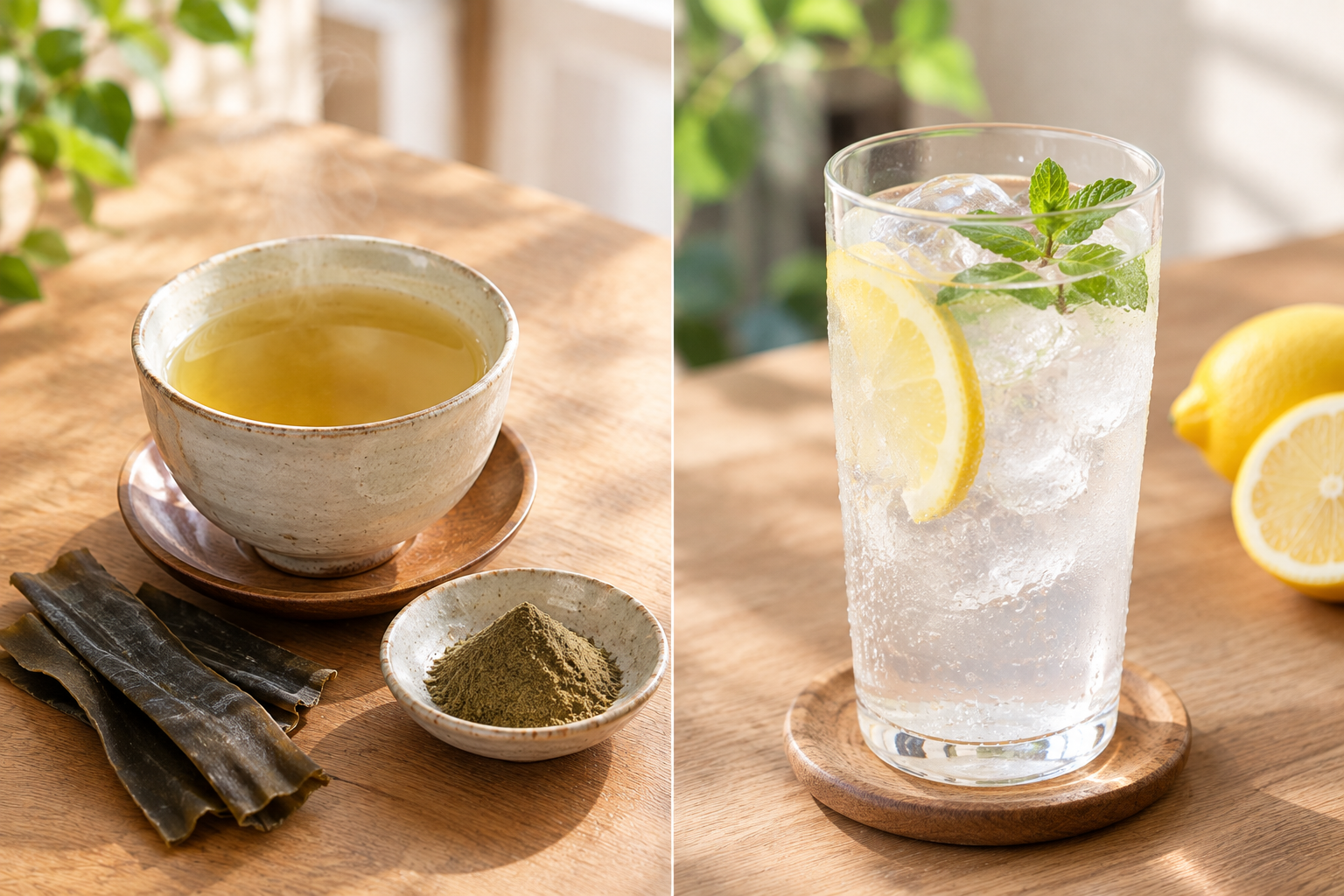
    If you order “kombucha” in Japan, there’s a fair chance you’ll be handed a small cup of hot, salty, savory liquid that tastes more like a light soup than a fizzy health drink. That’s not a mistake. In Japanese, konbucha (昆布茶) means kelp tea – a drink made from dried kombu seaweed – and it existed long before the fermented tea we call kombucha in English became famous. The two drinks share a name, but almost nothing else.

    The Problem You’re Actually Trying to Solve

    Most people land here for one of three reasons: they bought a jar of “kombucha” from a Japanese grocery store and found powder instead of a bottled drink; they saw kombucha on a menu in Japan and got something unexpected; or they’re simply curious why two completely different drinks have the same name. The short answer is that the English word was borrowed from Japanese and attached to the wrong drink. The longer answer is more interesting, and it also helps you know which one you’re actually buying.

    Who This Article Is NOT For

    • If you’re looking for a recipe for fermented kombucha, this isn’t it – I only cover it here to explain the difference.
    • If you need to watch your sodium intake, be aware that most Japanese konbucha powders contain added salt, and often MSG, so it’s a drink to check the label on rather than drink by the jug.
    • If you want a caffeine-free Japanese drink with no salt at all, roasted grain teas are the better fit – sobacha, roasted buckwheat tea, is a good place to start, and my caffeine-free Japanese tea guide compares all five zero-caffeine options side by side.

    The Two Drinks Side by Side

    Japanese konbucha (kelp tea)Fermented kombucha
    Made fromDried kombu kelpSweetened black or green tea
    ProcessKelp is shredded or ground into powderFermented with a SCOBY (bacteria and yeast)
    TasteSavory, salty, umamiTangy, sour, slightly fizzy
    ServedHot, like a light brothUsually cold, bottled
    CaffeineNone (no tea leaves)Usually some, from the tea it’s brewed with
    AlcoholNoneSmall amounts from fermentation (commercial versions are usually under 0.5%)
    Also used asA seasoning in cooking–
    Called in JapanKonbucha / kobuchaKōcha kinoko (“black tea mushroom”)

    What Japanese Konbucha Actually Is

    Konbucha is about as simple as a drink gets: kombu kelp, dried and either cut into thin strips or ground into a fine powder. The powdered kind dissolves completely in hot water – a teaspoon or so in a cup is typical – and commercial versions are usually seasoned with salt and sugar, and often MSG. You can also make it from strips by steeping a small amount of kelp in hot water and adding a pinch of salt.

    The taste is savory first: umami-rich, salty and lightly sweet, much closer to a thin dashi broth than to anything you’d call tea. It contains no tea leaves, so there’s no caffeine.

    People have been pouring hot water over chopped kelp in Japan since at least the Edo period. The instant powdered version came later – it was invented in 1918 – and that’s the form most people buy today.

    The Plum Version

    The most popular variation is ume-konbucha, kelp tea mixed with freeze-dried umeboshi (pickled plum). It adds a sour, slightly fruity note that cuts through the saltiness, and many people prefer it to plain konbucha. If you’re trying konbucha for the first time, the ume version is a friendly starting point.

    A Drink for Good Fortune

    Kombu has long been a celebratory food in Japan, partly because kobu sounds like the end of yorokobu, “to be happy.” That’s why kelp tea is served at New Year and at some weddings. In the Kansai region, there are also special New Year teas, fuku-cha and ōbuku-cha (“good fortune tea”), which combine sencha with kombu and umeboshi – so for those, there’s real green tea in the cup too.

    What Fermented Kombucha Actually Is

    The bottled drink sold in the West is sweetened tea – usually black, sometimes green – fermented with a SCOBY, a gel-like culture of bacteria and yeast often called the “mother.” Fermentation turns the sugar into organic acids and a little carbon dioxide, which gives it its tangy, fizzy character, and leaves small amounts of alcohol behind. Fruit or spices are often added afterward.

    It most likely originated in northeast China and spread through Russia and Europe before reaching Japan, where it had a brief boom in the 1970s under the name kōcha kinoko, “black tea mushroom.” Because it’s brewed from tea, it usually contains some caffeine, though typically less than the tea it started from.

    So Why Do They Share a Name?

    Nobody knows for certain. The most common explanation is that the English word “kombucha” is a misapplied loanword from Japanese: the name of the kelp drink ended up attached to the fermented one, perhaps because the floating culture looks a little like seaweed, or simply through confusion between Japanese terms. Whatever the cause, the result is that the original Japanese meaning has been almost completely overwritten in English – which is why Japanese stores abroad sometimes label their kelp tea “kobucha” or “konbu cha” to avoid confusion.

    How to Use Japanese Konbucha

    As a drink: dissolve about a teaspoon of powder in a cup of hot water. Taste and adjust; it’s easy to make it too salty.

    As a seasoning: this is where konbucha really shines in Japanese kitchens. A pinch works as an instant umami boost in:

    • Quick pickles (asazuke) – rub sliced cucumber or cabbage with a little konbucha powder and leave for 15-30 minutes
    • Japanese-style pasta, stir-fries and fried rice
    • Rice balls and plain rice
    • Ochazuke, where a pinch in the tea makes the broth noticeably more savory
    • Soups, as a quick substitute for dashi granules

    Keep it sealed and dry – the powder clumps quickly in humid air.

    A Few Things People Ask Me

    Does konbucha have caffeine? No. Japanese kelp tea contains no tea leaves, so there’s no caffeine at all.

    Is konbucha a probiotic drink? No. It isn’t fermented, so it has none of the live cultures that fermented kombucha is known for.

    Is konbucha healthy? It’s a light, savory drink, but most commercial powders contain a fair amount of salt and often MSG, so it’s best enjoyed in moderation rather than as a health drink. Unsalted versions exist if you look for them.

    Where can I buy it? Japanese kelp tea is easy to find as konbucha powder on Amazon, and the ume-konbucha plum version on Amazon is worth trying if plain kelp tea sounds too salty.

    Where I Landed

    Once you know the history, the confusion is almost funny: the Japanese drink that originally owned the name is a humble, salty cup of kelp broth, while the English word now belongs to a fizzy fermented tea from somewhere else entirely. They’re different drinks for different moments. Fermented kombucha is a cold, tangy refresher; Japanese konbucha is a warm, savory sip on a cold day – and, more often than not, a secret seasoning in the kitchen.

  • Caffeine-Free Japanese Tea: Five Drinks With Zero Caffeine (and a Few That Come Close)

    Caffeine-Free Japanese Tea: Five Drinks With Zero Caffeine (and a Few That Come Close)

    Disclosure: This post contains affiliate links. If you buy through one of them, I may earn a small commission at no extra cost to you. Several of these drinks are made from common allergens – barley, buckwheat and soy – so please check the allergy column in the table before trying one.

    When people tell me they love Japanese tea but can’t have caffeine after lunch, they usually assume the answer is “decaf sencha.” It’s rarely necessary. Japan has a whole family of everyday drinks that are called cha but aren’t made from the tea plant at all – roasted grains, roasted beans, seaweed, even pickled cherry blossoms – and none of them contain any caffeine. They’re not niche health products, either. They’re what Japanese families pour at dinner, give to children, and keep in the fridge all summer.

    The Problem You’re Actually Trying to Solve

    The confusing part is the word cha. In Japanese it’s used for almost any hot infusion, so “mugicha” and “sencha” sound like close relatives when one has no caffeine and the other has plenty. On top of that, several low-caffeine Japanese teas get described online as “caffeine-free” when they aren’t. If you’re avoiding caffeine for sleep, pregnancy advice from your doctor, or any other reason, it helps to know exactly which drinks are truly zero and which are only low.

    Who This Article Is NOT For

    • If you’re fine with a little caffeine and just want a gentler green tea, you don’t need to leave the tea plant – kukicha, or twig tea, is one of the lowest-caffeine real teas there is.
    • If you’re looking for a drink with medical benefits, none of these should be treated as a remedy. They’re pleasant caffeine-free drinks, nothing more.
    • If you have a barley, buckwheat or soy allergy, or celiac disease, skip the drinks in this list that contain those ingredients.

    The Five Zero-Caffeine Options at a Glance

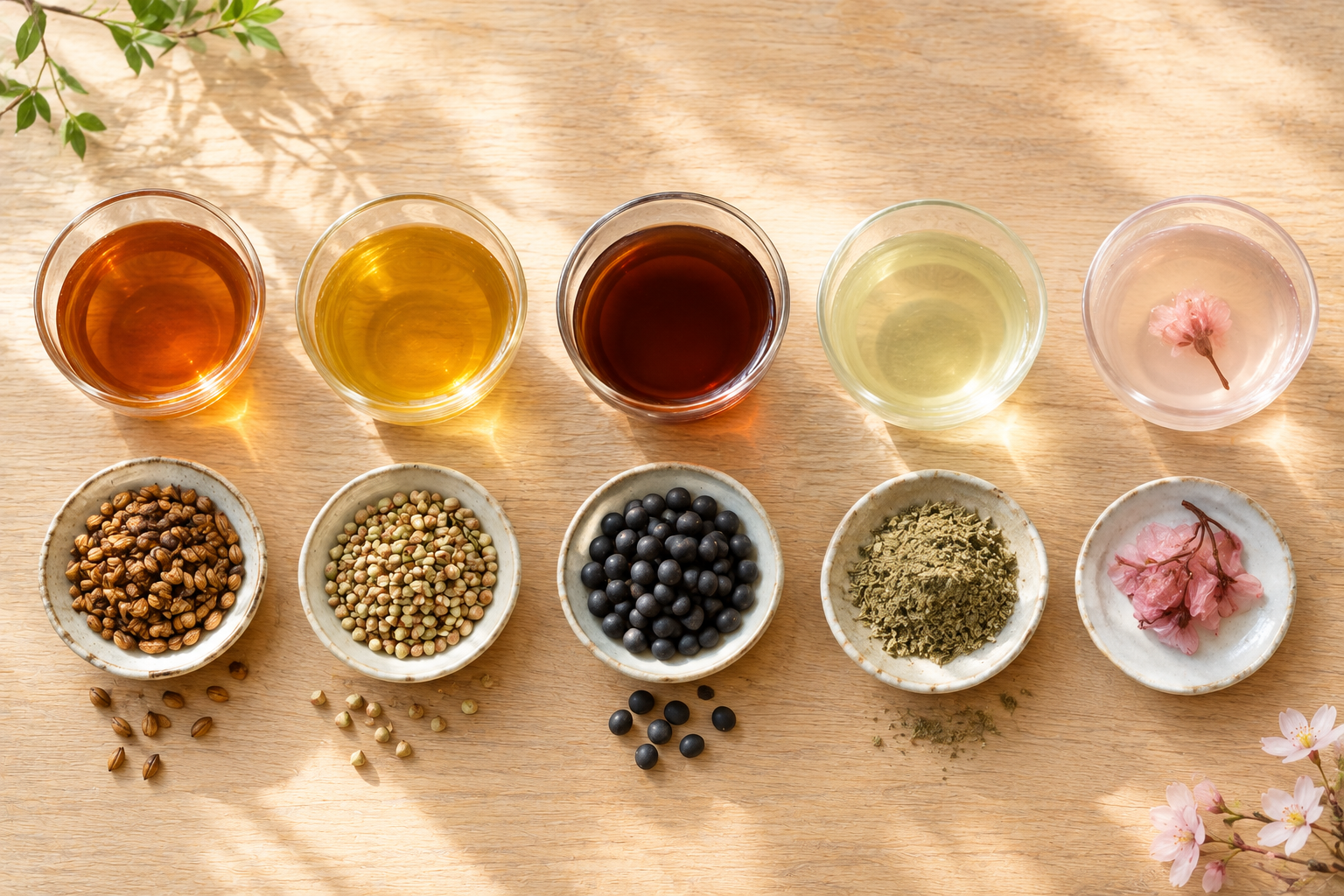
    DrinkMade fromTastes likeBest forWatch out for
    MugichaRoasted barleyToasty, grain-forward, slightly bitterBig jugs of cold tea in summerContains gluten
    SobachaRoasted buckwheatNutty, lightly sweet, no bitternessA cup after dinner, hot or coldBuckwheat allergy can be severe
    KuromamechaRoasted black soybeansToasted, gently sweet, mellowA hearty, warming cupSoy allergy
    KonbuchaPowdered kelpSavory, salty, umami-richA brothy cup on a cold dayUsually contains salt, often MSG
    SakurayuSalt-pickled cherry blossomsLight, slightly salty, floralCelebrations and special occasionsSalty; rinse blossoms if you prefer

    Mugicha: The Everyday One

    Roasted barley tea is the most common caffeine-free drink in Japan, especially in summer, when many households keep a pitcher of it in the fridge from June to September. It’s toasty and slightly bitter hot, and softer and sweeter cold. The usual method is one tea bag per liter of cold water, left in the fridge overnight. Brewed mugicha doesn’t keep long, so it’s best finished within a day or two.

    The important caution is gluten: barley contains it, so mugicha isn’t suitable for anyone with celiac disease or a gluten intolerance. My full mugicha guide covers hot, cold and loose-barley brewing, plus how to keep a jug fresh.

    Sobacha: The Nutty One

    Sobacha is made from roasted buckwheat kernels and is often served in soba restaurants after a meal. It’s nutty and lightly sweet with almost no bitterness, and the softened kernels can be eaten after brewing. Buckwheat itself is gluten-free, which makes sobacha the usual alternative to mugicha for people avoiding gluten – but buckwheat allergy can cause severe reactions, so it isn’t for everyone. My full sobacha guide covers the regular vs. dattan (tartary) varieties and how to brew both.

    Kuromamecha: The Hearty One

    Kuromamecha is tea made from roasted black soybeans. Beans from Tamba in Hyogo Prefecture are considered among the best – large, glossy and naturally sweet. The flavor is toasted and gently sweet with no bitterness or astringency, rounder and fuller than sobacha.

    To brew it, use about 10-15g of beans per 400ml of near-boiling water (around 95°C) and steep for about five minutes; the same beans can give a second, lighter cup. Like sobacha, the softened beans can be eaten afterward, added to rice or salads. People with a soy allergy should avoid it.

    Konbucha: The Savory One

    This is the one most often confused with something else. Japanese konbucha (also spelled kombucha) is not the fermented, fizzy drink sold in bottles in the West. It’s a hot drink made from powdered or finely cut kombu kelp, and it tastes savory and salty, closer to a light broth than to tea. A teaspoon of powder dissolved in hot water makes a cup, and some blends add dried umeboshi plum for a sour note.

    Most commercial konbucha contains salt and often MSG, so it’s a drink to enjoy in moderation, and worth checking the label if you’re watching your sodium intake. It also works as a seasoning – a pinch in ochazuke or a quick pickle is a classic use.

    Sakurayu: The Celebratory One

    Sakurayu, also called sakura-cha, is made by pouring hot water over cherry blossoms that have been pickled in salt and plum vinegar and then dried. In the cup, the blossoms slowly unfurl and float, and the drink is light, slightly salty and faintly floral.

    It’s traditionally served at weddings and engagement ceremonies in place of green tea. One explanation is linguistic: the Japanese expression ocha wo nigosu – literally “to make the tea cloudy” – means to be evasive, which isn’t a phrase anyone wants associated with a marriage. Cherry blossoms, on the other hand, stand for new beginnings. If the saltiness is too strong for you, give the blossoms a quick rinse before adding the water.

    Low Caffeine Isn’t No Caffeine

    Several Japanese teas are often described as caffeine-free when they’re actually just low:

    • Kukicha (twig tea) is made from stems, which contain much less caffeine than leaves – but still some.
    • Hojicha is roasted green tea and is lower in caffeine than sencha or matcha, but it isn’t caffeine-free.
    • Bancha, made from later-harvest leaves, has roughly half the caffeine of sencha.

    These are good choices if you want to cut back, but if you need to avoid caffeine completely, stick to the five drinks above.

    A Few Things People Ask Me

    Which caffeine-free Japanese tea tastes most like green tea? None of them really does, because none come from the tea plant. If you want green tea flavor with the least caffeine, kukicha is the closest compromise.

    Which one is best for children? In Japan, mugicha is the classic choice and is given to children routinely. As with any food, check allergies first – barley for mugicha, buckwheat for sobacha, soy for kuromamecha.

    Can I drink these during pregnancy? They’re caffeine-free, but that’s a question for your doctor or midwife rather than a tea blog, especially with allergens or added salt involved.

    Where can I buy them? Mugicha and sobacha tea bags are widely available. For something a little different, kuromamecha on Amazon – look for Tamba beans if you can – and Japanese konbucha kelp tea on Amazon are both easy to find.

    Where I Landed

    You don’t need decaf green tea to enjoy Japanese tea culture in the evening. Mugicha for summer jugs, sobacha after dinner, kuromamecha when you want something warming, konbucha when you’d rather have a savory cup, and sakurayu for special occasions – between them, there’s a caffeine-free option for almost any moment. Just check the allergens first, and remember that “low caffeine” teas like hojicha and kukicha aren’t the same as zero.