Author: arino

  • Encha Matcha Review: Is the Organic Pick Worth It, and Which Grade Should You Buy?

    Encha Matcha Review: Is the Organic Pick Worth It, and Which Grade Should You Buy?

    Disclosure: This post contains affiliate links. If you buy through one of them, I may earn a small commission at no extra cost to you. Product details below come from Encha’s own website at the time of writing (October 2026); grades and prices can change, so check the current listing before you buy.

    Quick Verdict

    • Is Encha worth it? Yes, if organic matters to you. Encha grows its matcha on its own organic farm in Uji and sells it in a simple three-grade system that’s easy to understand. If organic isn’t a priority, traditional Kyoto tea houses offer more depth and variety.
    • Best for drinking with water: Encha Ceremonial Grade – first-harvest, smooth and not bitter. Encha Ceremonial on Amazon
    • Best for lattes: Encha Latte Grade – made specifically to taste strong enough under milk. Encha Latte Grade on Amazon
    • Best for baking and smoothies: Encha Culinary Grade – second-harvest leaf, earthier and cheaper.
    • Don’t need organic and want to compare single-origin teas? Nio Teas’ matcha collection has a wide range from small Japanese farms. At the time of writing, ordering through the links on this page automatically applies a 10% discount at checkout – no code needed. Offers can change, so check the final price in your cart.

    Below: how Encha’s grades differ, who each one suits, the honest downsides, and how Encha compares with Ippodo and Marukyu Koyamaen.


    Most famous matcha brands are centuries-old Kyoto tea houses. Encha is different: it’s a newer, US-based brand built around one idea – organic, single-origin matcha from its own farm in the mountains of Uji. That focus has made it a popular choice among health-conscious buyers in the US, and it’s widely sold online, including through major US retailers.

    But “organic” and “Uji” on a pouch don’t automatically mean great matcha. So is Encha genuinely good, or just good at marketing?

    The Problem You’re Actually Trying to Solve

    You want matcha you can trust – organic, clean, and properly Japanese – and Encha keeps showing up. You’re not sure which of its grades to buy, whether its ceremonial grade can compete with traditional Kyoto brands, or whether you’d be better off with something else.

    Who This Article Is NOT For

    • If you’re comparing several brands at once, my matcha brand comparison puts Encha alongside Ippodo, Marukyu Koyamaen and DoMatcha.
    • If you want to explore koicha (thick tea) or a long ladder of premium grades, Encha’s short range isn’t built for that.
    • If you mainly want sweet, flavored matcha drinks, Encha’s flavored latte blends exist, but this review focuses on its pure matcha.

    About Encha

    Encha sells matcha grown on its own organic farm in the Uji mountains of Kyoto Prefecture. Rather than buying tea through layers of wholesalers, it controls the tea from the field to the pouch – a model that makes its sourcing unusually easy to trace.

    Its key selling points, according to its own site:

    • Organic farming, with no pesticides or synthetic chemicals
    • Single origin – all three main grades come from its Uji farm
    • Testing – Encha states radioactivity has never been detected in its matcha, and that lead is not detected at California’s Prop 65 limit, with reports published on its website
    • No added sugar in its pure matcha grades

    The Three Grades, Explained

    Encha keeps it simple: three main grades, defined mostly by harvest.

    GradeLeafTaste (per Encha)Best for
    CeremonialPremium first-harvest (spring) leavesSmooth, full-bodied, delicately grassy, not bitterDrinking with water only
    LatteStandard first-harvest leavesStrong, slightly bitter with water aloneLattes, iced matcha, shakes
    CulinaryPremium second-harvest leavesVegetal and earthy, with a sweet, nutty finishBaking, cooking, smoothies

    Encha also sells limited-edition reserve matcha from single cultivars, a “barista” grade for cafés, and flavored latte blends. For most people, though, the choice is between the three main grades above.

    What’s smart about this system

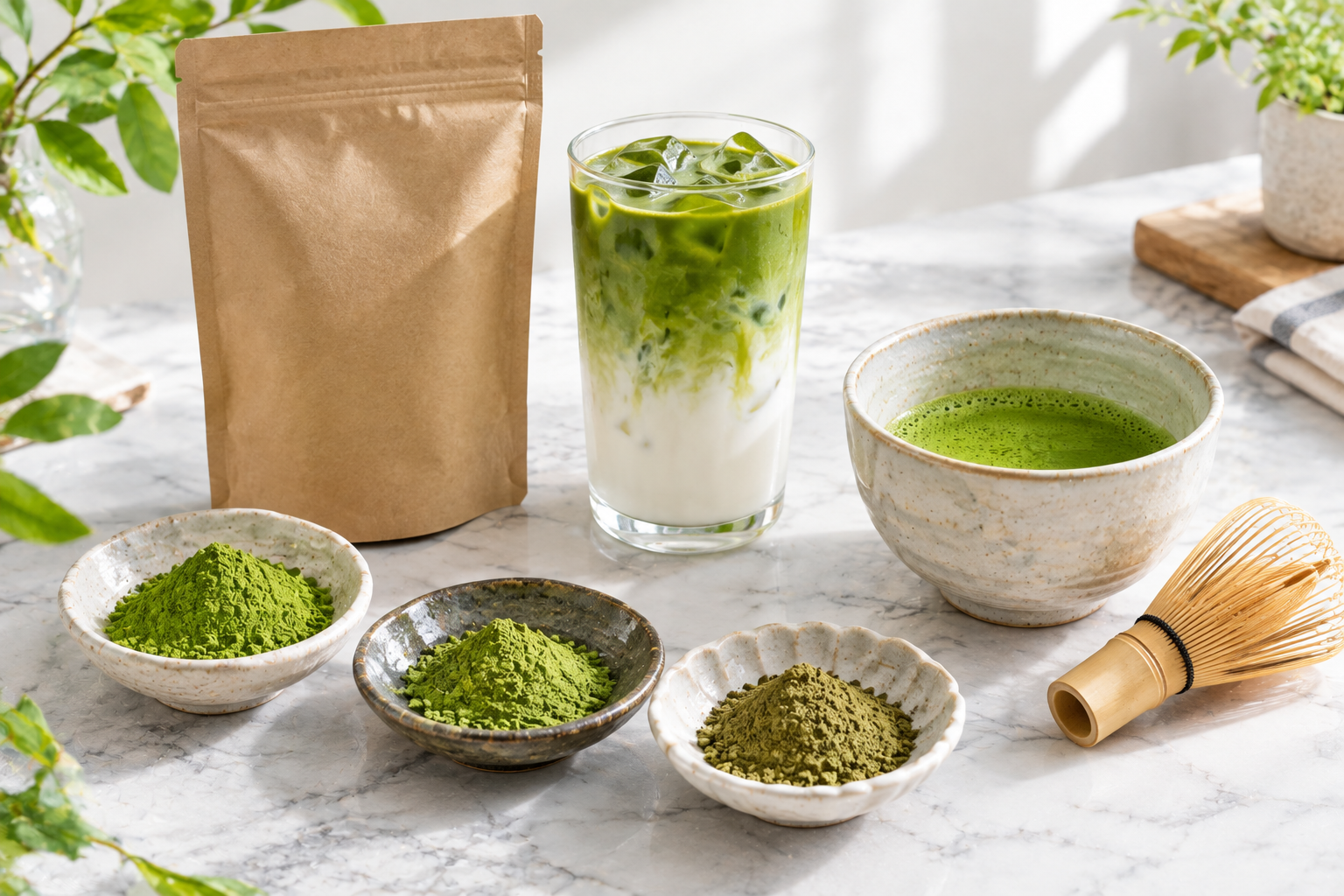
    Encha is unusually honest about one thing many brands blur: the latte grade is designed to taste a little strong and bitter on its own. That’s a feature, not a flaw – milk softens bitterness, and a delicate ceremonial matcha can disappear in a latte. Rather than telling you to put expensive ceremonial grade in milk, Encha tells you to buy the cheaper grade made for the job.

    Which Encha Should You Buy?

    You mostly…BuyWhy
    Drink matcha whisked with waterCeremonialSmooth enough to drink straight
    Make hot or iced lattesLatteHolds its flavor under milk, costs less
    Make smoothies or protein shakesLatte or CulinaryStrong flavor survives other ingredients
    BakeCulinaryNo point paying for first-harvest leaf in a cake
    Want both straight and lattesCeremonial for bowls, Latte for milkTwo pouches, each used for what it’s good at

    If you’re not sure, start with the grade that matches what you drink most often. If that’s lattes, my matcha latte guide covers how to make one that isn’t bitter or clumpy.

    What’s Genuinely Good

    • Organic and single origin. If you care about how your tea is grown – and with matcha you drink the whole leaf – Encha is one of the clearest choices.
    • A simple, honest grade system. Three grades, each with a clear job.
    • Published testing information. Encha shares its testing reports on its website, which few brands do.
    • Easy to buy in the US. Widely available online, and Encha’s own site ships within the US (free shipping was advertised at the time of writing).
    • A latte grade that actually works. Many brands sell “ceremonial” for everything; Encha’s latte grade is built for milk.

    The Honest Downsides

    • Less depth at the top end. If you want to explore a long ladder of premium grades or prepare koicha, traditional houses like Marukyu Koyamaen offer much more.
    • One farm means less variety. You won’t get the range of regions, cultivars and blends a big Kyoto tea house offers.
    • Pouch packaging. Encha uses resealable pouches rather than tins. They work well if you reseal them carefully and keep them cold, but they’re less protective once opened.
    • Flavored blends can confuse. Some Encha latte blends include added ingredients or sweeteners. Check the label if you want pure matcha.
    • Organic isn’t the same as better-tasting. Organic matcha can be excellent, but shading and fertilizing practices also affect sweetness and umami. Some of the richest-tasting matcha in Japan isn’t organic.

    How Encha Compares

    EnchaIppodoMarukyu Koyamaen
    OrganicYesNoNo
    SourcingOwn farm in UjiKyoto tea house blendsGrows and processes its own tea in Uji
    Grade range3 main gradesClassic and premium rangesVery wide, including koicha grades
    Best forOrganic buyers, lattesBeginners drinking matcha straightLearning grades, koicha
    Availability in the USEasyEasyOften sold out

    How to Prepare It

    Ceremonial (usucha): sift about 2g into a bowl, add about 70ml of water at around 80°C (175°F), and whisk in a quick zigzag until frothy.

    Latte: whisk 2g of latte-grade matcha with a little warm water into a smooth paste, then add about 150ml of hot or cold milk. Sweeten to taste.

    Storage: keep pouches sealed in the fridge, squeeze out the air each time, and finish an opened pouch within one to three months – Encha’s own recommendation.

    A Few Things People Ask Me

    Is Encha really organic? Encha says its matcha is organic and publishes its certificates and testing information on its website.

    Is Encha good for lattes? Yes – its latte grade is one of the best-designed latte matchas available, because it’s made to taste strong enough under milk.

    Is Encha better than Ippodo? Not better, different. Encha wins on organic and simplicity; Ippodo wins on depth, consistency and a more traditional flavor for drinking straight.

    Why does Encha latte grade taste bitter with water? That’s by design. Latte grade is made to stand up to milk, which softens bitterness. For drinking with water, choose ceremonial grade.

    Where I Landed

    Encha does exactly what it promises: clean, organic, single-origin Uji matcha in a simple range that’s easy to choose from. For organic-minded drinkers and latte lovers, it’s one of the best choices available in the US. For people chasing the deepest umami or wanting to explore koicha, a traditional Kyoto tea house will take you further. Choose Encha for organic and everyday drinking, and buy the grade that matches how you actually drink it.
  • Marukyu Koyamaen Matcha Review: Which Grade to Buy (and Whether It’s Worth the Hunt)

    Marukyu Koyamaen Matcha Review: Which Grade to Buy (and Whether It’s Worth the Hunt)

    Disclosure: This post contains affiliate links. If you buy through one of them, I may earn a small commission at no extra cost to you. Marukyu Koyamaen matcha is frequently out of stock and heavily resold – availability and prices change quickly, so always check the current listing before you buy.

    Quick Verdict

    • Is Marukyu Koyamaen worth it? Yes, if you drink matcha straight and want to understand grades. It’s one of Uji’s most respected producers, grows and processes its own tea, and offers one of the widest, most clearly structured grade ranges anywhere.
    • Best first tin: Aoarashi or Isuzu – approachable, balanced, and the classic starting points. Marukyu Koyamaen Isuzu on Amazon
    • Best for sweet, smooth usucha: Wako – a favorite for its sweetness and low bitterness. Marukyu Koyamaen Wako on Amazon
    • First step into koicha: Kinrin – the usual entry point for thick tea.
    • Can’t find it in stock, or mostly making lattes? Nio Teas’ matcha collection is easier to get and more affordable. At the time of writing, ordering through the links on this page automatically applies a 10% discount at checkout – no code needed. Offers can change, so check the final price in your cart.

    Below: how the grade system works, which grade fits which use, the honest downsides, and how to avoid overpaying a reseller.


    If Ippodo is the brand most people start with, Marukyu Koyamaen is the one many matcha lovers end up with. It’s the name you hear from tea ceremony students, from people who have been drinking matcha for years, and from anyone who starts asking why one tin of “ceremonial” matcha tastes so different from another.

    The reason is simple: Marukyu Koyamaen doesn’t just sell matcha in a few grades. It sells a ladder – a carefully structured range from approachable everyday matcha to some of the most refined tea in Uji – and once you understand that ladder, you understand matcha grading in general.

    The Problem You’re Actually Trying to Solve

    You’ve heard Marukyu Koyamaen is excellent, but the lineup is long, the names are unfamiliar (Aoarashi, Isuzu, Yugen, Wako, Kinrin, Unkaku, Tenju…), and every listing seems to be sold out or marked up. You want to know which grade is right for you, whether it’s actually better than easier-to-find brands, and how to buy it without overpaying.

    Who This Article Is NOT For

    • If you’re still choosing between brands, my matcha brand comparison compares Marukyu Koyamaen with Ippodo, Encha and DoMatcha.
    • If you want to understand how Uji matcha differs from Nishio, Kagoshima or Yame, my matcha region comparison covers that.
    • If you mostly make sweet iced lattes, Marukyu Koyamaen’s grades are more than you need – and harder to find than a good latte-grade matcha.

    About Marukyu Koyamaen

    Marukyu Koyamaen is a family-owned tea producer based in Ogura, Uji, in Kyoto Prefecture. It traces its history back to around the turn of the 18th century, and it’s now run by a later generation of the same family. Unlike many brands that buy finished tea, Marukyu Koyamaen grows, harvests and processes its own tea, and it has won awards at Japan’s national tea competitions many times.

    Its matcha is used by tea ceremony schools, temples and shrines in Japan – which says a lot about how seriously professionals take it. Its matcha is also kosher certified.

    How the Grade System Works

    The key to Marukyu Koyamaen is one division: usucha grades and koicha grades.

    • Usucha (thin tea) grades are made to be whisked into a light, frothy bowl. They’re the everyday grades.
    • Koicha-capable grades are refined and smooth enough to be prepared as koicha – thick tea, kneaded into a glossy paste with much more matcha and much less water. Thick tea exposes any bitterness, so only the highest-quality leaf works. These grades also make excellent usucha.

    As a rule of thumb, Kinrin and above can be used for koicha. Below Kinrin, think usucha.

    The Main Grades, Roughly From Entry to Top

    GradeBest forCharacter
    Aoarashi (青嵐)First-time drinkers, daily matcha, lattesBalanced, approachable, good value
    Isuzu (五十鈴)Daily usucha, tea ceremony practiceClassic balance of sweetness and umami, clean finish
    Yugen (又玄)Daily usucha with more depthRicher umami, smooth mouthfeel
    Wako (和光)Premium usucha, special occasionsNotably sweet, lingering finish, very little bitterness
    Kinrin (金輪)First koicha, rich usuchaSoft, creamy, full on the palate
    Unkaku (雲鶴)Koicha and premium usuchaDeeper, more refined umami
    Eiju (永寿)KoichaSmooth, rounded, easy to whisk
    Choan, Kiwami Choan, TenjuFormal tea gatherings, special koichaMarukyu Koyamaen’s top tier – extremely smooth and rich

    This isn’t every product Marukyu Koyamaen makes – the full catalog in Japan is longer – but these are the grades you’re most likely to see abroad.

    Which Grade Should You Buy?

    You are…Start withWhy
    New to good matchaAoarashi or IsuzuForgiving, balanced, sensibly priced
    Drinking usucha dailyIsuzu or YugenThe best balance of quality and price
    Wanting the “wow” usuchaWakoSweetness and smoothness that stand out
    Curious about koichaKinrinThe entry point to thick tea
    An experienced koicha drinkerUnkaku or aboveDepth that shows in thick tea
    Mostly making lattesAoarashi – or a cheaper latte grade elsewhereMilk hides the difference

    A practical approach many tea students use: buy one usucha grade (Isuzu or Wako) and drink it for a month. Then try one grade higher and taste them side by side. The differences become obvious once you compare directly – and that’s the real education Marukyu Koyamaen offers.

    What’s Genuinely Good

    • The clearest grade ladder in matcha. Each step up adds smoothness and depth in a way you can actually taste.
    • Grown and processed in-house. Fewer middlemen, and more control over quality.
    • Respected by professionals. Used by tea schools, temples and shrines in Japan.
    • Excellent koicha grades. If you want to explore thick tea, few brands are as well suited.
    • Strong value at the lower grades when bought at a fair price – Isuzu and Wako punch well above their price.

    The Honest Downsides

    • Availability. Global matcha demand has made Marukyu Koyamaen hard to find. Popular grades sell out quickly, and some retailers limit how many tins you can buy.
    • Reseller markups. Because it’s scarce, it’s often resold at two or three times its Japanese price. A “great deal” from an unknown seller may be old stock.
    • Learning curve. The Japanese grade names mean nothing until you learn the system. Beginners can easily buy the wrong grade.
    • Not certified organic. If organic certification matters to you, Encha or DoMatcha are better fits.
    • Overkill for lattes. In milk and syrup, most of what you’re paying for disappears.

    How to Buy It Without Overpaying

    • Use authorized retailers that sell sealed tins with clear best-before dates. Many reputable Japanese tea shops abroad carry Marukyu Koyamaen.
    • Check the price against similar sizes. A 40g tin of Isuzu or Wako shouldn’t cost several times what a comparable Ippodo tin costs.
    • Look at the best-before date. Sealed, nitrogen-flushed tins keep well for months, but fresher is always better.
    • On Amazon, check the seller, read recent reviews for freshness complaints, and avoid listings with no date information. Marukyu Koyamaen matcha on Amazon
    • In Uji or Kyoto, buying in person is often easier and cheaper – and a good excuse for a trip.

    Once opened, keep the tin sealed in the fridge and finish it within a month or two.

    How to Prepare It

    Usucha: sift about 2g (a heaped teaspoon) into a bowl, add 60-70ml of water at about 80°C (175°F), and whisk briskly in a zigzag until a fine foam forms.

    Koicha (Kinrin and above): sift about 4g into a bowl, add around 30ml of water at about 80°C, and knead slowly with the whisk in circles until the matcha becomes a smooth, glossy paste – no foam.

    A Few Things People Ask Me

    Marukyu Koyamaen or Ippodo? Ippodo is easier to buy and simpler to navigate – great for beginners. Marukyu Koyamaen has a deeper grade system and some of the best koicha grades available, so it rewards people who want to learn. Many matcha drinkers keep one of each.

    Which is the best Marukyu Koyamaen matcha? For most people drinking usucha, Wako is the standout. For koicha, Kinrin is the entry point, and the top grades (Choan, Kiwami Choan, Tenju) are for special occasions.

    Why is it always sold out? Worldwide demand for high-quality Uji matcha has grown faster than production. Good matcha can’t be made quickly, so popular grades sell out.

    Is Aoarashi good for lattes? Yes – it’s the grade most often recommended for daily matcha and lattes in the range.

    Where I Landed

    Marukyu Koyamaen is the brand that teaches you matcha. Start with Isuzu or Wako for usucha, try Kinrin when you’re curious about koicha, and taste grades side by side to understand what you’re paying for. Just be patient and careful about where you buy: a fairly priced, fresh tin from a good retailer is worth waiting for, while an overpriced tin of old stock isn’t. And if you can’t find it, don’t let the hunt stop you from drinking good matcha – plenty of excellent tea is easier to get.

  • Ippodo Matcha Review: Is It Worth It, and Which Grade Should You Buy?

    Ippodo Matcha Review: Is It Worth It, and Which Grade Should You Buy?

    Disclosure: This post contains affiliate links. If you buy through one of them, I may earn a small commission at no extra cost to you. Prices below are from Ippodo’s US online store at the time of writing (October 2026) and change often – check the current price before you buy.

    Quick Verdict

    • Is Ippodo worth it? Yes, for most people who drink matcha straight. It’s consistent, clearly graded and genuinely Uji-style, from a Kyoto tea house that has been selling tea since 1717. It’s not the cheapest way to make lattes.
    • Best first tin: Sayaka – Ippodo’s own first recommendation for newcomers. Ippodo Sayaka on Amazon
    • Best value daily matcha: Kan – the cheapest per gram in the classic range.
    • Best for a special bowl or koicha: Ummon – bold, full umami. Ippodo Ummon on Amazon
    • Mostly making lattes? You don’t need Ippodo’s prices. Nio Teas’ matcha collection has more affordable single-origin options – and at the time of writing, ordering through the links on this page automatically applies a 10% discount at checkout, no code needed. Offers can change, so check the final price in your cart.

    Below, you’ll find the full lineup with price per gram, which grade suits which use, the honest downsides, and the safest way to buy it.


    Ippodo is usually the first “real” matcha brand people hear about after a disappointing supermarket tin. It’s recommended in almost every matcha discussion, sold in Kyoto, Tokyo and New York, and its simple white-and-gold cans are instantly recognizable. That reputation raises an obvious question: is it actually better, or are you paying for the name?

    The short answer is that Ippodo is good at the thing most brands aren’t – making each grade predictable, so you know what you’re buying. The longer answer depends on which tin you pick and how you drink it.

    The Problem You’re Actually Trying to Solve

    You’ve decided to try a quality matcha, Ippodo keeps coming up, and you’re looking at a lineup of Japanese names – Kan, Sayaka, Seiun, Ummon, Kuon, Kanza – with prices ranging from about $20 to over $100. You want to know whether the brand deserves its reputation and which tin to buy so you don’t overspend or under-buy.

    Who This Article Is NOT For

    • If you’re still choosing between brands, my matcha brand comparison puts Ippodo side by side with Marukyu Koyamaen, Encha and DoMatcha.
    • If you only make sweet iced lattes or bake with matcha, Ippodo’s grades are more than you need. A good culinary or latte-grade matcha is better value.
    • If you need certified organic matcha, Ippodo isn’t sold as organic. Encha or DoMatcha are better fits.

    About Ippodo

    Ippodo Tea is a family-run tea house founded in Kyoto in 1717. Its main shop still stands on Teramachi Street in central Kyoto, and it sells matcha, gyokuro, sencha and hojicha, both in Japan and through international online stores. Its matcha is stone-milled and blended in the Uji tradition – each grade is a blend designed to taste the same from year to year, rather than a single-farm tea that changes with each harvest.

    That blending is the key to understanding the brand. You’re not buying a specific farm’s tea; you’re buying a flavor that Ippodo’s tea masters keep consistent. For a beginner, that’s a real advantage: once you find a grade you like, it will taste the same next time.

    The Lineup, With Price per Gram

    Ippodo splits its matcha into a “classic” range for everyday drinking and a “premium” range. Here’s how they compare:

    MatchaSizePrice (US store)Price per gramHow Ippodo describes it
    Kan20g box$22~$1.10Medium, well-balanced, mild bitterness and earthiness
    Sayaka40g can$50~$1.25Medium-rich, smooth, accessible – their first pick for newcomers
    Seiun40g can$67~$1.68Rich, full umami and complexity
    Ummon40g can$82~$2.05Punchy, robust umami, pleasant bitterness
    Kuon20g can$64~$3.20Bright fragrance, deep refined umami, long finish
    Kanza20g can$104~$5.20Smooth, full-bodied, silky, clean aftertaste

    Prices at the time of writing (October 2026). Ippodo has raised prices in recent years, so expect changes.

    Two things stand out from the per-gram numbers. First, the jump from Kan to Sayaka is small – only about 15 cents a gram – so Sayaka is often the better buy if you drink matcha straight. Second, the premium grades rise steeply: Kanza costs nearly five times as much per gram as Kan. Those top tins are for people who already know what they’re tasting for.

    Which Ippodo Matcha Should You Buy?

    How you drink itBest pickWhy
    First time trying good matchaSayakaSmooth and forgiving, not too heavy
    Daily usucha on a budgetKanLowest price per gram, balanced flavor
    Daily usucha, more depthSeiunNoticeably richer umami than Sayaka
    Koicha or a special occasionUmmon, Kuon or KanzaBuilt for richness and thick tea
    Hot matcha latteKan or SayakaEnough flavor to stand up to milk
    Iced sweet latte or bakingProbably not IppodoMilk and sugar hide what you’re paying for

    If you’re unsure, start with Sayaka. Ippodo itself calls it its first recommendation for new customers, and it’s a sensible benchmark for judging every matcha you try afterward.

    What’s Genuinely Good About Ippodo

    • Consistency. Blended grades taste the same tin after tin. That predictability is rare in matcha.
    • Clear grading. The descriptions are short and honest – “medium,” “rich,” “punchy” – and the price steps line up with real differences in depth and smoothness.
    • Freshness-friendly sizes. The 20g and 40g tins are small enough to finish before the matcha fades.
    • Easy to brew well. The classic grades are forgiving: whisked at around 80°C (175°F), they don’t turn harsh easily.
    • Reputation that holds up. Three centuries in Kyoto isn’t a marketing invention – and the tea house is still run by the same family.

    The Honest Downsides

    • Price. You’re paying for a premium Kyoto name. Some smaller Japanese producers sell comparable matcha for less.
    • Not certified organic. If that matters to you, choose another brand.
    • Blends, not single origin. If you like comparing farms, regions and cultivars, Ippodo’s blended approach gives you less to explore.
    • Overkill for sweet drinks. In a large, sweet latte, most people can’t tell Sayaka from a good latte-grade matcha that costs half as much.
    • Resellers. Ippodo is widely resold on marketplaces. A tin that’s been sitting in a warehouse can be stale even when it’s genuine.

    Where to Buy It (and How to Avoid Stale Tins)

    • Ippodo’s official online store ships its US range directly and is the safest source for freshness.
    • Amazon is convenient and often faster, but check who the seller is, read recent reviews for freshness complaints, and look for a clear best-before date. Ippodo matcha on Amazon
    • In Kyoto or Tokyo, buying at an Ippodo shop is a lovely experience – and the staff will let you compare grades.

    Once opened, keep the tin tightly sealed in the fridge and finish it within about a month. My matcha storage guide covers the details.

    How to Prepare Ippodo Matcha

    Usucha (thin tea): sift about 2g (roughly 1 heaped teaspoon) into a bowl, add about 70ml of water at around 80°C (175°F), and whisk briskly in a zigzag until a fine foam forms.

    Koicha (thick tea): for the grades suited to it, use about twice as much matcha with much less water, and knead it slowly into a thick, glossy paste rather than whisking it into foam.

    Latte: whisk 2g of matcha with a little hot water into a smooth paste, then add around 150ml of warm or cold milk.

    A Few Things People Ask Me

    Is Ippodo better than Marukyu Koyamaen? They’re different rather than better. Ippodo is simpler to navigate and great for beginners; Marukyu Koyamaen has a deeper grade system that rewards people who want to learn. My brand comparison covers both.

    Is Ippodo ceremonial grade? “Ceremonial grade” isn’t an official term in Japan. What matters is that Ippodo’s higher grades are suitable for tea ceremony use, and its classic grades are made for everyday usucha.

    Why is Ippodo so expensive? You’re paying for Uji-style stone-milled matcha, consistent blending, small fresh tins, and a famous name. The classic grades are fairly priced for what they are; the premium grades are luxury products.

    Is it worth it for lattes? For hot lattes, Kan or Sayaka work well. For sweet iced lattes, you’ll get better value elsewhere.

    Where I Landed

    Ippodo deserves its reputation, but not every tin deserves your money. For most people, Sayaka is the right first purchase: smooth, approachable and a good yardstick for every matcha that follows. If you drink matcha straight every day and want to spend less, Kan is the value pick; if you want to find out what great matcha can taste like, save up for Ummon. And if your matcha mostly ends up under milk and syrup, skip the famous name and put the money toward fresher everyday matcha instead.

  • The Best Japanese Green Tea Bags: Which Brands Actually Taste Like Real Japanese Tea

    The Best Japanese Green Tea Bags: Which Brands Actually Taste Like Real Japanese Tea

    Disclosure: This post contains affiliate links. If you buy through one of them, I may earn a small commission at no extra cost to you.

    Quick Picks

    • Best overall (premium): Ippodo sencha tea bags – real Kyoto tea-house sencha in a bag, 2g per bag. Ippodo tea bags on Amazon
    • Best everyday value: Ito En green tea bags – consistent, easy to find, and genuinely Japanese. Ito En green tea bags on Amazon
    • Best budget / supermarket pick: Yamamotoyama – an inexpensive classic, especially their genmaicha. Yamamotoyama tea bags on Amazon
    • Best for evenings: hojicha tea bags – roasted, mellow and gentler than sencha. Hojicha tea bags on Amazon
    • Ready to move beyond bags? Nio Teas’ sencha collection – loose-leaf sencha from small Japanese farms. At the time of writing, ordering through the links on this page automatically applies a 10% discount at checkout – no code needed. Offers can change, so check the final price in your cart.

    Below, you’ll find what separates a good Japanese tea bag from a dusty one, a comparison table, and how to brew a tea bag so it doesn’t taste bitter.


    Most green tea bags taste the same: thin, grassy, a little bitter, and gone after one cup. That’s not because green tea is bland. It’s because most tea bags are filled with the smallest, cheapest leftovers of tea processing, packed in paper and left on a shelf for months.

    Good Japanese tea bags exist, though, and the best of them are surprisingly close to loose-leaf tea. The trick is knowing what to look for on the box – because the brand name on the front tells you much less than the details on the back.

    The Problem You’re Actually Trying to Solve

    You want real Japanese green tea, but you don’t want to deal with a teapot, a strainer and wet leaves – at work, while traveling, or just on busy mornings. You’ve probably already tried a supermarket green tea bag and found it flat or bitter, and you’re wondering whether paying more actually makes a difference.

    It does – but only if you’re paying for the right things.

    Who This Article Is NOT For

    What Makes a Good Japanese Tea Bag

    1. Leaf size: “fannings” vs. real leaf

    Cheap tea bags are usually filled with fannings and dust – tiny broken particles left over after the good leaf has been sorted out. They release flavor quickly, which sounds good, but they also release bitterness quickly, and their aroma fades fast.

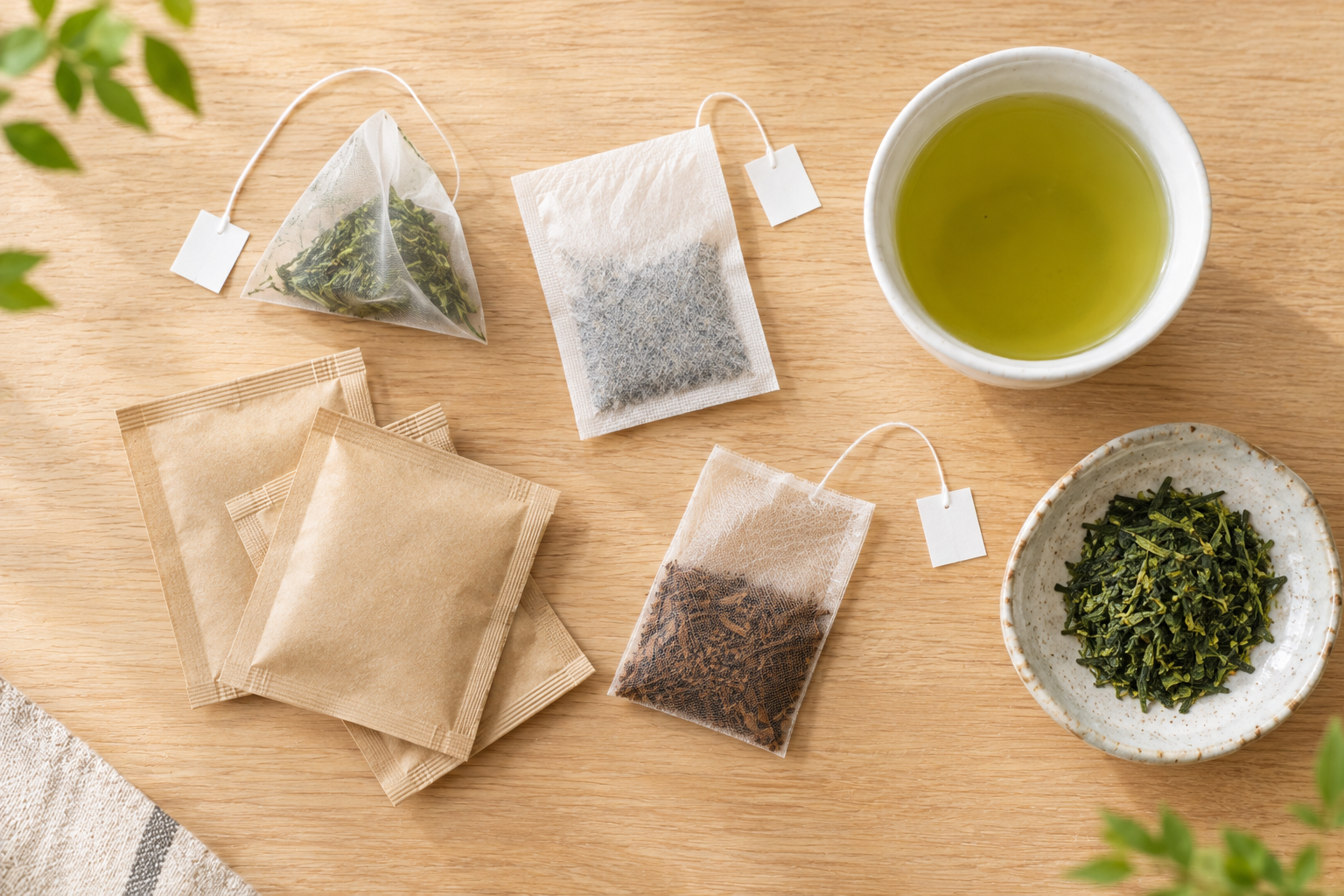
    Better tea bags use larger, broken leaf pieces. You can often see the difference through a mesh bag: recognizable green leaf fragments instead of fine brown-green powder.

    2. Bag type: paper vs. mesh vs. pyramid

    • Flat paper bags are the cheapest. They give the leaves very little room to open, and some people notice a slight papery taste.
    • Mesh and pyramid bags give the leaves space to unfurl and let water flow through more freely – a closer experience to loose leaf. Many are made from nylon or PET; some brands now use plant-based or biodegradable materials. Check the box if this matters to you.

    3. Amount of tea per bag

    Look for about 2g per bag or more. Many budget bags contain 1.5g or less, which is part of why they taste weak – people then steep them longer, which makes them bitter. It’s a lose-lose.

    4. Origin and harvest

    “Product of Japan” is the minimum. Better brands name a region (Uji, Shizuoka, Kagoshima) or say the tea is from the first harvest (ichibancha). If a box just says “green tea” with no origin, it may not be Japanese tea at all.

    5. Freshness and packaging

    Green tea fades quickly once exposed to air. Individually wrapped bags, or bags in a resealable foil pouch, stay fresh much longer than loose bags in a cardboard box. Check the best-before date and buy the freshest box you can.

    Comparison Table

    Brand / typeLeaf qualityBag stylePrice levelBest for
    Ippodo (sencha, gyokuro, hojicha)Kyoto tea-house loose-leaf grade, 2g/bagBiodegradable plastic bagsPremiumGifts, tea lovers, office “treat”
    Ito En green tea bagsGood, consistentMostly paper or mesh, varies by lineMidEveryday drinking
    YamamotoyamaBasic everydayPaperBudgetLarge boxes, genmaicha
    Western brand sencha sachets (e.g. Harney & Sons)Decent senchaSachetMidEasy to find in Western stores
    Hojicha tea bags (various brands)Roasted leaf or stemsMixedBudget-midEvenings, low bitterness

    The Options, One by One

    Ippodo

    Ippodo is a Kyoto tea house dating back to 1717, and its tea bags are essentially its loose-leaf teas portioned into bags. Their sampler set includes sencha, gyokuro and hojicha at 2g per bag, and the bags themselves are made from a biodegradable plastic material. Brewing instructions are simple: one bag in about 150ml of water, around 90 seconds for sencha and gyokuro (cooled water), or 60 seconds with boiling water for hojicha.

    What’s good: this is as close to loose-leaf quality as tea bags get. The gyokuro bags in particular are a rare chance to try shaded tea without buying a full bag of leaf.

    The catch: price. Per cup, it costs several times more than supermarket tea bags. It’s the one I’d buy as a gift or for a desk drawer treat rather than for drinking five cups a day.

    Ito En

    Ito En is one of Japan’s largest tea companies, best known abroad for its bottled “Oi Ocha” green tea. Its tea bags are widely available in Asian supermarkets and online, and the quality is reliable from box to box.

    What’s good: a solid, clean-tasting Japanese green tea at an everyday price, and easy to find. Their matcha-blended green tea bags add a little body and color.

    The catch: it won’t have the depth or sweetness of a premium first-harvest sencha. Think of it as a dependable daily cup.

    Yamamotoyama

    Yamamotoyama is a long-established Japanese tea and nori company and a fixture in many American grocery stores. Their tea bags are among the cheapest Japanese options available.

    What’s good: price and availability. Their genmaicha tea bags are a particularly good value, because the toasted rice gives flavor and body that hides the limits of everyday leaf.

    The catch: flat paper bags and basic leaf. Steep briefly to avoid bitterness.

    Western Brand Sencha Sachets

    Several Western tea companies sell Japanese sencha in sachets – Harney & Sons is a common example. These are often easier to find in Western supermarkets and cafés than Japanese brands.

    What’s good: convenient and usually better than generic “green tea” bags, since they name the tea as Japanese sencha.

    The catch: you’re paying a Western brand’s markup, and sourcing details are usually limited. Check the origin on the box.

    Hojicha Tea Bags

    Roasted green tea is one of the best types of Japanese tea for a bag, because roasting makes it forgiving: it’s hard to make hojicha bitter, and boiling water is fine. Several Japanese brands sell hojicha tea bags, including Ito En and Ippodo.

    What’s good: toasty, mellow, and gentle in the evening. A good choice for people who find sencha too grassy.

    The catch: it isn’t caffeine-free – just gentler than sencha in most cups.

    How to Brew a Japanese Tea Bag (So It Doesn’t Taste Bitter)

    Most bitter tea-bag tea is a brewing problem, not a tea problem.

    1. Cool the water. For sencha and gyokuro bags, use water around 70-80°C (158-176°F) – let boiled water stand for a few minutes, or pour it into your mug first and wait. Boiling water is fine for hojicha and genmaicha.
    2. Use less water. About 150ml (5oz) per bag, not a giant mug. A large mug is why many tea bags taste weak.
    3. Keep it short. 60-90 seconds for sencha. Set a timer.
    4. Don’t squeeze the bag. Squeezing pushes out the bitterest part of the brew.
    5. Re-steep good bags. Premium bags like Ippodo’s can give a second, lighter cup – use slightly hotter water and a shorter time.
    6. Try cold brew. Put one or two bags in a bottle of cold water and refrigerate for 2-3 hours. It’s smooth, sweet and almost impossible to make bitter.

    A Few Things People Ask Me

    Are Japanese tea bags as good as loose leaf? The best ones come close, but loose leaf still wins for depth and for multiple infusions. Tea bags win on convenience.

    Why does my green tea bag taste bitter? Usually water that’s too hot, too long a steep, or squeezing the bag. Fix those three things before you blame the tea.

    Are tea bags made of plastic? Many mesh and pyramid bags are made of nylon or PET; some brands use plant-based or biodegradable materials, and traditional paper bags are also common. Check the packaging if you want to avoid plastic.

    How long do tea bags stay fresh? Unopened, until the best-before date. Once opened, keep them in an airtight container and use them within a month or two for the best flavor.

    What’s the next step up from tea bags? Loose-leaf sencha brewed in a mug with a fine strainer. Nio Teas’ sencha collection is a good place to start – the link-only discount mentioned at the top applies there too.

    Where I Landed

    A good Japanese tea bag is about three things: real leaf, enough of it, and fresh packaging. For a special cup or a gift, Ippodo’s tea bags are the closest thing to loose-leaf tea in a bag. For everyday drinking, Ito En is the reliable choice, and Yamamotoyama’s genmaicha is the bargain. Whichever you pick, brew it with cooler water and a shorter steep than the box suggests – that one change makes more difference than any brand.

  • How to Choose a Yunomi: The Japanese Teacup Guide (Shape, Size and Material)

    How to Choose a Yunomi: The Japanese Teacup Guide (Shape, Size and Material)

    Disclosure: This post contains affiliate links. If you buy through one of them, I may earn a small commission at no extra cost to you.

    In most Japanese homes, every member of the family has their own teacup. It might be a tall, chunky pottery cup that’s been used every morning for years, or a delicate white porcelain one kept for good sencha. Ask someone which cup is theirs and they’ll know immediately. That’s the yunomi (湯呑み), the everyday Japanese teacup – and the right one makes a surprising difference to how your tea tastes and feels.

    Yunomi come in an enormous range of shapes, sizes and clays, and they’re one of the easiest pieces of Japanese teaware to start collecting. This guide explains what actually matters when you choose one.

    The Problem You’re Actually Trying to Solve

    You’ve bought a good Japanese tea and maybe a kyusu, and now you’re drinking it out of a coffee mug. It works, but something feels off: the tea cools too fast or burns your fingers, you can’t see its color, or a mug-sized pour makes delicate sencha taste weak. You want a cup that suits the tea – without having to learn the history of Japanese pottery first.

    Who This Article Is NOT For

    • If you’re looking for a bowl for matcha, that’s a chawan, which is much wider and shaped for whisking – a different purchase.
    • If you’re still choosing a teapot, start with my kyusu buying guide. The teapot affects your tea more than the cup does.
    • If you’re buying a complete matching set as a gift, my Japanese tea set gift guide is a better starting point.

    What a Yunomi Is

    Yunomi literally means “hot water drinker.” It’s the everyday, handle-less teacup used for green tea in Japan – at home, at the office and in casual restaurants. Unlike Western cups, a yunomi usually has no handle: you hold it with one hand and support the base with the other. That’s also a quiet temperature check – if the cup is too hot to hold comfortably, the tea is probably too hot for good green tea.

    You’ll often see two broad styles:

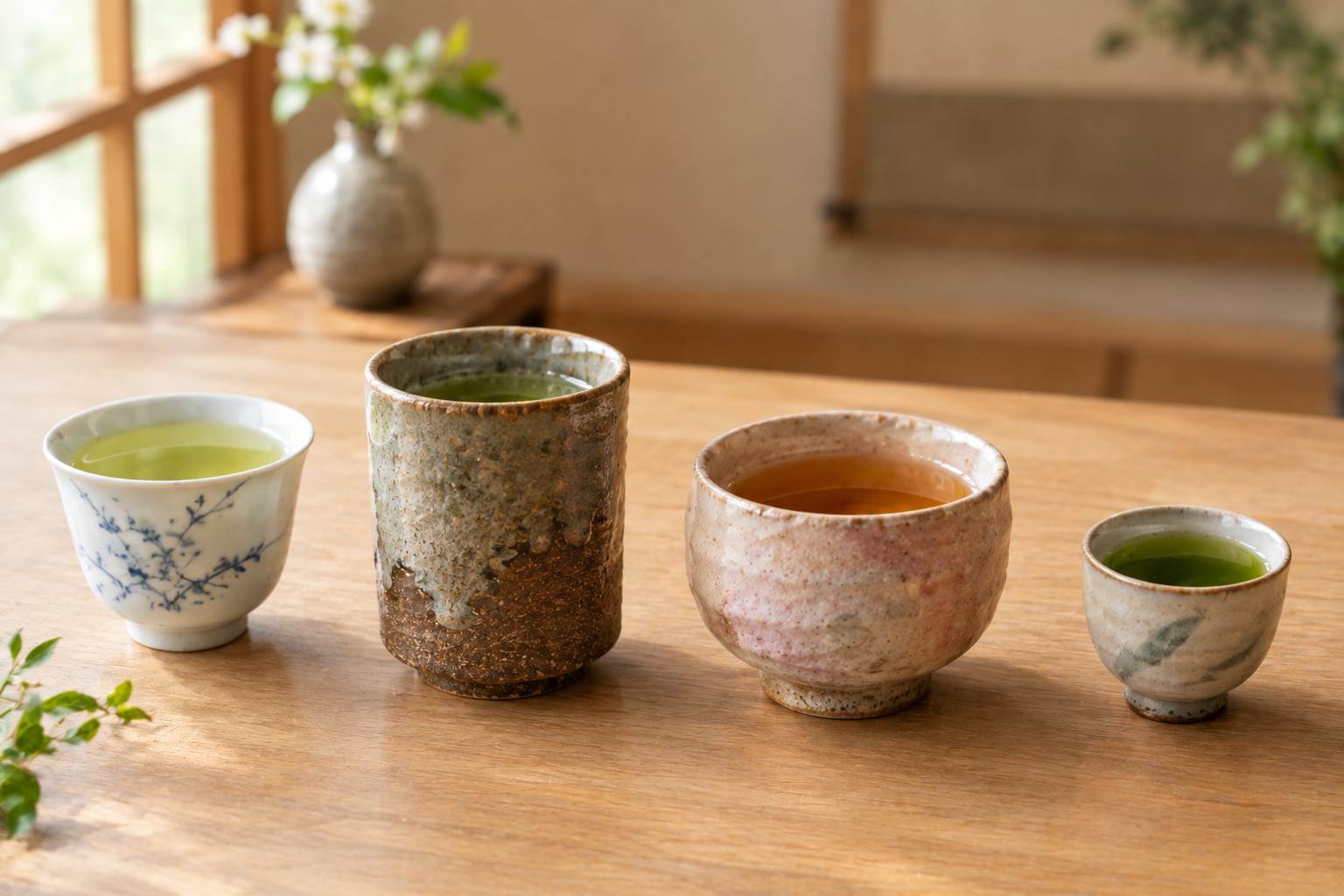
    • Nagayunomi (長湯呑): tall, cylindrical cups for everyday drinking. They hold more tea and keep it warm longer.
    • Kumidashi (汲出): shorter, wider, rounder cups, traditionally used to serve guests. Their wide mouths release aroma and show off the tea’s color.

    The large, thick, tall cups you see at sushi restaurants – often printed with fish names in kanji – are the extreme version of the everyday nagayunomi.

    Material: Porcelain, Stoneware or Glass

    Porcelain (磁器)

    Porcelain is made from fine, white clay fired at high temperatures. It’s thin, smooth, hard and non-porous. Well-known porcelain wares include Arita (Saga Prefecture) and Hasami (Nagasaki Prefecture).

    • Best for: gyokuro, fine sencha and any tea where you want to see the color clearly.
    • Why: the white interior shows the tea’s color, and the thin walls feel elegant on the lips. Porcelain doesn’t absorb flavor or smell, so it’s neutral.
    • Downside: thin porcelain passes heat to your fingers quickly, and it cools fast.

    Stoneware and Earthenware (陶器)

    Pottery cups are thicker, heavier and more textured, often with expressive glazes. Famous examples include Hagi (Yamaguchi), Mino (Gifu), Shigaraki (Shiga) and Mashiko (Tochigi).

    • Best for: hojicha, bancha, genmaicha and other teas brewed with hotter water.
    • Why: thick walls insulate, so the tea stays warm and the cup is comfortable to hold even when hot. The rough texture feels warm and natural in the hand.
    • Downside: some pottery is slightly porous and can absorb aromas or stains over time. This is why many people keep separate cups for green tea and strong-smelling drinks.

    A note on Hagi ware: Hagi pottery is famous for changing with use. Tea gradually seeps into the fine cracks in its glaze and slowly changes the cup’s color over the years – a quality known as Hagi no nanabake, “the seven transformations of Hagi.” Many owners treasure this, but if you want a cup that stays exactly the same, choose glazed porcelain.

    Glass

    Heat-resistant glass is ideal for cold-brewed tea and for showing off the bright color of good green tea. It’s not traditional, but it’s practical in summer. Make sure any glass you use with hot tea is labeled heat-resistant.

    Shape: What It Changes

    ShapeEffectBest for
    Tall and narrowKeeps tea warm longer; holds moreEveryday sencha, bancha, hojicha
    Short and wideReleases aroma; cools tea faster; shows colorFine sencha, serving guests
    Small and shallowSmall, concentrated servingsGyokuro
    Flared rimGentle on the lips; tea flows smoothlyAll teas
    Thick rimSoft, comfortable feel with hot drinksHot hojicha, bancha
    Thin rimDelicate feel; good for cold teaGyokuro, cold brew

    Small details matter more than you’d expect. A thin, slightly flared rim makes delicate tea feel lighter in the mouth, while a thicker rim feels warm and comforting with hot roasted tea.

    Size: Match the Cup to the Tea

    Size is the most practical choice of all. A cup that’s too big for the tea leads to either a half-empty cup or weak tea.

    • Gyokuro: about 40-60ml. Gyokuro is brewed with very little water and drunk in small, concentrated sips, so tiny cups are traditional.
    • Fine sencha: about 80-120ml. Small to medium cups let you enjoy the aroma and keep the tea at its best temperature.
    • Everyday sencha: about 120-180ml. A standard everyday cup.
    • Bancha, hojicha, genmaicha: about 150-250ml. These teas are drunk in larger quantities, so a bigger, taller cup suits them.

    Tip: check that your teapot’s volume matches the cups you’ll use. A 300ml kyusu fills two or three medium cups well. Pouring a little into each cup in turn, rather than filling one at a time, gives every cup the same strength.

    The Inside Color Matters

    If you love green tea’s color, look for a cup that’s white or pale inside. A white interior shows the bright green of fukamushi sencha, the pale gold of gyokuro and the amber of hojicha. A dark interior is beautiful in its own way but hides the tea completely – better suited to roasted teas, where color matters less.

    How to Choose Your First Yunomi

    1. Decide what you drink most. Sencha? Hojicha? Your everyday tea should decide your first cup.
    2. Choose the material. Porcelain for delicate green tea; stoneware for hot, roasted teas.
    3. Pick a size. For most people, a 120-180ml cup is the most versatile.
    4. Hold it if you can. A yunomi is meant to feel good in your hands. Weight, texture and the shape of the rim are all personal.
    5. Check the care instructions. Some handmade pottery shouldn’t go in the dishwasher or microwave.

    If you only buy one cup, a medium-sized cup with a white interior is the most versatile choice.

    Caring for Your Yunomi

    • Rinse with warm water after use. For porcelain, mild dish soap is fine.
    • Be gentle with porous pottery. Avoid soaking it in soapy water for long periods, since some unglazed or porous clay can absorb the smell. Rinse well and let it dry completely before putting it away.
    • Dry thoroughly. Damp pottery stored in a cupboard can develop odors or mold.
    • Check before the dishwasher or microwave. Mass-produced porcelain is often fine; handmade pieces and cups with gold or silver decoration usually aren’t.
    • Before first use, some potters recommend soaking new stoneware in water to help it settle in. Follow the maker’s advice if it comes with instructions.
    • If a cup chips, don’t throw it away – the traditional Japanese art of kintsugi repairs broken pottery with lacquer and gold.

    A Few Things People Ask Me

    Why don’t yunomi have handles? Japanese green tea is brewed below boiling, so the cup is usually comfortable to hold. Holding the cup itself also lets you feel the temperature of the tea.

    What’s the difference between a yunomi and a teacup for guests? Everyday yunomi are taller and personal; guest cups are often shorter, wider and come in matching sets, sometimes with lids and saucers.

    Can I use a yunomi for coffee or Western tea? Yes, though thin porcelain cups may feel very hot with boiling drinks. Thick pottery works better.

    Where can I buy a good yunomi? For delicate green tea, a white Arita porcelain yunomi on Amazon is a classic choice. And a beautiful cup deserves good tea – Nio Teas’ sencha collection has fresh sencha from small Japanese farms.

    Where I Landed

    You don’t need a cabinet full of teaware. One good yunomi – the right size for your favorite tea, with a white interior and a rim that feels good on your lips – will make every cup more enjoyable. Start with one for your everyday tea. Then, if you’re like most tea drinkers in Japan, you’ll slowly find a second for hojicha, a tiny one for gyokuro, and a favorite you’ll reach for every morning for years.

  • Japanese Tea and Cheese Pairing (Plus Chocolate and Western Desserts): What Actually Works

    Japanese Tea and Cheese Pairing (Plus Chocolate and Western Desserts): What Actually Works

    Disclosure: This post contains affiliate links. If you buy through one of them, I may earn a small commission at no extra cost to you. Allergy note: cheese and many desserts contain milk, and some contain nuts, wheat or eggs – adjust the pairings to suit your guests.

    Japanese tea is usually paired with Japanese sweets: a bowl of matcha with a delicate wagashi, a cup of sencha with a rice cracker. But Japanese tea also goes remarkably well with Western food – especially cheese and chocolate. In France, tea and cheese pairings have become part of the growing interest in Japanese tea, and once you try one, it makes sense: tea has umami, roasted notes and refreshing bitterness, the same qualities that make wine and cheese work together.

    The difference is that tea is gentler, has no alcohol, and refreshes your palate rather than coating it. This guide covers which Japanese teas go with which cheeses, chocolates and desserts, and why.

    The Problem You’re Actually Trying to Solve

    You want to serve Japanese tea with something other than wagashi – for a dinner party, an afternoon cheese board, or just with dessert – but you don’t know where to start. Pair the wrong tea with the wrong food and one of them disappears: a delicate gyokuro gets flattened by a strong blue cheese, or a smoky hojicha overwhelms a light fruit tart.

    Who This Article Is NOT For

    • If you’re looking for traditional Japanese sweets to serve with matcha, my wagashi pairing guide covers that.
    • If you want strict rules, pairing is personal. Treat these as starting points, then trust your own taste.
    • If you’re pairing very strong, pungent blue cheeses, tea can struggle; wine or a sweet drink may suit them better.

    Why Tea and Cheese Work Together

    Three things make the pairings click:

    1. Umami meets umami. Gyokuro and good sencha are rich in amino acids, which give them a savory, brothy quality. Aged cheeses like Parmesan are also full of umami. Together, they reinforce each other.
    2. Roast meets roast. Hojicha and genmaicha have toasty, nutty, caramel-like notes – the same flavors found in aged Gouda, Gruyère and dark chocolate.
    3. Bitterness cuts richness. The gentle astringency of green tea cleans fat from your palate, so each bite of cheese or chocolate tastes fresh again.

    A good rule of thumb: match intensity. Light teas with light foods, bold teas with bold foods.

    Pairing by Tea

    Sencha: Fresh Cheese, Light Desserts and Savory Bites

    Sencha’s grassy freshness and light bitterness make it a natural partner for fresh, tangy flavors.

    • Fresh goat cheese (chèvre): the classic sencha pairing. The tea’s green, umami notes bring out the cheese’s freshness, and its bitterness tames the tang.
    • Ricotta or fresh cow’s milk cheese: a gentle match for a light, sweet sencha.
    • Sheep’s milk cheese: try a deep-steamed fukamushi sencha, whose fuller body stands up to the richer fat.
    • Cheesecake: sencha’s astringency cuts through the creaminess, keeping a rich dessert from feeling heavy.
    • Savory foods: smoked salmon, light salads and herb-based dishes.

    Tip: cold-brewed sencha is excellent with salty or sharp cheeses – it’s refreshing and acts like a palate cleanser.

    Gyokuro: Aged Cheese and Umami

    Gyokuro’s deep sweetness and savory umami call for foods with depth.

    • Parmesan (Parmigiano-Reggiano) or aged Comté: long-aged cheeses are full of savory compounds that echo gyokuro’s umami. Small pieces with small cups of gyokuro make a memorable tasting.
    • Rich triple-cream cheeses (Brie-style): their soft, buttery texture can bring out gyokuro’s sweetness.
    • Fresh mozzarella: serve it with cold-brewed gyokuro, a drizzle of olive oil and a pinch of salt for a light, elegant pairing.

    Avoid: strong blue cheese and very spicy foods, which overwhelm gyokuro’s subtlety.

    Hojicha: Aged, Nutty Cheeses and Dark Chocolate

    Hojicha is the most food-friendly Japanese tea. Its roasted, toasty, slightly caramel flavor and low bitterness go with almost anything rich.

    • Aged Gouda or aged Cheddar: the caramelized, nutty flavors of aged hard cheeses echo hojicha’s roast. This is one of the easiest and most reliable pairings to start with.
    • Camembert and Brie: hot hojicha softens the cheese in your mouth, and its woody aroma blends with the creamy center.
    • Washed-rind cheeses (like Pont-l’Évêque): a roasted stem hojicha can stand up to their stronger aroma.
    • Dark chocolate: hojicha’s toasty sweetness harmonizes with cocoa’s roasted bitterness. Try 60-75% dark chocolate.
    • Desserts: chocolate cake, brownies, tiramisu, caramel desserts, pecan pie, dried fruit and roasted nuts.

    Genmaicha: Nutty Cheeses and Grain-Based Snacks

    The toasted rice in genmaicha gives it a mellow, popcorn-like aroma.

    • Gruyère and other nutty alpine cheeses: the toasty rice echoes the cheese’s roasted, nutty flavors.
    • Mild cheeses: genmaicha is gentle enough not to overpower them.
    • Snacks and desserts: crackers, shortbread, oatmeal cookies and grain-based treats.

    Matcha: Creamy Cheeses, White Chocolate and Berries

    Matcha’s thick body, deep vegetal flavor and bitterness need richness to balance them.

    • Mascarpone or burrata: their creaminess softens matcha’s astringency.
    • Alpine cheeses like Gruyère: their smooth, nutty character complements matcha’s earthy finish.
    • White chocolate and milk chocolate: the classic matcha partner; the sweetness and milk fat round out the bitterness.
    • Cream-based desserts: panna cotta, cream puffs, vanilla ice cream and shortcake.
    • Berries: strawberries and raspberries add bright acidity that contrasts beautifully with matcha.

    Tip: for pairings, serve matcha as usucha (thin tea), not as a sweet latte. A latte’s milk and sugar compete with the food.

    Wakocha (Japanese Black Tea): Milk Chocolate and Baked Goods

    Japanese black tea is gentle, with little astringency and a natural sweetness.

    • Milk chocolate, scones, butter cookies and fruit tarts: wakocha’s soft, honeyed character suits classic afternoon-tea foods.
    • Mild, creamy cheeses: an easy match for its gentle body.

    Quick Pairing Chart

    TeaCheeseChocolateDesserts
    SenchaFresh goat cheese, ricottaLight, fruity chocolateCheesecake, fruit, light cakes
    Fukamushi senchaSheep’s milk cheese–Butter cookies
    GyokuroParmesan, aged Comté–Simple, lightly sweet desserts
    HojichaAged Gouda, Cheddar, CamembertDark chocolateBrownies, tiramisu, caramel
    GenmaichaGruyère, mild cheeses–Crackers, shortbread, oat cookies
    MatchaMascarpone, burrata, GruyèreWhite and milk chocolateCream desserts, berries, ice cream
    WakochaMild creamy cheesesMilk chocolateScones, fruit tarts

    How to Host a Tea and Cheese Tasting

    1. Choose three teas with different characters: for example, a sencha, a hojicha and a matcha or gyokuro.
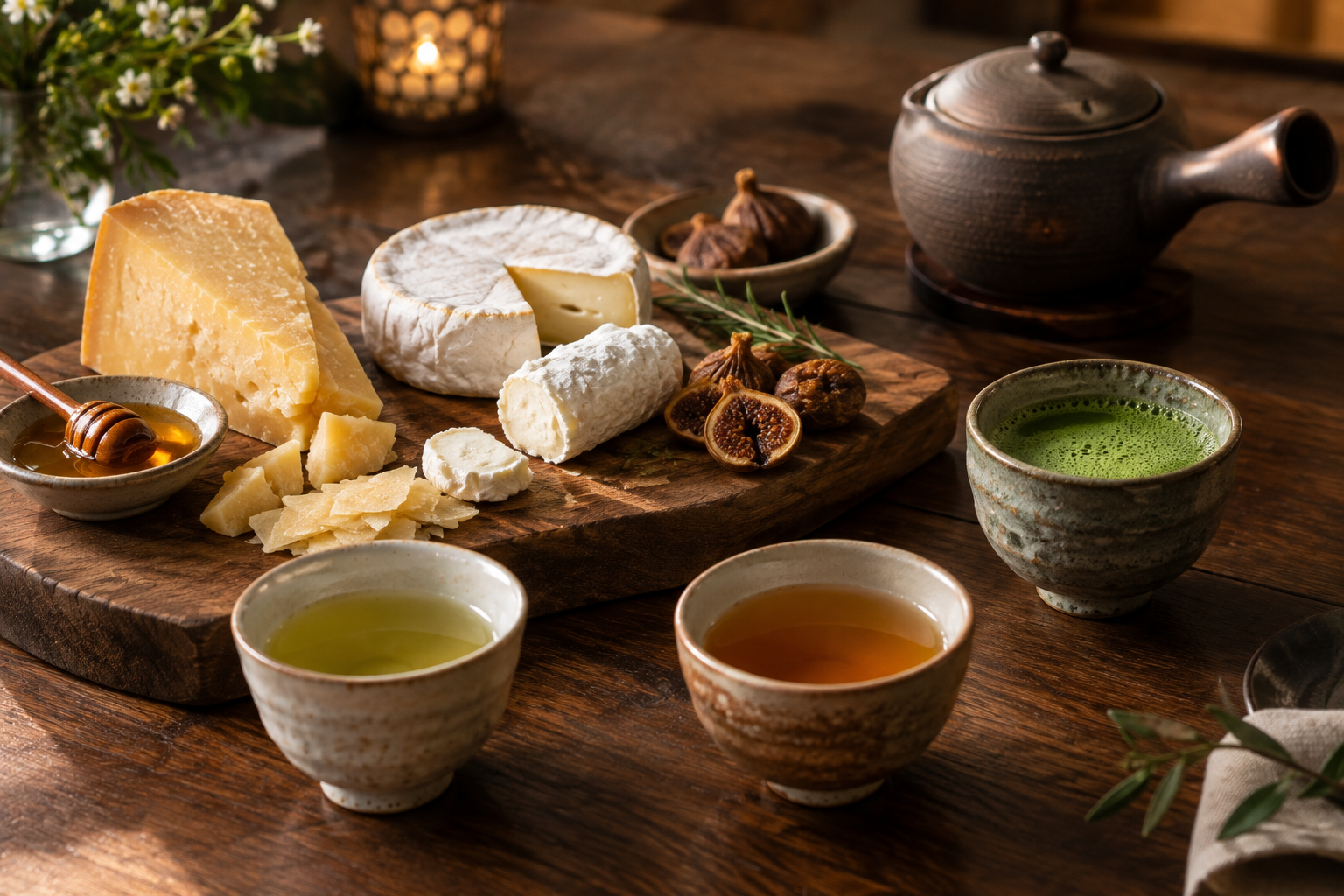
    2. Choose three or four cheeses, from fresh to aged: a goat cheese, a Brie, an aged Gouda and a Parmesan.
    3. Go from light to strong. Start with the lightest tea and cheese, and finish with the boldest, just as you would with wine.
    4. Serve small amounts. Small cups of tea and bite-sized pieces of cheese let everyone compare without filling up.
    5. Offer neutral crackers and water between pairings to reset the palate.
    6. Add a bridge. If a pairing feels disconnected, a little honey, fig jam or dried fruit often brings tea and cheese together.
    7. End with dessert. Finish with hojicha and dark chocolate, or matcha and white chocolate.

    Hot or Cold?

    • Hot tea softens cheese and releases aromas, making creamy and aged cheeses feel even richer.
    • Cold-brewed tea is refreshing and works like a palate cleanser – ideal with salty, sharp or fatty foods, and in summer.

    A Few Things People Ask Me

    What’s the easiest pairing to start with? Hojicha with aged Gouda, or hojicha with dark chocolate. Both are forgiving and taste good to almost everyone.

    Does tea really work with cheese, or is it a gimmick? It genuinely works, for the same reasons wine does: complementary flavors and a drink that refreshes the palate. It’s a good option for anyone who doesn’t drink alcohol.

    Which tea is best with chocolate? Hojicha for dark chocolate, matcha for white chocolate, and sencha or wakocha for milk chocolate.

    What should I buy to try this? A fresh, quality sencha like the ones in Nio Teas’ sencha collection covers the fresh-cheese pairings, and loose-leaf hojicha on Amazon handles aged cheese and chocolate. If you’re choosing a hojicha, my hojicha brand comparison can help.

    Where I Landed

    Pairing Japanese tea with cheese and chocolate opened up a whole new way of serving tea for me. A cheese board with three teas instead of three wines is relaxed, interesting and something everyone at the table can enjoy. Start with hojicha and aged Gouda, add a fresh sencha with goat cheese, and finish with matcha and white chocolate. After that, you’ll start noticing pairings everywhere.

  • What to Do With Used Tea Leaves and Old Green Tea: Practical Uses That Actually Work

    What to Do With Used Tea Leaves and Old Green Tea: Practical Uses That Actually Work

    Disclosure: This post contains affiliate links. If you buy through one of them, I may earn a small commission at no extra cost to you. Used tea leaves spoil quickly – see the food safety notes below before eating them.

    If you brew loose-leaf Japanese tea every day, you end up with a lot of soggy leaves. And sooner or later, you’ll also find a half-finished bag of sencha at the back of the cupboard that’s past its best-before date and smells a little flat. Throwing either away feels wasteful – especially with good tea.

    In Japan, used tea leaves even have their own name, chagara (茶殻), and there’s a long tradition of using them around the house, from cleaning tatami floors to cooking. Some of the popular “tea leaf hacks” online work well; others are more folklore than fact. This guide covers the uses worth trying, how to do them properly, and what to be careful about.

    The Problem You’re Actually Trying to Solve

    You have two different problems, and they need different solutions:

    1. Used leaves after brewing – wet, perishable, and still full of flavor and fiber.
    2. Old, unused tea – dry and safe, but stale, with faded aroma.

    Old tea can often be revived; used leaves need to be used quickly or dried. Mixing the two up is how people end up with moldy leaves in the fridge.

    Who This Article Is NOT For

    • If your matcha has gone dull, the best fix is prevention – my matcha storage guide covers how to keep it fresh in the first place.
    • If you’re hoping tea leaves will cure skin problems or work as a medicine, this isn’t that article. These are practical household uses, not remedies.
    • If your tea has visible mold, a musty smell or signs of damp, don’t try to rescue it. Throw it away.

    Part 1: Reviving Old, Unused Tea

    Roast Stale Sencha Into Hojicha

    This is the single best use for old green tea. Roasting brings out new, toasty aromas and covers the flat, faded notes of stale leaf. You get a fresh-tasting hojicha from tea you were about to throw out.

    How to do it:

    1. Sift out the fine bits. Shake the tea through a strainer. Powdery fragments scorch easily.
    2. Heat a dry pan. Use a clean, dry frying pan (no oil) over low to medium-low heat. A traditional houroku, a clay tea roaster, works even better.
    3. Add the tea. About 15-20g is a good batch – a thin layer, not a pile.
    4. Keep it moving. Shake the pan or stir constantly with a spatula. Within a few minutes, the kitchen will fill with a sweet, toasty smell.
    5. Watch the color. Roast for roughly 5-10 minutes, until the leaves are an even light to medium brown. Stop before they turn black.
    6. Cool and store. Spread the leaves on a plate to cool, then keep them in an airtight container.

    Brew it like regular hojicha: near-boiling water, about 30 seconds.

    Tip: Bancha and lower-grade sencha roast beautifully. Very fine, deep-steamed teas break up easily, so roast them more gently.

    Cook and Bake With Old Matcha

    Matcha that’s lost its bright color and sweetness isn’t pleasant to drink straight, but it’s still fine for recipes where sugar, butter and milk do the heavy lifting: cookies, pound cake, pancakes and matcha lattes with plenty of milk. The color will be duller, so it suits recipes where appearance matters less. My guide to baking with matcha covers how to keep the flavor and color as good as possible.

    Make Cold Brew

    Slightly stale sencha often tastes better cold-brewed than hot, because cold water extracts less bitterness and the faded aroma matters less. Use about 10g of leaf per liter of cold water and refrigerate for a few hours.

    Grind It Into Tea Salt

    Grind dry old sencha finely in a spice grinder or mortar and mix it with salt – roughly one part tea to two or three parts salt. It’s lovely sprinkled on tempura, rice balls, grilled fish or roasted vegetables.

    Part 2: Using Leaves After Brewing

    Eat Them

    Japanese tea leaves, especially good sencha and gyokuro, are tender enough to eat after brewing – and gyokuro leaves in particular are often enjoyed this way in Japan. They’re soft, slightly bitter and pleasantly green.

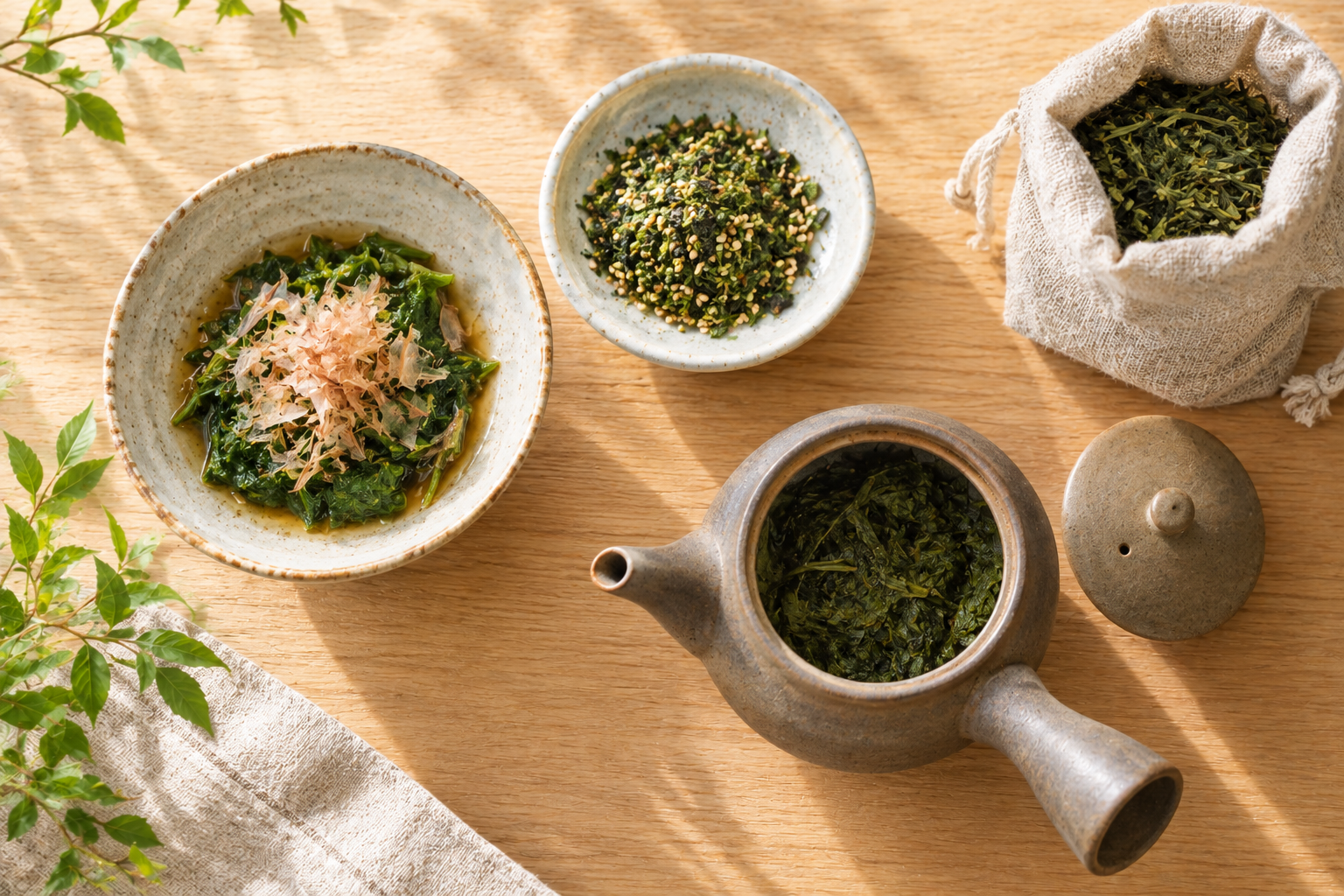
    • With ponzu or soy sauce. Squeeze out the water, then dress the leaves with a little ponzu or soy sauce and a pinch of bonito flakes. This is a classic way to finish a pot of gyokuro.
    • In salads and dressings. Chop and add to a simple salad or mix into dressings.
    • Tsukudani. Simmer the leaves with soy sauce, mirin and sugar until the liquid is gone to make a savory rice topping.
    • Furikake. Dry the leaves in a low oven or a dry pan, then crumble them with sesame seeds, salt and nori.
    • In cooking. Mix chopped leaves into omelets, fritters, fried rice or tempura batter.

    Best leaves to eat: high-grade sencha, fukamushi and especially gyokuro. Tougher teas like bancha or hojicha are less pleasant to chew.

    Food safety: used tea leaves are wet and perishable. Treat them like cooked vegetables:

    • Use them the same day, or refrigerate in a covered container and use within about a day.
    • Don’t leave them sitting in the teapot or at room temperature for long.
    • If they smell sour, look slimy or show any mold, throw them away.

    Use Them for Cleaning

    This one is genuinely traditional. In Japanese homes, people scattered damp tea leaves on tatami mats or wooden floors before sweeping. The leaves trap dust and stop it from flying up, making sweeping easier.

    How to do it:

    • Squeeze the leaves well so they’re damp, not wet.
    • Scatter them lightly over the floor, then sweep them up with the dust.

    Caution: tea can stain. Test on a small, hidden area first, and avoid using this on light-colored carpets, unsealed wood, fabric or light tatami. For most modern homes, a quick test is essential.

    Use Them to Reduce Smells

    Thoroughly dried tea leaves are often used in Japan to absorb odors in small spaces. Results are modest, but many people find them useful for:

    • The fridge: put dried leaves in a small dish or a cloth pouch.
    • Shoes: place a pouch of dried leaves inside overnight.
    • Hands and cutting boards: rubbing damp leaves on your hands or a board after cutting fish or garlic can help freshen them before washing.

    The important part: the leaves must be completely dry before you leave them anywhere. Damp leaves in a closed space are an invitation for mold. Dry them on a tray in a sunny spot for a day or two, or in a low oven, and replace them every week or two.

    Add Them to Compost or the Garden

    Used tea leaves are organic matter and can go into compost. You can also dig them lightly into garden soil. Their fertilizer effect is mild, so think of them as compost material rather than plant food.

    Tips:

    • Mix them into compost or soil rather than piling them on the surface, where they can go moldy.
    • Go easy with houseplants – a thick layer of wet leaves on a potted plant can encourage mold and fungus gnats.
    • Remove tea bags with plastic or nylon mesh, and staples, before composting.

    Quick Reference: What to Do With Each

    What you haveBest uses
    Old, stale sencha or banchaRoast into hojicha; cold brew; tea salt
    Old, dull matchaBaking, lattes, smoothies
    Used gyokuro or good sencha leavesEat with ponzu; furikake; tsukudani
    Used everyday tea leavesCleaning, deodorizing (dried), compost
    Tea that’s moldy or smells mustyThrow away

    How to Avoid Having Old Tea in the First Place

    • Buy smaller bags. 50-100g of sencha is a good size for most people.
    • Store it properly. Airtight, dark and cool. A good tea canister makes a big difference.
    • Finish opened tea within a few weeks. Sencha starts to fade once opened; matcha even faster.
    • Keep unopened tea in the fridge if you won’t open it soon, and let it reach room temperature before opening to avoid condensation.

    A Few Things People Ask Me

    Can I drink expired green tea? If it’s been stored dry and shows no mold or musty smell, old tea is usually still safe – it just tastes flat. The best-before date is about quality. Roasting it into hojicha is the best way to enjoy it.

    Can I reuse tea leaves the next day? Not for brewing. Leaves left wet overnight can start to spoil, so either brew all your infusions in one session or refrigerate the leaves and cook with them within a day.

    Do tea leaves really remove smells? Dried leaves can help a little in small spaces like shoes or the fridge. They’re not as strong as baking soda or activated charcoal, but they’re free.

    What should I buy to make my own hojicha? A traditional houroku tea roaster on Amazon makes roasting easier and more even. And when it’s time for fresh tea, Nio Teas’ sencha collection offers smaller bags that are easier to finish while fresh.

    Where I Landed

    The best way to use old tea is to roast it – turning a stale bag of sencha into fresh hojicha feels like a small kitchen magic trick. For used leaves, I eat the good ones with a splash of ponzu, dry a handful for the fridge, and put the rest in the compost. Good tea deserves more than one life, as long as you remember the one rule: dry leaves keep, wet leaves don’t.

  • Japan’s Fermented Teas: Goishicha, Awa Bancha, Ishizuchi Kurocha and Batabata-cha

    Japan’s Fermented Teas: Goishicha, Awa Bancha, Ishizuchi Kurocha and Batabata-cha

    Disclosure: This post contains affiliate links. If you buy through one of them, I may earn a small commission at no extra cost to you.

    Most people think of Japanese tea as fresh, green and grassy – the opposite of fermented. And for nearly all Japanese tea, that’s true: sencha, gyokuro and matcha are steamed precisely to stop any fermentation. But in a few remote mountain villages, mostly on the island of Shikoku, farmers have been making something completely different for centuries: teas fermented with bacteria, like pickles, that taste sour, earthy and unlike anything else in Japanese tea.

    These are Japan’s post-fermented teas. They’re rare, a few of them very nearly disappeared, and they’re one of the most fascinating corners of Japanese tea culture. This guide covers the four you’re most likely to hear about, how they’re made, and how to brew them.

    The Problem You’re Actually Trying to Solve

    If you’ve seen “goishicha” or “awa bancha” in a specialty tea shop, you probably had questions: Is it green tea? Is it like pu-erh? Why does it smell sour? Is it supposed to? English information is limited, and many descriptions mix these teas up with ordinary bancha or with kombucha.

    Who This Article Is NOT For

    • If you’re looking for the general difference between Japanese and Chinese tea processing, my Japanese vs. Chinese tea comparison explains why most Japanese tea is steamed instead.
    • If you’re interested in fermented tea for health reasons, I’m not going to make medical claims here. Some research on these teas is ongoing, but treat them as a fascinating drink, not a remedy. For what’s actually known about green tea and health, see my careful look at green tea health benefits.
    • If you want a fizzy fermented drink, that’s kombucha – made by fermenting sweetened tea with a culture, not by fermenting the leaves themselves.

    What “Post-Fermented” Actually Means

    Tea people use the word “fermentation” in two very different ways, which causes a lot of confusion.

    • Oxidation (often loosely called fermentation) is what turns leaves dark in black tea and oolong. It’s driven by the leaf’s own enzymes – no microbes involved.
    • True fermentation, or post-fermentation, uses microorganisms – molds and bacteria – to transform the leaves after they’ve been heated. That’s how Chinese pu-erh and other dark teas are made, and it’s how Japan’s fermented teas are made too.

    What makes Japan’s fermented teas special is that most of them rely on lactic acid bacteria, the same kind of microbes that ferment pickles, sauerkraut and yogurt. That’s where their distinctive sourness comes from.

    In 2018, the traditional fermented tea techniques of Shikoku – goishicha, awa bancha and Ishizuchi kurocha – were recognized by Japan’s national government as folk cultural properties worth recording and preserving.

    Goishicha (Kochi): The “Go Stone” Tea

    Where: Otoyo Town, in the mountains of Kochi Prefecture

    Goishicha (碁石茶) is probably the most famous Japanese fermented tea, and it has the most elaborate process. It’s fermented twice:

    1. Steaming. Tea branches with their leaves are harvested in early summer (roughly mid-June to early August) and steamed in a large cauldron for about two hours.
    2. First fermentation (aerobic). The leaves are stripped from the branches and spread on straw mats in a closed room for about a week, where molds grow on them.
    3. Second fermentation (anaerobic). The leaves are packed into wooden barrels with the steaming liquid, covered, and weighted down with stones for about two weeks. Without air, lactic acid bacteria take over.
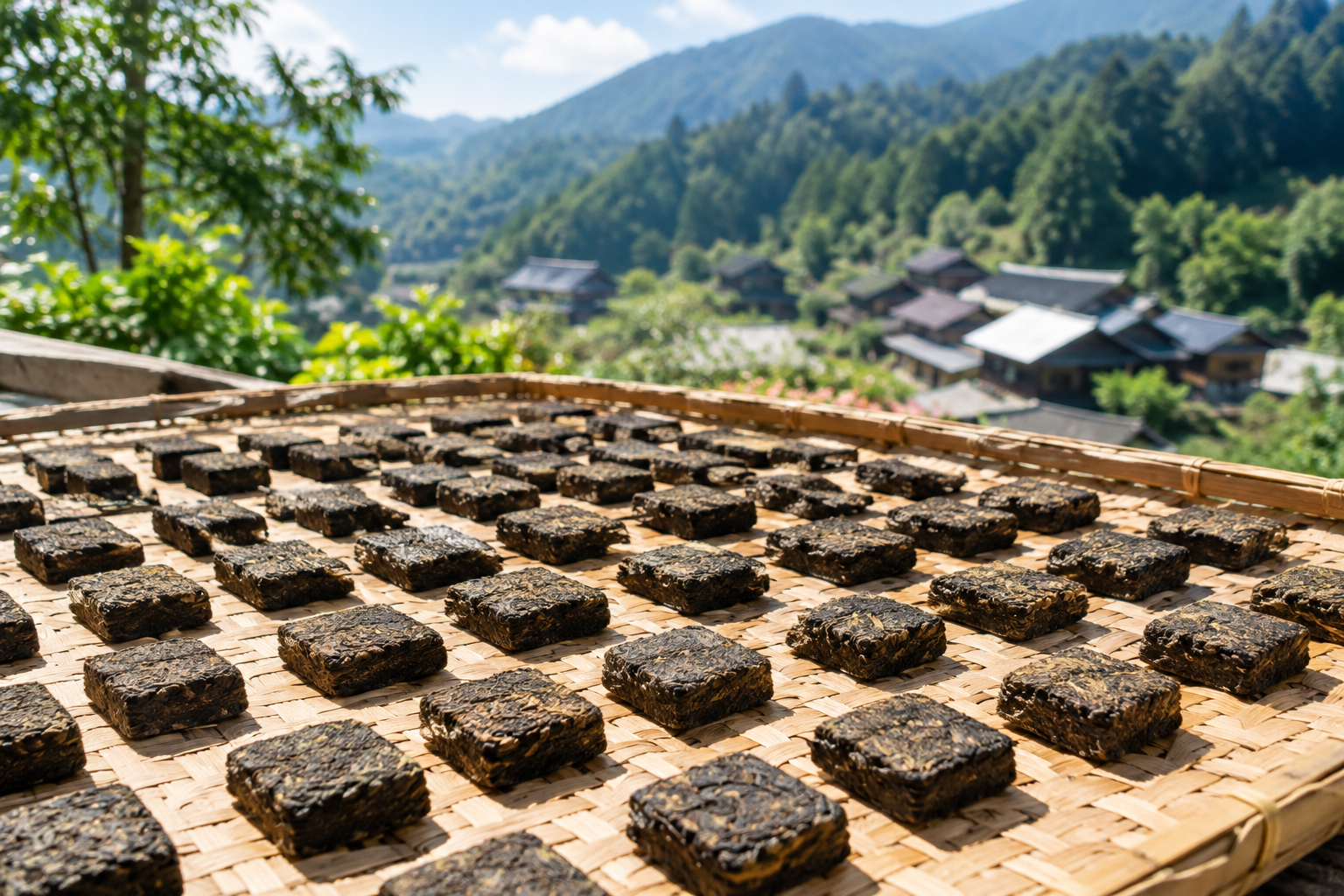
    4. Cutting and drying. The pressed leaves are cut into small squares about 3-4cm across and dried in the sun for several days.

    The name comes from that final step: the dark squares lying on straw mats look like stones on a Go board.

    Flavor: sharply sour and tangy, with an earthy depth. It’s often compared to a mild vinegar or pickled plum – not what you’d expect from a cup of tea.

    Tradition: in parts of Japan’s Seto Inland Sea region, goishicha was historically used to make chagayu, rice porridge cooked in tea, which created a market for this small mountain town’s product.

    Awa Bancha (Tokushima): The Pickled Summer Tea

    Where: Kamikatsu and Naka towns in Tokushima Prefecture

    Awa bancha (阿波晩茶) is the most approachable of Japan’s fermented teas, and the one people in its home region actually drink every day. The “ban” in its name is written with the character for “late” (晩), because it’s made from mature leaves picked late in the season, from about July to August – the opposite of delicate spring sencha.

    How it’s made:

    1. Boiling. Instead of steaming, the leaves are boiled.
    2. Rolling. They’re rolled or rubbed, by machine or by hand, to break them down.
    3. Fermentation (anaerobic). The leaves are packed tightly into barrels, covered with the cooking liquid and weighted to keep out air. Lactic acid fermentation runs for about two weeks to a month.
    4. Sun-drying. Finally, they’re dried outdoors on mats for a few days.

    Because it relies on the local bacteria in each farm’s barrels, no two batches taste exactly alike.

    Flavor: gently sour, with a soft, slightly savory sweetness and almost no bitterness. Tasters often describe hints of pickles, olives or umeboshi. It’s much milder than goishicha and is an excellent introduction to fermented tea.

    Caffeine: generally considered low, because it’s made from mature summer leaves and fermented – though it isn’t caffeine-free.

    Ishizuchi Kurocha (Ehime): The Tea That Nearly Vanished

    Where: the area around Mount Ishizuchi, Ehime Prefecture

    Ishizuchi kurocha (“Ishizuchi black tea”) is made with a double fermentation similar to goishicha: a first, aerobic fermentation with molds, then an anaerobic lactic acid fermentation, before the leaves are dried in the sun.

    Its story is a near-miss. Production declined so much in the 20th century that, at one point, only one elderly couple was still making it. A local group learned the method from them to keep the tradition alive, and today it’s produced again in small amounts. In 2023, its production method was designated an Important Intangible Folk Cultural Property of Japan.

    Flavor: strongly sour and acidic when young. Like some wines, it’s said to mellow with a few years of careful storage.

    Batabata-cha (Toyama): The Whisked Fermented Tea

    Where: Asahi Town, Toyama Prefecture, on the Japan Sea coast

    The last one is different in both place and style. In Asahi, a dark fermented tea, made from mature leaves, is boiled, poured into a bowl with a pinch of salt and whipped with a special double-headed bamboo whisk until frothy. The custom – named after the brisk “bata bata” whisking – is a social one: neighbors gather to share batabata-cha at community gatherings and religious occasions.

    Flavor: mild, slightly salty and gently earthy, with a soft foam.

    How the Four Compare

    TeaRegionFermentationFlavor
    GoishichaOtoyo, KochiTwo-stage (mold, then lactic acid)Sharp, sour, earthy
    Awa banchaKamikatsu / Naka, TokushimaLactic acid (anaerobic)Mild, gently sour, savory
    Ishizuchi kurochaMount Ishizuchi area, EhimeTwo-stage (mold, then lactic acid)Strongly sour, mellows with age
    Batabata-chaAsahi, ToyamaMicrobial fermentationMild, salted, whisked frothy

    How to Brew Japan’s Fermented Teas

    These teas are brewed hotter and longer than green tea. They’re forgiving – there’s little bitterness to worry about.

    Awa bancha:

    • About 5g of leaf per 300ml of boiling water
    • Steep for 2-3 minutes, or simmer briefly for a stronger cup
    • Can be re-steeped several times, lengthening the time each round
    • Excellent cold: brew hot, then chill

    Goishicha:

    • Simmer one or two squares in about 1-1.5 liters of water for around 10 minutes
    • Drink hot, or chill it for a refreshing, tangy summer drink
    • Some people blend it with other teas to soften the sourness

    Ishizuchi kurocha: brew like goishicha, starting with a small amount since it’s quite sour.

    Tip: if the sourness surprises you, try a little less leaf, or mix the brewed tea half and half with hojicha or roasted barley tea.

    Buying and Storing

    These teas are produced in small amounts, so they’re mostly found at specialty tea shops, regional shops or online. A few tips:

    • Check the region on the label. Real goishicha comes from Otoyo, awa bancha from Kamikatsu or Naka.
    • Expect variation. Small-batch fermentation means flavor changes from year to year and farm to farm – that’s part of the charm.
    • Store it dry and dark. Keep it in an airtight container, away from moisture and strong smells.

    A Few Things People Ask Me

    Is this the same as pu-erh? They’re related – both are post-fermented with microbes – but Japan’s versions mostly use lactic acid fermentation, which makes them noticeably sour. Pu-erh tends to be earthy rather than tangy.

    Is awa bancha the same as regular bancha? No. Ordinary bancha is an everyday green tea made from later-harvest leaves, and it isn’t fermented. Awa bancha shares the name because it’s also made from mature leaves, but its fermentation makes it a completely different drink.

    Is it the same as kombucha? No. Kombucha is sweetened tea fermented with a culture after brewing. These teas are fermented as leaves, before brewing.

    Where can I buy them? Look for awa bancha on Amazon – the easiest one to find and the best first try. If you want to go further, goishicha on Amazon is the classic, more intense version.

    Where I Landed

    Japan’s fermented teas are a reminder that “Japanese tea” isn’t only about bright spring greens. In a handful of mountain villages, people found a way to preserve summer leaves with bacteria, wooden barrels and sunshine – and created teas that taste like nothing else. Start with a cup of awa bancha. If its gentle tang wins you over, goishicha is waiting.

  • Senchado: Japan’s Other Tea Ceremony, Made With Sencha Instead of Matcha

    Senchado: Japan’s Other Tea Ceremony, Made With Sencha Instead of Matcha

    Disclosure: This post contains affiliate links. If you buy through one of them, I may earn a small commission at no extra cost to you.

    When people say “Japanese tea ceremony,” they almost always mean chanoyu: a quiet tatami room, a bamboo whisk, and a bowl of frothy matcha. But Japan has a second tea ceremony that most visitors – and plenty of tea lovers – have never heard of. It uses loose-leaf green tea, a tiny teapot and thimble-sized cups, and it grew out of a rebellion against the formality of the matcha ceremony.

    It’s called senchado (煎茶道), “the way of sencha.” This guide explains where it came from, how it differs from the matcha ceremony, what actually happens during one, and how you can try the spirit of it at home.

    The Problem You’re Actually Trying to Solve

    You’ve probably read about the matcha tea ceremony, but you drink mostly sencha or gyokuro – and you’re curious whether there’s a traditional, mindful way to enjoy leaf tea too. English information on senchado is scarce, and what exists is often either very academic or a brief mention in a matcha article.

    Who This Article Is NOT For

    • If you’re looking for the matcha tea ceremony and how to behave as a guest, that’s chanoyu – a different tradition with different rules.
    • If you just want the best everyday brewing method for sencha, you don’t need any ceremony. My green tea temperature guide covers that more directly.
    • If you want a strict, step-by-step manual for one school’s procedure, that’s best learned from a teacher. Senchado has many schools, and their details differ.

    Where Senchado Came From

    Senchado’s roots go back to China and to Zen Buddhism.

    Ingen and the Obaku school. In 1654, the Chinese Zen master Ingen (Yinyuan Longqi) arrived in Japan. He founded the Obaku school of Zen, one of Japan’s three main Zen schools, and its head temple, Manpuku-ji, in Uji, south of Kyoto. Along with Buddhism, Ingen and his followers brought Chinese culture with them – including the Ming-dynasty custom of steeping loose tea leaves rather than whisking powdered tea.

    Baisao, the “Old Tea Seller.” The figure most associated with senchado is Baisao (売茶翁, “old tea seller”), an Obaku monk born in 1675 in what is now Saga Prefecture. In 1735, at about 61, he set up a small tea stall in Kyoto. Rather than running a formal shop, he carried his tea and utensils to scenic spots around the city and served anyone who stopped – aristocrats, merchants and ordinary people alike – while talking about Zen. Famously, he didn’t set a price; his sign said he would accept whatever people chose to pay, “anything from a hundred gold coins down to half a sen,” and if they paid nothing, that was fine too.

    Baisao openly criticized how the matcha ceremony of his day had become expensive, rigid and focused on status. For him, tea was a way of living freely and simply, not a display of rare utensils. In 1755, when he was about 81, he stopped selling tea and burned his utensils so they wouldn’t be treated as treasures after his death.

    Nagatani Sōen and modern sencha. Around the same period, in 1738, Nagatani Sōen of Ujitawara developed the steaming-and-rolling method that became the basis of today’s sencha. Baisao visited him in 1742. Better tea and Baisao’s free-spirited style together helped sencha spread.

    From free spirit to formal “way.” Ironically, after Baisao’s death, sencha drinking became popular among Edo-period intellectuals, poets and painters – the bunjin (literati) – who loved its connection to Chinese scholarly culture. Over the 19th century, schools formed and created their own procedures and utensils, and senchado became a formal tradition of its own. Baisao is now honored as its founding figure, and Manpuku-ji remains its spiritual home, hosting large sencha gatherings.

    Senchado vs. Chanoyu: The Key Differences

    Chanoyu (matcha ceremony)Senchado (sencha ceremony)
    TeaPowdered matcha, whiskedLoose-leaf tea (sencha or gyokuro), steeped
    Main utensilsChawan (bowl), chasen (whisk), chashaku (scoop)Small teapot, tiny cups, saucers, brazier and kettle
    RootsJapanese Zen and the tea masters of the 16th centuryChinese tea culture, Obaku Zen, Baisao
    AestheticWabi-sabi: rustic, restrainedOften lighter and influenced by Chinese literati culture
    AtmosphereHighly formal, set movementsStill structured, but often seen as more relaxed
    SeatingUsually tatami; some schools offer table-styleTatami or table-style, depending on the school

    The biggest difference you’ll notice is the cup. In senchado, especially with gyokuro, guests may receive only a few sips of very concentrated tea in a cup not much bigger than a thimble – the point is to taste every drop carefully.

    The Utensils of Senchado

    Each school has its own preferences, but these are the utensils you’ll usually see:

    • Ryoro (涼炉): a small portable brazier, traditionally burning charcoal, used to heat the water.
    • Bofura (ボーフラ): a small, round, unglazed clay kettle that sits on the ryoro.
    • Kyusu or houhin: a small teapot. A houhin has no handle and is often used for gyokuro.
    • Yuzamashi: a cooling bowl for bringing water down to the right temperature.
    • Small cups (senchawan): usually five, thin and delicate, often white inside so you can see the color of the tea.
    • Chataku: saucers for the cups, often metal or lacquered wood.
    • Chagu tray and tea caddy: for setting out the utensils and holding the leaf.

    Many of these are simply refined versions of things you might already use for good sencha at home – which is part of senchado’s appeal.

    What Happens During a Sencha Ceremony

    Procedures vary between schools, but a typical senchado gathering follows a general flow:

    1. Preparing the space. Utensils are arranged neatly, sometimes with a scroll, a flower arrangement or seasonal decoration.
    2. Warming the utensils. Hot water is poured into the teapot and cups to warm them, then discarded.
    3. Cooling the water. The water is cooled in the yuzamashi to the right temperature – especially low for gyokuro.
    4. Adding the leaves. The host measures the tea into the pot with care.
    5. Steeping. The cooled water is poured over the leaves and left to steep quietly.
    6. Pouring evenly. The tea is poured into the cups a little at a time, going back and forth, so every cup has the same strength. The last drops, the richest, are shaken out carefully.
    7. Serving. Cups are placed on saucers and offered to guests, who receive them with a bow and drink slowly, often in a few small sips.
    8. Second infusion. The host often brews the same leaves again, letting guests notice how the flavor changes.
    9. Sweets. A small sweet is often served to accompany the tea.

    The movements are calm, efficient and deliberate. Some practitioners describe senchado as “meditation in motion” – the focus on each simple action helps quiet the mind.

    Where to Experience Senchado

    • Manpuku-ji, Uji. The head temple of the Obaku school is the historic center of senchado and hosts sencha gatherings and events, especially in spring and autumn. It’s easy to combine with a visit to Uji’s tea shops.
    • Kyoto and other cities. Some senchado teachers offer lessons or experiences for visitors, including in English. Search for “senchado experience” with the city name, and book ahead.
    • Tea events and cultural centers. Japanese cultural centers abroad occasionally host senchado demonstrations.

    Because many senchado schools offer table-style seating, it can be more comfortable than a traditional matcha ceremony if sitting on tatami is hard for you.

    Bringing the Spirit of Senchado Home

    You don’t need a ryoro or a teacher to enjoy the essence of senchado. Try this the next time you brew a good sencha or gyokuro:

    • Make it a separate moment. Clear the table and put away your phone.
    • Warm everything first. Pour hot water into the pot and cups, then discard it.
    • Cool the water deliberately. Pour it into a cooling bowl or a spare cup and watch the steam settle.
    • Use small cups. Smaller servings make you slow down and notice the flavor.
    • Pour back and forth. Fill the cups a little at a time so each is the same strength, and shake out the last drops.
    • Brew a second time. Taste how the tea changes.

    A good teapot makes this easier – my kyusu buying guide covers what to look for.

    A Few Things People Ask Me

    Is senchado older than the matcha ceremony? No. The matcha ceremony took shape earlier, in the 15th and 16th centuries. Senchado developed from the 17th and 18th centuries onward.

    Is senchado less formal than chanoyu? It began as a reaction against formality, and many people find it more relaxed. But today’s senchado schools do have set procedures, so it’s still a structured practice.

    Can senchado use gyokuro? Yes. Many schools serve gyokuro as well as sencha, often in very small, concentrated cups.

    What should I buy to try it at home? A small handle-less houhin teapot on Amazon is ideal for small, careful servings, and a high-quality leaf like Nio Teas’ gyokuro is what senchado is really made for.

    Where I Landed

    What I love about senchado is its origin story: a monk walking around Kyoto with a basket of tea, serving anyone for whatever they could pay, because he believed tea belonged to everyone. The ceremony that grew up after him is more formal than he might have liked, but its heart is still simple – good leaf, carefully cooled water, small cups and full attention. You can bring that into your own kitchen this afternoon.

  • Japanese Tea Souvenirs: What to Buy in Japan, Where to Find It, and How to Bring It Home

    Japanese Tea Souvenirs: What to Buy in Japan, Where to Find It, and How to Bring It Home

    Disclosure: This post contains affiliate links. If you buy through one of them, I may earn a small commission at no extra cost to you. Customs and tax-free rules change – always check the official rules for your own country before you travel.

    Tea is one of the best souvenirs you can bring back from Japan. It’s light, it packs flat, it’s far fresher and cheaper than what you’ll find at home, and it’s a gift almost anyone can enjoy. But walk into a Japanese department store food hall or a tea shop in Kyoto and the choice can be overwhelming: dozens of senchas, matcha in every grade, tins, tea bags, tea sweets, teapots and whisks.

    This guide covers what’s actually worth buying, where to buy it, how to keep it fresh, and how to get it through customs without trouble.

    The Problem You’re Actually Trying to Solve

    You want to bring tea home – for yourself or as gifts – without wasting money on tourist packaging, buying something that will be stale by the time you open it, or getting stuck at customs. You also probably don’t read Japanese labels, and you have limited suitcase space.

    Who This Article Is NOT For

    • If you want to know which historic shops to visit in Kyoto, my guide to the oldest tea shops in Uji and Kyoto covers that in detail – several of them also ship internationally.
    • If you’re not traveling and just want good Japanese tea at home, skip to the end; you don’t need a plane ticket.
    • If you’re shopping for a professional tea business, import rules for commercial quantities are very different from personal souvenirs.

    The Best Tea Souvenirs, Ranked by Usefulness

    1. Sencha

    Sencha is the everyday green tea of Japan, and the easiest souvenir to love. A 100g bag of good sencha in Japan often costs less than a mediocre one abroad, and it’s light and compact. Look for first harvest (一番茶, ichibancha) on the label for the best flavor, and choose a region to match the taste you like: Shizuoka for fresh and balanced, Kagoshima for rich and smooth.

    Good for: yourself, tea-drinking friends, anyone with a teapot.

    2. Hojicha

    Roasted green tea is one of the most universally liked Japanese teas: toasty, sweet, low in bitterness and easy to brew. Hojicha tea bags are an especially good gift for people who don’t own a teapot. In Kanazawa, look for the local roasted stem tea, Kaga bocha.

    Good for: coworkers, family, people new to Japanese tea.

    3. Genmaicha

    Green tea mixed with roasted rice is nutty, comforting and very forgiving to brew. It’s often sold in convenient tea bags, which makes it a good gift for offices.

    4. Matcha

    Matcha is the souvenir most visitors think of first, and buying it in Japan is a real advantage: prices are lower and the choice is enormous. But it’s also the most fragile tea – it loses its color and aroma quickly once opened. Buy small tins (20-40g) rather than large bags, and only buy as much as you’ll use within a month or two of opening.

    Tip: Japanese labels often show the intended use. 薄茶 (usucha, thin tea) grades are what most people want for drinking; “for cooking” or “for lattes” grades are better for baking and milk drinks.

    5. Gyokuro

    If you want to bring home something you really can’t find easily abroad, gyokuro – shade-grown, sweet and rich in umami – is a special treat. It’s expensive, so a small 50g bag goes a long way.

    6. Tea-Flavored Sweets

    Matcha KitKats, matcha cookies, hojicha chocolate and matcha baumkuchen are fun, easy gifts. They’re also one of the few tea souvenirs that don’t require any brewing – perfect for children or people who don’t drink tea.

    Tea Tools Worth Carrying Home

    Tea tools are where Japan really shines, because many are handmade and much cheaper than abroad.

    • Chasen (bamboo whisk): essential for matcha, light and inexpensive. Keep it in its plastic holder to protect the tines in your luggage.
    • Chashaku (bamboo scoop): tiny and very easy to pack.
    • Chazutsu (tea canister): a washi-wrapped or metal tea tin is both beautiful and practical, and keeps tea fresh at home.
    • Yunomi (teacup): small, light and widely available in local pottery styles.
    • Kyusu (teapot): Tokoname and Banko teapots are wonderful souvenirs, but they’re fragile. Wrap them in clothes and pack them in the middle of your suitcase, or carry them on.
    • Chawan (matcha bowl): beautiful but heavy and breakable. Many pottery shops can pack them carefully or ship them.

    Where to Buy

    Specialty tea shops. The best quality and the most knowledgeable staff. Many will let you taste before you buy, and staff in tourist areas often speak some English. Kyoto and Uji have the most famous shops, but every tea region has its own.

    Department store food halls (depachika). The basement food floors of department stores in big cities have counters from well-known tea companies, often with beautifully packaged gift sets. Great for buying several gifts in one place.

    Tea regions themselves. If you visit Uji, Shizuoka or Kagoshima, farm shops and local stores sell fresh tea directly – often the best value of all.

    Supermarkets. For everyday sencha, hojicha and genmaicha tea bags, a regular supermarket is surprisingly good and very cheap. It’s also where you’ll find the tea that Japanese families actually drink.

    Airports. Convenient for last-minute gifts, but the selection is smaller and prices are higher. Think of it as a backup, not a plan.

    How to Read a Japanese Tea Label (the Basics)

    You don’t need to read Japanese to shop well – just look for a few characters:

    JapaneseMeaning
    煎茶Sencha
    玉露Gyokuro
    抹茶Matcha
    ほうじ茶Hojicha
    玄米茶Genmaicha
    一番茶 / 新茶First harvest / new tea of the year
    製造年月日 or 賞味期限Production date / best-before date
    内容量Net weight

    Always check the best-before date, and choose the freshest package you can find.

    Keeping Your Tea Fresh on the Way Home

    Tea is sensitive to air, light, heat and moisture, so a little care helps:

    • Buy sealed packages. Vacuum-sealed or nitrogen-flushed bags last much longer than tea scooped into a bag at the counter.
    • Don’t open it until you’re home. Once opened, sencha and matcha start to fade.
    • Keep it away from heat. Don’t leave tea in a hot car or a sunny window during your trip.
    • Store it properly at home. Keep opened tea in an airtight canister in a cool, dark place, and drink it within a few weeks. Unopened packages can go in the fridge, but let them come to room temperature before opening to avoid condensation.

    Customs: Can You Bring Tea Home?

    For most countries, ordinary dried tea for personal use is allowed, but rules vary – and food items generally have to be declared.

    United States. According to the USDA, travelers can bring true tea (green, black, oolong and other teas from the tea plant) in any quantity, but it must be declared at entry. Herbal teas are generally allowed if commercially packaged and ready to steep, with some exceptions. If you declare everything, you won’t be penalized even if an inspector refuses an item. Keeping tea in its original packaging with receipts makes inspection easier.

    Other countries. Australia and New Zealand have particularly strict biosecurity rules and require you to declare food and plant products. Many other countries are more relaxed for personal amounts. Check your own country’s customs website before you buy large quantities.

    A few practical tips:

    • Keep tea in its original, labeled packaging.
    • Be careful with tea blends that contain flowers, fruit peel or seeds (for example, some cherry blossom or citrus teas), which can be restricted in some countries.
    • Matcha in carry-on luggage: some airports screen large amounts of powder separately. Packing big quantities of matcha in checked luggage avoids the hassle.

    Tax-Free Shopping in Japan

    Visitors to Japan can buy many goods, including tea, tax-free, as long as they spend at least 5,000 yen (before tax) at the same store on the same day.

    The system is changing. From November 1, 2026, shops will charge the full price including tax, and you’ll claim the refund when you leave Japan after completing a departure procedure at the airport. The old special sealed-bag rules for food and other consumables are being dropped, but you still can’t use up tax-free goods before you leave, and every item on a tax-free receipt needs to be with you at departure. Check the latest rules before your trip, and keep your receipts together.

    Easy Gift Ideas by Budget

    • Small gifts for coworkers: hojicha or genmaicha tea bags, matcha sweets
    • For a tea-loving friend: a 100g bag of first-harvest sencha and a yunomi
    • For a matcha fan: a small tin of usucha-grade matcha and a chasen
    • For someone special: gyokuro or a handmade kyusu
    • For yourself: a chazutsu tea canister – it’ll keep every future bag of tea fresh

    A Few Things People Ask Me

    How much tea should I buy? Only as much as you’ll drink within a few months. Unopened sencha keeps reasonably well, but matcha is best within a month or two of opening.

    Is tea cheaper in Japan? Usually, yes – especially sencha and everyday teas, which can cost a fraction of the price abroad.

    Are tea bags or loose leaf better as gifts? Tea bags for people who don’t own a teapot; loose leaf for tea lovers.

    What if I didn’t buy enough? You don’t have to go back. Nio Teas’ sencha collection ships teas from small Japanese farms internationally, and my sencha brand comparison covers other good places to order. To keep your souvenirs fresh at home, a washi tea canister on Amazon does the job beautifully.

    Where I Landed

    The best tea souvenirs aren’t the fanciest boxes at the airport – they’re a fresh bag of first-harvest sencha from a tea shop, a small tin of matcha you’ll actually finish, and maybe one handmade tool you’ll use for years. Buy sealed, declare it at customs, and you’ll be drinking the taste of your trip long after you get home.