Category: Japanese Tea Guides

  • What to Do With Used Tea Leaves and Old Green Tea: Practical Uses That Actually Work

    What to Do With Used Tea Leaves and Old Green Tea: Practical Uses That Actually Work

    Disclosure: This post contains affiliate links. If you buy through one of them, I may earn a small commission at no extra cost to you. Used tea leaves spoil quickly – see the food safety notes below before eating them.

    If you brew loose-leaf Japanese tea every day, you end up with a lot of soggy leaves. And sooner or later, you’ll also find a half-finished bag of sencha at the back of the cupboard that’s past its best-before date and smells a little flat. Throwing either away feels wasteful – especially with good tea.

    In Japan, used tea leaves even have their own name, chagara (茶殻), and there’s a long tradition of using them around the house, from cleaning tatami floors to cooking. Some of the popular “tea leaf hacks” online work well; others are more folklore than fact. This guide covers the uses worth trying, how to do them properly, and what to be careful about.

    The Problem You’re Actually Trying to Solve

    You have two different problems, and they need different solutions:

    1. Used leaves after brewing – wet, perishable, and still full of flavor and fiber.
    2. Old, unused tea – dry and safe, but stale, with faded aroma.

    Old tea can often be revived; used leaves need to be used quickly or dried. Mixing the two up is how people end up with moldy leaves in the fridge.

    Who This Article Is NOT For

    • If your matcha has gone dull, the best fix is prevention – my matcha storage guide covers how to keep it fresh in the first place.
    • If you’re hoping tea leaves will cure skin problems or work as a medicine, this isn’t that article. These are practical household uses, not remedies.
    • If your tea has visible mold, a musty smell or signs of damp, don’t try to rescue it. Throw it away.

    Part 1: Reviving Old, Unused Tea

    Roast Stale Sencha Into Hojicha

    This is the single best use for old green tea. Roasting brings out new, toasty aromas and covers the flat, faded notes of stale leaf. You get a fresh-tasting hojicha from tea you were about to throw out.

    How to do it:

    1. Sift out the fine bits. Shake the tea through a strainer. Powdery fragments scorch easily.
    2. Heat a dry pan. Use a clean, dry frying pan (no oil) over low to medium-low heat. A traditional houroku, a clay tea roaster, works even better.
    3. Add the tea. About 15-20g is a good batch – a thin layer, not a pile.
    4. Keep it moving. Shake the pan or stir constantly with a spatula. Within a few minutes, the kitchen will fill with a sweet, toasty smell.
    5. Watch the color. Roast for roughly 5-10 minutes, until the leaves are an even light to medium brown. Stop before they turn black.
    6. Cool and store. Spread the leaves on a plate to cool, then keep them in an airtight container.

    Brew it like regular hojicha: near-boiling water, about 30 seconds.

    Tip: Bancha and lower-grade sencha roast beautifully. Very fine, deep-steamed teas break up easily, so roast them more gently.

    Cook and Bake With Old Matcha

    Matcha that’s lost its bright color and sweetness isn’t pleasant to drink straight, but it’s still fine for recipes where sugar, butter and milk do the heavy lifting: cookies, pound cake, pancakes and matcha lattes with plenty of milk. The color will be duller, so it suits recipes where appearance matters less. My guide to baking with matcha covers how to keep the flavor and color as good as possible.

    Make Cold Brew

    Slightly stale sencha often tastes better cold-brewed than hot, because cold water extracts less bitterness and the faded aroma matters less. Use about 10g of leaf per liter of cold water and refrigerate for a few hours.

    Grind It Into Tea Salt

    Grind dry old sencha finely in a spice grinder or mortar and mix it with salt – roughly one part tea to two or three parts salt. It’s lovely sprinkled on tempura, rice balls, grilled fish or roasted vegetables.

    Part 2: Using Leaves After Brewing

    Eat Them

    Japanese tea leaves, especially good sencha and gyokuro, are tender enough to eat after brewing – and gyokuro leaves in particular are often enjoyed this way in Japan. They’re soft, slightly bitter and pleasantly green.

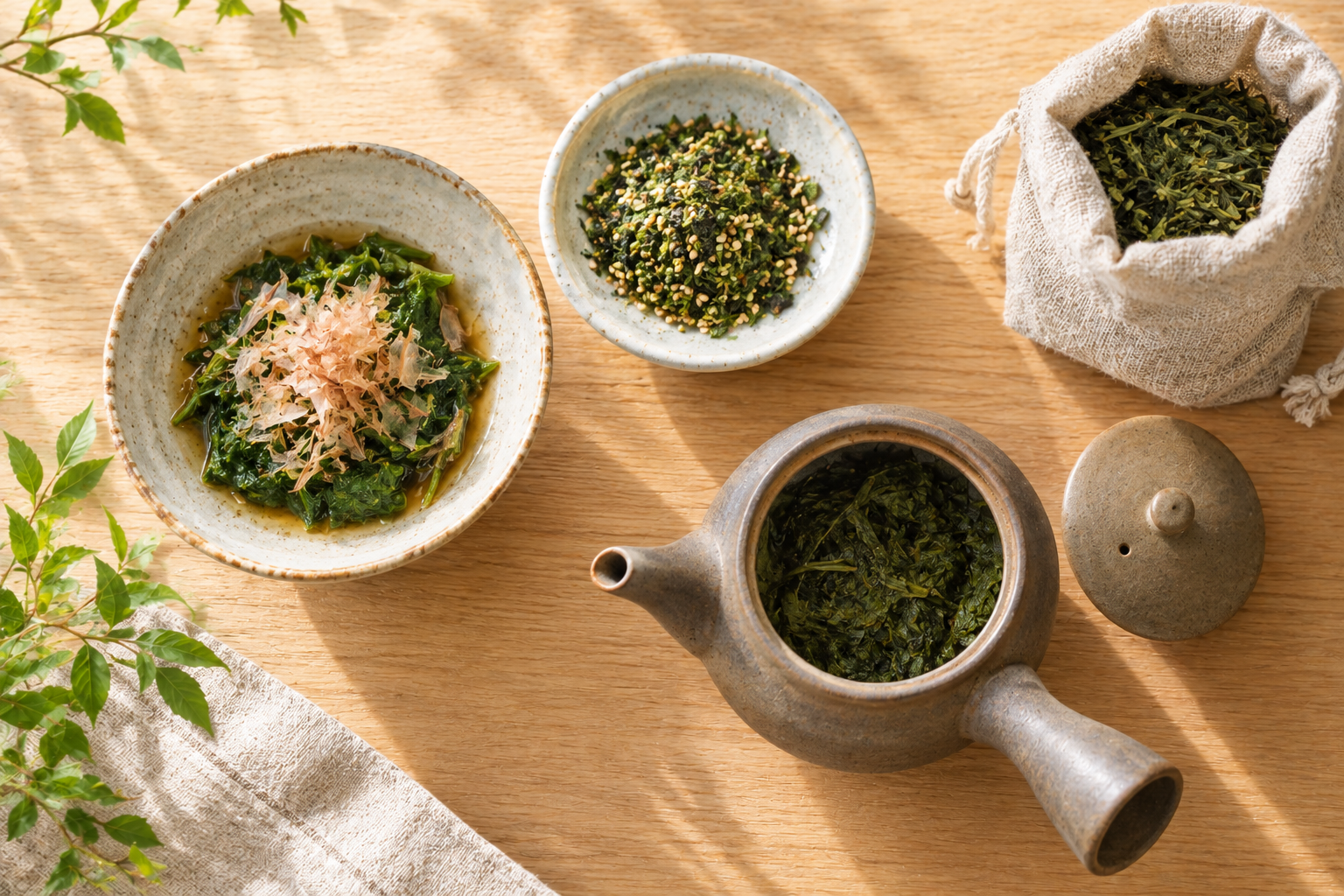
    • With ponzu or soy sauce. Squeeze out the water, then dress the leaves with a little ponzu or soy sauce and a pinch of bonito flakes. This is a classic way to finish a pot of gyokuro.
    • In salads and dressings. Chop and add to a simple salad or mix into dressings.
    • Tsukudani. Simmer the leaves with soy sauce, mirin and sugar until the liquid is gone to make a savory rice topping.
    • Furikake. Dry the leaves in a low oven or a dry pan, then crumble them with sesame seeds, salt and nori.
    • In cooking. Mix chopped leaves into omelets, fritters, fried rice or tempura batter.

    Best leaves to eat: high-grade sencha, fukamushi and especially gyokuro. Tougher teas like bancha or hojicha are less pleasant to chew.

    Food safety: used tea leaves are wet and perishable. Treat them like cooked vegetables:

    • Use them the same day, or refrigerate in a covered container and use within about a day.
    • Don’t leave them sitting in the teapot or at room temperature for long.
    • If they smell sour, look slimy or show any mold, throw them away.

    Use Them for Cleaning

    This one is genuinely traditional. In Japanese homes, people scattered damp tea leaves on tatami mats or wooden floors before sweeping. The leaves trap dust and stop it from flying up, making sweeping easier.

    How to do it:

    • Squeeze the leaves well so they’re damp, not wet.
    • Scatter them lightly over the floor, then sweep them up with the dust.

    Caution: tea can stain. Test on a small, hidden area first, and avoid using this on light-colored carpets, unsealed wood, fabric or light tatami. For most modern homes, a quick test is essential.

    Use Them to Reduce Smells

    Thoroughly dried tea leaves are often used in Japan to absorb odors in small spaces. Results are modest, but many people find them useful for:

    • The fridge: put dried leaves in a small dish or a cloth pouch.
    • Shoes: place a pouch of dried leaves inside overnight.
    • Hands and cutting boards: rubbing damp leaves on your hands or a board after cutting fish or garlic can help freshen them before washing.

    The important part: the leaves must be completely dry before you leave them anywhere. Damp leaves in a closed space are an invitation for mold. Dry them on a tray in a sunny spot for a day or two, or in a low oven, and replace them every week or two.

    Add Them to Compost or the Garden

    Used tea leaves are organic matter and can go into compost. You can also dig them lightly into garden soil. Their fertilizer effect is mild, so think of them as compost material rather than plant food.

    Tips:

    • Mix them into compost or soil rather than piling them on the surface, where they can go moldy.
    • Go easy with houseplants – a thick layer of wet leaves on a potted plant can encourage mold and fungus gnats.
    • Remove tea bags with plastic or nylon mesh, and staples, before composting.

    Quick Reference: What to Do With Each

    What you haveBest uses
    Old, stale sencha or banchaRoast into hojicha; cold brew; tea salt
    Old, dull matchaBaking, lattes, smoothies
    Used gyokuro or good sencha leavesEat with ponzu; furikake; tsukudani
    Used everyday tea leavesCleaning, deodorizing (dried), compost
    Tea that’s moldy or smells mustyThrow away

    How to Avoid Having Old Tea in the First Place

    • Buy smaller bags. 50-100g of sencha is a good size for most people.
    • Store it properly. Airtight, dark and cool. A good tea canister makes a big difference.
    • Finish opened tea within a few weeks. Sencha starts to fade once opened; matcha even faster.
    • Keep unopened tea in the fridge if you won’t open it soon, and let it reach room temperature before opening to avoid condensation.

    A Few Things People Ask Me

    Can I drink expired green tea? If it’s been stored dry and shows no mold or musty smell, old tea is usually still safe – it just tastes flat. The best-before date is about quality. Roasting it into hojicha is the best way to enjoy it.

    Can I reuse tea leaves the next day? Not for brewing. Leaves left wet overnight can start to spoil, so either brew all your infusions in one session or refrigerate the leaves and cook with them within a day.

    Do tea leaves really remove smells? Dried leaves can help a little in small spaces like shoes or the fridge. They’re not as strong as baking soda or activated charcoal, but they’re free.

    What should I buy to make my own hojicha? A traditional houroku tea roaster on Amazon makes roasting easier and more even. And when it’s time for fresh tea, Nio Teas’ sencha collection offers smaller bags that are easier to finish while fresh.

    Where I Landed

    The best way to use old tea is to roast it – turning a stale bag of sencha into fresh hojicha feels like a small kitchen magic trick. For used leaves, I eat the good ones with a splash of ponzu, dry a handful for the fridge, and put the rest in the compost. Good tea deserves more than one life, as long as you remember the one rule: dry leaves keep, wet leaves don’t.
  • Japan’s Fermented Teas: Goishicha, Awa Bancha, Ishizuchi Kurocha and Batabata-cha

    Japan’s Fermented Teas: Goishicha, Awa Bancha, Ishizuchi Kurocha and Batabata-cha

    Disclosure: This post contains affiliate links. If you buy through one of them, I may earn a small commission at no extra cost to you.

    Most people think of Japanese tea as fresh, green and grassy – the opposite of fermented. And for nearly all Japanese tea, that’s true: sencha, gyokuro and matcha are steamed precisely to stop any fermentation. But in a few remote mountain villages, mostly on the island of Shikoku, farmers have been making something completely different for centuries: teas fermented with bacteria, like pickles, that taste sour, earthy and unlike anything else in Japanese tea.

    These are Japan’s post-fermented teas. They’re rare, a few of them very nearly disappeared, and they’re one of the most fascinating corners of Japanese tea culture. This guide covers the four you’re most likely to hear about, how they’re made, and how to brew them.

    The Problem You’re Actually Trying to Solve

    If you’ve seen “goishicha” or “awa bancha” in a specialty tea shop, you probably had questions: Is it green tea? Is it like pu-erh? Why does it smell sour? Is it supposed to? English information is limited, and many descriptions mix these teas up with ordinary bancha or with kombucha.

    Who This Article Is NOT For

    • If you’re looking for the general difference between Japanese and Chinese tea processing, my Japanese vs. Chinese tea comparison explains why most Japanese tea is steamed instead.
    • If you’re interested in fermented tea for health reasons, I’m not going to make medical claims here. Some research on these teas is ongoing, but treat them as a fascinating drink, not a remedy. For what’s actually known about green tea and health, see my careful look at green tea health benefits.
    • If you want a fizzy fermented drink, that’s kombucha – made by fermenting sweetened tea with a culture, not by fermenting the leaves themselves.

    What “Post-Fermented” Actually Means

    Tea people use the word “fermentation” in two very different ways, which causes a lot of confusion.

    • Oxidation (often loosely called fermentation) is what turns leaves dark in black tea and oolong. It’s driven by the leaf’s own enzymes – no microbes involved.
    • True fermentation, or post-fermentation, uses microorganisms – molds and bacteria – to transform the leaves after they’ve been heated. That’s how Chinese pu-erh and other dark teas are made, and it’s how Japan’s fermented teas are made too.

    What makes Japan’s fermented teas special is that most of them rely on lactic acid bacteria, the same kind of microbes that ferment pickles, sauerkraut and yogurt. That’s where their distinctive sourness comes from.

    In 2018, the traditional fermented tea techniques of Shikoku – goishicha, awa bancha and Ishizuchi kurocha – were recognized by Japan’s national government as folk cultural properties worth recording and preserving.

    Goishicha (Kochi): The “Go Stone” Tea

    Where: Otoyo Town, in the mountains of Kochi Prefecture

    Goishicha (碁石茶) is probably the most famous Japanese fermented tea, and it has the most elaborate process. It’s fermented twice:

    1. Steaming. Tea branches with their leaves are harvested in early summer (roughly mid-June to early August) and steamed in a large cauldron for about two hours.
    2. First fermentation (aerobic). The leaves are stripped from the branches and spread on straw mats in a closed room for about a week, where molds grow on them.
    3. Second fermentation (anaerobic). The leaves are packed into wooden barrels with the steaming liquid, covered, and weighted down with stones for about two weeks. Without air, lactic acid bacteria take over.
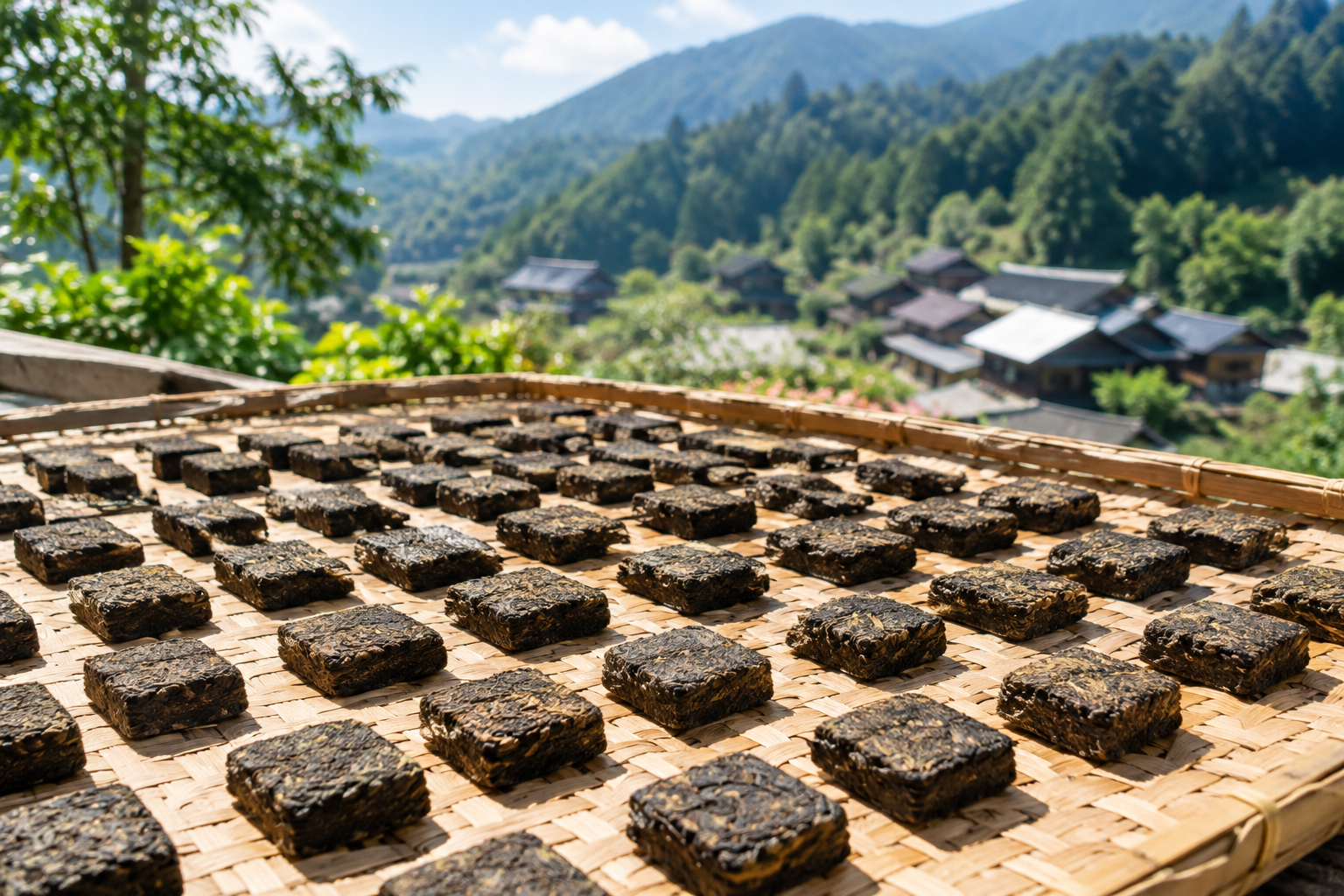
    4. Cutting and drying. The pressed leaves are cut into small squares about 3-4cm across and dried in the sun for several days.

    The name comes from that final step: the dark squares lying on straw mats look like stones on a Go board.

    Flavor: sharply sour and tangy, with an earthy depth. It’s often compared to a mild vinegar or pickled plum – not what you’d expect from a cup of tea.

    Tradition: in parts of Japan’s Seto Inland Sea region, goishicha was historically used to make chagayu, rice porridge cooked in tea, which created a market for this small mountain town’s product.

    Awa Bancha (Tokushima): The Pickled Summer Tea

    Where: Kamikatsu and Naka towns in Tokushima Prefecture

    Awa bancha (阿波晩茶) is the most approachable of Japan’s fermented teas, and the one people in its home region actually drink every day. The “ban” in its name is written with the character for “late” (晩), because it’s made from mature leaves picked late in the season, from about July to August – the opposite of delicate spring sencha.

    How it’s made:

    1. Boiling. Instead of steaming, the leaves are boiled.
    2. Rolling. They’re rolled or rubbed, by machine or by hand, to break them down.
    3. Fermentation (anaerobic). The leaves are packed tightly into barrels, covered with the cooking liquid and weighted to keep out air. Lactic acid fermentation runs for about two weeks to a month.
    4. Sun-drying. Finally, they’re dried outdoors on mats for a few days.

    Because it relies on the local bacteria in each farm’s barrels, no two batches taste exactly alike.

    Flavor: gently sour, with a soft, slightly savory sweetness and almost no bitterness. Tasters often describe hints of pickles, olives or umeboshi. It’s much milder than goishicha and is an excellent introduction to fermented tea.

    Caffeine: generally considered low, because it’s made from mature summer leaves and fermented – though it isn’t caffeine-free.

    Ishizuchi Kurocha (Ehime): The Tea That Nearly Vanished

    Where: the area around Mount Ishizuchi, Ehime Prefecture

    Ishizuchi kurocha (“Ishizuchi black tea”) is made with a double fermentation similar to goishicha: a first, aerobic fermentation with molds, then an anaerobic lactic acid fermentation, before the leaves are dried in the sun.

    Its story is a near-miss. Production declined so much in the 20th century that, at one point, only one elderly couple was still making it. A local group learned the method from them to keep the tradition alive, and today it’s produced again in small amounts. In 2023, its production method was designated an Important Intangible Folk Cultural Property of Japan.

    Flavor: strongly sour and acidic when young. Like some wines, it’s said to mellow with a few years of careful storage.

    Batabata-cha (Toyama): The Whisked Fermented Tea

    Where: Asahi Town, Toyama Prefecture, on the Japan Sea coast

    The last one is different in both place and style. In Asahi, a dark fermented tea, made from mature leaves, is boiled, poured into a bowl with a pinch of salt and whipped with a special double-headed bamboo whisk until frothy. The custom – named after the brisk “bata bata” whisking – is a social one: neighbors gather to share batabata-cha at community gatherings and religious occasions.

    Flavor: mild, slightly salty and gently earthy, with a soft foam.

    How the Four Compare

    TeaRegionFermentationFlavor
    GoishichaOtoyo, KochiTwo-stage (mold, then lactic acid)Sharp, sour, earthy
    Awa banchaKamikatsu / Naka, TokushimaLactic acid (anaerobic)Mild, gently sour, savory
    Ishizuchi kurochaMount Ishizuchi area, EhimeTwo-stage (mold, then lactic acid)Strongly sour, mellows with age
    Batabata-chaAsahi, ToyamaMicrobial fermentationMild, salted, whisked frothy

    How to Brew Japan’s Fermented Teas

    These teas are brewed hotter and longer than green tea. They’re forgiving – there’s little bitterness to worry about.

    Awa bancha:

    • About 5g of leaf per 300ml of boiling water
    • Steep for 2-3 minutes, or simmer briefly for a stronger cup
    • Can be re-steeped several times, lengthening the time each round
    • Excellent cold: brew hot, then chill

    Goishicha:

    • Simmer one or two squares in about 1-1.5 liters of water for around 10 minutes
    • Drink hot, or chill it for a refreshing, tangy summer drink
    • Some people blend it with other teas to soften the sourness

    Ishizuchi kurocha: brew like goishicha, starting with a small amount since it’s quite sour.

    Tip: if the sourness surprises you, try a little less leaf, or mix the brewed tea half and half with hojicha or roasted barley tea.

    Buying and Storing

    These teas are produced in small amounts, so they’re mostly found at specialty tea shops, regional shops or online. A few tips:

    • Check the region on the label. Real goishicha comes from Otoyo, awa bancha from Kamikatsu or Naka.
    • Expect variation. Small-batch fermentation means flavor changes from year to year and farm to farm – that’s part of the charm.
    • Store it dry and dark. Keep it in an airtight container, away from moisture and strong smells.

    A Few Things People Ask Me

    Is this the same as pu-erh? They’re related – both are post-fermented with microbes – but Japan’s versions mostly use lactic acid fermentation, which makes them noticeably sour. Pu-erh tends to be earthy rather than tangy.

    Is awa bancha the same as regular bancha? No. Ordinary bancha is an everyday green tea made from later-harvest leaves, and it isn’t fermented. Awa bancha shares the name because it’s also made from mature leaves, but its fermentation makes it a completely different drink.

    Is it the same as kombucha? No. Kombucha is sweetened tea fermented with a culture after brewing. These teas are fermented as leaves, before brewing.

    Where can I buy them? Look for awa bancha on Amazon – the easiest one to find and the best first try. If you want to go further, goishicha on Amazon is the classic, more intense version.

    Where I Landed

    Japan’s fermented teas are a reminder that “Japanese tea” isn’t only about bright spring greens. In a handful of mountain villages, people found a way to preserve summer leaves with bacteria, wooden barrels and sunshine – and created teas that taste like nothing else. Start with a cup of awa bancha. If its gentle tang wins you over, goishicha is waiting.

  • Senchado: Japan’s Other Tea Ceremony, Made With Sencha Instead of Matcha

    Senchado: Japan’s Other Tea Ceremony, Made With Sencha Instead of Matcha

    Disclosure: This post contains affiliate links. If you buy through one of them, I may earn a small commission at no extra cost to you.

    When people say “Japanese tea ceremony,” they almost always mean chanoyu: a quiet tatami room, a bamboo whisk, and a bowl of frothy matcha. But Japan has a second tea ceremony that most visitors – and plenty of tea lovers – have never heard of. It uses loose-leaf green tea, a tiny teapot and thimble-sized cups, and it grew out of a rebellion against the formality of the matcha ceremony.

    It’s called senchado (煎茶道), “the way of sencha.” This guide explains where it came from, how it differs from the matcha ceremony, what actually happens during one, and how you can try the spirit of it at home.

    The Problem You’re Actually Trying to Solve

    You’ve probably read about the matcha tea ceremony, but you drink mostly sencha or gyokuro – and you’re curious whether there’s a traditional, mindful way to enjoy leaf tea too. English information on senchado is scarce, and what exists is often either very academic or a brief mention in a matcha article.

    Who This Article Is NOT For

    • If you’re looking for the matcha tea ceremony and how to behave as a guest, that’s chanoyu – a different tradition with different rules.
    • If you just want the best everyday brewing method for sencha, you don’t need any ceremony. My green tea temperature guide covers that more directly.
    • If you want a strict, step-by-step manual for one school’s procedure, that’s best learned from a teacher. Senchado has many schools, and their details differ.

    Where Senchado Came From

    Senchado’s roots go back to China and to Zen Buddhism.

    Ingen and the Obaku school. In 1654, the Chinese Zen master Ingen (Yinyuan Longqi) arrived in Japan. He founded the Obaku school of Zen, one of Japan’s three main Zen schools, and its head temple, Manpuku-ji, in Uji, south of Kyoto. Along with Buddhism, Ingen and his followers brought Chinese culture with them – including the Ming-dynasty custom of steeping loose tea leaves rather than whisking powdered tea.

    Baisao, the “Old Tea Seller.” The figure most associated with senchado is Baisao (売茶翁, “old tea seller”), an Obaku monk born in 1675 in what is now Saga Prefecture. In 1735, at about 61, he set up a small tea stall in Kyoto. Rather than running a formal shop, he carried his tea and utensils to scenic spots around the city and served anyone who stopped – aristocrats, merchants and ordinary people alike – while talking about Zen. Famously, he didn’t set a price; his sign said he would accept whatever people chose to pay, “anything from a hundred gold coins down to half a sen,” and if they paid nothing, that was fine too.

    Baisao openly criticized how the matcha ceremony of his day had become expensive, rigid and focused on status. For him, tea was a way of living freely and simply, not a display of rare utensils. In 1755, when he was about 81, he stopped selling tea and burned his utensils so they wouldn’t be treated as treasures after his death.

    Nagatani Sōen and modern sencha. Around the same period, in 1738, Nagatani Sōen of Ujitawara developed the steaming-and-rolling method that became the basis of today’s sencha. Baisao visited him in 1742. Better tea and Baisao’s free-spirited style together helped sencha spread.

    From free spirit to formal “way.” Ironically, after Baisao’s death, sencha drinking became popular among Edo-period intellectuals, poets and painters – the bunjin (literati) – who loved its connection to Chinese scholarly culture. Over the 19th century, schools formed and created their own procedures and utensils, and senchado became a formal tradition of its own. Baisao is now honored as its founding figure, and Manpuku-ji remains its spiritual home, hosting large sencha gatherings.

    Senchado vs. Chanoyu: The Key Differences

    Chanoyu (matcha ceremony)Senchado (sencha ceremony)
    TeaPowdered matcha, whiskedLoose-leaf tea (sencha or gyokuro), steeped
    Main utensilsChawan (bowl), chasen (whisk), chashaku (scoop)Small teapot, tiny cups, saucers, brazier and kettle
    RootsJapanese Zen and the tea masters of the 16th centuryChinese tea culture, Obaku Zen, Baisao
    AestheticWabi-sabi: rustic, restrainedOften lighter and influenced by Chinese literati culture
    AtmosphereHighly formal, set movementsStill structured, but often seen as more relaxed
    SeatingUsually tatami; some schools offer table-styleTatami or table-style, depending on the school

    The biggest difference you’ll notice is the cup. In senchado, especially with gyokuro, guests may receive only a few sips of very concentrated tea in a cup not much bigger than a thimble – the point is to taste every drop carefully.

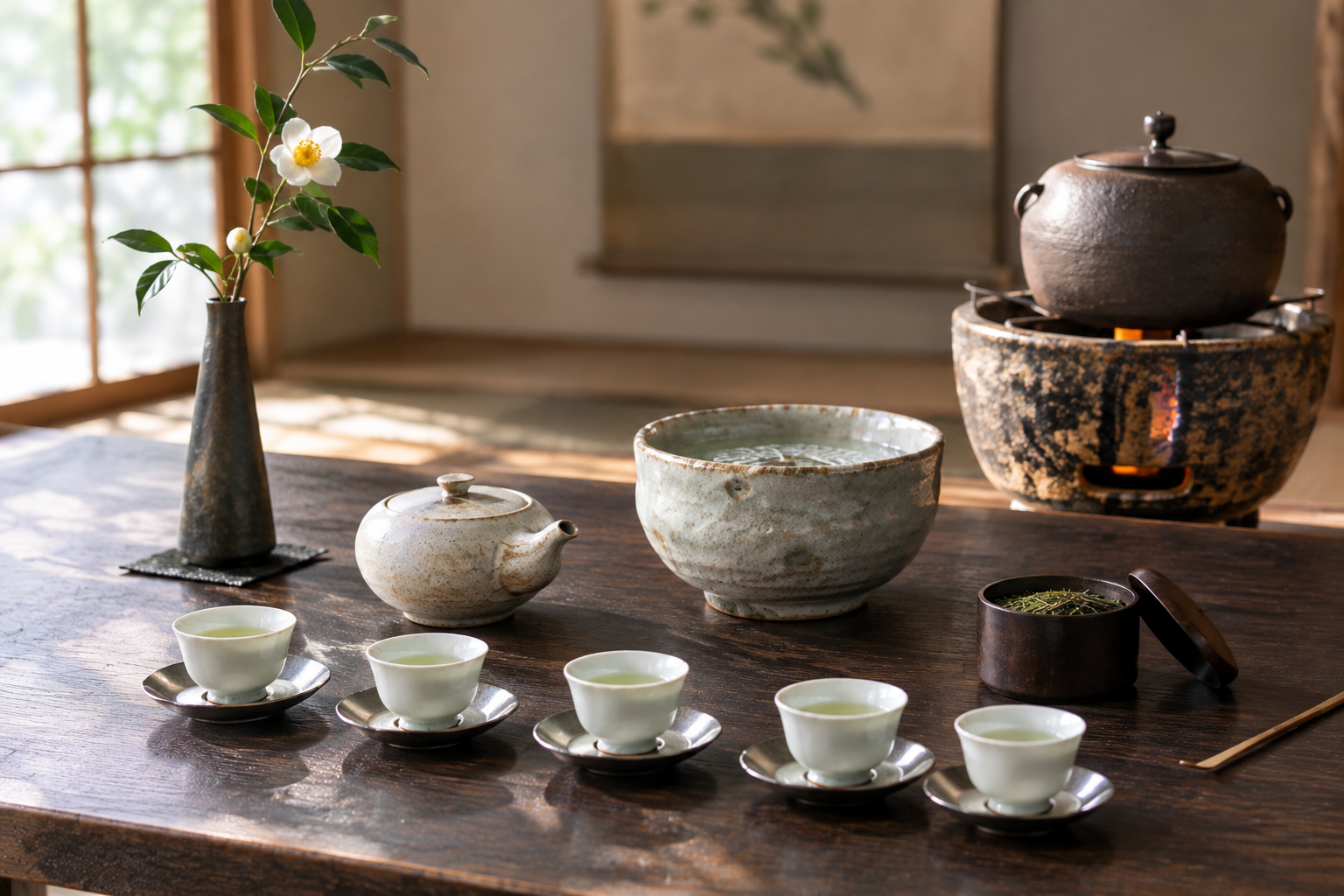
    The Utensils of Senchado

    Each school has its own preferences, but these are the utensils you’ll usually see:

    • Ryoro (涼炉): a small portable brazier, traditionally burning charcoal, used to heat the water.
    • Bofura (ボーフラ): a small, round, unglazed clay kettle that sits on the ryoro.
    • Kyusu or houhin: a small teapot. A houhin has no handle and is often used for gyokuro.
    • Yuzamashi: a cooling bowl for bringing water down to the right temperature.
    • Small cups (senchawan): usually five, thin and delicate, often white inside so you can see the color of the tea.
    • Chataku: saucers for the cups, often metal or lacquered wood.
    • Chagu tray and tea caddy: for setting out the utensils and holding the leaf.

    Many of these are simply refined versions of things you might already use for good sencha at home – which is part of senchado’s appeal.

    What Happens During a Sencha Ceremony

    Procedures vary between schools, but a typical senchado gathering follows a general flow:

    1. Preparing the space. Utensils are arranged neatly, sometimes with a scroll, a flower arrangement or seasonal decoration.
    2. Warming the utensils. Hot water is poured into the teapot and cups to warm them, then discarded.
    3. Cooling the water. The water is cooled in the yuzamashi to the right temperature – especially low for gyokuro.
    4. Adding the leaves. The host measures the tea into the pot with care.
    5. Steeping. The cooled water is poured over the leaves and left to steep quietly.
    6. Pouring evenly. The tea is poured into the cups a little at a time, going back and forth, so every cup has the same strength. The last drops, the richest, are shaken out carefully.
    7. Serving. Cups are placed on saucers and offered to guests, who receive them with a bow and drink slowly, often in a few small sips.
    8. Second infusion. The host often brews the same leaves again, letting guests notice how the flavor changes.
    9. Sweets. A small sweet is often served to accompany the tea.

    The movements are calm, efficient and deliberate. Some practitioners describe senchado as “meditation in motion” – the focus on each simple action helps quiet the mind.

    Where to Experience Senchado

    • Manpuku-ji, Uji. The head temple of the Obaku school is the historic center of senchado and hosts sencha gatherings and events, especially in spring and autumn. It’s easy to combine with a visit to Uji’s tea shops.
    • Kyoto and other cities. Some senchado teachers offer lessons or experiences for visitors, including in English. Search for “senchado experience” with the city name, and book ahead.
    • Tea events and cultural centers. Japanese cultural centers abroad occasionally host senchado demonstrations.

    Because many senchado schools offer table-style seating, it can be more comfortable than a traditional matcha ceremony if sitting on tatami is hard for you.

    Bringing the Spirit of Senchado Home

    You don’t need a ryoro or a teacher to enjoy the essence of senchado. Try this the next time you brew a good sencha or gyokuro:

    • Make it a separate moment. Clear the table and put away your phone.
    • Warm everything first. Pour hot water into the pot and cups, then discard it.
    • Cool the water deliberately. Pour it into a cooling bowl or a spare cup and watch the steam settle.
    • Use small cups. Smaller servings make you slow down and notice the flavor.
    • Pour back and forth. Fill the cups a little at a time so each is the same strength, and shake out the last drops.
    • Brew a second time. Taste how the tea changes.

    A good teapot makes this easier – my kyusu buying guide covers what to look for.

    A Few Things People Ask Me

    Is senchado older than the matcha ceremony? No. The matcha ceremony took shape earlier, in the 15th and 16th centuries. Senchado developed from the 17th and 18th centuries onward.

    Is senchado less formal than chanoyu? It began as a reaction against formality, and many people find it more relaxed. But today’s senchado schools do have set procedures, so it’s still a structured practice.

    Can senchado use gyokuro? Yes. Many schools serve gyokuro as well as sencha, often in very small, concentrated cups.

    What should I buy to try it at home? A small handle-less houhin teapot on Amazon is ideal for small, careful servings, and a high-quality leaf like Nio Teas’ gyokuro is what senchado is really made for.

    Where I Landed

    What I love about senchado is its origin story: a monk walking around Kyoto with a basket of tea, serving anyone for whatever they could pay, because he believed tea belonged to everyone. The ceremony that grew up after him is more formal than he might have liked, but its heart is still simple – good leaf, carefully cooled water, small cups and full attention. You can bring that into your own kitchen this afternoon.

  • Japanese Tea Souvenirs: What to Buy in Japan, Where to Find It, and How to Bring It Home

    Japanese Tea Souvenirs: What to Buy in Japan, Where to Find It, and How to Bring It Home

    Disclosure: This post contains affiliate links. If you buy through one of them, I may earn a small commission at no extra cost to you. Customs and tax-free rules change – always check the official rules for your own country before you travel.

    Tea is one of the best souvenirs you can bring back from Japan. It’s light, it packs flat, it’s far fresher and cheaper than what you’ll find at home, and it’s a gift almost anyone can enjoy. But walk into a Japanese department store food hall or a tea shop in Kyoto and the choice can be overwhelming: dozens of senchas, matcha in every grade, tins, tea bags, tea sweets, teapots and whisks.

    This guide covers what’s actually worth buying, where to buy it, how to keep it fresh, and how to get it through customs without trouble.

    The Problem You’re Actually Trying to Solve

    You want to bring tea home – for yourself or as gifts – without wasting money on tourist packaging, buying something that will be stale by the time you open it, or getting stuck at customs. You also probably don’t read Japanese labels, and you have limited suitcase space.

    Who This Article Is NOT For

    • If you want to know which historic shops to visit in Kyoto, my guide to the oldest tea shops in Uji and Kyoto covers that in detail – several of them also ship internationally.
    • If you’re not traveling and just want good Japanese tea at home, skip to the end; you don’t need a plane ticket.
    • If you’re shopping for a professional tea business, import rules for commercial quantities are very different from personal souvenirs.

    The Best Tea Souvenirs, Ranked by Usefulness

    1. Sencha

    Sencha is the everyday green tea of Japan, and the easiest souvenir to love. A 100g bag of good sencha in Japan often costs less than a mediocre one abroad, and it’s light and compact. Look for first harvest (一番茶, ichibancha) on the label for the best flavor, and choose a region to match the taste you like: Shizuoka for fresh and balanced, Kagoshima for rich and smooth.

    Good for: yourself, tea-drinking friends, anyone with a teapot.

    2. Hojicha

    Roasted green tea is one of the most universally liked Japanese teas: toasty, sweet, low in bitterness and easy to brew. Hojicha tea bags are an especially good gift for people who don’t own a teapot. In Kanazawa, look for the local roasted stem tea, Kaga bocha.

    Good for: coworkers, family, people new to Japanese tea.

    3. Genmaicha

    Green tea mixed with roasted rice is nutty, comforting and very forgiving to brew. It’s often sold in convenient tea bags, which makes it a good gift for offices.

    4. Matcha

    Matcha is the souvenir most visitors think of first, and buying it in Japan is a real advantage: prices are lower and the choice is enormous. But it’s also the most fragile tea – it loses its color and aroma quickly once opened. Buy small tins (20-40g) rather than large bags, and only buy as much as you’ll use within a month or two of opening.

    Tip: Japanese labels often show the intended use. 薄茶 (usucha, thin tea) grades are what most people want for drinking; “for cooking” or “for lattes” grades are better for baking and milk drinks.

    5. Gyokuro

    If you want to bring home something you really can’t find easily abroad, gyokuro – shade-grown, sweet and rich in umami – is a special treat. It’s expensive, so a small 50g bag goes a long way.

    6. Tea-Flavored Sweets

    Matcha KitKats, matcha cookies, hojicha chocolate and matcha baumkuchen are fun, easy gifts. They’re also one of the few tea souvenirs that don’t require any brewing – perfect for children or people who don’t drink tea.

    Tea Tools Worth Carrying Home

    Tea tools are where Japan really shines, because many are handmade and much cheaper than abroad.

    • Chasen (bamboo whisk): essential for matcha, light and inexpensive. Keep it in its plastic holder to protect the tines in your luggage.
    • Chashaku (bamboo scoop): tiny and very easy to pack.
    • Chazutsu (tea canister): a washi-wrapped or metal tea tin is both beautiful and practical, and keeps tea fresh at home.
    • Yunomi (teacup): small, light and widely available in local pottery styles.
    • Kyusu (teapot): Tokoname and Banko teapots are wonderful souvenirs, but they’re fragile. Wrap them in clothes and pack them in the middle of your suitcase, or carry them on.
    • Chawan (matcha bowl): beautiful but heavy and breakable. Many pottery shops can pack them carefully or ship them.

    Where to Buy

    Specialty tea shops. The best quality and the most knowledgeable staff. Many will let you taste before you buy, and staff in tourist areas often speak some English. Kyoto and Uji have the most famous shops, but every tea region has its own.

    Department store food halls (depachika). The basement food floors of department stores in big cities have counters from well-known tea companies, often with beautifully packaged gift sets. Great for buying several gifts in one place.

    Tea regions themselves. If you visit Uji, Shizuoka or Kagoshima, farm shops and local stores sell fresh tea directly – often the best value of all.

    Supermarkets. For everyday sencha, hojicha and genmaicha tea bags, a regular supermarket is surprisingly good and very cheap. It’s also where you’ll find the tea that Japanese families actually drink.

    Airports. Convenient for last-minute gifts, but the selection is smaller and prices are higher. Think of it as a backup, not a plan.

    How to Read a Japanese Tea Label (the Basics)

    You don’t need to read Japanese to shop well – just look for a few characters:

    JapaneseMeaning
    煎茶Sencha
    玉露Gyokuro
    抹茶Matcha
    ほうじ茶Hojicha
    玄米茶Genmaicha
    一番茶 / 新茶First harvest / new tea of the year
    製造年月日 or 賞味期限Production date / best-before date
    内容量Net weight

    Always check the best-before date, and choose the freshest package you can find.

    Keeping Your Tea Fresh on the Way Home

    Tea is sensitive to air, light, heat and moisture, so a little care helps:

    • Buy sealed packages. Vacuum-sealed or nitrogen-flushed bags last much longer than tea scooped into a bag at the counter.
    • Don’t open it until you’re home. Once opened, sencha and matcha start to fade.
    • Keep it away from heat. Don’t leave tea in a hot car or a sunny window during your trip.
    • Store it properly at home. Keep opened tea in an airtight canister in a cool, dark place, and drink it within a few weeks. Unopened packages can go in the fridge, but let them come to room temperature before opening to avoid condensation.

    Customs: Can You Bring Tea Home?

    For most countries, ordinary dried tea for personal use is allowed, but rules vary – and food items generally have to be declared.

    United States. According to the USDA, travelers can bring true tea (green, black, oolong and other teas from the tea plant) in any quantity, but it must be declared at entry. Herbal teas are generally allowed if commercially packaged and ready to steep, with some exceptions. If you declare everything, you won’t be penalized even if an inspector refuses an item. Keeping tea in its original packaging with receipts makes inspection easier.

    Other countries. Australia and New Zealand have particularly strict biosecurity rules and require you to declare food and plant products. Many other countries are more relaxed for personal amounts. Check your own country’s customs website before you buy large quantities.

    A few practical tips:

    • Keep tea in its original, labeled packaging.
    • Be careful with tea blends that contain flowers, fruit peel or seeds (for example, some cherry blossom or citrus teas), which can be restricted in some countries.
    • Matcha in carry-on luggage: some airports screen large amounts of powder separately. Packing big quantities of matcha in checked luggage avoids the hassle.

    Tax-Free Shopping in Japan

    Visitors to Japan can buy many goods, including tea, tax-free, as long as they spend at least 5,000 yen (before tax) at the same store on the same day.

    The system is changing. From November 1, 2026, shops will charge the full price including tax, and you’ll claim the refund when you leave Japan after completing a departure procedure at the airport. The old special sealed-bag rules for food and other consumables are being dropped, but you still can’t use up tax-free goods before you leave, and every item on a tax-free receipt needs to be with you at departure. Check the latest rules before your trip, and keep your receipts together.

    Easy Gift Ideas by Budget

    • Small gifts for coworkers: hojicha or genmaicha tea bags, matcha sweets
    • For a tea-loving friend: a 100g bag of first-harvest sencha and a yunomi
    • For a matcha fan: a small tin of usucha-grade matcha and a chasen
    • For someone special: gyokuro or a handmade kyusu
    • For yourself: a chazutsu tea canister – it’ll keep every future bag of tea fresh

    A Few Things People Ask Me

    How much tea should I buy? Only as much as you’ll drink within a few months. Unopened sencha keeps reasonably well, but matcha is best within a month or two of opening.

    Is tea cheaper in Japan? Usually, yes – especially sencha and everyday teas, which can cost a fraction of the price abroad.

    Are tea bags or loose leaf better as gifts? Tea bags for people who don’t own a teapot; loose leaf for tea lovers.

    What if I didn’t buy enough? You don’t have to go back. Nio Teas’ sencha collection ships teas from small Japanese farms internationally, and my sencha brand comparison covers other good places to order. To keep your souvenirs fresh at home, a washi tea canister on Amazon does the job beautifully.

    Where I Landed

    The best tea souvenirs aren’t the fanciest boxes at the airport – they’re a fresh bag of first-harvest sencha from a tea shop, a small tin of matcha you’ll actually finish, and maybe one handmade tool you’ll use for years. Buy sealed, declare it at customs, and you’ll be drinking the taste of your trip long after you get home.

  • The Best Milk for a Matcha Latte: Oat, Dairy, Soy, Almond and Coconut Compared

    The Best Milk for a Matcha Latte: Oat, Dairy, Soy, Almond and Coconut Compared

    Disclosure: This post contains affiliate links. If you buy through one of them, I may earn a small commission at no extra cost to you.

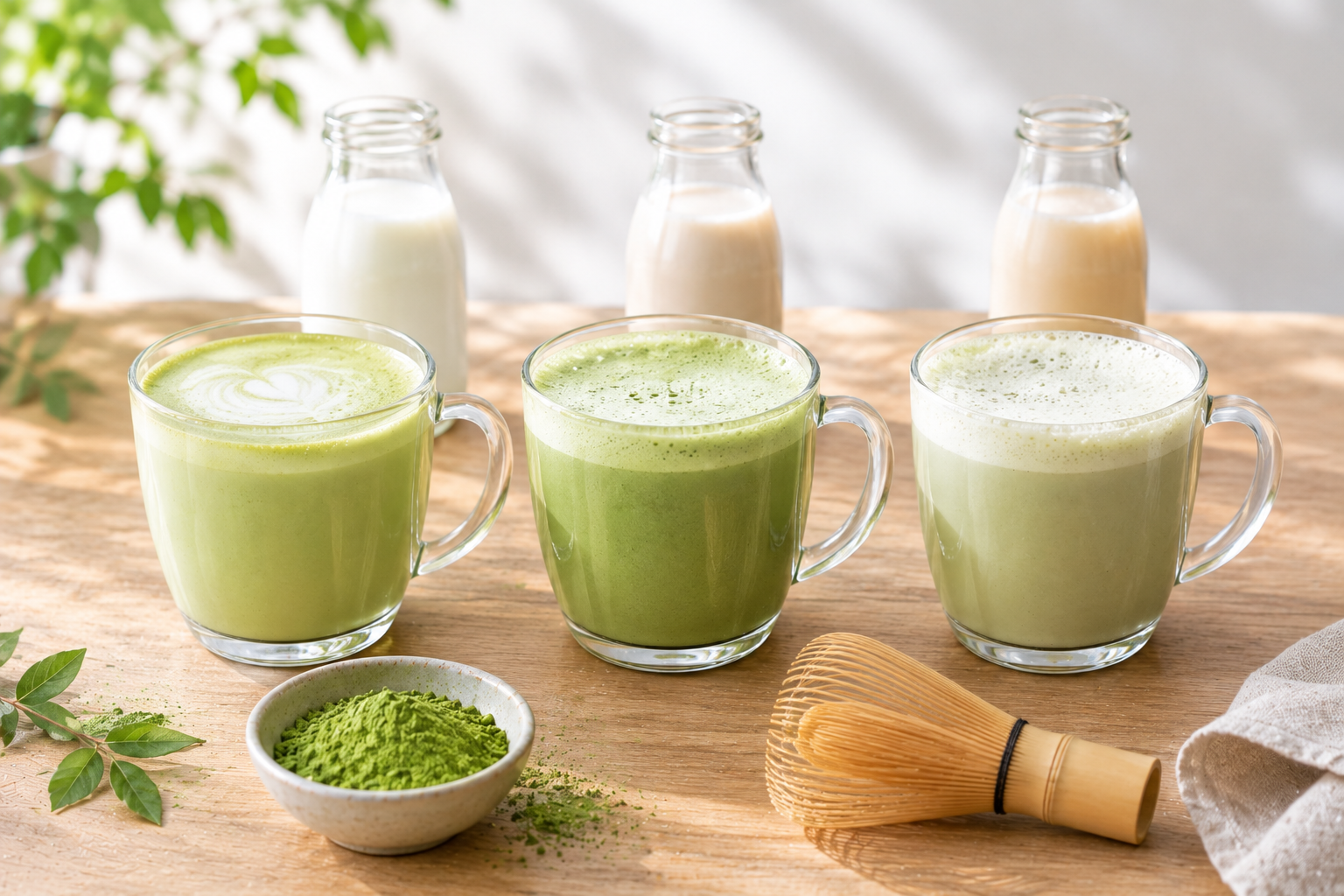
    For a while I blamed my matcha for every disappointing latte. Some came out thin and watery, some tasted oddly flat, and a few separated into a sad layer of foam on top of something that looked like pond water. Then I made the same latte, with the same matcha, three times in a row with three different milks – and realized the milk was doing at least half the work. The matcha brings the flavor, but the milk decides the texture, the sweetness, and whether that flavor shines or disappears.

    Here’s how the most common milks actually behave in a matcha latte, and which one to choose for what you want.

    The Problem You’re Actually Trying to Solve

    Most “best milk” lists name a winner and stop there. But the right milk depends on what you care about: creaminess, foam, letting the matcha taste come through, keeping it light, or avoiding dairy. A milk that’s perfect for a hot café-style latte can be disappointing iced, and vice versa.

    Who This Article Is NOT For

    • If your lattes are clumpy or bitter no matter which milk you use, the problem is probably technique, not milk. My matcha latte guide covers temperature, sifting and the order of steps.
    • If you’re mainly counting calories, my matcha vs. matcha latte calorie comparison breaks down how much each milk adds.
    • If you drink matcha straight, you don’t need any of this – though it’s still worth knowing why oat milk is so popular in cafés.

    The Quick Comparison

    MilkFlavor in a matcha latteFoamHot or iced?Best for
    Whole dairySweet, round, softens bitternessExcellent, silkyBoth, best hotClassic café latte
    OatNaturally sweet, slightly malty, complements matchaVery good (barista versions)BothThe best all-rounder, dairy-free
    SoyNeutral, slight bean noteExcellent, stableBest hotHigh protein, dairy-free
    AlmondLight, nutty, less sweetWeak unless barista styleBest icedLighter lattes
    CoconutSweet, strongly coconutFair; better as barista blendBest icedTropical-style drinks
    Cashew / macadamiaButtery, smoothModerate to goodBothLetting good matcha shine

    Whole Dairy Milk: The Classic

    Whole cow’s milk is still the benchmark for a reason. Its fat and natural sugars round out matcha’s bitterness and bring out its sweetness, and its proteins create a silky, long-lasting microfoam. If you want the latte you’d get in a good café in Japan, this is it.

    Downsides: heavier than plant milks, and the richness can mute a very delicate, high-grade matcha. Lower-fat milks foam well but taste thinner.

    Best for: hot, café-style lattes.

    Oat Milk: The Crowd Favorite

    Oat milk has become the default in many cafés, and it earns that place. Its natural sweetness and slightly malty, cereal-like flavor pair beautifully with matcha’s grassy notes, softening bitterness without hiding the tea. Barista versions foam almost as well as dairy, and it works both hot and iced.

    Downsides: regular (non-barista) oat milk can be thin and may separate in iced drinks unless shaken well. Some brands are noticeably sweet.

    Best for: an everyday, dairy-free latte, hot or iced. If you’re unsure where to start, start here.

    Soy Milk: The Best Dairy-Free Foam

    Soy milk’s high protein content gives it the most dairy-like foam of any plant milk – thick, smooth and stable. Its neutral flavor lets the matcha come through, with only a faint bean note in the background.

    Downsides: some people dislike the beany aftertaste, and soy milk can occasionally curdle if it’s heated too fast or meets very hot liquid. Warming it gently and adding it to slightly cooled matcha helps.

    Best for: hot lattes, and anyone who wants protein without dairy.

    Almond Milk: Light but Thin

    Almond milk is light, mildly nutty and less sweet than oat milk. That makes it a good choice if you want a lower-calorie latte where the matcha flavor stays front and center. Unsweetened almond milk is one of the lightest options available.

    Downsides: standard almond milk foams poorly and can separate in hot drinks, giving a watery texture. Barista versions are much better.

    Best for: iced lattes, where foam matters less.

    Coconut Milk: Use With Care

    Coconut milk is sweet and creamy, but its flavor is strong – it can easily become the star of the drink and push the matcha into the background. Carton coconut milk drinks are light and can separate; canned coconut milk is far too rich on its own.

    Best for: iced, tropical-style lattes – matcha with coconut and a touch of vanilla or mango. Mixing coconut milk with oat milk is a good way to get the flavor without overwhelming the tea.

    Cashew and Macadamia: The Underrated Options

    Cashew and macadamia milks are smooth and buttery, with a gentle flavor that doesn’t compete with matcha. Macadamia in particular gives a rich, café-style texture. They’re less common and often more expensive, but if you have a good-quality matcha and want to taste it clearly, they’re worth trying.

    Tips for Better Lattes With Any Milk

    • Whisk the matcha with a little hot water first. Make a smooth paste with about 60-70ml of water at 70-80°C before adding milk. Pouring cold milk onto dry powder is the main cause of clumps.
    • Don’t overheat the milk. Warm it until it’s hot but not boiling – around 60-65°C (140-150°F) is ideal. Hotter milk loses sweetness, and plant milks are more likely to separate.
    • Choose barista versions of plant milks. They’re formulated to foam and to resist separating, and the difference is significant.
    • Buy unsweetened milk and sweeten yourself. That way you control the sweetness and taste the matcha, not the sugar.
    • For iced lattes, shake. Whisk the matcha with warm water, then shake with cold milk and ice in a jar. It mixes better than stirring.
    • Use culinary or latte-grade matcha. Milk hides some of the subtle notes of ceremonial grade, so a good latte-grade matcha gives better value.

    How Much Milk to Use

    A good starting point for one latte is about 2g of matcha (roughly 1 teaspoon), whisked with 60ml of hot water, topped with 150-180ml of milk. From there, adjust to the milk you’re using:

    • Rich milks (whole dairy, oat, macadamia): you can use the full amount of milk; they carry the matcha well.
    • Light milks (almond, skim): use a little less milk, or add an extra half-gram of matcha, so the latte doesn’t taste watery.
    • Strong-flavored milks (coconut): use more matcha or mix the coconut milk half and half with a neutral milk, so the tea isn’t drowned out.
    • Iced lattes: remember the ice will melt and dilute the drink, so go slightly stronger on the matcha.

    If your latte tastes more like sweet milk than tea, the fix is usually more matcha, not less milk.

    Which Milk Should You Pick?

    • You want the classic café latte: whole milk.
    • You want dairy-free and don’t know where to start: barista oat milk.
    • You want the best foam without dairy: soy milk.
    • You want a lighter iced latte: unsweetened almond milk.
    • You want to taste a high-quality matcha clearly: cashew or macadamia, or a smaller amount of whole milk.
    • You want something fun for summer: a coconut-oat blend, iced.

    A Few Things People Ask Me

    What milk do Japanese cafés use? Most matcha lattes in Japan are still made with cow’s milk, though oat and soy milk are now widely available as alternatives.

    Does milk change the taste of matcha? Yes – fat and sugar soften bitterness, and stronger-flavored milks like coconut can mask it. That’s why mild milks let the matcha come through most clearly.

    Why does my plant-milk latte separate? Usually because the milk was overheated, poured onto hot matcha too fast, or isn’t a barista version. Warm it gently and use a barista blend.

    What should I buy to make better lattes at home? A good latte-grade matcha matters as much as the milk – Nio Teas’ matcha collection has options suited to lattes. A handheld milk frother on Amazon makes café-style foam easy with any milk.

    Where I Landed

    There isn’t one perfect milk – but there is a perfect milk for the latte you want. For me, barista oat milk is the everyday choice, whole milk is the treat, and almond milk is for hot summer afternoons over ice. Try two side by side with the same matcha, and you’ll see exactly how much difference the milk makes.

  • Japanese Tea Caffeine Chart: Every Type Ranked, From Gyokuro to Mugicha

    Japanese Tea Caffeine Chart: Every Type Ranked, From Gyokuro to Mugicha

    Disclosure: This post contains affiliate links. If you buy through one of them, I may earn a small commission at no extra cost to you. Caffeine figures are approximate and vary with the tea, the amount of leaf and how you brew it. If you need to limit caffeine for medical reasons, check with your doctor.

    “Is green tea low in caffeine?” is one of the questions I hear most, and the honest answer is: it depends enormously on which Japanese tea you mean. A cup of gyokuro can rival a strong coffee, while a cup of bancha has only a fraction of that, and mugicha has none at all. They’re all sold as “Japanese tea,” which is exactly why the confusion happens.

    This chart ranks the main Japanese teas by caffeine, using the official figures from Japan’s Standard Tables of Food Composition wherever they exist, and explains why the numbers vary so much.

    The Problem You’re Actually Trying to Solve

    You want to drink Japanese tea but keep an eye on caffeine – maybe in the evening, maybe because coffee makes you jittery, maybe because a doctor told you to cut back. Most online lists either give one vague number for “green tea” or contradict each other. The reason is that caffeine depends not only on the tea, but on how much leaf you use and how hot and long you brew it.

    Who This Article Is NOT For

    The Chart

    The figures below are caffeine per 100ml of brewed tea, from Japan’s official food composition tables, which use set brewing conditions for each tea. Matcha is listed per gram of powder, because you drink the whole leaf.

    RankTeaCaffeine (per 100ml)Official brewing conditions
    1Gyokuro~160mg10g leaf, 60ml water at 60°C, 2.5 min
    2Matcha~32mg per 1g of powder (≈64mg in a typical 2g bowl)Whole powdered leaf, whisked
    3Black tea (incl. Japanese wakocha)~30mg5g leaf, 360ml boiling water, 1.5-4 min
    4Sencha~20mg10g leaf, 430ml at 90°C, 1 min
    4Hojicha~20mg15g leaf, 650ml at 90°C, 30 sec
    6Bancha~10mgStandard brewing
    6Genmaicha~10mg15g leaf, 650ml at 90°C, 30 sec
    6Kamairicha~10mgStandard brewing
    –Kukicha (stem tea)Low (not listed officially; stems contain less caffeine than leaves)–
    –Mugicha, sobacha, kuromamecha0mgNot made from the tea plant

    For comparison, the same tables list brewed coffee at about 60mg per 100ml.

    What That Means for a Real Cup

    Per-100ml figures are useful for comparison, but nobody drinks exactly 100ml. Here’s a rough idea of what a typical serving contains, using the figures above. Treat these as ballpark estimates, not precise measurements.

    TeaTypical servingApproximate caffeine
    Matcha (usucha)2g powder in one bowl60-70mg
    GyokuroA small cup of about 30-40ml50-65mg
    SenchaA 150ml cup~30mg
    HojichaA 150ml cup~30mg or less, depending on brewing
    Bancha / genmaichaA 150ml cup~15mg
    KukichaA 150ml cupLower than sencha
    Brewed coffeeA 150ml cup~90mg

    Seen this way, a regular cup of sencha has roughly a third of the caffeine of a similar-sized cup of coffee, while matcha and gyokuro sit much closer to coffee – even though they’re served in smaller amounts.

    Why Gyokuro Tops the Chart

    Gyokuro’s number looks shocking – more than double coffee per 100ml. Two things explain it:

    1. Shading. Gyokuro is shaded for around three weeks before harvest. Shaded leaves tend to keep more caffeine, as well as more of the amino acid theanine that gives gyokuro its sweetness.
    2. Concentration. Gyokuro is brewed with a lot of leaf and very little water – the official method uses 10g of leaf in just 60ml. The result is a tiny, very concentrated cup.

    In practice, you drink only a few sips of gyokuro at a time, so a single serving contains less caffeine than the per-100ml figure suggests. But ounce for ounce, it’s the strongest Japanese tea.

    Matcha: More Than It Looks

    Matcha powder contains around 3.2g of caffeine per 100g – roughly 32mg per gram. Because you whisk and drink the whole leaf rather than steeping it, all of that ends up in your cup. A typical bowl of usucha (thin matcha) uses about 2g, giving around 60-70mg, and a strong bowl or a large latte with more powder can easily go higher. That’s why matcha can feel nearly as energizing as coffee.

    The Surprising Truth About Hojicha

    Hojicha has a reputation as a “low-caffeine” tea, and many sources give it very low numbers. But in Japan’s official tables, hojicha comes out at about 20mg per 100ml – the same as sencha.

    The difference is in how it’s brewed and served. Hojicha is often made from bancha or stems, which start lower in caffeine, and it’s usually brewed quickly with lots of water. A typical home cup can be gentler than sencha – but it isn’t caffeine-free, and a strong hojicha latte made with plenty of powder can contain a fair amount. My matcha vs. hojicha comparison explains this in more detail.

    The Gentle End: Bancha, Genmaicha, Kamairicha and Kukicha

    At around 10mg per 100ml, bancha, genmaicha and kamairicha are the lowest-caffeine teas in the official tables.

    • Bancha is made from older, later-harvest leaves, which contain less caffeine than young spring buds.
    • Genmaicha is diluted by roasted rice – part of what’s in the pot isn’t tea at all.
    • Kukicha isn’t listed officially, but because it’s made from stems and twigs, which contain much less caffeine than leaves, it’s one of the gentlest true teas you can drink.

    These are good choices for the afternoon or early evening if you want real green tea with a light touch.

    How Brewing Changes Caffeine

    The chart uses fixed brewing conditions, but your cup can be very different. Four things matter most:

    1. Water temperature. Caffeine dissolves more readily in hot water. Cooler water extracts less.
    2. Steeping time. Longer steeps pull out more caffeine.
    3. Amount of leaf. More leaf means more caffeine.
    4. Which infusion. Caffeine comes out quickly, so most of it is in the first infusion. Second and third cups contain noticeably less.

    How to Cut Caffeine Without Giving Up Green Tea

    • Cold brew it. Cold water extracts far less caffeine than hot water, while still giving you plenty of sweetness and flavor.
    • Drink the second infusion. If you’re sensitive, pour away or share the first cup and drink the later ones.
    • Choose low-caffeine teas. Bancha, genmaicha, kukicha and lightly brewed hojicha are the gentlest options.
    • Use less leaf and a shorter steep. Small changes add up.
    • Switch to a caffeine-free cha in the evening. Mugicha, sobacha and kuromamecha give you the ritual of a hot cup with zero caffeine.

    A Few Things People Ask Me

    Which Japanese tea has the most caffeine? Gyokuro, per 100ml, followed by matcha. In a typical serving, matcha often delivers the most, because you drink the whole leaf.

    Which has the least? Among true teas, kukicha, bancha, genmaicha and kamairicha. For zero caffeine, mugicha, sobacha and kuromamecha.

    Does Japanese green tea have more caffeine than coffee? Most Japanese teas have much less per cup. Gyokuro and strong matcha are the exceptions that can come close.

    Is decaf Japanese green tea available? It exists but is uncommon. Most people find it easier to switch to a naturally low-caffeine tea or a caffeine-free grain tea.

    What should I buy for low-caffeine drinking? Nio Teas’ kukicha is one of the gentlest true green teas, and hojicha tea bags on Amazon are an easy, mellow option for the afternoon.

    Where I Landed

    “Green tea” covers a huge range of caffeine. Gyokuro and matcha are genuinely strong, sencha sits in the middle, and bancha, genmaicha and kukicha are gentle enough for the afternoon. Once you know where your favorite tea sits on the chart – and how brewing shifts it – you can drink Japanese tea at any time of day without guessing.

  • Visiting Japan’s Tea Fields: A Traveler’s Guide to Tea Country

    Visiting Japan’s Tea Fields: A Traveler’s Guide to Tea Country

    Disclosure: This post contains affiliate links. If you buy through one of them, I may earn a small commission at no extra cost to you. Travel details like access and opening times change often – always check the latest information before you go.

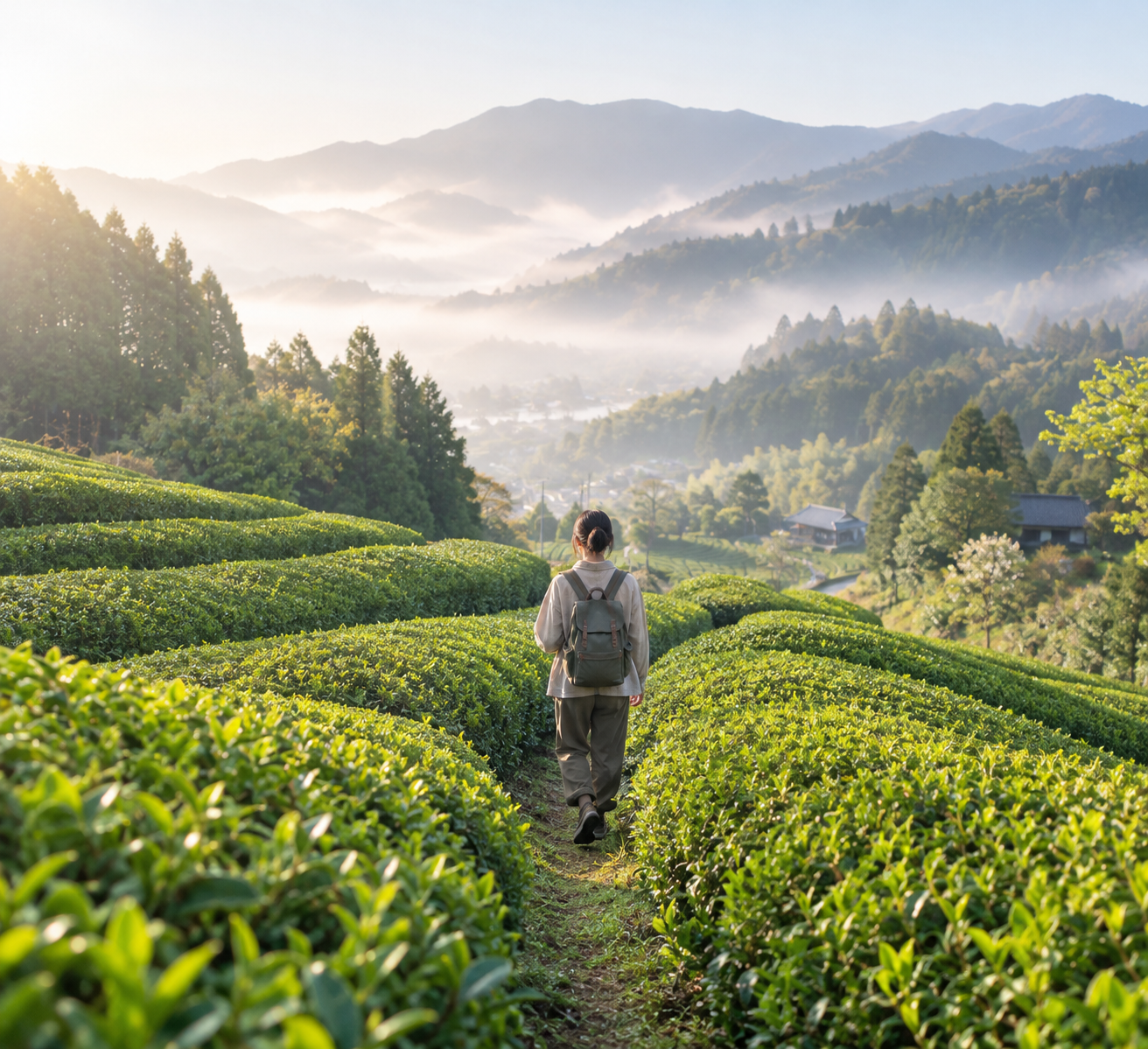
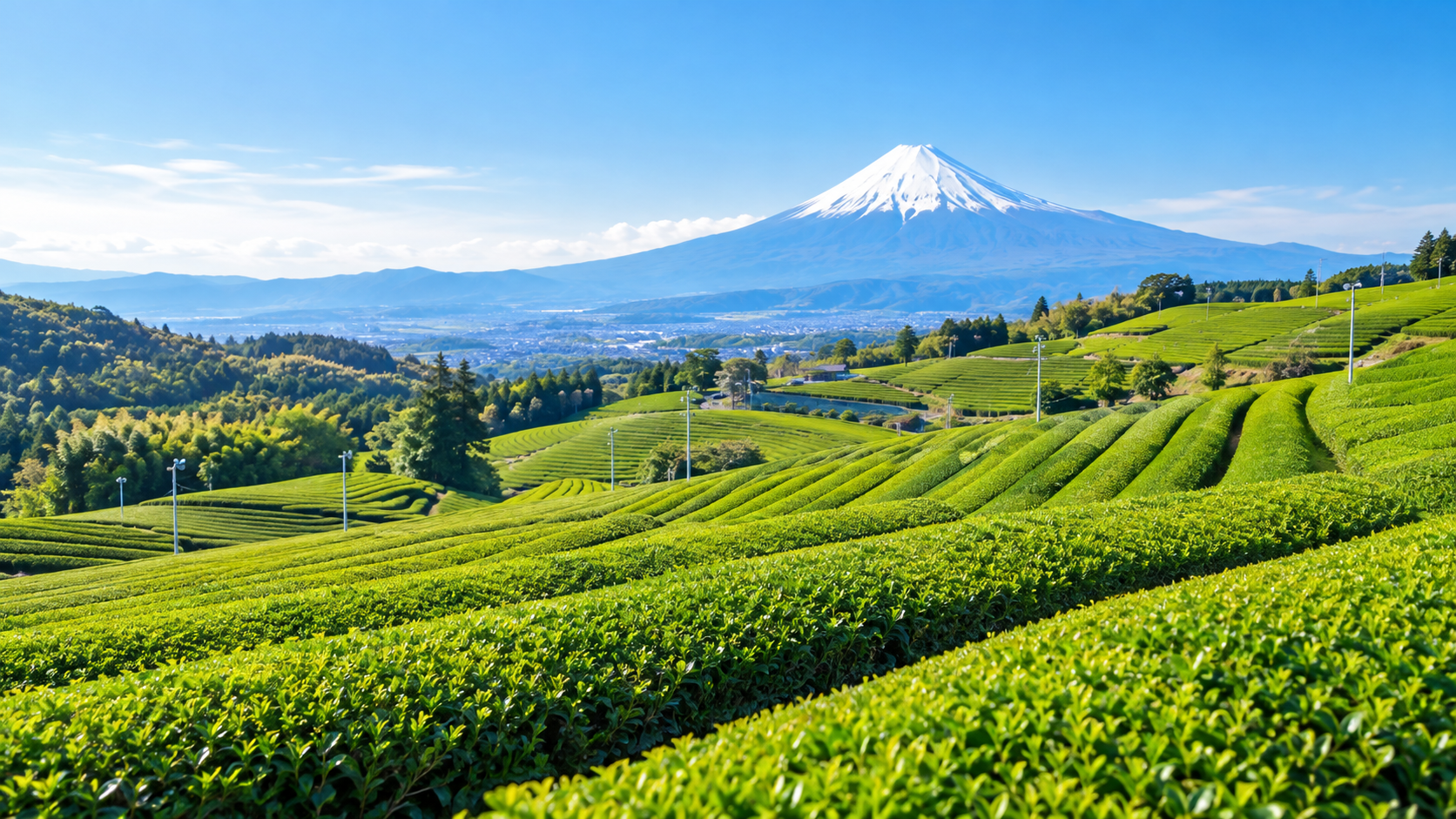
    Most visitors to Japan experience tea in a café or a tea ceremony room in Kyoto. That’s wonderful, but it’s only half the story. Out in the countryside, the same tea grows in neat, rounded rows that ripple across hillsides like green waves, sometimes with Mount Fuji rising behind them. Standing in a tea field in early May, when the new leaves are bright green and the air smells faintly sweet, is one of the most memorable things I’ve done in Japan – and almost none of the people I met there were tourists.

    This guide covers the tea regions that are easiest and most rewarding to visit, what you can do there, and when to go.

    The Problem You’re Actually Trying to Solve

    Japan’s tea regions are mostly rural, quiet and not set up like big tourist attractions. Information in English is scattered, public transport can be limited, and it’s easy to show up in the wrong season and find bare-looking bushes. A little planning makes the difference between a frustrating detour and a highlight of your trip.

    Who This Article Is NOT For

    • If you only have time for city tea experiences, my guide to the oldest tea shops in Uji and Kyoto covers historic shops you can visit without leaving town.
    • If you’re looking for a formal tea ceremony, that’s usually easier to book in Kyoto or Tokyo than in the tea fields themselves.
    • If you can’t travel, you can still “visit” these regions through their tea – see the end of this article.

    When to Go

    Late April to May – the best time. This is the first harvest, when the fresh new leaves turn the fields a vivid green and tea farms are at their busiest. It’s also when shincha, the first tea of the year, appears in shops. (More on shincha.) Kagoshima’s harvest starts earliest, often in early April, and the season moves north from there.

    Summer. The fields are green and second-harvest work continues, but it’s hot and humid.

    Autumn. Quieter, comfortable weather, and the fields are still green, if less vivid.

    Winter. The bushes are dormant and darker green – but in places like Shizuoka, the cold, clear air gives the best views of Mount Fuji.

    Shizuoka: Tea Fields and Mount Fuji

    Shizuoka is Japan’s most famous tea prefecture and the easiest to reach from Tokyo by shinkansen.

    Obuchi Sasaba (Fuji City). If you’ve seen a photo of tea rows leading up to Mount Fuji, it was probably taken here. It’s a working tea plantation on Fuji’s southern foothills, maintained by local farmers and a preservation association, and it’s free to visit.

    • Best time: early to mid-May for bright new leaves; December to February for the clearest views of Fuji. Early morning gives the best chance of a clear mountain.
    • Access: the nearest stations are Shin-Fuji (shinkansen) and Fuji. Buses are infrequent, so a taxi or car is usually easier – roughly 20-30 minutes.
    • Tips: stay on the paths and don’t step into the fields; this is a working farm. Drones and commercial shoots need permission. Facilities are limited, so bring water.

    Makinohara Plateau and Shimada. A vast tea-growing plateau associated with deep-steamed fukamushi sencha, with wide views of tea rows. The Fujinokuni Cha no Miyako Museum in this area is dedicated to tea and its history, and makes a good base for exploring the region.

    Kawane. Further into the mountains along the Oi River, known for fragrant mountain-grown sencha. Combine it with a ride on the scenic Oigawa Railway.

    Kyoto: Uji and Wazuka

    Kyoto’s tea country is just south of the city and pairs naturally with a Kyoto trip.

    Uji. About 20-30 minutes from Kyoto Station by train, Uji is the historic home of Japanese tea. Walk the street leading to Byōdō-in temple, lined with tea shops selling matcha, sencha and matcha sweets, and stop at one of the long-established tea houses. Uji is less about fields and more about tea culture, shops and history – and it’s very easy to visit in half a day.

    Wazuka. For tea fields, head to Wazuka, a quiet town in the hills that grows much of the leaf sold as “Uji tea.” Its terraced tea fields climb steep slopes and are some of the most beautiful in Japan. Several farms, including Kyoto Obubu Tea Farms, offer tours in English with field walks, factory visits, tastings and, in season, tea picking. It’s rural and best reached by car or a booked tour – plan ahead.

    Ujitawara. Near Uji, this is where Nagatani Sōen developed the method for making sencha in 1738. His former home in the Yuyadani area is a small pilgrimage spot for tea lovers.

    Kyushu: Kagoshima, Yame and Ureshino

    Kyushu has some of Japan’s biggest and most beautiful tea landscapes, and far fewer visitors.

    Chiran (Kagoshima). Minamikyushu, the area around Chiran, is one of Japan’s largest tea-producing areas. Tea fields stretch toward the cone of Mount Kaimon, and viewpoints like Chabakken-oka look out over both. Chiran is also known for its preserved samurai residences and gardens.

    • Best time: April to May, when the new shoots appear – earlier than anywhere else in mainland Japan.
    • Access: about 45 minutes to an hour by car from Kagoshima-Chuo Station, or by bus.
    • Experiences: local tea shops and cafés serve Chiran tea, and some hands-on experiences, such as hand-rolling or brewing lessons, can be booked in advance.

    Yame (Fukuoka). Famous for high-quality gyokuro, Yame has wide, rolling tea fields. The Yame Central Tea Garden (Yame Chuo Daichaen) is a hillside viewpoint overlooking a sea of tea bushes, and it’s a peaceful stop on a drive through the region. A car is the easiest way to explore.

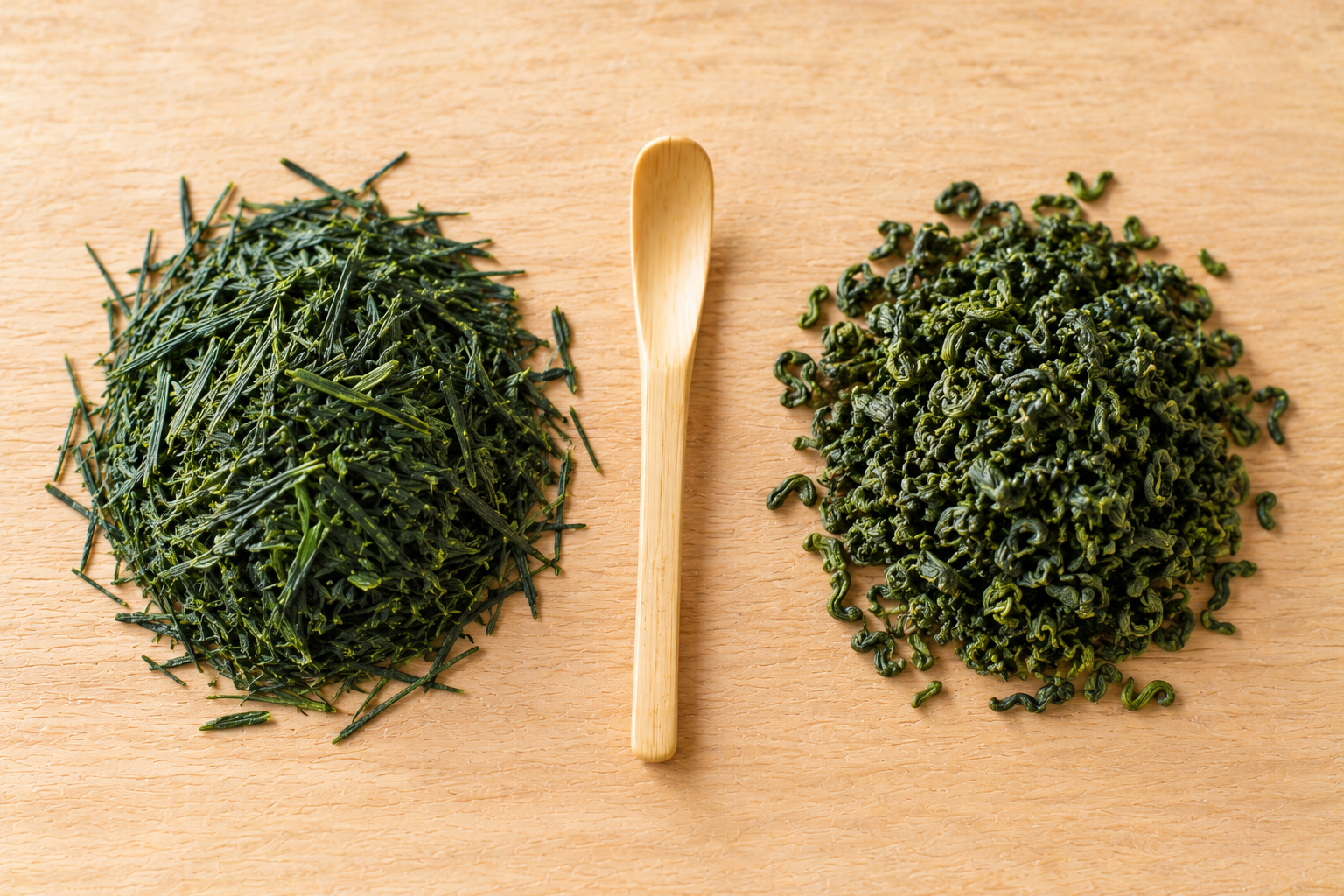
    Ureshino (Saga). A hot-spring town that’s also a tea town, known for its curly tamaryokucha. Combine a soak in Ureshino’s famous onsen with tea tasting, and look for tea-themed experiences around town.

    Practical Tips for Visiting Tea Country

    • Rent a car if you can. Many tea fields are rural, and buses can be infrequent.
    • Respect working farms. Stay out of the rows, don’t pick leaves unless you’re on a picking experience, and be quiet near homes.
    • Book tours ahead. English tours and tastings often need advance reservations, especially in spring.
    • Bring cash. Small farm shops and rural cafés may not take cards.
    • Check the weather for views. Mountain views, especially of Fuji, are best on clear mornings.
    • Buy tea at the source. Farm shops often sell fresh tea that’s hard to find abroad – and in May, you may find shincha just days old.

    A Sample Day Trip

    From Tokyo: take the shinkansen to Shin-Fuji, then a taxi to Obuchi Sasaba early in the morning. Continue to the Makinohara area and the tea museum by car, and finish with fresh sencha at a local farm shop.

    From Kyoto: spend the morning in Uji, visiting Byōdō-in and the tea shops along its approach, then head to Wazuka in the afternoon for a booked farm tour and tasting.

    A Few Things People Ask Me

    Can I pick tea myself? Yes, on some booked tours, mainly in spring. Don’t pick leaves on your own – the fields are private farms.

    Do I need to speak Japanese? Not for tours offered in English. For rural farm shops and cafés, a translation app and a few basic phrases go a long way.

    Which region is best for a first visit? Uji is the easiest from Kyoto, and Obuchi Sasaba is the most iconic view from Tokyo. For a true tea-country experience, Wazuka or Chiran.

    Can’t travel? Taste the regions at home. Nio Teas’ sencha collection can be filtered by region, so you can try teas from Shizuoka, Kagoshima and more side by side. And if you are traveling, a tea infuser bottle on Amazon lets you brew the fresh tea you buy on the road.

    Where I Landed

    Visiting tea fields changed how I drink tea at home. When I open a bag of Shizuoka sencha now, I picture those green rows climbing toward Fuji; a Kagoshima tea reminds me of the warm, early spring in Chiran. If you’re planning a trip to Japan, give yourself one morning in tea country – ideally in May, with a fresh cup of shincha at the end of it.

  • Kuromamecha: Japan’s Roasted Black Soybean Tea (and How to Make It at Home)

    Kuromamecha: Japan’s Roasted Black Soybean Tea (and How to Make It at Home)

    Disclosure: This post contains affiliate links. If you buy through one of them, I may earn a small commission at no extra cost to you. Important: kuromamecha is made from soybeans, a common allergen – if you have a soy allergy, please skip it.

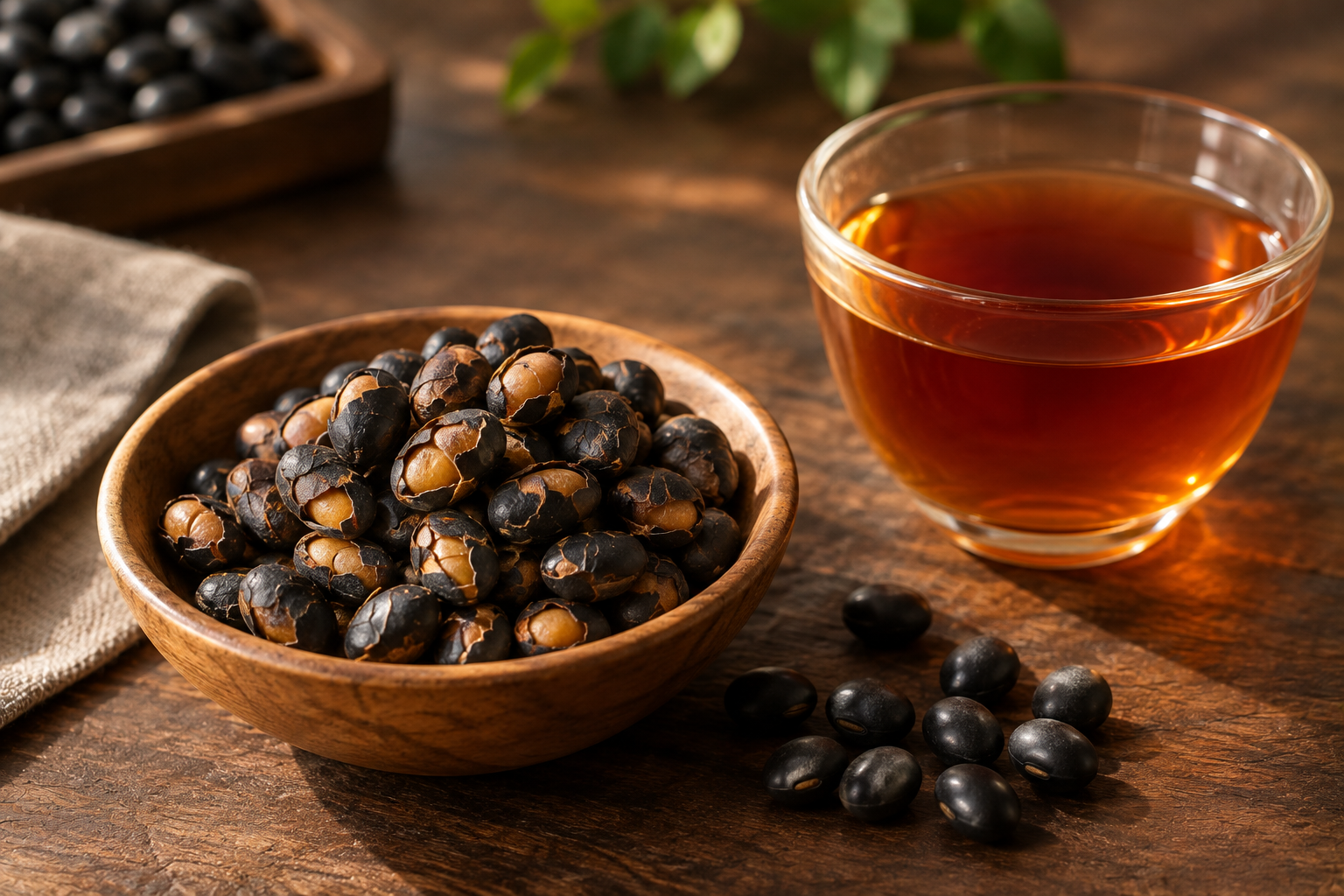
    The first time I made kuromamecha, I was mostly curious about the beans. They’re glossy and jet black when raw, and after roasting they crack open to show a pale, golden interior that smells like toasted nuts. Brewed, they turn into a reddish-brown tea that’s gently sweet, toasty and completely free of caffeine. And when the tea is done, the softened beans at the bottom of the pot are good enough to eat as a snack.

    Kuromamecha (黒豆茶, “black bean tea”) is one of Japan’s quieter caffeine-free drinks – less famous than mugicha or sobacha, but just as easy to love, and one of the few you can easily make from scratch.

    The Problem You’re Actually Trying to Solve

    Most people find kuromamecha while looking for a caffeine-free alternative to green tea, or after seeing black soybeans in a Japanese grocery store and wondering what else they’re used for. The questions are usually the same: what does it taste like, how is it different from other roasted teas, and is it worth buying ready-made or making at home?

    Who This Article Is NOT For

    • If you have a soy allergy, kuromamecha isn’t safe for you. It’s made entirely from soybeans.
    • If you’re looking for a tea with green tea flavor, kuromamecha doesn’t come from the tea plant and tastes nothing like sencha or matcha.
    • If you want a full comparison of Japan’s caffeine-free drinks, start with my caffeine-free Japanese tea guide, then come back here for the details.

    What Kuromamecha Actually Is

    Kuromamecha is an infusion made by roasting black soybeans and steeping them in hot water. Like mugicha (barley tea) and sobacha (buckwheat tea), it’s called cha in Japanese but isn’t made from tea leaves, so it contains no caffeine.

    The beans used are a black variety of soybean, the same kind simmered into the glossy sweet black beans called kuromame that are an essential part of the Japanese New Year feast, osechi. The black color comes from the bean’s skin, which also gives the tea its reddish-brown or purplish tint.

    Tamba Black Beans: The Prized Variety

    Not all black soybeans are equal. The most prized are Tamba kuromame, grown in the Tamba area that spans parts of Hyogo and Kyoto prefectures. They’re large – often around 13-15mm across compared with 8-10mm for ordinary soybeans – glossy, and naturally sweet, and they’ve been cultivated in the region for centuries with careful hand-planting and harvesting.

    Tamba beans are considered among the best for kuromamecha too, giving a sweeter, rounder cup. Beans from Hokkaido are also common; they tend to be a little smaller, with an earthier, deeper roasted flavor.

    If a package says “Tamba,” that’s a sign of a premium tea.

    What It Tastes Like

    • Toasty and nutty, like roasted soybeans or lightly roasted nuts
    • Gently sweet, with no added sugar
    • No bitterness or astringency, since there are no tea leaves
    • Round and soft, slightly fuller than sobacha

    Compared with its caffeine-free cousins:

    DrinkMade fromFlavorWatch out for
    KuromamechaRoasted black soybeansToasty, sweet, roundSoy allergy
    MugichaRoasted barleyToasty, grain-forward, slightly bitterContains gluten
    SobachaRoasted buckwheatNutty, light, sweetBuckwheat allergy

    If you like sobacha, kuromamecha is a natural next step: similar toasty sweetness, but with more body. It’s also a useful option for people who avoid gluten (unlike mugicha) or buckwheat (unlike sobacha) – as long as soy isn’t a problem.

    How to Brew Kuromamecha

    Hot (loose beans):

    • About 10-15g of roasted beans per 400ml of water (roughly a small handful)
    • Near-boiling water, around 95°C (203°F)
    • Steep about 5 minutes; longer for a stronger cup
    • The same beans can give a second, lighter infusion

    Hot (tea bags): steep in near-boiling water for 3-5 minutes.

    Cold brew: use a similar ratio in cold water and refrigerate for 4-6 hours or overnight. Cold-brewed kuromamecha is cleaner and a little less toasty than hot.

    Tip: lightly crushing the roasted beans before brewing helps them release flavor faster.

    Don’t Throw Away the Beans

    After one or two infusions, the beans are soft and still taste of roasted soybean. You can eat them:

    • Plain as a snack, warm or cold
    • Mixed into freshly cooked rice
    • Sprinkled over salads, yogurt or oatmeal
    • Added to soups or stews

    It’s one of the nicest things about kuromamecha – the drink and a snack from the same handful of beans.

    How to Make Kuromamecha at Home

    Making your own is easy and fills the kitchen with a lovely toasted smell.

    1. Soak. Rinse black soybeans and soak them in water for about 8 hours or overnight.
    2. Dry. Drain and dry them thoroughly – spread them on a towel for several hours. Wet beans scorch easily.
    3. Roast. Choose one method:
      • Oven (easiest): spread the beans in a single layer on a lined tray, no oil, and roast at about 170°C (340°F) for 40-50 minutes, stirring every 10-20 minutes.
      • Stovetop: use a dry, uncoated pan over low-medium heat for about 30-40 minutes, stirring often. Some beans will pop.
    4. Check. They’re done when most skins have cracked and the insides look light golden-brown. They may still feel slightly chewy but will harden as they cool.
    5. Cool and store. Let them cool completely, then keep them in an airtight container. Use within a few weeks for the best flavor.

    Brew as above – about 10 beans per cup is a good starting point.

    Troubleshooting Homemade Kuromamecha

    • The tea tastes burnt or bitter: the heat was too high, or the beans were roasted too long. Roast more gently next time and stop as soon as most skins have cracked.
    • The tea tastes weak or “beany”: the beans weren’t roasted enough. Roast a little longer, until the insides are golden rather than pale.
    • The beans scorched on the outside but stayed pale inside: they were still damp, or the heat was uneven. Dry them thoroughly and stir more often.
    • The tea is cloudy: usually from crushed beans or bits of skin. It’s harmless – strain it through a fine mesh if you prefer a clear cup.

    Blends Worth Trying

    Kuromamecha also blends well with other roasted drinks:

    • With barley: mixing roasted black soybeans with roasted barley gives a rounder, sweeter version of mugicha. Many Japanese households make a blend like this for everyday drinking, though remember barley contains gluten.
    • With hojicha: a few roasted black soybeans in a pot of hojicha add sweetness and body to the roasted tea. This one contains caffeine from the hojicha.
    • With brown rice: roasted black soybeans and roasted brown rice together make a nutty, genmaicha-like cup without any tea leaves.

    Start with roughly equal parts and adjust to taste.

    Kuromamecha and the Japanese New Year

    Because black soybeans are a New Year food, kuromamecha has a natural seasonal connection. In osechi, kuromame represents health and hard work, thanks to a pun: mame means both “bean” and “diligent” or “healthy.” A warm cup of black soybean tea is a nice, caffeine-free companion to the rich New Year meal – or a way to use up leftover beans after the holidays.

    A Few Things People Ask Me

    Does kuromamecha have caffeine? No. It’s made from soybeans, not tea leaves, so it’s naturally caffeine-free – a popular evening drink in Japan.

    Is it the same as the black beans in osechi? It’s made from the same type of bean, but the osechi dish is simmered in sweet syrup, while kuromamecha uses beans that are dry-roasted with nothing added.

    Is kuromamecha healthy? It’s a pleasant, caffeine-free, sugar-free drink. Some products advertise health benefits, but I’d treat it as a tasty alternative to sugary drinks rather than a remedy.

    Where can I buy it? Ready-made kuromamecha on Amazon is easy to find, in both loose beans and tea bags – look for Tamba beans if you can. To make your own, start with dried Japanese black soybeans on Amazon.

    Where I Landed

    Kuromamecha is one of my favorite caffeine-free drinks because it gives you three things from one handful of beans: a warm, toasty cup, a second infusion, and a snack at the end. It’s sweet without sugar, gentle enough for any time of day, and simple enough to roast at home on a weekend afternoon. If you already enjoy sobacha or mugicha, it deserves a place on the same shelf.

  • Japanese Green Tea Regions: How Shizuoka, Kagoshima, Uji and Others Taste Different

    Japanese Green Tea Regions: How Shizuoka, Kagoshima, Uji and Others Taste Different

    Disclosure: This post contains affiliate links. If you buy through one of them, I may earn a small commission at no extra cost to you.

    The first time I bought two senchas side by side – one from Shizuoka, one from Kagoshima – I expected them to taste roughly the same. Same tea type, same country, similar price. Instead, the Kagoshima tea was deep green, rich and smooth, while the Shizuoka tea was lighter, fresher and more fragrant. Neither was “better,” but they were clearly different, and the region on the label was the best clue to why.

    Japan is a small country, but its tea regions stretch from northern Honshu to the subtropical south, and climate, terrain, cultivars and local processing traditions all leave their mark. This guide covers the regions you’re most likely to see on a bag of Japanese green tea, and what each one tends to taste like.

    The Problem You’re Actually Trying to Solve

    Region names show up on almost every Japanese tea label – Shizuoka, Kagoshima, Uji, Yame, Sayama – but most guides either just list them or focus only on matcha. If you’re buying sencha or other leaf teas, you want to know what a region actually says about the taste, so you can choose one you’ll like instead of guessing.

    Who This Article Is NOT For

    • If you’re specifically comparing matcha regions, my matcha region comparison covers Uji, Nishio, Shizuoka, Kagoshima and Yame for powdered tea.
    • If you want a hard rule like “Kagoshima is always sweeter,” regions don’t work that way. Cultivar, harvest, steaming and the individual farm matter just as much.
    • If you’re new to Japanese tea entirely, start by learning the main tea types first, then come back to regions.

    The Big Picture: Two Giants and Many Specialists

    Two prefectures dominate Japanese tea production:

    • Kagoshima – about 27,000 tonnes of aracha (unrefined tea) in 2024
    • Shizuoka – about 25,800 tonnes in 2024

    That 2024 result was historic: it was the first time since records began in 1959 that Kagoshima produced more tea than Shizuoka. Strong demand for tea used in bottled drinks, which favors Kagoshima’s large, mechanized farms and longer harvest season, helped it take the lead.

    After those two, production drops sharply. Mie, Miyazaki and Kyoto follow – in 2023, the top five were Shizuoka, Kagoshima, Mie, Miyazaki and Kyoto – with Fukuoka, Saga, Saitama, Nara and others making smaller amounts, often of more specialized teas.

    Shizuoka: The Heart of Japanese Tea

    Shizuoka has long been the center of the Japanese tea industry. Yabukita, the cultivar behind most Japanese tea, was selected there, and the prefecture is home to the country’s biggest tea market and countless farms, factories and wholesalers.

    Shizuoka isn’t one style, though. A few areas are worth knowing:

    • Makinohara and Kakegawa – broad tea plateaus closely associated with fukamushi (deep-steamed) sencha, which gives a deep green, smooth, full-bodied cup
    • Kawane and Honyama – mountain areas along rivers, where mist and temperature swings produce lighter, more aromatic, elegant senchas
    • Shizuoka city and surrounding hills – a wide range of everyday and premium teas

    Typical character: fresh, balanced, often aromatic, with classic sencha grassiness. Mountain teas lean fragrant and refined; plateau teas lean rich and deep-steamed.

    Kagoshima: Early, Green and Rich

    Kagoshima, at the southern tip of Kyushu, has a warm climate that lets it harvest earlier than anywhere else on the main islands – its shincha (first tea of the year) is usually the first to reach the market each spring. Much of its tea is grown on wide, flat land, which allows large-scale mechanized farming.

    Kagoshima growers also plant a wider range of cultivars than most regions, including Yutakamidori and the sweet Saemidori, and many teas are partly shaded or deep-steamed. Chiran is one of its best-known tea areas.

    Typical character: deep green color, rich body, smooth sweetness and umami, lower astringency. A great choice if you find some senchas too sharp.

    Mie: Home of Kabusecha

    Mie Prefecture’s tea is sold as Ise-cha, and it’s best known for kabusecha, sencha that is shaded for a short time before harvest. By most accounts, Mie produces the majority of Japan’s kabusecha. My kabusecha guide explains how that light shading changes the flavor.

    Typical character: sencha with extra sweetness and roundness from shading.

    Kyoto (Uji): The Birthplace of Sencha

    Uji, south of Kyoto, is famous for gyokuro and matcha, and for its long association with the tea ceremony. It’s also where modern sencha was born: in 1738, a tea maker named Nagatani Sōen in Ujitawara developed the steaming-and-rolling method that became the basis of today’s sencha.

    Uji is a relatively small producer by volume, and much of its focus is on shaded teas. Uji sencha exists, but the region’s prestige and prices come mostly from gyokuro and matcha.

    Typical character: refined, elegant teas; known above all for shaded teas with deep umami.

    Fukuoka (Yame): Japan’s Gyokuro Country

    Yame, in Fukuoka Prefecture, is one of Japan’s most celebrated gyokuro regions, regularly winning top awards for its traditionally shaded teas. It also makes excellent sencha and kabusecha.

    Typical character: rich, sweet, full of umami, especially in its shaded teas.

    Saitama (Sayama): The Northern Tea

    Sayama, in Saitama Prefecture near Tokyo, is near the northern limit of commercial tea growing in Japan. The cold winters mean fewer harvests and thicker leaves, and local producers use a strong final firing called Sayama-bi that gives the tea a distinctive roasted, full flavor.

    There’s a well-known saying about it: “Iro wa Shizuoka, ka wa Uji yo, aji wa Sayama de todome sasu” – “For color, Shizuoka; for aroma, Uji; but for flavor, Sayama is the best.”

    Typical character: bold, rich, with a toasty depth from the firing.

    Kyushu Specialists: Miyazaki, Saga and Nagasaki

    The rest of Kyushu has its own distinct traditions:

    • Miyazaki – a major producer of sencha and Japan’s leading region for rare pan-fired kamairicha, especially in mountainous Takachiho and Gokase
    • Saga (Ureshino) and Nagasaki (Sonogi) – known for tamaryokucha, the curly-leaved green tea with a soft, round flavor

    These regions are good places to look if you want something beyond standard sencha.

    A Quick Comparison

    RegionKnown forTypical character
    ShizuokaSencha, fukamushi, mountain teasBalanced, fresh, aromatic (mountain) or deep (plateau)
    KagoshimaEarly shincha, diverse cultivarsDeep green, rich, smooth, low astringency
    Mie (Ise)KabusechaSweet, rounded sencha
    Kyoto (Uji)Gyokuro, matcha, birthplace of senchaRefined, umami-rich
    Fukuoka (Yame)GyokuroVery sweet, rich umami
    Saitama (Sayama)Sayama-bi firingBold, rich, toasty
    MiyazakiKamairicha, senchaGentle, toasty (pan-fired)
    Saga / NagasakiTamaryokuchaRound, mild, soft

    How to Use Regions When Buying

    • If you want a classic, fresh sencha: start with Shizuoka, especially a mountain tea from Kawane or Honyama.
    • If you find sencha too bitter: try Kagoshima or a fukamushi from Makinohara or Kakegawa.
    • If you want extra sweetness without gyokuro prices: look for Ise kabusecha from Mie.
    • If you want something bold: try Sayama.
    • If you want to taste the difference yourself: buy a Shizuoka sencha and a Kagoshima sencha at the same price and brew them side by side.

    Remember that region is only one clue. A tea’s cultivar, harvest (first flush is best) and steaming style all matter too, so read the whole label.

    A Few Things People Ask Me

    Which region makes the best sencha? There isn’t one. Shizuoka and Kagoshima both make outstanding teas in different styles, and smaller regions have their own specialties. “Best” depends on whether you like fresh and aromatic or rich and smooth.

    Is Uji tea better because it’s famous? Uji is famous mainly for gyokuro and matcha, and its name carries a premium. For sencha, other regions often offer as good or better value.

    Why do some teas list a region and a cultivar? Both affect flavor. A “Kagoshima Saemidori” tells you both where it was grown and which plant it came from – which together say a lot about the taste.

    Where can I buy single-region teas? Nio Teas’ sencha collection can be filtered by region, which makes side-by-side comparisons easy. For classic everyday tea, Shizuoka sencha on Amazon is widely available.

    Where I Landed

    Learning the regions didn’t make me choose a favorite – it made me curious. I now keep a fresh Shizuoka sencha for mornings, a rich Kagoshima tea for when I want something smoother, and the occasional Sayama or Ise kabusecha to remind me how much variety there is. Start with Shizuoka and Kagoshima side by side. Once you taste the difference, the rest of the map starts to make sense.

  • Tamaryokucha: Japan’s Curly Green Tea (Guricha), Explained

    Tamaryokucha: Japan’s Curly Green Tea (Guricha), Explained

    Disclosure: This post contains affiliate links. If you buy through one of them, I may earn a small commission at no extra cost to you.

    Pour a spoonful of sencha onto a plate and you’ll see fine, straight, dark-green needles. Pour out a spoonful of tamaryokucha next to it and the difference is obvious: the leaves are curled into little commas and coils, like tiny green question marks. They look almost like a Chinese tea. In the cup, they taste softer and rounder than sencha, with less bite and a gentle, almost fruity sweetness.

    Tamaryokucha (玉緑茶, “jade green tea”) – also called guricha, “curly tea” – is one of Japan’s lesser-known green teas. It makes up only around 3% of the country’s production, mostly in Kyushu, and its curly shape has a surprisingly interesting history involving the Soviet Union.

    The Problem You’re Actually Trying to Solve

    Most people come across tamaryokucha on a specialty tea list and wonder whether it’s just sencha with a different name, or a different kind of tea altogether. The confusion is understandable: some tamaryokucha is steamed like sencha, and some is pan-fired like Chinese green tea. Knowing which is which – and what that does to the flavor – is the key to choosing one you’ll like.

    Who This Article Is NOT For

    • If you love sencha’s bright, grassy edge, tamaryokucha is deliberately gentler. It may feel a little soft at first.
    • If you want rich, savory umami, a shaded tea like gyokuro is the better choice.
    • If you’re looking for the deep green, cloudy, full-bodied cup of deep-steamed tea, my fukamushi sencha guide covers that style instead.

    What Makes It Tamaryokucha: The Missing Step

    To understand tamaryokucha, it helps to know how sencha gets its shape. Sencha goes through several rolling stages, ending with a final shaping step (seijū) that presses the leaves into straight, thin needles.

    Tamaryokucha skips that final straight-rolling step. Instead, the leaves are dried while being tumbled, often in a rotating drum, and they naturally curl into comma and spiral shapes – the “jade” or magatama (curved bead) shape that gives the tea its name.

    That one difference in processing changes both how the tea looks and how it brews: curled leaves unfold more slowly in the pot, giving a gentler, rounder extraction.

    Two Kinds: Steamed and Pan-Fired

    There are two main types of tamaryokucha, and it’s worth knowing which one you’re buying:

    Mushisei tamaryokucha (steamed). The leaves are steamed like sencha, then curled and dried. Often shortened to mushiguri (“steamed curly”) in Kyushu. It tastes closest to sencha, but milder and rounder. This is the type most people mean by “tamaryokucha” or “guricha” today.

    Kamairisei tamaryokucha (pan-fired). The leaves are heated in an iron pan instead of steamed. This is usually just called kamairicha, and it has a light, toasty aroma and a golden cup.

    If the label says “kamairi,” it’s pan-fired. If it says “mushisei,” “mushiguri” or simply “guricha,” it’s almost always steamed.

    A Tea Made for Export

    The steamed version has an unusual origin story. Around 1930, Japanese tea makers wanted to sell more tea to the Soviet Union, where drinkers were used to curly, pan-fired Chinese green tea. Straight Japanese sencha didn’t look right to them. So Japanese producers developed a steamed tea shaped to resemble Chinese tea, and steamed it longer than usual to soften its bitterness.

    It worked. Exports grew quickly, and the name tamaryokucha was chosen through an industry call for names in 1932, during that export boom. After the war, it was also exported to North Africa and Central Asia. As those export markets faded, producers began selling it at home, where it found a following of its own.

    The nickname guricha comes from the swirling, scroll-like “guri” pattern found in traditional Japanese lacquerwork, which the curled leaves resemble. The name started in the Izu area of Shizuoka and has since spread more widely.

    Sencha vs. Steamed vs. Pan-Fired at a Glance

    SenchaSteamed tamaryokucha (guricha)Pan-fired tamaryokucha (kamairicha)
    Kill-green stepSteamingSteaming (often longer)Hot iron pan
    Final shapingRolled into straight needlesFinal straight rolling skipped; leaves curlLeaves curl
    Leaf lookThin, straight, dark greenComma-shaped curls, deep greenComma-shaped curls, slightly duller green
    Cup colorYellow-greenClear yellow-greenGolden yellow
    TasteBright, grassy, some astringencyRound, mild, gently sweetLight, toasty, low astringency
    Main regionsShizuoka, Kagoshima and most of JapanUreshino, Sonogi, IzuMiyazaki, Kumamoto

    The table shows why tamaryokucha is easy to confuse with both its neighbors: it shares the steaming of sencha (or the pan-firing of Chinese-style tea) but has its own curled shape and softer character.

    Where It’s Made

    Tamaryokucha is mainly a Kyushu tea:

    • Ureshino (Saga) – the best-known region, with a long tea-growing history and a reputation for round, sweet, smooth teas
    • Sonogi (Nagasaki) – a strong competitor to Ureshino, known for steamed tamaryokucha that has won national awards
    • Kumamoto and Miyazaki – associated especially with pan-fired versions
    • Fukuoka and Oita – smaller amounts
    • Izu (Shizuoka) – outside Kyushu, where the “guricha” name originated

    What It Tastes Like

    Compared with sencha, steamed tamaryokucha is usually:

    • Rounder and smoother, with less astringency
    • Gently sweet, sometimes with a light berry-like or citrusy note
    • Softer on the finish, often with an almond-like aftertaste
    • Clear, yellow-green in the cup

    Because its leaves are curled and unfold gradually, it’s also more forgiving to brew. It’s hard to make it harsh unless you use very hot water or steep it much too long.

    How to Brew Tamaryokucha

    • Leaf: about 4-5g (weigh it if you can – curled leaves take up more space than sencha, so teaspoon measurements can mislead)
    • Water: 70-80°C (158-176°F); pan-fired versions can take a little hotter, around 80-85°C
    • First infusion: 60-90 seconds – a little longer than sencha, since the curled leaves need time to open
    • Second infusion: slightly hotter water, 30-45 seconds
    • Third infusion: hotter again, about 60 seconds

    As with all Japanese tea, pour out every last drop between infusions so the leaves don’t keep steeping in the pot. My green tea temperature guide explains why getting the water temperature right matters so much.

    Cold brew also works well: about 4-5g of leaf in 500ml of cold water, refrigerated for 4-8 hours, gives a smooth, sweet iced tea.

    Tamaryokucha With Food

    Its soft, round character makes tamaryokucha an easy tea to drink with meals. It doesn’t overpower delicate flavors the way a sharp sencha can, so it works well with:

    • Fish and seafood, from sashimi to simply grilled fish – a natural pairing in coastal Nagasaki and Saga
    • Rice dishes and onigiri
    • Light Japanese sweets such as castella or yokan, where its gentle sweetness complements rather than competes

    A good everyday habit is to brew a pot at the start of a meal and refill it as you go – the curled leaves give several pleasant infusions, and the later cups stay smooth.

    Storing It

    Treat tamaryokucha like any good green tea: keep it in an airtight, opaque container, away from heat, light and strong smells, and finish an opened bag within a couple of months. The curled leaves are a little sturdier than fine sencha needles, but the aroma still fades once the bag is open.

    How to Choose a Good One

    • Check the method. Decide whether you want steamed (mild, sencha-like) or pan-fired (toasty, golden).
    • Look for origin. Ureshino and Sonogi are reliable signs for steamed tamaryokucha; Miyazaki and Kumamoto for pan-fired.
    • Look at the leaves. Good tamaryokucha has evenly sized, clearly curled leaves with a vivid, consistent green color.
    • Check freshness. As with any green tea, a recent harvest and an airtight package make a big difference. Spring-harvested shincha versions are especially aromatic.

    A Few Things People Ask Me

    Is tamaryokucha the same as kamairicha? Not exactly. Kamairicha is one type of tamaryokucha – the pan-fired kind. Most tamaryokucha sold today is steamed (mushisei), which tastes closer to sencha.

    Is tamaryokucha the same as fukamushi sencha? No. Both may involve longer steaming, but fukamushi is rolled into straight needles and brews cloudy and deep green. Tamaryokucha is curled and brews clearer and milder.

    Why is it so hard to find outside Japan? It’s a small part of Japan’s production and mostly made by Kyushu producers for the domestic market, so fewer exporters carry it.

    Where can I buy it? For a pan-fired version, Nio Teas’ Pan Fired Kamairicha from Miyazaki Sabou is a good example of the curly, toasty style. For steamed guricha and Ureshino teas, try tamaryokucha on Amazon.

    Where I Landed

    Tamaryokucha is a good reminder that small changes in processing make big changes in the cup. Skip one rolling step, and you get curled leaves, a rounder flavor and a tea that’s far more forgiving to brew. Its odd history – a Japanese tea shaped to look Chinese for Soviet buyers – makes it even more fun to drink. If you like sencha but sometimes find it a little sharp, a cup of Ureshino or Sonogi tamaryokucha is well worth trying.