Category: Japanese Tea Guides

  • Wagashi for People Who Aren’t Sure About Anko (And What to Pair With Matcha)

    Wagashi for People Who Aren’t Sure About Anko (And What to Pair With Matcha)

    Disclosure: This post contains affiliate links. If you buy through one of them, I may earn a small commission at no extra cost to you.

    I’ll say the quiet part out loud: the first time someone handed me a piece of yokan, dense red bean jelly, sweet in a way I wasn’t expecting from something that texturally resembled a fruit gummy, I didn’t love it. It took me a few different wagashi, in a specific order, before anko clicked for me instead of feeling like an obstacle. I think a lot of people give up one bite too early, on the wrong wagashi, and decide the whole category isn’t for them.

    That’s really the honest starting point for this guide. Anko, sweetened red bean paste, is the backbone of most traditional Japanese sweets, and it’s also the single biggest reason Western newcomers bounce off wagashi entirely. The texture is unfamiliar — a sweet bean paste isn’t a flavor concept most people grew up with — and if your first experience is something anko-forward like a dense slice of yokan, it’s easy to write off the whole category before giving it a fair shot. Nobody tells you there’s actually a natural order to work through, one that lets you build up tolerance and appreciation the way you might work up to darker roast coffee or spicier food.

    The Problem You’re Actually Trying to Solve

    You’ve searched for a wagashi guide, maybe because you’re pairing something with matcha and want to do it properly, maybe because you’re just curious about Japanese sweets and don’t know where to start. Either way, you’ve probably run into the same wall I did: most wagashi guides list fifteen types in one long, undifferentiated block, with zero acknowledgment that some of these are a much easier on-ramp than others if you didn’t grow up eating sweetened bean paste.

    This guide sorts wagashi by how approachable they are for a first-timer, specifically around anko intensity, so you can actually build up to the deeper end of the category instead of getting thrown into it and deciding you don’t like any of it.

    Who This Article Is NOT For

    Let’s save you some scrolling if this isn’t quite your situation.

    • If you already love anko and eat wagashi regularly, this beginner-focused ordering will feel too cautious — you probably already know your way around yokan and monaka.
    • If you want a full historical and cultural breakdown of every wagashi category (namagashi, han-namagashi, higashi, and all their sub-classifications), this is a practical tasting guide, not an academic deep dive into Japanese confectionery classification.
    • If you’re gluten-free or have a peanut allergy specifically, most wagashi are naturally free of both, but always check ingredient labels individually — I’m not covering allergen specifics item by item here.

    If you’re past that, here’s where the actual guide starts.

    What Actually Determines How Approachable a Wagashi Is

    Three things, and once you know them, you can predict pretty accurately whether a wagashi you’ve never tried will feel easy or challenging on a first bite.

    1. How much anko is actually present, and how concentrated it is. A dollop tucked inside a pancake-like shell reads very differently than a solid block of nothing but bean paste.

    2. Texture familiarity. Anything chewy, gooey, or jelly-like (mochi, kanten-based jellies) asks more of an unfamiliar palate than something crisp or cake-like, which reads closer to Western baked goods.

    3. Sweetness balance. Some wagashi lean quite sweet on their own; others are deliberately restrained specifically because they’re meant to be eaten alongside bitter matcha, which changes how they taste in isolation versus with tea. A wagashi that seems too sweet eaten alone can taste perfectly balanced once you actually put it next to a bowl of whisked matcha, which is worth keeping in mind before writing anything off based on a solo bite.

    Comparison Table

    WagashiAnko LevelTextureBeginner FriendlinessPairs Well With
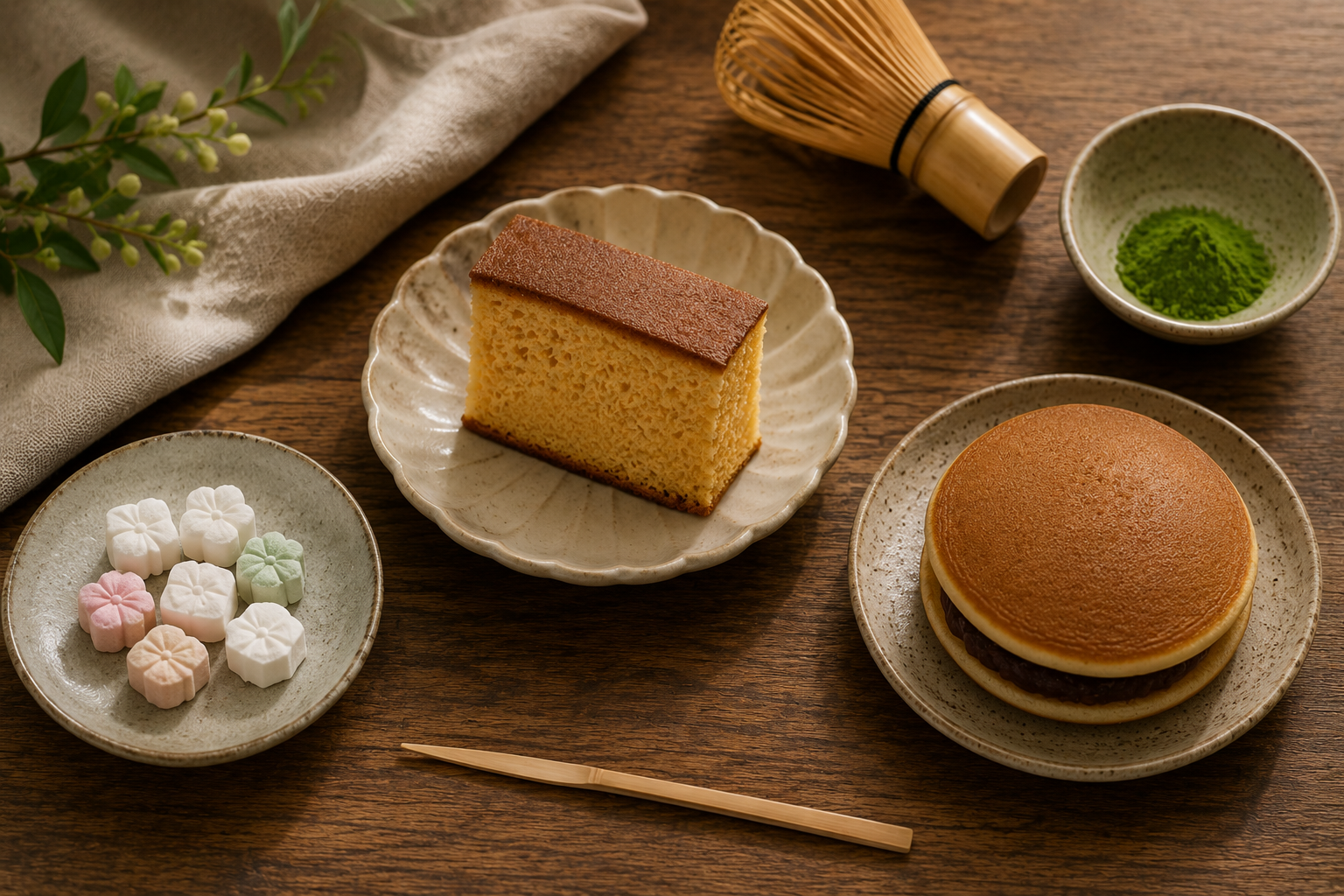
    RakuganNoneDry, crumbly, hard candy-likeVery easyUsucha (thin matcha)
    CastellaNoneSoft, sponge cake-likeVery easySencha, hojicha
    SenbeiNone (savory)Crisp, crunchyVery easyAny tea, especially hojicha
    DorayakiModerate, containedSoft pancake exterior, smooth fillingEasyHojicha, mild sencha
    DaifukuModerate, containedChewy mochi exteriorModerateSencha, usucha
    MonakaHigh, but crisp shellCrisp wafer, dense paste fillingModerate-challengingUsucha, koicha
    YokanVery high, solid formDense, jelly-likeMost challengingKoicha (thick matcha)

    The Wagashi, One by One

    Rakugan

    Shop rakugan on Amazon →

    Rakugan is a dry, pressed sweet made from rice flour, sugar, and a liquid sweetener called mizuame, shaped into intricate molded forms, often flowers or seasonal motifs. It contains no anko at all.

    Why it’s a good starting point: The texture is closer to a firm sugar candy than anything unfamiliar, and the flavor is straightforwardly sweet without the bean paste element that trips people up. It’s also traditionally served specifically with usucha, thin matcha, in tea ceremony settings, so it’s a historically correct pairing, not just a beginner workaround.

    The tradeoff: It’s quite sweet and quite dry on its own, meant to be eaten in small pieces alongside tea rather than as a standalone snack. Don’t expect much complexity — this is about pure, simple sweetness, and it can feel a little chalky if you eat it without tea to wash it down.

    Castella

    Shop castella cake on Amazon →

    Castella is a soft, honey-sweetened sponge cake, baked rather than steamed or pressed, and while purists debate whether it technically counts as wagashi versus a Portuguese-influenced import, it’s sold and eaten alongside other traditional sweets throughout Japan.

    Why it’s a good starting point: This is the easiest entry point on the entire list, because it tastes almost exactly like a Western sponge cake. No anko, no unfamiliar texture, nothing to adjust to. If you want proof that Japanese sweets aren’t universally challenging for a Western palate, this is it.

    The tradeoff: Because it’s so close to something you already know, it doesn’t really teach you anything new about wagashi as a category. Think of it as the on-ramp, not the destination.

    Senbei

    Shop senbei rice crackers on Amazon →

    Senbei are savory or lightly sweet rice crackers, often brushed with soy sauce, and while they sit slightly outside the sweet-wagashi conversation, they’re a traditional higashi-category pairing for tea and worth knowing about specifically because they sidestep the sweetness question entirely.

    Why it’s a good starting point: If you’re someone who generally prefers savory over sweet, this is your entry point into the tea-pairing world without touching anko or heavy sugar at all.

    The tradeoff: If what you actually wanted was a sweet treat to go with your tea, senbei won’t scratch that itch — it’s a genuinely different category of pairing.

    Dorayaki

    Shop dorayaki on Amazon →

    Dorayaki is two small, fluffy castella-style pancakes sandwiched around a filling of sweetened anko. This is where anko actually enters the picture, but in a contained, moderate way.

    Why it’s a good starting point: The pancake exterior is instantly familiar, and the anko filling is portioned rather than dominant, so you get a genuine introduction to the flavor without it overwhelming the bite. This is often the wagashi I’d recommend as someone’s actual first anko experience — it asks the least of you while still being the real thing, not a workaround.

    The tradeoff: The filling does have that distinct sweetened bean texture, slightly grainy, quite sweet, and if that specific mouthfeel isn’t for you, dorayaki will make that clear quickly, even in a small dose.

    Daifuku

    Shop daifuku mochi on Amazon →

    Daifuku is a soft mochi ball wrapped around a filling, most commonly anko, though strawberry and other fruit variations are common too and often easier for a first-timer than the plain red bean version.

    Why it’s worth trying next: The chewy mochi exterior is a genuinely different texture experience than anything in Western desserts, and it’s worth getting comfortable with on its own before combining it with anko. Starting with a fruit-filled daifuku lets you adjust to the mochi texture first before tackling mochi and anko together.

    The tradeoff: Mochi’s stickiness and chew is polarizing even independent of the anko question — some people love it immediately, others need a few tries before it stops feeling unusual.

    Monaka

    Shop monaka on Amazon →

    Monaka is anko sandwiched between two thin, crisp wafers made from mochi rice, often shaped like flowers, leaves, or the moon. Despite the crisp wafer shell, the anko filling itself is usually dense and largely unmodified — this is closer to the real thing.

    Why it’s worth trying next: The crisp wafer gives you a textural anchor that’s easy to like immediately, which makes the anko filling underneath feel more approachable than it would completely on its own.

    The tradeoff: The anko-to-shell ratio is much higher than dorayaki, so if you weren’t sold on the bean paste texture there, monaka will ask more of you, not less.

    Yokan

    Shop yokan on Amazon →

    Yokan is a dense, jelly-like block made almost entirely of sweetened bean paste set with agar (kanten). There’s no shell, no pancake, no wafer to soften the experience — it’s anko in its most concentrated, unaccompanied form.

    Why it’s worth trying last, not first: This is the wagashi that most directly tests whether you actually enjoy anko’s flavor and texture on their own terms, without any supporting structure to ease you in. In my experience, people who’ve built up to yokan through the other wagashi on this list tend to genuinely enjoy it, appreciating the concentrated flavor rather than being ambushed by it; people who start here often don’t, and end up assuming the problem is wagashi as a whole rather than just this one especially intense entry point.

    The tradeoff: It’s the most likely wagashi to end someone’s wagashi journey prematurely if it’s their first exposure. Save it for later, once you already know anko works for you.

    Which One Should You Actually Start With

    If you want zero risk and guaranteed enjoyment: Castella. It’s essentially cake, and it pairs beautifully with any tea you already like.

    If you want the traditional tea ceremony pairing without any anko involved: Rakugan alongside usucha (thin matcha).

    If you’re ready for your actual first anko experience: Dorayaki. Contained, familiar shell, moderate filling.

    If you’ve enjoyed dorayaki and want to go further: Daifuku, ideally a fruit-filled version first, then a plain anko version once you’re comfortable with the mochi texture itself.

    If you’re confident anko is for you and want the real, concentrated experience: Monaka, then yokan, in that order.

    A Few Things People Ask Me

    What tea should I actually pair with wagashi? Sweeter, richer wagashi like yokan and monaka traditionally pair with koicha, thick matcha, because the tea’s intensity balances the concentrated sweetness. Lighter wagashi like rakugan and castella pair well with usucha or a simple sencha, since neither the tea nor the sweet needs to compete with the other.

    Is there a wagashi with no sugar or minimal sweetness at all? Senbei is your best bet if you want something to pair with tea without leaning sweet at all. Beyond that, most wagashi are built around sweetness as the whole point, so a genuinely low-sugar option within the sweet category is hard to find authentically.

    Can I make anko more approachable at home, or does it always taste the same? Anko varies more than people expect — koshian (smooth, strained paste) and tsubuan (chunkier, with whole beans left in) have noticeably different textures, and some brands sweeten more aggressively than others. If your first anko experience was overly sweet or grainy, it’s worth trying a different preparation before writing off the flavor entirely.

    Is wagashi always this small and delicate, or are there bigger portions? Traditional wagashi are intentionally small — they’re meant to be a few refined bites alongside tea, not a full dessert course. If you’re craving a bigger portion, dorayaki and daifuku tend to come in more substantial single servings than something like rakugan or monaka.

    Where I Landed

    I’ll be honest: yokan still isn’t my favorite, even now, and that’s fine. The point of this guide was never to convert you into loving every single wagashi — it’s to make sure you actually give the category a fair trial instead of judging all of wagashi off one dense, anko-heavy first impression. Start with castella or rakugan, work your way through dorayaki and daifuku, and see where your own preference actually lands before deciding anko isn’t for you. Some people stop happily at dorayaki and never look back, and that’s a completely legitimate place to land — you don’t owe the category a full commitment to yokan just because it exists.

    If you’re building this into an actual matcha routine at home, pair the lighter sweets with a usucha-style whisked matcha, and save the richer, anko-forward ones for when you’ve got a proper thick koicha to stand up to them — my matcha powder brands comparison is a good next stop if you’re still figuring out which matcha to keep on hand for exactly that.
  • Uji vs Shizuoka vs Yame Matcha: How Japan’s Matcha Regions Actually Differ

    Uji vs Shizuoka vs Yame Matcha: How Japan’s Matcha Regions Actually Differ

    Disclosure: This post contains affiliate links. If you buy through one of them, I may earn a small commission at no extra cost to you.

    I used to assume “matcha is matcha” the same way I used to assume all olive oil was basically interchangeable, until someone handed me two tins side by side — one from Uji, one from Kagoshima — and the difference wasn’t subtle at all. One was creamy and almost sweet in a rounded, restrained way. The other hit brighter and more direct, less shy about announcing itself. Same plant, same general process, wildly different personality. That’s when region started actually meaning something to me instead of just being a line on a tin I skimmed past.

    If you’ve started noticing that matcha tins list a region like Uji or Kagoshima the way a wine bottle lists an appellation, and you’ve wondered whether that actually matters or if it’s just marketing dressing, this article is here to answer that honestly. Some of it is genuine terroir. Some of it really is just prestige branding built up over centuries. I’ll tell you which is which, region by region, so the next time you’re staring at a tin deciding between two similarly priced options, you’ll actually know what that geographic label is telling you.

    Quick Picks: Which Region to Buy

    • Best for classic ceremonial matcha: Uji – the traditional benchmark for usucha. Uji ceremonial matcha on Amazon
    • Best value for everyday drinking: Nishio – smooth and balanced without the prestige markup. Nishio matcha on Amazon
    • Best for lattes and baking: Kagoshima – sweet, creamy and strong enough to survive milk.
    • Best for single-origin tins from small farms: Nio Teas’ matcha collection. At the time of writing, ordering through the links on this page automatically applies a 10% discount at checkout – no code needed. Offers can change, so check the final price in your cart.

    Want specific brands rather than regions? My matcha brand comparison covers where well-known brands source from. The full regional breakdown, a “how you drink it” chart and the head-to-head comparisons are below.

    The Problem You’re Actually Trying to Solve

    You’ve searched for a comparison of matcha-growing regions because you’re trying to figure out whether region should actually factor into your buying decision, or whether it’s a distinction that matters mostly to specialists and doesn’t change much for a casual home drinker. You might also just be curious why Uji gets treated like the gold standard everywhere you look, while Kagoshima and Shizuoka rarely get the same reverence despite Kagoshima actually producing more tea overall.

    The honest answer sits in the middle. Region genuinely does shape flavor — soil, climate, and altitude all leave a real fingerprint on the final cup, the same way they do in wine or coffee. But region isn’t a strict quality hierarchy either. Uji’s reputation comes from centuries of tradition and refined processing as much as raw terroir, and some of the other regions are quietly excellent in ways Uji’s fame overshadows.

    Who This Article Is NOT For

    Let’s save you some scrolling if this isn’t quite your situation.

    • If you’re brand new to matcha and haven’t settled on liking it yet, region-level nuance won’t matter to you at this stage — start with a well-reviewed everyday matcha brand instead and worry about regional character once you already know you’re hooked.
    • If you only ever drink matcha in lattes with milk and sweetener, most regional nuance gets buried under dairy and sugar anyway. This distinction matters most for people drinking matcha straight.
    • If you want a definitive “best region” ranking, that’s not really how this works — the regions below are different, not stacked in a strict order, and the “best” one depends entirely on what you’re looking for in a cup.

    If you’re past that, here’s where the actual comparison starts.

    What Actually Shapes Regional Character

    Three things determine why matcha from one region tastes noticeably different from another, and once you understand them, the flavor descriptions below will make a lot more sense.

    1. Climate and terrain. Temperature swings, fog, altitude, and rainfall all affect how the tea plant develops, the same way they affect wine grapes. A region with hot summers and cold winters, like Uji, develops differently than a warmer, more consistently temperate region like Kagoshima.

    2. Soil composition. Volcanic soil, river-valley soil, and mountain soil all carry different mineral profiles into the leaf. Kagoshima’s volcanic soil in particular is often cited as a defining factor in its smoother, less bitter character compared to regions on more traditional agricultural soil.

    3. Local processing tradition. Some regions specialize in techniques refined over centuries specifically for ceremonial-grade matcha, while others built their reputation around volume and consistency for everyday drinking and food use. This is arguably as influential as the growing conditions themselves — the same leaf handled by two different processing traditions can end up tasting meaningfully different.

    Comparison Table

    RegionPrefectureFlavor ProfileTextureBest For
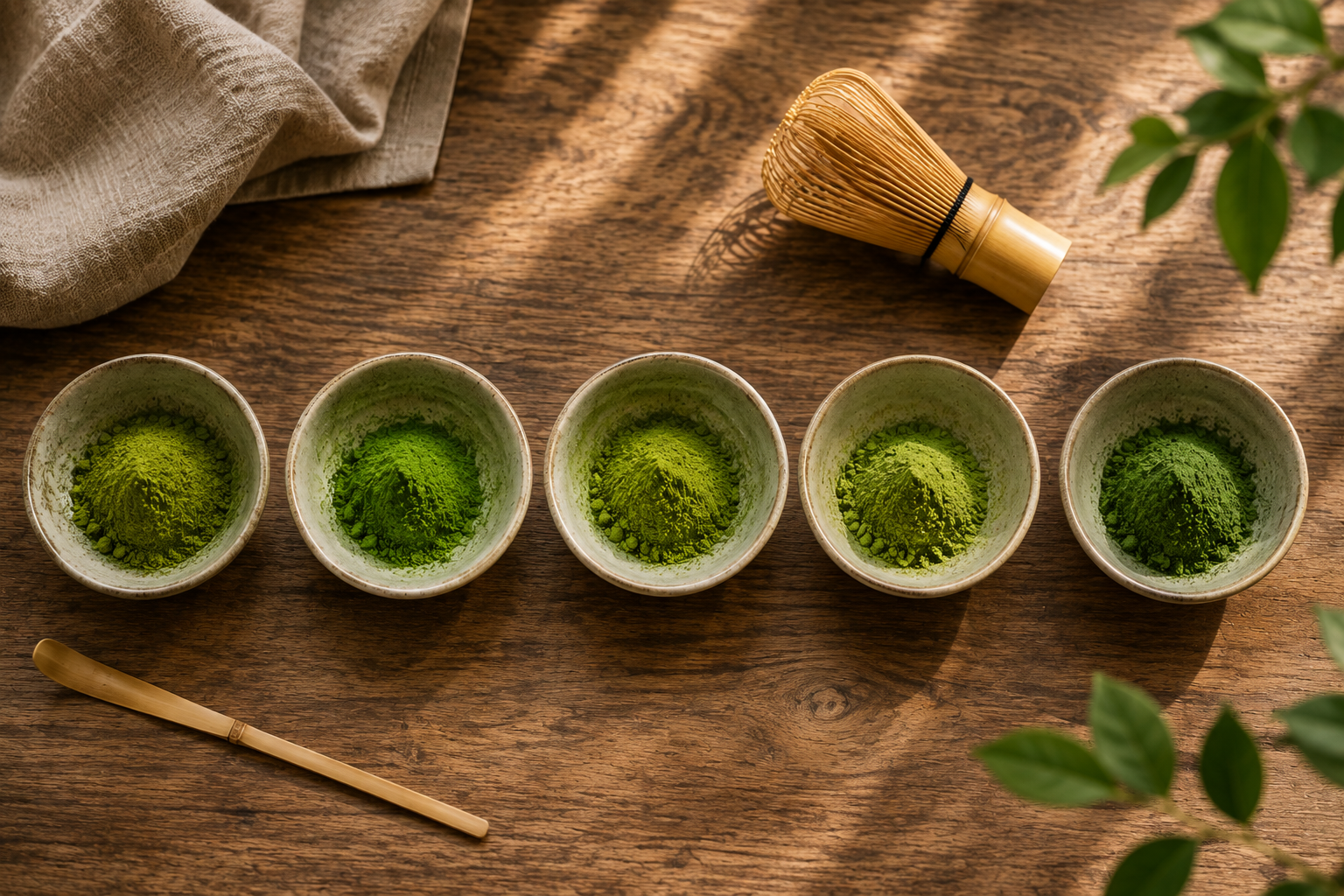
    UjiKyotoBold umami, creamy, naturally sweetVelvety smoothCeremonial drinking, tea ceremony
    NishioAichiBalanced sweetness, gentle bitterness, brightFine and smoothEveryday drinking, lattes, baking
    ShizuokaShizuokaLight, grassy, refreshingly astringentSmooth, less creamyBeginners, blended drinks
    KagoshimaKagoshimaRich, sweet, minimal bitternessCreamy and smoothLattes, desserts, casual daily drinking
    YameFukuokaVery sweet, mellow umami, highly aromaticSilky smoothLuxury ceremonial matcha, wagashi pairing

    A quick note before diving into each region: this isn’t a niche distinction reserved for tea sommeliers. Once you’ve tasted two or three of these back to back, the differences stop feeling subtle and start feeling obvious — the same shift that happens the first time you compare a light-roast coffee to a dark-roast one side by side instead of drinking them weeks apart.

    The Regions, One by One

    Uji (Kyoto)

    Uji is where shading tea plants to produce tencha — the leaf that becomes matcha — was pioneered centuries ago, and that head start shows in how deeply refined the region’s processing tradition is. The climate, hot summers and cold winters, is credited with developing especially high-grade leaves, and Uji’s growers have had the longest runway of anyone to perfect the craft.

    Why it tastes the way it does: Uji matcha tends toward bold umami with a creamy, naturally sweet character and a deep, vivid green color. It’s the flavor profile most people picture when they imagine “proper” ceremonial matcha, largely because Uji effectively set that template in the first place.

    The catch: Uji production has been shrinking, and that scarcity, combined with centuries of prestige, pushes prices upward in a way that isn’t purely about the leaf in the tin — you’re also paying for reputation and heritage. That doesn’t make it bad value, but it’s worth knowing the price reflects more than terroir alone. If you’re buying Uji matcha purely for the flavor and not the name, it’s worth comparing it honestly against Nishio or Yame before assuming Uji automatically wins.

    Nishio (Aichi)

    Nishio produces a striking share of Japan’s tencha output from a relatively small number of dedicated growers, and it’s built its reputation on consistency and value rather than ceremonial prestige. The Samidori cultivar, closely associated with this region, produces a vivid green color and refined umami.

    Why it tastes the way it does: Balanced sweetness with gentle bitterness, bright and vivid green, generally described as clean and approachable rather than intense in any one direction.

    The catch: Because Nishio isn’t chasing Uji’s reputation game, it tends to be undervalued relative to what’s actually in the tin — genuinely good matcha at a more reasonable price than the ceremonial-prestige regions charge for similar quality.

    Shizuoka

    Shizuoka is Japan’s largest overall tea-producing region by volume, though matcha specifically is a smaller part of a broader green tea operation that also produces enormous quantities of sencha. The terrain near Mount Fuji gives the tea a clean, brisk quality.

    Why it tastes the way it does: Lighter, grassier, and noticeably more astringent than Uji or Kagoshima matcha, with a brighter, less creamy character overall.

    The catch: That brisker, more astringent profile makes Shizuoka matcha a genuinely good beginner-friendly option, but it’s not the pick if you’re chasing the deep umami and sweetness that draws people to matcha in the first place. Think of it as matcha’s more assertive, less coddling entry point.

    Kagoshima

    Kagoshima recently overtook Shizuoka as Japan’s top tea-producing region by volume, and its volcanic soil is a defining feature of the local growing conditions. Warmer weather and a longer growing season than Kyoto also shape how the plants develop here.

    Why it tastes the way it does: Rich and sweet with minimal bitterness, vibrant bright green, and a creamy, smooth texture that holds up particularly well in lattes and desserts.

    The catch: Kagoshima’s scale and warmer climate make for reliable, crowd-pleasing matcha, but it doesn’t carry the same centuries-deep ceremonial tradition Uji or Yame can claim — this is matcha built for wide appeal and everyday use rather than formal tea ceremony. That’s not a knock on quality, just a different design goal than the more ceremony-focused regions.

    Yame (Fukuoka)

    Yame built its reputation on gyokuro, a shade-grown loose-leaf tea prized for its intense sweetness, and that same expertise in shading and cultivation carries directly over into their matcha.

    Why it tastes the way it does: Very sweet with mellow umami and a notably aromatic quality, deep jade green in color, and an especially silky-smooth texture — arguably the sweetest, most fragrant of the five regions here.

    The catch: That sweetness and refinement come at a price point that competes directly with Uji, and Yame doesn’t carry quite the same name recognition outside Japan, so you’re relying more on your own palate than brand prestige to judge whether it’s worth it. In my experience, it usually is — this is the region I’d point to as the most underrated relative to its actual quality.

    Head to Head: The Comparisons People Search For

    Uji vs. Shizuoka: Uji is creamier, sweeter and deeper in umami; Shizuoka is lighter, grassier and more astringent. Choose Uji for traditional usucha you’ll drink straight, and Shizuoka if you want a brisker, more affordable matcha or you’re still working out whether you like matcha at all.

    Uji vs. Yame: the closest match on this list. Both make refined ceremonial matcha. Yame tends to be sweeter and more aromatic; Uji tends to be deeper and more classic. If you love one, the other is worth trying – Yame often costs a little less for similar quality, because its name carries less of a premium outside Japan.

    Uji vs. Nishio: Nishio is the practical alternative to Uji – smooth, bright and balanced, usually at a lower price. For everyday drinking and lattes, many people won’t miss the difference. For a special bowl of usucha, Uji still has the edge in depth.

    Uji vs. Kagoshima: different design goals. Uji is built around tradition and ceremony; Kagoshima around sweetness, creaminess and everyday use, which makes it one of the best choices for lattes and desserts.

    Which Region for How You Drink It

    Region matters a lot for some uses and barely at all for others. This is the chart I’d use before paying extra for a region name.

    How you drink itBest regionsDoes region matter?What to look for on the label
    Usucha (thin tea), straightUji, Yame, NishioA lotFirst harvest, ceremonial or usucha grade
    Koicha (thick tea)Uji, YameA lotKoicha grade – expensive, so buy small tins
    Hot matcha latteKagoshima, NishioSomewhat“Latte” or premium culinary grade
    Iced latte or smoothieKagoshima, ShizuokaA littleBright color; freshness matters more than prestige
    Baking and dessertsNishio, Kagoshima, ShizuokaVery littleCulinary grade; skip expensive ceremonial tins

    If you mostly make lattes or bake, don’t pay extra for a famous region name – that money is better spent on fresher matcha in a smaller tin.

    Which Region Should You Actually Buy

    If you want the classic, deeply traditional matcha experience: Uji. It set the template most people associate with “real” ceremonial matcha, for good reason.

    If you want excellent quality without paying for prestige: Nishio. Consistently good, less defined by reputation than by what’s actually in the cup.

    If you’re new to matcha and want something less intense to start with: Shizuoka. Lighter and brisker, a gentler on-ramp than the creamier regions.

    If lattes and desserts are your main use case: Kagoshima. Rich, sweet, and built to hold up against milk and sugar without disappearing.

    If you want the sweetest, most aromatic option and don’t mind paying for it: Yame. Underrated outside Japan relative to how good it actually is.

    A Few Things People Ask Me

    Is Uji matcha always the best? Not objectively — it’s the most prestigious and traditional, but “best” depends on what you’re after. Yame arguably edges it out on pure sweetness and aroma, and Nishio offers comparable quality at a friendlier price. Uji’s reputation is earned, but it isn’t the automatic top pick for every use case.

    Does region matter more than grade? They matter differently. Grade tells you about harvest timing, leaf selection, and processing quality within a batch; region tells you about the underlying flavor character that grade is then refining. A high grade from a region whose profile you dislike will still taste like that region, just a more polished version of it.

    Can I taste the regional difference in a latte, or does milk erase it? Milk mutes a lot of nuance, but it doesn’t erase everything — Kagoshima’s natural sweetness and creaminess in particular tend to survive milk better than Shizuoka’s brisker, more astringent profile does. If lattes are your main use case, leaning toward Kagoshima or Nishio makes practical sense.

    Do brands usually disclose the growing region on the package? The better ones do, and it’s a genuinely useful signal — a brand willing to name Uji, Nishio, Kagoshima, or Yame specifically is telling you more than one that just says “grown in Japan.” Vague sourcing language is often a sign the tea is a blend from wherever was cheapest that season, not a deliberate regional choice.

    Are there other matcha-growing regions besides these five? Yes — Mie prefecture (sometimes marketed under the Ise name) and a handful of smaller producing areas also grow tencha, but Uji, Nishio, Shizuoka, Kagoshima, and Yame account for the overwhelming majority of what actually reaches the export market, which is why they’re the five worth knowing well.

    Where I Landed

    If I’m being honest about where my own preference landed after actually tasting through all five, it’s Yame — that sweetness and aroma won me over in a way I didn’t expect, especially given how little attention it gets outside Japan compared to Uji. But I’d never tell someone new to matcha to start there. Start with Uji or Nishio to understand what “classic” matcha tastes like, then branch out to Kagoshima if you’re leaning toward lattes, Shizuoka if you want something lighter, and Yame once you’re ready for the sweetest, most fragrant version of all of this.

    None of these regions are wrong choices, and none of them are automatically “better” than the others despite what price tags and prestige might suggest. The real value of knowing this stuff isn’t picking a winner — it’s being able to walk into a tea shop or scroll through an online listing and actually understand what you’re being offered, instead of defaulting to whichever tin has the most recognizable name on it.

    If you’re ready to actually buy based on region rather than just brand name, my matcha powder brands comparison covers where several well-known brands source from, which is often the fastest way to shop by region. If you’d rather try single-origin tins from small farms, Nio Teas’ matcha collection is where I’d start – the link-only discount mentioned at the top applies there too.

  • Matcha vs Green Tea: What’s Actually Different (And Which One You Should Be Drinking)

    Matcha vs Green Tea: What’s Actually Different (And Which One You Should Be Drinking)

    Disclosure: This post contains affiliate links. If you buy through one of them, I may earn a small commission at no extra cost to you.

    Someone once told me matcha was “just stronger green tea,” the way espresso is stronger coffee, and I let that idea sit unquestioned in my head for way longer than I should have. It’s not true, and once you actually understand why, a lot of confusing label claims and wildly different price tags suddenly make sense. Matcha and green tea come from the exact same plant. That’s about where the similarities stop.

    I get why the confusion sticks around. Every grocery store green tea box says “made from the finest green tea leaves,” every matcha tin says roughly the same thing, and both liquids end up some shade of green in your cup. The marketing language is nearly identical even though the products underneath it are genuinely different. If you’ve ever wondered why matcha costs three or four times as much as sencha, or why one makes you jittery and the other doesn’t, or which one you should actually be reaching for on a given morning, this is the article that untangles it.

    The Problem You’re Actually Trying to Solve

    You’ve searched “matcha vs green tea” because somewhere along the way, you got curious enough to want the real answer instead of another vague “they’re basically the same, just different forms” line. Maybe you’re trying to decide which one to buy. Maybe you read a health claim about one of them and want to know if it’s actually true or just marketing. Maybe you had both back to back and noticed they tasted nothing alike and want to know why.

    The short, honest answer is that matcha is a specific, more intensive version of green tea production — same plant, dramatically different growing method, processing, and how you actually consume it. Once you understand those three differences, most of the confusing claims you’ve run into online start to make sense on their own.

    Who This Article Is NOT For

    Let’s save you some scrolling if this isn’t quite your situation.

    • If you already know the production differences and just want to know which specific brand to buy, skip ahead to my matcha powder brands comparison or my best hojicha brands guide instead — this article is about the category-level differences, not brand picks.
    • If you’re looking for a deep dive into the chemistry and clinical research, this is a practical explainer, not a scientific literature review. I’ll cover what the actual compound differences are, but I won’t be citing dosage-specific studies or making medical claims.
    • If you’re only interested in flavored or bottled green tea drinks, most of what’s below assumes you’re drinking loose leaf or whisked matcha, not a sweetened bottled beverage — the comparisons don’t map cleanly onto those products.

    If you’re past that, here’s where the actual explanation starts.

    What Actually Makes Them Different

    There isn’t a long list of vague factors here — the differences boil down to three things, and once you understand these, everything else about matcha versus green tea follows naturally.

    1. How the plant is grown. This is the biggest, earliest divergence, and it happens weeks before either tea is even picked.

    2. How the leaf is processed after harvest. This is where “green tea” splits into dozens of styles (sencha, bancha, gyokuro) while matcha stays on its own single track.

    3. How you actually consume it. This is the difference most people notice first, even if they don’t realize it’s downstream of the first two.

    Comparison Table

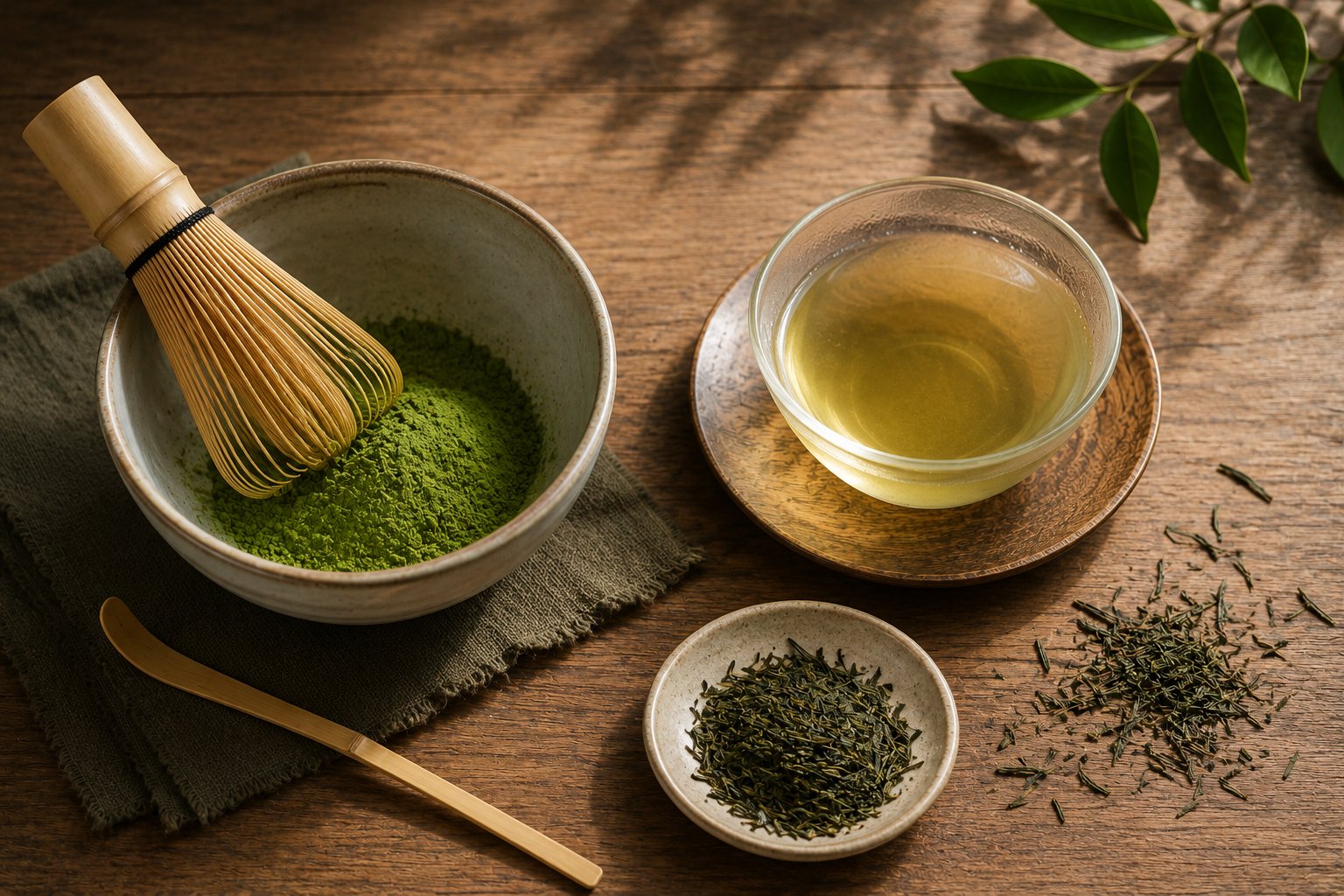
    MatchaGreen Tea (e.g. Sencha)
    Growing methodShaded 3–4 weeks before harvestGrown in full sun
    ProcessingSteamed, dried, deveined, stone-ground into powderSteamed, rolled, dried into whole or cut leaves
    How you drink itWhole leaf consumed, whisked into waterLeaves steeped, then discarded
    CaffeineHigher (whole leaf ingested)Lower (only what leaches into the water)
    L-theanineHigher (shading boosts it significantly)Present, but at lower levels
    FlavorConcentrated umami, vegetal, slightly bitterLighter, grassy, sometimes floral or nutty
    Typical priceSignificantly higher per servingGenerally more affordable

    The Differences, One by One

    The Growing Method

    Ordinary green tea grows in full sun, the way most people picture a tea field — rolling green hills under open sky. Matcha starts life the same way, but a few weeks before harvest, the plants are covered to block most of the sunlight. That shading is not a minor detail; it’s the single decision that sets everything else about matcha in motion.

    Why it matters: Blocking sunlight forces the plant to produce more chlorophyll to compensate, which is a big part of why matcha has that intensely vivid green color that ordinary green tea leaves don’t share. Shading also increases the leaf’s L-theanine content, an amino acid responsible for a lot of the calm, smooth “umami” character matcha is known for, while suppressing the compounds that would otherwise make the tea taste sharply bitter or astringent.

    What this means for you: If you’ve ever wondered why matcha tastes rounder and more savory while sencha tastes brighter and grassier, this is the root cause. It’s not a different plant — it’s a plant grown under deliberately different conditions to push its chemistry in a specific direction. It also explains why matcha’s growing season is more limited and labor-intensive than ordinary green tea’s, since the shading structures have to be built, maintained, and timed precisely around harvest — another reason matcha commands a higher price before it’s even been processed.

    The Processing

    After harvest, both teas get steamed almost immediately to stop oxidation and lock in that green color — this part is actually similar. From there, the paths split completely.

    Ordinary green tea gets rolled, shaped, and dried into the whole or cut leaves you recognize from a tea bag or loose-leaf tin. Matcha’s leaves, called tencha before processing, skip the rolling step entirely. Instead, the leaves are dried flat, have their stems and veins removed, and are then stone-ground into the ultra-fine powder that defines matcha. That grinding process alone is slow and labor-intensive — traditional stone mills produce only a small amount of matcha per hour, which is a real part of why matcha costs what it does.

    Why it matters: This processing difference is the reason matcha and green tea aren’t interchangeable in recipes or brewing methods, even though they come from the same plant. You can’t “steep” matcha the way you’d steep sencha, because there’s no discrete leaf to strain out — it’s already a powder meant to be fully suspended in the water. It also explains the price gap more directly than anything else on this list: grinding tencha into matcha the traditional way, on granite stone mills, is genuinely slow. A single traditional stone mill typically produces only a small amount of true ceremonial-grade matcha per hour, which is part of why higher-end matcha carries a price tag that ordinary rolled-leaf green tea never approaches.

    How You Actually Consume It

    This is the difference most people notice immediately, even before they understand why it’s happening. With green tea, you steep leaves in hot water, let the flavor infuse, and then discard the spent leaves. You’re only getting whatever compounds successfully dissolved into the water during that steeping window.

    With matcha, there’s no discarding step. You whisk the entire ground leaf directly into water, which means you’re consuming the whole leaf, not just what leached out of it. That’s the real reason matcha delivers noticeably more caffeine and L-theanine per serving than an equivalent amount of steeped green tea — you’re not filtering anything out.

    Why it matters: This is also why matcha hits differently than a cup of green tea. The caffeine comes in alongside a much higher dose of L-theanine, which is often described as producing a calmer, more sustained energy than the sharper jolt-and-crash some people get from coffee or plain caffeine. Whether that’s the case for you personally varies, but the mechanism — whole leaf versus steeped-and-discarded — is the actual explanation, not just marketing language. It’s also worth knowing this cuts both ways: because you’re consuming everything in the leaf, matcha also concentrates whatever else was present in that leaf, which is part of why sourcing and growing conditions matter more for matcha than they do for a tea you’re only partially extracting.

    Why the Price Gap Is So Large

    This is worth calling out on its own, because it’s the practical question underneath a lot of “matcha vs green tea” searches: why does a tin of matcha cost what four or five bags of sencha cost?

    It comes down to the three differences above stacking on top of each other. Shading the plants requires physical infrastructure and reduces how much usable leaf a farm produces per season. Only the youngest, most tender leaves are typically selected for higher-grade matcha, which narrows the harvest window further. And the grinding process itself, done properly, is slow by design. None of that applies to ordinary green tea, which can be harvested more broadly, processed faster, and doesn’t require specialized milling equipment. You’re not paying extra for a fancier label — the entire production chain is genuinely more constrained at every step.

    That’s also why “cheap ceremonial-grade matcha” is worth being skeptical of. If the price doesn’t reflect that constrained production process, something in the chain was almost certainly cut — often the shading period, the leaf selection, or the grinding method.

    Which One Should You Actually Reach For

    If you want a daily ritual that feels calm and deliberate: matcha. The whisking process itself, plus the L-theanine-driven steadiness many people report, makes it suited to a slower morning routine rather than a rushed one.

    If you want something light, easy, and affordable to drink multiple times a day: green tea, specifically a straightforward sencha. It’s gentler, cheaper, and doesn’t require special equipment the way whisking matcha does.

    If you want the most caffeine for the least effort: matcha, since you’re consuming the whole leaf rather than a partial steeped extraction — though if pure caffeine content is genuinely your top priority, coffee will still outpace both.

    If you’re cooking or baking: green tea, or a culinary-grade matcha rather than ceremonial grade. Ceremonial matcha’s subtlety gets lost against other ingredients, so save that grade for drinking it straight, and use a cheaper culinary grade or plain green tea leaves in recipes instead.

    If you’re just starting out and unsure which you’ll actually like: green tea is the lower-commitment entry point — no whisk required, cheaper to experiment with, and a more familiar starting flavor for most people coming from black tea or coffee.

    A Few Things People Ask Me

    Is matcha just “stronger” green tea? Not exactly — it’s a different growing and processing method applied to the same plant, which changes the flavor profile and nutrient concentration, not just the strength. A very strong cup of steeped sencha still won’t taste like matcha, because the shading and whole-leaf consumption change the actual chemistry, not just the intensity.

    Does matcha really have more antioxidants than green tea? Because you consume the whole leaf with matcha instead of a partial water-soluble extraction, you generally do end up with more of the leaf’s compounds per serving, antioxidants included. That said, be wary of any specific numeric claim (“10x the antioxidants!”) without a cited source — a lot of marketing rounds this up aggressively.

    Which one has less caffeine, if I’m sensitive to it? Green tea, by a meaningful margin, since you’re only getting what dissolves during steeping rather than the whole ground leaf. If caffeine sensitivity is a real concern, a lighter steeped green tea, or hojicha specifically (which is roasted in a way that further reduces caffeine), are both gentler options than matcha.

    Can I substitute one for the other in a recipe? Not cleanly. Matcha’s concentrated powder form behaves very differently in baking and cooking than steeped green tea leaves or liquid would, and the flavor intensity is much higher. If a recipe calls for one, swapping in the other usually throws off both the texture and the taste.

    Is one of them more “authentic” or traditional than the other? Not really — both have deep roots in Japanese tea culture, just in different contexts. Matcha is closely tied to formal tea ceremony, while steeped green teas like sencha are the everyday, at-home tea most people in Japan actually drink day to day. Neither one is a lesser or more “real” version of the other; they simply developed for different occasions.

    Where I Landed

    Neither one is objectively “better” — they’re suited to different moments, and honestly, I keep both in my kitchen for exactly that reason. Matcha is what I reach for when I want a slower, more deliberate morning, something closer to a ritual than a beverage. Green tea, usually a simple sencha or a good hojicha, is what I drink the rest of the day when I just want something pleasant without the ritual attached, or when I’m on my third cup and don’t want to whisk anything.

    The confusion around these two was never really about the tea itself — it was about the language brands use to describe them, which tends to flatten two genuinely different products into interchangeable-sounding marketing copy. Now that you know where the actual differences come from — the shading, the grinding, the whole-leaf consumption — you can read past that marketing copy a lot more easily, and price tags that used to seem arbitrary will start to make a lot more sense.

    If you’d rather just taste the difference for yourself before reading another word about it, a simple side-by-side works well: a basic loose-leaf sencha next to a starter tin of ceremonial-grade matcha will make everything above click into place faster than any explanation can.

    If you’ve read this far because you’re trying to decide what to actually buy rather than just understand the difference, that’s the natural next step — take a look at my matcha powder brands comparison if matcha’s the direction you’re leaning, or my best hojicha brands guide if you want something gentler and more everyday. Either way, now you’ll actually know why they taste as different as they do.

  • Best Hojicha Brands Compared: What’s Actually Worth Your Money

    Best Hojicha Brands Compared: What’s Actually Worth Your Money

    Disclosure: This post contains affiliate links. If you buy through one of them, I may earn a small commission at no extra cost to you. I only recommend products I’d genuinely tell a friend to try — everything below is based on my own research and, where noted, my own kettle.

    Quick Picks

    • Best overall for drinking straight: Ippodo Kuki-Hojicha – gentle, refined and easy to love. Ippodo Kuki-Hojicha on Amazon
    • Best for lattes: Hojicha Co. powder – a dark roast built to stand up to milk. Hojicha Co. on Amazon
    • Best budget everyday cup: Ito En – dependable and cheap. Ito En hojicha on Amazon
    • Prefer farm-direct Japanese tea? Nio Teas ships teas from small Japanese farms. At the time of writing, ordering through the links on this page automatically applies a 10% discount at checkout – no code needed. Offers can change, so check the final price in your cart.

    The full comparison table, what each one gets right and wrong, and which roast suits how you drink are below.

    Hojicha was the tea I recommended to my coffee-addicted friend who kept saying matcha made her jittery. One cup in, she asked why nobody told her roasted green tea existed sooner. That reaction isn’t rare — hojicha has this way of winning people over almost immediately, because it tastes nothing like what most people expect from green tea. No grassy bitterness, no astringency to fight through. Just something closer to toasted grain and caramel, with next to no caffeine to worry about at 8pm.

    The tricky part is that hojicha sits in a weird spot in the market. It’s not as hyped as matcha, so it doesn’t have dozens of dedicated subscription boxes competing for your attention. What it does have is a scattered mix of options — a couple of centuries-old Kyoto and Uji tea houses that happen to make excellent hojicha as part of a wider catalog, a modern brand built specifically around the hojicha latte trend, a small-batch regional specialty, and a familiar everyday name you’ve probably already seen on a grocery shelf without realizing how good its hojicha actually is. None of that is obvious until you’ve actually gone looking, so I did the looking for you.

    The Problem You’re Actually Trying to Solve

    You’ve searched “best hojicha brands” because you’ve either already had good hojicha somewhere and want to recreate it at home, or you’ve heard about the hojicha latte trend and want to know where to actually buy the real thing instead of a flavored syrup dressed up with the name. Either way, you’re running into the same wall: unlike matcha, there isn’t a wall of “hojicha subscription box” options to sort through. What you actually get is a scattered field of individual products from brands that vary wildly in quality and sourcing honesty, with no obvious starting point.

    That scattered field is actually the bigger trap. A lot of “hojicha powder” on the market is made from low-grade tea dust roasted dark enough to hide how mediocre the base leaf was. Good hojicha starts with decent tea before it ever sees a roasting drum, and a dark, smoky roast can mask an underlying leaf that wasn’t worth much to begin with — which is exactly how a lot of budget hojicha gets away with tasting merely “fine” instead of actually good. This guide sorts out which of the well-known names are doing that properly, and which ones are worth your money at every price point, including the cheap end.

    Who This Article Is NOT For

    Let’s save you some scrolling if this isn’t quite your situation.

    • If you want flavored hojicha blends — vanilla hojicha, hojicha chai, anything with add-ins — none of what’s below is really about that. Everything here is rooted in the roasted leaf itself, not flavoring dressed up with a hojicha label.
    • If you’re only after the cheapest possible bag to try hojicha once, one of the picks below actually covers that ground well, so keep reading rather than skipping straight to the grocery store aisle.
    • If matcha lattes are actually what you’re after and hojicha is just a passing curiosity, you’ll get more mileage from my matcha powder brands comparison instead — the sourcing and grading conversations are completely different between the two categories.

    If you’re past that, here’s where the actual comparison starts.

    What I Actually Judged These On

    Three criteria, consistent with every guide on this site.

    1. Base leaf quality before roasting. Hojicha is fundamentally a processing technique, not a tea in its own right — it starts as bancha, sencha, kukicha (stems), or even leftover tencha, then gets roasted. I looked at whether a brand names what they started with, because that base leaf determines the ceiling of how good the final roast can taste.

    2. Roasting craft and transparency. Is the roast level, the equipment, or the roaster’s approach described specifically, or is it just “traditionally roasted” with no further detail? Small-batch roasters who talk about drum temperature and batch size tend to actually care about consistency in a way mass producers don’t.

    3. Fit for how you’ll actually drink it. Straight brewing and latte-making want different things from hojicha — latte use tolerates a bolder, darker roast better since milk mutes subtlety, while straight brewing rewards a more balanced roast that doesn’t need dairy to soften it. I noted which products lean which way so you’re not stuck guessing after the bag arrives.

    Comparison Table

    OptionBase LeafRoast StyleStarting PriceBest For
    Ippodo Kuki-HojichaKukicha (stems)Gentle, biscuit-like~$15–25Refined, food-pairing hojicha
    Marukyu Koyamaen HojichaLeftover tenchaGentle roast on high-grade leaf~$15–30Matcha lovers curious about hojicha
    Maruhachi Kaga BouchaStem hojichaBold, smoky, drum-roasted~$15–25Distinctive regional character
    Hojicha Co.Blended leaf, powderDark roast, latte-optimized~$15–25Hojicha lattes specifically
    Ito EnBancha/sencha blendConsistent, everyday roast~$8–15Budget-friendly daily drinking

    The Options, One by One

    Ippodo Kuki-Hojicha

    Shop Ippodo Kuki-Hojicha on Amazon →

    Ippodo, the centuries-old Kyoto tea house, makes their hojicha from kukicha — the stems and twigs left over from processing other teas — rather than leaf. That base gives it a naturally lighter, more refined character than leaf-based hojicha.

    What I liked: In my experience, this is the hojicha I’d serve someone who claims they don’t like roasted tea, because it’s gentler and more biscuit-like than smokier styles. It pairs well with food in a way bolder hojichas don’t, which fits Ippodo’s overall reputation for balance over intensity.

    What bugged me: If you’re specifically chasing that deep, smoky, campfire-adjacent hojicha character, this will read as too mild. It’s a specific style, not an all-purpose “best hojicha” pick.

    Bottom line: The right choice if refinement and food-pairing matter more to you than boldness.

    Marukyu Koyamaen Hojicha

    Shop Marukyu Koyamaen Hojicha on Amazon →

    Marukyu Koyamaen is primarily known as a top-tier matcha producer, but their hojicha is made from high-grade tencha leaves that didn’t quite make the cut for matcha, then gently roasted rather than blasted dark. That starting point — leaf that was grown and shaded for matcha in the first place — sets it apart from hojicha made from ordinary bancha.

    What I liked: You can genuinely taste the difference a better base leaf makes. The roast is gentle enough that you still get sweetness and depth rather than pure smokiness, which makes sense once you know it started life as near-matcha-grade tea.

    What bugged me: It’s priced closer to a specialty tea than a daily-drinking bag, which makes sense given the leaf quality, but it’s worth knowing upfront if you were expecting bargain-bin hojicha pricing — this isn’t the tea to buy if you just want something cheap to try the category for the first time.

    Bottom line: Worth trying specifically if you already love Marukyu Koyamaen’s matcha and are curious what their approach looks like applied to a roasted tea, or if you want to see what hojicha tastes like when it starts from genuinely premium leaf.

    Maruhachi Kaga Boucha

    Shop Maruhachi Kaga Boucha on Amazon →

    This is a stem hojicha from Kanazawa, roasted in small batches in a rotating iron drum at high heat, and it’s the boldest, most distinctive option on this list — amber liquor, aromas leaning toward roasted chestnut, cocoa, and a touch of wood smoke.

    What I liked: This is the hojicha for someone who wants character, not just a mild “green tea alternative.” The smoke and roast come through clearly without tipping into bitterness, and it’s the kind of tea that makes a genuinely memorable gift for someone who already drinks a lot of tea and wants something they haven’t tried.

    What bugged me: That same boldness makes it a less obvious starting point if you’re brand new to hojicha and want something gentle to ease into. Start with a milder option first if this is your very first hojicha.

    Bottom line: The most distinctive, gift-worthy pick on this list — not necessarily the first hojicha you should buy, but possibly the most memorable one.

    Hojicha Co.

    Shop Hojicha Co. powder on Amazon →

    Hojicha Co. builds their whole product line around the hojicha latte specifically, with a dark roast powder designed to hold up against milk rather than get lost in it.

    What I liked: If lattes are genuinely your main use case, this is the most purpose-built option here. The darker roast reads as more forceful in a straight cup but translates into a well-balanced, not-too-sweet latte, which is exactly the tradeoff you want from a powder built for that job.

    What bugged me: Drunk straight, without milk, the boldness that makes it great in a latte can feel like a bit much — it’s optimized for one use case and it shows.

    Bottom line: The clear pick if hojicha lattes are the actual reason you’re here, less ideal if you mostly drink tea straight.

    Want more detail? My full Hojicha Co. review covers who’s behind the brand, how to use the powder beyond a basic latte, and the honest downsides.

    Ito En

    Shop Ito En hojicha on Amazon →

    Ito En is the name most people have actually seen before, even if they didn’t clock it as hojicha — it’s one of Japan’s largest tea companies, and their roasted green tea shows up in tea bags, bottled drinks, and instant powder sticks across grocery stores worldwide.

    What I liked: This is the most accessible, most consistent everyday option on this list by a wide margin. It won’t blow you away with complexity, but it’s a genuinely solid, reliable cup for a fraction of what the specialty brands charge, and it’s the easiest to buy in bulk without a second thought.

    What bugged me: It’s mass-produced, and it tastes like it — pleasant and clean, but without the depth or character you get from a small-batch, single-origin option like Kaga Boucha or Marukyu Koyamaen. This is a daily-drinker, not a tea to savor slowly.

    Bottom line: The right call if you just want good, reliable hojicha in your kitchen without spending specialty-tea money, or if you’re not yet sure hojicha is going to become a habit and don’t want to commit much upfront.

    Which One Should You Actually Buy

    If you want something refined that pairs well with food: Ippodo Kuki-Hojicha. Gentle, biscuit-like, never smoky.

    If you already love a specific matcha brand and want to see their range: Marukyu Koyamaen Hojicha, made from the same caliber of leaf as their matcha.

    If you want something bold and memorable, especially as a gift: Maruhachi Kaga Boucha. The most distinctive character on this list.

    If lattes are your whole reason for being here: Hojicha Co. Built specifically for that job, and it shows in the results.

    If you just want a reliable everyday cup without spending much: Ito En. Not exciting, but genuinely dependable, and the easiest on-ramp if you’re still deciding whether hojicha is for you.

    A Few Things People Ask Me

    Is hojicha actually caffeine-free? No. It’s often described as nearly caffeine-free, but Japan’s official food composition tables list brewed hojicha at about 20mg of caffeine per 100ml – the same as sencha under their standard brewing method. In practice, a home cup is often gentler, because hojicha is usually made from later-harvest leaves or stems and brewed quickly with plenty of water. It’s a good evening choice for many people, just not a zero-caffeine one.

    Can I make hojicha from regular green tea myself by roasting it at home? Technically yes, and some people do pan-roast bancha at home for fun, but getting the even, controlled roast that small-batch producers achieve with proper drum roasters is hard to replicate in a home kitchen. It’s a fun experiment, not a real substitute for a well-roasted commercial product.

    Why do some hojicha products use stems instead of leaves? Stem-based hojicha, called kukicha when unroasted, naturally has a lighter, sweeter character than leaf-based hojicha, and stems roast more evenly than leaf because they’re denser and less prone to scorching. That’s part of why Ippodo’s stem-based hojicha reads as gentler than a leaf-roasted style like Kaga Boucha.

    Does the powder form work as well as loose leaf for a straight cup, not just lattes? It can, but powder brands tend to be optimized specifically for milk-based drinks, where a bolder roast reads as balanced rather than harsh. If you mostly drink hojicha straight, a loose-leaf option built for that purpose, like Ippodo’s or Marukyu Koyamaen’s, will usually taste more considered than a latte-first powder.

    Is the mass-market stuff like Ito En actually worth buying, or should I always go specialty? It’s genuinely worth buying if your goal is a dependable daily cup rather than a tea to savor and think about. Specialty hojicha rewards attention the way a good coffee bean does; Ito En is more like a solid drip coffee — reliable, unpretentious, and exactly what you want most mornings.

    Where I Landed

    If I had to recommend just one starting point to someone who’s never had real hojicha, I’d point them to Ippodo’s Kuki-Hojicha first, purely because it’s the gentlest on-ramp and the least likely to surprise someone expecting “just tea.” But the tea I keep coming back to for myself is the Kaga Boucha — that smoky, roasted-chestnut character isn’t for everyone’s first cup, but once you know you like hojicha, it’s the one that actually feels worth seeking out rather than just defaulting to whatever’s on the shelf.

    And if you just want a dependable everyday bag without thinking too hard about it, Ito En will not let you down — it’s proof that you don’t need to spend specialty-tea money to get a genuinely decent cup of hojicha on a Tuesday morning.

    Whichever you pick, brew it a little differently than you would sencha or matcha — hojicha handles hotter water well, close to boiling, since roasting removes most of the compounds that turn bitter under heat. That’s part of why it’s such a forgiving, easy tea to get right on your first try, even if everything else on this list of options felt a little overwhelming to sort through. It’s also, in my experience, the tea most likely to convert someone who insists they don’t like green tea at all — which might be exactly why you ended up here.

    Ready to try one? Start with Ippodo Kuki-Hojicha on Amazon for a gentle first cup, or browse Nio Teas for farm-direct Japanese teas with the link-only discount.

  • The Real Matcha Whisk Buying Guide (Plus the Other Tools Nobody Tells You About)

    The Real Matcha Whisk Buying Guide (Plus the Other Tools Nobody Tells You About)

    Disclosure: This post contains affiliate links. If you buy through one of them, I may earn a small commission at no extra cost to you. I only recommend tools I’d genuinely tell a friend to buy — everything below is based on my own research and, where noted, my own kitchen counter.

    My first matcha whisk was a metal milk frother I already owned, because I figured foam is foam and a chasen was just an overpriced kitchen gadget dressed up in tradition. My matcha clumped, tasted bitter in the middle of the cup where the powder never fully dissolved, and I genuinely thought I just didn’t like matcha for almost a year. Then I actually bought a real bamboo whisk, and the difference wasn’t subtle — it was like realizing you’d been making coffee with the wrong grind size the entire time.

    That’s the thing nobody tells you when you’re getting into matcha: the tea itself only gets you halfway there. The tools matter more than people expect, and buying the wrong ones, or buying nothing at all and improvising, is the single most common reason people decide they “don’t like matcha” when really they just never gave it a fair shot.

    I’ve since talked to enough people who had the exact same experience — a bitter, clumpy first cup, a quiet conclusion that matcha “just isn’t for them,” and no idea that the actual culprit was sitting in their utensil drawer the whole time. So before you write off matcha, or before you spend money on a random bundle that showed up first in a search, here’s what each of these tools actually does, and which ones are worth your money.

    The Problem You’re Actually Trying to Solve

    You’ve searched for a matcha whisk buying guide because you’re standing in front of a wall of options — bamboo whisks with different prong counts, bowls in every shape and price point, tiny bamboo scoops that seem almost decorative, and you have no idea which of these actually matter versus which ones are just upsells designed to make your cart bigger.

    Here’s the part that makes this genuinely confusing: some of these tools make a real, tasteable difference, and some genuinely don’t matter much for a casual home routine. A wide, uneven splash pattern from whisking in the wrong shaped bowl is a real problem. A hand-carved bamboo scoop instead of a plain teaspoon is mostly aesthetic. This guide is here to tell you which is which, so you spend money where it actually improves your cup and skip the stuff that’s just pretty packaging.

    Who This Article Is NOT For

    Let’s save you some scrolling if this isn’t quite your situation.

    • If you exclusively make iced matcha lattes in a shaker bottle or blender, you genuinely don’t need a chasen at all. A cocktail shaker or milk frother does that job fine, and buying ceremonial tools for a latte routine is like buying a chef’s knife to open mail.
    • If you already own a full tea ceremony set and are just looking to upgrade one specific piece, this broad starter guide will feel too basic — you probably already know more about prong counts than most of what’s below.
    • If budget is your only concern and you want the single cheapest way to make drinkable matcha, a metal whisk or a milk frother will technically work, just without the texture a bamboo chasen gives you. This guide is for people willing to spend a little to get it right, not for the absolute rock-bottom option.

    If you’re past that, here’s where the actual guide starts.

    What I Actually Judged These On

    Three criteria, same as every guide on this site, because vague “best of” lists with ten fuzzy factors don’t actually help anyone decide.

    1. Does it change the taste or texture of your matcha? Some tools genuinely affect the final cup. Others are nice to have but wouldn’t change what’s in front of you if you skipped them. I weighted tools that touch this directly — the whisk, the sifter — much higher than tools that are mostly about ritual and presentation.

    2. Durability for a beginner’s hands. A lot of these are handmade from natural materials, and a beginner who doesn’t yet know proper whisking technique can snap a delicate whisk within weeks. I looked at which options forgive an unpracticed hand versus which ones are for people who already know what they’re doing.

    3. Price relative to actual necessity. Not every tool on a “complete tea ceremony set” list is something you need on day one. I sorted these by what genuinely earns its place in a beginner’s kit versus what you can add later once you know you’re sticking with matcha.

    Comparison Table

    ToolDo You Actually Need It?Price RangeWhat It Actually Affects
    Chasen (bamboo whisk)Yes, essential~$10–35Texture, foam, clump-free mixing
    Furui (sifter)Yes, close to essential~$8–20Removes clumps before whisking, smoother texture
    Chawan (matcha bowl)Helpful, not mandatory~$15–60+Whisking angle and space, presentation
    Chashaku (bamboo scoop)Nice to have~$5–15Consistent measuring, mostly ritual
    Naoshi / whisk standNice to have~$5–12Preserves whisk shape between uses

    The Tools, One by One

    Chasen (Bamboo Whisk)

    Shop bamboo matcha whisks on Amazon →

    This is the one tool on this list that actually changes what’s in your cup, not just how you feel making it. A chasen is carved from a single piece of bamboo into anywhere from 60 to 120 (occasionally more) delicate prongs, and that prong count genuinely changes texture: fewer prongs, like 60 to 80, produce a coarser, denser foam suited to thick koicha-style matcha, while higher prong counts like 100 to 120 create a finer, silkier froth better suited to the thin, everyday usucha style most people drink at home.

    What I liked: For a first whisk, 80 to 100 prongs is genuinely the sweet spot — sturdy enough that a beginner’s imperfect technique won’t destroy it in a week, and fine enough to give you real foam instead of a clumpy mess. In my experience, this single purchase did more for my matcha than any brand or grade upgrade I made afterward.

    What bugged me: Cheap machine-cut whisks exist everywhere, and they look nearly identical to handcrafted ones in a product photo. They tend to shed prongs and lose their shape within a few weeks of regular use, which ends up costing you more in replacements than just buying a properly made one upfront.

    Bottom line: Buy one 80 to 100-prong bamboo chasen before you buy anything else on this list. It’s the one non-negotiable tool, and everything else in this guide is secondary to getting this one right.

    Furui (Sifter)

    Shop matcha sifters on Amazon →

    A furui is a small fine-mesh sifter, sometimes with a decorative charm on top, that you use to sift matcha powder before whisking. It sounds like a step you could skip, and for a while I did skip it, which is exactly why my early cups had that gritty, clumpy texture I blamed on the tea itself.

    What I liked: This is the cheapest fix for the most common beginner complaint about matcha — clumps that never fully dissolve no matter how hard you whisk. Sifting breaks up compacted powder before water even touches it, and the improvement is immediate and obvious the very first time you try it. Matcha compacts naturally just sitting in its tin, so this isn’t a sign you bought bad tea — it’s just what fine powder does over time.

    What bugged me: It’s one more small item to store and clean, and if you’re someone who forgets extra kitchen tools exist, it’ll end up in a drawer unused. The habit matters more than the tool itself.

    Bottom line: Cheap enough that there’s no real reason to skip it. Pairs directly with the chasen as the second half of “actually necessary.”

    Chawan (Matcha Bowl)

    Shop matcha bowls (chawan) on Amazon →

    A chawan is a wide, shallow bowl specifically shaped to give a chasen room to move in a proper “W” or zigzag motion without splashing everywhere. You can technically whisk matcha in any mug, but the shape matters more than you’d expect.

    What I liked: Once I switched from a narrow mug to an actual wide-mouthed bowl, whisking got noticeably easier and less messy — there’s simply more room for the whisk to move freely, which translates to better foam with less effort. It’s also just a nicer way to start your morning than hunching over a coffee mug.

    What bugged me: This is where price can spiral fast if you’re not careful. Handmade ceramic chawan from known potters can run well over a hundred dollars, and none of that premium touches the taste of your tea. A simple, wide, mid-priced bowl does the same functional job as an expensive artisan piece.

    Bottom line: Worth having, but resist the urge to buy the prettiest, priciest option first. A plain wide bowl works exactly as well functionally.

    Chashaku (Bamboo Scoop)

    Shop chashaku bamboo scoops on Amazon →

    A chashaku is a slender bamboo scoop traditionally used to measure matcha powder, usually two scoops per serving in casual use.

    What I liked: It’s an elegant little object, and if you care about the ritual side of matcha as much as the drinking side, it adds something a plastic measuring spoon doesn’t.

    What bugged me: Functionally, a regular teaspoon measures matcha just as accurately. This is squarely in “nice to have” territory, not “changes your tea” territory, and I’d rank it well below the whisk and sifter in priority.

    Bottom line: A pleasant add-on once you already have the essentials, not something to prioritize early.

    Naoshi (Whisk Stand)

    Shop matcha whisk stands (naoshi) on Amazon →

    A naoshi is a small ceramic or bamboo stand that holds your chasen upright between uses, keeping the prongs curved outward in their proper shape instead of drying flat or bent.

    What I liked: If you’re actually going to keep a bamboo whisk for a long time, this genuinely extends its life by preventing the prongs from drying in a bent or crushed position, which is one of the most common ways a chasen degrades early.

    What bugged me: It’s easy to forget to use it consistently, and if you do, the whisk dries however it happens to be sitting, which defeats the purpose. It only helps if it actually becomes part of your routine.

    Bottom line: A smart cheap investment if you’re committed to keeping your whisk in good shape long-term, skippable if you’re still deciding whether matcha is a habit that’s going to stick.

    Which Tools Should You Actually Buy

    If you’re buying your very first matcha setup and want the minimum that actually works: an 80 to 100-prong bamboo chasen plus a furui sifter. That combination alone fixes the two most common beginner complaints — bitterness from bad technique and clumps from unsifted powder.

    If you’re past the basics and want the full at-home ritual: add a wide chawan next. It’s the next tool that actually changes your experience, not just your shelf display.

    If you’re already committed and want to protect your investment long-term: add a naoshi whisk stand so your chasen doesn’t degrade prematurely.

    If you’re mostly in it for the aesthetic and ritual, not just the tea: the chashaku is worth adding once the functional basics are covered, purely for the experience of it.

    A Few Things People Ask Me

    Can I use a metal whisk or milk frother instead of a bamboo chasen? You can, and it’ll technically produce foam, but it won’t aerate matcha the same way. Bamboo’s flexible prongs fold air into the tea gently as they move, where a metal whisk tends to just stir the powder around without the same fine, even froth. If you’re making straight usucha-style matcha with just water, the difference is noticeable. If you’re drowning it in milk for a latte, it matters a lot less.

    How long does a bamboo whisk actually last? With reasonable care — rinsing right after use, letting it dry properly shaped (ideally on a naoshi), and not leaving matcha residue caked in the prongs — a decent chasen can last a year or more of daily use before the prongs start losing their spring. Cheap machine-cut ones tend to fail much sooner, sometimes within weeks.

    Do I need a different whisk for koicha versus usucha, or can one whisk do both? An 80 to 100-prong whisk can reasonably handle both styles if you’re just drinking at home casually. Serious practitioners tend to keep a lower-prong whisk (60-80) specifically for the dense, paste-like koicha and a higher-prong one (100+) for everyday thin usucha, but that’s a refinement for later, not a day-one requirement.

    Is a “matcha starter kit” bundle worth buying instead of individual pieces? Sometimes, if the bundle’s whisk and sifter are decent quality — check reviews on the specific bundle rather than assuming bundling automatically means good value. I’ve seen bundles where the bowl and scoop are nice but the whisk itself is the cheap machine-cut kind that won’t last, which defeats the purpose of buying a “complete” set in the first place.

    Where I Landed

    If I could go back and redo my own matcha starter kit, I’d have skipped the milk frother phase entirely and just bought a proper 100-prong bamboo whisk and a cheap sifter on day one. Those two tools alone would have saved me a year of wrongly assuming I didn’t like matcha. Everything else on this list — the bowl, the scoop, the stand — genuinely makes the experience nicer, but none of it will fix bad matcha the way the whisk and sifter will.

    Start with those two. Everything after that is you deciding how deep into the ritual you actually want to go, and there’s no wrong answer there — just don’t let a fancy chawan distract you from the one tool that’s doing the actual work. Matcha rewards patience with the right setup a lot faster than most people expect; you don’t need years of practice, you just need the whisk and sifter doing what they’re supposed to do from your very first cup.

  • Matcha Powder Brands Compared: Which One Actually Deserves Your Money

    Matcha Powder Brands Compared: Which One Actually Deserves Your Money

    Disclosure: This post contains affiliate links. If you buy through one of them, I may earn a small commission at no extra cost to you. I only recommend products I’d genuinely tell a friend to buy — everything below is based on my own research and, where noted, my own whisk.

    Quick Picks

    • Best for beginners: Ippodo – well-graded, easy to buy, and room to move up to better tins without switching brands. Ippodo matcha on Amazon
    • Best for understanding grades: Marukyu Koyamaen – the deepest grade range, from everyday to top ceremonial. Marukyu Koyamaen matcha on Amazon
    • Best organic pick: Encha – single-farm organic matcha with simple, clear grades. Encha matcha on Amazon
    • Best budget organic: DoMatcha – dependable for daily drinking and lattes. DoMatcha on Amazon
    • Prefer single-origin tins from small farms? Nio Teas’ matcha collection. At the time of writing, ordering through the links on this page automatically applies a 10% discount at checkout – no code needed. Offers can change, so check the final price in your cart.

    Shopping by region instead of brand? My Uji vs Shizuoka vs Yame matcha comparison covers how each region tastes. Below, you’ll find the full comparison table and an honest look at each brand.

    The first time I bought “ceremonial grade” matcha from a random Amazon listing, I made myself a cup, took one sip, and immediately understood why so many people say they hate matcha. It tasted like grass clippings dissolved in bitterness, with none of the sweetness or umami depth people rave about. It took me embarrassingly long to realize the problem wasn’t matcha. It was that specific tin. Once I tried the real thing from an actual Kyoto tea house, the gap was almost insulting — like comparing instant coffee to a proper pour-over.

    That gap is exactly why this comparison exists. “Ceremonial grade” isn’t a regulated term, so brands slap it on almost anything, and the price range for something calling itself matcha runs from eight dollars to eighty. You shouldn’t have to gamble twenty dollars just to find out if you like matcha or just dislike bad matcha, and yet that’s exactly the position most people are in when they start searching.

    I went through four of the brands that come up again and again in serious tea circles — not the ones with the biggest ad budgets, but the ones actual matcha drinkers keep recommending to each other. Two of them are centuries-old Kyoto tea houses. Two are newer companies built around a specific sourcing philosophy. All four are legitimately good in different ways, and none of them are the eight-dollar tin that ruined my first impression of matcha.

    The Problem You’re Actually Trying to Solve

    You’ve searched “matcha powder brands comparison” because you’re standing at a fork in the road. Either you’ve had good matcha somewhere — a café, a friend’s kitchen, a trip to Japan — and you want to recreate that at home without settling for something worse. Or you’ve had bad matcha, the kind that’s bitter and dull green and tastes like it’s been sitting in a warehouse for two years, and you’re trying to figure out if the good stuff is worth the extra money.

    Here’s what makes this genuinely confusing: unlike coffee, where you can generally trust that “specialty grade” means something, matcha grading is done entirely in-house by each brand. There’s no third party checking whether a company’s “ceremonial grade” is actually first-harvest tencha ground on granite stones, or just decent second-harvest leaf with a fancier label. You end up relying on brand reputation more than you’d like to, which is exactly why it matters which brand you pick, not just which grade.

    Who This Article Is NOT For

    Let’s save you some scrolling if this isn’t quite your situation.

    • If you only ever make iced matcha lattes with a ton of milk and sweetener, you genuinely don’t need to spend on the top-tier ceremonial grades reviewed here. A culinary or latte-grade matcha will serve you just as well and save you real money — I’ll flag which brands do that well.
    • If you’re buying matcha purely for baking, the same applies. Heat and other ingredients mask the subtlety that ceremonial grade is built for, so save your money for a culinary-grade tin instead.
    • If you want flavored or blended matcha — vanilla matcha, matcha chai, anything with add-ins — none of the four brands below are really playing in that space. They’re all about the purity of the leaf itself, and honestly, once you taste a genuinely good unflavored matcha, you tend to lose interest in the flavored stuff anyway.
    • If you’re shopping purely on price and want the cheapest possible tin that technically qualifies as matcha, none of the four brands here compete on rock-bottom price. You can find cheaper matcha elsewhere; you just won’t find matcha that tastes like what I’m describing in this article.

    If you’re past that, here’s where the actual comparison starts.

    What I Actually Judged These On

    Three criteria, same as always, because vague “best of” lists with ten fuzzy factors don’t help anyone actually decide.

    1. Sourcing and traceability. Can I find out exactly where the tea comes from — which region, ideally which farm — and how it’s processed? “Sourced from Japan” without more detail is a red flag. The brands that name their region, their farmers, or their tea master earn real trust here.

    2. Grade honesty. Since “ceremonial grade” is unregulated, I looked at whether a brand’s grading system actually tracks meaningful differences in harvest timing, leaf selection, and processing, or whether it’s just marketing language slapped on a single product line.

    3. Price per actual use. Not just the sticker price, but what you’re paying per gram relative to what grade you’re getting, and whether the price reflects real quality or just brand prestige.

    Comparison Table

    BrandOriginGrading TransparencyStarting PriceBest For
    IppodoUji, Kyoto (multiple sourcing partners)High~$25–90+Traditionalists, gifting, wide grade range
    Marukyu KoyamaenUji, Kyoto (single estate since 1704)Very High~$20–150+Purists who want to understand grading depth
    EnchaUji, Kyoto (single family-farm partner)High~$15–35Organic-focused buyers, everyday drinkers
    DoMatchaUji & Kagoshima, JapanModerate–High~$15–45Budget-conscious organic shoppers

    The Brands, One by One

    Ippodo

    Shop Ippodo Matcha on Amazon →

    Ippodo has been operating in Kyoto since 1717, which makes it one of the oldest and most recognized names in Japanese tea, period. Their matcha lineup spans a genuinely wide range, from everyday-drinking grades up to Kuon, one of their most expensive offerings, made from young shaded leaves and handpicked in small batches.

    What I liked: The range itself is a strength. You can start cheap to see if you even like matcha, then move up the ladder as your palate develops, all within one trusted brand instead of hopping between companies. The packaging and presentation also make Ippodo an easy gift, if that’s part of what you’re shopping for.

    What bugged me: Because the catalog is so wide, it’s easy to accidentally buy a mid-tier tin thinking you’re getting the good stuff, when Ippodo’s real showcase teas sit at a noticeably higher price point. Read the product descriptions carefully rather than assuming “ceremonial” means top-of-line here — within Ippodo’s own lineup, “ceremonial” covers a much bigger spread than you’d expect from a single label.

    Bottom line: A safe, well-regarded starting point, especially if you want room to grow into pricier tins later without switching brands. It’s the brand I’d point a total beginner toward first, purely because the on-ramp is so gentle.

    Marukyu Koyamaen

    Shop Marukyu Koyamaen Matcha on Amazon →

    Marukyu Koyamaen is often described as Ippodo’s biggest rival in global popularity, and once you dig into their grading system, you understand why tea nerds love them specifically. Founded in 1704 with a private estate in Uji, their range splits cleanly into two families: higher grades like Kinrin and above that can be prepared as both thick and thin tea, and everyday grades from Wako downward meant for thin tea only.

    What I liked: In my experience, this is the brand that rewards you for actually learning about matcha instead of just buying whatever’s labeled “premium.” Once you understand the Koicha/Usucha split, their whole lineup suddenly makes sense, and you can pick exactly the right tin for what you’re making instead of guessing. Their tea can be found in temples, shrines, and Japanese tea schools, which says something about how seriously working professionals take it.

    What bugged me: That same depth is a barrier for a total beginner. If you don’t already know the difference between Koicha and Usucha, the product page can feel like a foreign language, and you might need to do some homework before you order confidently — this isn’t a brand that holds your hand the way Ippodo’s simpler product descriptions do.

    Bottom line: My personal pick for anyone who wants to go deep and actually understand grading, not just buy a pretty tin. Worth the slight learning curve, and honestly, the homework is part of the fun once you get into it.

    Encha

    Shop Encha Matcha on Amazon →

    Encha is a California-based company founded by a Stanford-trained engineer who left tech after discovering matcha, and built the whole business around one philosophy: work directly with a single family farm in the Uji mountains, skip the trading layers, and stay obsessively organic. Every product carries USDA organic certification, and the company runs its own annual testing for heavy metals and radioactivity on top of the standard certification requirements.

    What I liked: The farm-direct story isn’t just marketing fluff — the sourcing is genuinely narrow and specific, one partner farm rather than a blend from unnamed suppliers, and that traceability shows up in the consistency from batch to batch. If organic certification and transparency matter more to you than heritage and prestige, Encha is doing real work here, not just using the word “organic” as a sticker.

    What bugged me: Because everything comes from one farm, you don’t get the range of regional or seasonal variety that Ippodo or Marukyu Koyamaen can offer across their catalogs. It’s excellent at what it does, but it does one thing.

    Bottom line: The best pick if organic certification and clean sourcing are non-negotiable for you, and you don’t need a huge range of grades to choose from.

    DoMatcha

    Shop DoMatcha on Amazon →

    DoMatcha sources from Uji and Kagoshima and leans hard into a multi-country organic verification story — certified organic in Japan under JAS standards, and again under USDA and Canadian organic standards, which is a more layered claim than most competitors bother making. Their ceremonial line comes from shade-grown, de-veined, de-stemmed tencha leaves, and they also offer a Summer Harvest line picked later in the year for a bolder, more affordable everyday option.

    What I liked: The Summer Harvest line is genuinely smart. It’s positioned honestly as a different, less delicate harvest rather than being dressed up as ceremonial grade, which is more transparency than a lot of budget-friendly brands bother with. It’s a good entry point if you want something drinkable daily without ceremonial-grade pricing.

    What bugged me: The sourcing detail, while solid, isn’t quite as narrow or farm-specific as Encha’s single-partner story, and the flavor profile in the lower tiers leans more generic than the top brands on this list. It’s reliable rather than exceptional.

    Bottom line: A dependable, reasonably priced option if you want organic certification and a daily-drinking tea without paying Ippodo or Marukyu Koyamaen prices.

    A Quick Word on Tasting Fairly

    If you do end up buying more than one of these to compare, brew them the same way every time, or you’ll end up comparing your brewing inconsistency instead of the tea. Use water around 175–180°F, not boiling — boiling water scorches matcha and makes even good tea taste bitter, which is a mistake I made constantly when I was starting out and blamed on the tea itself. Sift the powder before whisking if you can; it breaks up clumps and makes a real difference in texture. And taste each one plain, without milk or sweetener, at least once, even if lattes are your end goal — that’s the only way to actually judge what you’re paying for.

    Which One Should You Actually Buy

    If you’re completely new to matcha and want to build up gradually: Ippodo. The wide grade range means you can start cheap and work your way up as you figure out what you actually like.

    If you already know you like matcha and want to actually understand what you’re drinking: Marukyu Koyamaen. The grading system takes a little study, but it pays off in knowing exactly what you’re buying every time.

    If organic certification and farm-direct sourcing are what matter most to you: Encha. Single farm, real traceability, none of the vague “sourced from Japan” language.

    If you want a solid daily-drinking matcha without ceremonial-grade pricing: DoMatcha’s Summer Harvest line, or their standard ceremonial tin if you want to go a notch up without jumping brands entirely.

    A Few Things People Ask Me

    Is more expensive always better with matcha? Not linearly. There’s a real quality jump between an eight-dollar grocery-store tin and a proper mid-range ceremonial grade from any of these four brands — that gap is enormous. But the jump from a solid mid-range tin to the most expensive showcase tea in a brand’s lineup is much smaller and mostly matters to people who already have a trained palate for it.

    Does “organic” actually matter for matcha specifically? More than it does for most teas, in my opinion, because you’re consuming the entire ground leaf rather than steeping and discarding it the way you would with loose leaf tea. Whatever was on that leaf ends up in your cup. That’s part of why Encha and DoMatcha lean so hard on their organic certifications as a selling point rather than an afterthought.

    Can I use ceremonial grade for lattes, or do I need a separate culinary grade? You can, but it’s a bit like using a fine wine for sangria. Ceremonial grade is built for the subtlety of whisked tea with water alone; once you add milk and sweetener, most of that nuance gets buried anyway. If lattes are your main use case, save money and buy a culinary or latte-specific grade instead.

    How fast does matcha go bad once opened? Faster than most people expect. Matcha oxidizes and loses vibrancy within four to six weeks of opening if it’s not kept airtight and refrigerated, which is part of why buying a giant tin to save money can backfire — you’ll be drinking stale matcha by the time you’re halfway through it.

    Where I Landed

    If someone asked me to buy exactly one tin right now, no context, I’d reach for Marukyu Koyamaen. Not because the others are worse — Ippodo’s range is genuinely excellent and Encha’s sourcing story is the most transparent of the bunch — but because Marukyu Koyamaen is the brand that made me actually understand matcha instead of just drinking it. Once you know what Koicha-grade tea is supposed to taste like, you stop being able to unknow it, and that changes how you drink every cup after.

    That said, don’t let anyone, including me, talk you into an eighty-dollar tin as your very first purchase. Start with something mid-range, figure out if the fuss is actually for you, and only then decide how far down this rabbit hole you want to go. Matcha is one of those things people either fall for completely or shrug off entirely, and there’s no way to know which one you are until you’ve had a cup that was actually made well.

    Ready to choose? Start with Ippodo matcha on Amazon if you’re new to matcha, or browse Nio Teas’ matcha collection for single-origin tins with the link-only discount.

  • The Real Guide to Japanese Green Tea Subscription Boxes (No Fluff, No Filler)

    The Real Guide to Japanese Green Tea Subscription Boxes (No Fluff, No Filler)

    Disclosure: This post contains affiliate links. If you sign up through one of them, I may earn a small commission at no extra cost to you. I only recommend boxes I’d genuinely tell a friend to try — everything below is based on my own research and, where noted, my own cup.

    I still remember the first bag of sencha someone shipped me from Shizuoka. It was nothing like the dusty green tea bags I’d grown up drinking. It smelled like grass after rain, almost savory, and it made the supermarket stuff I’d been drinking taste like colored water. That’s the moment I got hooked, and it’s also the moment I started paying way too much attention to how these tea subscription boxes actually differ from one another — because on the surface, they all look the same. Pretty packaging, “authentic Japanese tea” somewhere in the copy, a monthly charge to your card. Underneath, they’re wildly different products, and picking the wrong one means either wasting money or, worse, deciding you just don’t like Japanese tea when really you just never tasted the good stuff.

    The Problem You’re Actually Trying to Solve

    You’ve typed “japanese green tea subscription box” into Google because you want something specific, even if you haven’t fully named it yet. Maybe you had matcha at a café and want to know what real tea tastes like. Maybe you’re tired of buying random bags of sencha online and getting stale, low-grade leaves with a fancy label slapped on top. Maybe you just want a small monthly ritual that isn’t coffee, something that slows you down for five minutes.

    Here’s the pain point nobody addresses upfront: most of these boxes are not actually about tea. They’re snack boxes that happen to include a tea bag or two, and the marketing photos make it look like tea is the star when it’s really a supporting character. If you want tea — real leaf, real origin, real seasonal variation, the kind of thing where you can taste the difference between a spring harvest and a summer one — you have to know which boxes treat tea as the main event and which ones treat it as a garnish next to the candy.

    That’s the whole point of this guide. I went through five of the most talked-about options, dug into how they actually source their tea, and figured out which one matches which kind of person. I’m not here to tell you every box is amazing, because they’re not, and I’m not going to pretend a snack box is a tea box just because a press release says so. I’m here to tell you which one actually matches what you’re looking for, and to be upfront about the ones that will leave you a little let down.

    Who This Article Is NOT For

    Before you keep reading, let’s save you some time, because I’d rather lose a reader now than waste twenty minutes of your day.

    • If you want variety-pack candy and snacks with tea as a side character, this isn’t the deep dive you need. You’re better off going straight to a snack-box comparison instead of a tea-focused one, because everything here is graded on tea quality first.
    • If you’re looking for herbal tea, chai blends, or “wellness tea” with turmeric and ashwagandha thrown in, none of what’s below is for you. Everything here is rooted in actual Japanese tea culture — sencha, gyokuro, hōjicha, kamairicha, matcha — not flavored blends dreamed up in a marketing meeting somewhere.
    • If your budget is under $15 a month and you want it delivered every single month like clockwork, a couple of the boxes here ship quarterly or let single-origin sourcing dictate the schedule, and that inconsistency will drive you nuts if predictability is what you’re after.
    • If you already have a favorite Japanese tea farm or importer you order directly from, honestly, stick with them. A subscription box is for discovery, not for replacing a relationship you’ve already built with a specific grower.

    If none of those describe you, keep going, because the next part is where this actually gets useful.

    What I Actually Judged These On

    I narrowed my criteria down to three things, because most “best of” lists throw in ten vague factors — packaging, “value,” “customer service reputation” — that don’t actually help you decide anything when you’re staring at your phone trying to pick one.

    1. Tea centrality. Is tea the actual product, or is it a supporting cast member in a snack box? I weighted this heavily because it’s the single biggest source of disappointment I’ve seen in reviews, forums, and honestly in my own first subscription years ago. Nothing stings quite like paying for a “tea box” and getting one sad sachet buried under twenty bags of rice crackers.

    2. Sourcing transparency. Can you find out where the tea is actually grown, who grows it, and what grade it is? Vague marketing copy like “premium Japanese tea” without a region, a farm, or a harvest season attached is a red flag for me. The good boxes name names — Uji, Shizuoka, Kagoshima, Yame — and the mediocre ones just say “Japan” and hope you don’t ask more.

    3. Value against what you’re actually drinking. Not just price per box, but price per cup, and whether you’re paying for tea or paying for packaging, snacks, and a nice unboxing experience you’ll forget about by month three. A $40 box with one gram of tea is a worse deal than a $20 box that’s mostly tea, even though the sticker price says otherwise.

    Everything below got measured against those three, in that order.

    Comparison Table

    BoxTea FocusFrequencyStarting PriceSourcing TransparencyBest For
    BokksuLow–Medium (snack-first)Monthly~$35–40/moModerateSnack lovers who want a little tea on the side
    SakuracoLow–Medium (snack-first)Monthly~$40/moModerateGift-giving, unboxing experience
    Yunomi ExplorationsHighMonthly or quarterly~$25–35/moHighTea drinkers who want variety and real farm info
    Nio TeasHighMonthly~$20–30/moHighBeginners who want guided single-origin teas
    TomotchaVery HighMonthly~$15–25/moVery HighPurists who want one focused tea a month, no distractions

    Prices shift with promotions and shipping destination, so treat these as a general range, not gospel — always check the current checkout price before you commit.

    The Boxes, One by One

    Bokksu

    Visit Bokksu’s official site →

    Bokksu is, first and foremost, a Japanese snack subscription. You get twenty-plus snacks and candies a month, and tea shows up as one or two items tucked in among the rest, usually tied to a regional or seasonal theme like a prefecture spotlight or a festival.

    What I liked: The curation is genuinely fun, and the accompanying booklet gives you context on where things come from, who makes them, and why. If you’re new to Japanese food culture broadly, not just tea, this scratches that itch well, and it’s a genuinely nice gift for someone who likes snack boxes in general.

    What bugged me: If you’re subscribing specifically for tea, you’ll be underwhelmed. You might get one sachet of hōjicha in a box otherwise packed with rice crackers and chocolate, and the tea rarely gets the same depth of sourcing detail as the snacks do. In my experience, treating Bokksu as a “tea subscription” sets you up to be disappointed — it’s a snack box that happens to include tea, not the other way around, and no amount of clever packaging changes that math.

    Bottom line: Great if snacks are 80% of what you want and tea is a bonus. Skip it if tea is the actual reason you’re here.

    Sakuraco

    Visit Sakuraco’s official site →

    Sakuraco is Bokksu’s sibling in spirit — same general category, monthly artisan snacks from small Japanese makers, with tea and a piece of tableware included each month.

    What I liked: The tableware inclusion is a nice touch if you like building out a little tea corner at home, and the snack sourcing leans toward small, traditional producers rather than mass-market brands, which does come through in the taste and the presentation.

    What bugged me: Same issue as Bokksu — tea is not the center of gravity here. You’ll get maybe one tea item per box, and the sourcing detail on that specific tea tends to be thin compared to boxes that specialize in tea alone. It’s easy to finish the tea in one sitting and forget you even had it a week later.

    Bottom line: Better if you want something to gift, or if you’re building a whole tea-ceremony aesthetic at home and the cup or plate matters as much as the leaves inside it.

    Yunomi Explorations

    Visit Yunomi’s official site →

    Yunomi runs a marketplace of nearly a thousand teas sourced directly from small farms and producers across Japan, and their Explorations subscription pulls from that catalog — you get around eleven different teas per box (roughly 10 grams each) plus a couple of tisanes and Japanese snacks, either monthly or on a quarterly cadence depending on which tier you pick.

    What I liked: This is where sourcing transparency actually shows up in a way that feels real rather than performative. Each tea in the catalog is tied to a specific farm or producer, and because the pool is so large, you genuinely get exposed to teas you’d never stumble onto searching Amazon — folk teas from small villages, roasted varieties, the occasional black or oolong tea grown in Japan, which most people don’t even realize exists. If you want to actually learn tea, not just drink it, this is the box that respects your curiosity instead of talking down to you.

    What bugged me: With that much variety comes some inconsistency. Not every tea in every box will be a favorite, and if you want a dependable “same great tea every month” experience, the discovery format works against you a little. You have to be okay with a miss now and then in exchange for the hits being genuinely memorable.

    Bottom line: My personal pick if you’re already tea-curious and want to keep discovering. It’s the box that treats you like someone who actually cares about tea, not someone who needs a Japan-themed dopamine hit once a month.

    Nio Teas

    Visit Nio Teas’ official site →

    Nio Teas focuses specifically on green tea and matcha, sourced from small farmers who grow without pesticides, and the subscription structure lets you pick between more matcha-forward months or more leaf-tea-forward months, with rarer and more exclusive teas unlocking the longer you stay subscribed.

    What I liked: The pesticide-free sourcing claim is specific and checkable, not just a vague “premium” label slapped on the box, and I appreciated that new subscribers get a starter tool — a kyusu teapot or a matcha whisk — so you’re not stuck steeping tea with the wrong equipment and wondering why it tastes off. That detail alone tells you they’ve thought about the beginner experience.

    What bugged me: Because it splits attention between matcha and leaf tea, you don’t get quite the same depth in either direction as a box that commits to one lane. If you already know you’re a leaf-tea person, or already know you’re a matcha person, you might find yourself paying for variety you don’t actually want month after month.

    Bottom line: Solid for someone starting from zero who wants both matcha and leaf tea without having to choose yet, and doesn’t want to buy a whisk and a teapot separately before they even know if they’ll like it.

    Tomotcha

    Visit Tomotcha’s official site →

    Tomotcha does one thing: every month, they ship a single distinctive Japanese tea, usually loose-leaf green tea like sencha or gyokuro, sometimes something roasted like hōjicha, sometimes something you’ve genuinely never heard of, like a tamaryokucha or a sakura-infused blend. That’s it. One tea, 40 to 60 grams, enough for around 35 cups.

    What I liked: Honestly, this is the box for people who are tired of “variety” being used as a substitute for quality. There’s no filler, no snack padding, no tableware upsell competing for your attention. You get one tea a month and the freedom to actually sit with it — brew it a few different ways, notice how it changes as the bag empties, actually learn what that specific region’s tea tastes like instead of getting three grams and moving on to the next shiny thing before you’ve even finished forming an opinion.

    What bugged me: If you crave variety or you’re the type who wants to try five different teas in a single month, this will feel slow, maybe even a little boring at first. It’s also not the box for someone who wants a big unboxing moment for social media — the presentation is minimal by design, no confetti, no extras, just tea in a bag with a short write-up.

    Bottom line: My dark horse pick. It’s the least “Instagrammable” box on this list and, in my experience, the one that respects the tea itself the most.

    Which One Should You Actually Pick

    If you’re brand new to Japanese tea and want hand-holding: Nio Teas. The starter equipment and the matcha/leaf split make it forgiving, and you won’t feel lost the first time you open the box.

    If you already know you like tea and want to go deep: Yunomi Explorations. Nearly a thousand teas in the catalog means you won’t run out of things to discover, and the farm-level sourcing is the real deal, not marketing gloss.

    If tea is secondary and what you actually want is a fun monthly Japan-themed unboxing with snacks: Bokksu or Sakuraco. — great for anyone who wants that little rush of excitement every time a new box lands on the doorstep

    If you’re a minimalist who wants to taste one tea properly instead of sampling everything at once: it’s worth knowing that Tomotcha exists and does exactly that — one focused tea a month, no distractions. It’s a tiny operation run out of Osaka, so it doesn’t have the same reach or infrastructure as the others on this list, but it’s the purest expression of “just good tea” you’ll find here.

    A Few Things People Ask Me

    Do any of these ship matcha specifically, or is it mostly leaf tea? Nio Teas splits between matcha and leaf tea by design. The others lean leaf-tea-heavy, with matcha showing up occasionally rather than as the core offering — if matcha specifically is your whole reason for subscribing, it’s worth checking each box’s current lineup before you commit, since rotations change.

    Is it worth paying more for the snack-inclusive boxes if I want both snacks and tea? Only if you genuinely want both in one package and don’t mind the tea being an afterthought. If you actually care about tea quality, you’ll get better results subscribing to a tea-focused box and buying snacks separately.

    Do these boxes work well as gifts for someone who’s never tried Japanese tea? Sakuraco and Nio Teas are the friendliest starting points — Sakuraco for the presentation and unboxing moment, Nio Teas for the included brewing tool that removes the guesswork.

    Where I Landed

    If you’d asked me before I started digging into this which box would win, I would have guessed Bokksu, just because it’s the name that comes up everywhere. It’s not. For actual tea — the thing you presumably searched for — Yunomi Explorations and Nio Teas are doing the real work, with real farm-level sourcing instead of a vague “premium Japan” label slapped on the box. If you’ve been buying random bags of “Japanese green tea” off Amazon and wondering why it tastes flat, start with one of those two.

    Pick the one that matches what you actually wanted when you typed that search query — not the one with the prettiest Instagram feed.