Author: arino

  • How to Store Green Tea (Sencha, Gyokuro, and the Rest)

    How to Store Green Tea (Sencha, Gyokuro, and the Rest)

    Disclosure: This post contains affiliate links. If you buy through one of them, I may earn a small commission at no extra cost to you.

    I once found an unfinished bag of sencha shoved behind a spice rack, six months forgotten, and when I finally brewed it, the color had faded and the flavor was thin and papery, closer to hot water with a vague grassy suggestion than the tea I remembered buying. Nothing was wrong with that tea when I bought it. Everything went wrong after, because loose leaf green tea degrades under the same conditions matcha does, just with a slightly longer runway before it becomes noticeable, which is exactly what let it slip out of my rotation and out of my mind for half a year.

    If you’ve read my guide to storing matcha, the core principles here will feel familiar, since the same enemies, oxygen, light, heat, and moisture, are at work. But loose leaf tea behaves differently enough from powder that it deserves its own specific approach rather than a copy-pasted version of the matcha rules — whole leaves and fine powder simply age at different speeds and respond to different fixes.

    The Problem You’re Actually Trying to Solve

    You’ve searched for how to store green tea because you’ve either just bought a bag of sencha or gyokuro and want to protect it properly, or you’ve had the same experience I did, a tea that tasted great initially and went flat or stale well before you expected. Both come down to a handful of avoidable habits that most people never think about until the tea itself starts tasting disappointing.

    Who This Article Is NOT For

    Let’s save you some scrolling if this isn’t quite your situation.

    • If you’re storing matcha specifically, my matcha storage guide covers that separately, since fine powder behaves differently from whole leaf.
    • If you finish a bag within a few weeks of opening anyway, most of the anxiety below won’t apply to you — you’re already moving through tea fast enough that degradation isn’t a real risk.
    • If you want a hard expiration date, loose leaf tea degrades gradually in quality rather than becoming unsafe, so this is about flavor, not food safety.

    If you’re past that, here’s where the actual guide starts.

    What Actually Degrades Loose Leaf Tea

    Oxygen. Tea oxidizes on contact with air, which dulls both color and flavor over time. This is the single most avoidable factor, since it’s purely a function of how well-sealed your storage actually is, and it’s also the factor most people get wrong simply by leaving a bag folded over rather than properly resealed.

    Light. Light breaks down the chlorophyll responsible for green tea’s color and some of its flavor compounds. A clear jar on an open shelf is one of the worst places you could realistically keep it, however nice it looks sitting out for guests to admire.

    Heat. Warm environments speed up every other degradation process on this list. A cool, stable pantry temperature slows things down meaningfully compared to a spot near a stove or a sunny window, even if the temperature difference feels minor day to day.

    Moisture and odor absorption. Dried tea leaves are porous enough to pick up ambient smells from your kitchen, and any moisture introduced can encourage mold in more severe cases, not just staleness. This is part of why a container that smells faintly of coffee or spices is a genuinely bad neighbor for your tea, even in a sealed cabinet.

    How Long Different Green Teas Actually Last

    TeaOpened Shelf LifeUnopened Shelf Life
    Sencha1–2 months for peak flavor, up to 6 usableUp to a year, sealed and cool
    Gyokuro1–2 months for peak flavorUp to a year, sealed and cool
    Genmaicha2–3 months (rice content adds some stability)Up to a year
    Hojicha3–6 months (roasting adds stability)Up to a year or more

    These numbers are about quality, not safety — tea past these windows won’t make you sick, it will simply taste flatter, more one-dimensional, and less vibrant than it did fresh.

    The Actual Storage Method

    Keep It in an Opaque, Airtight Container

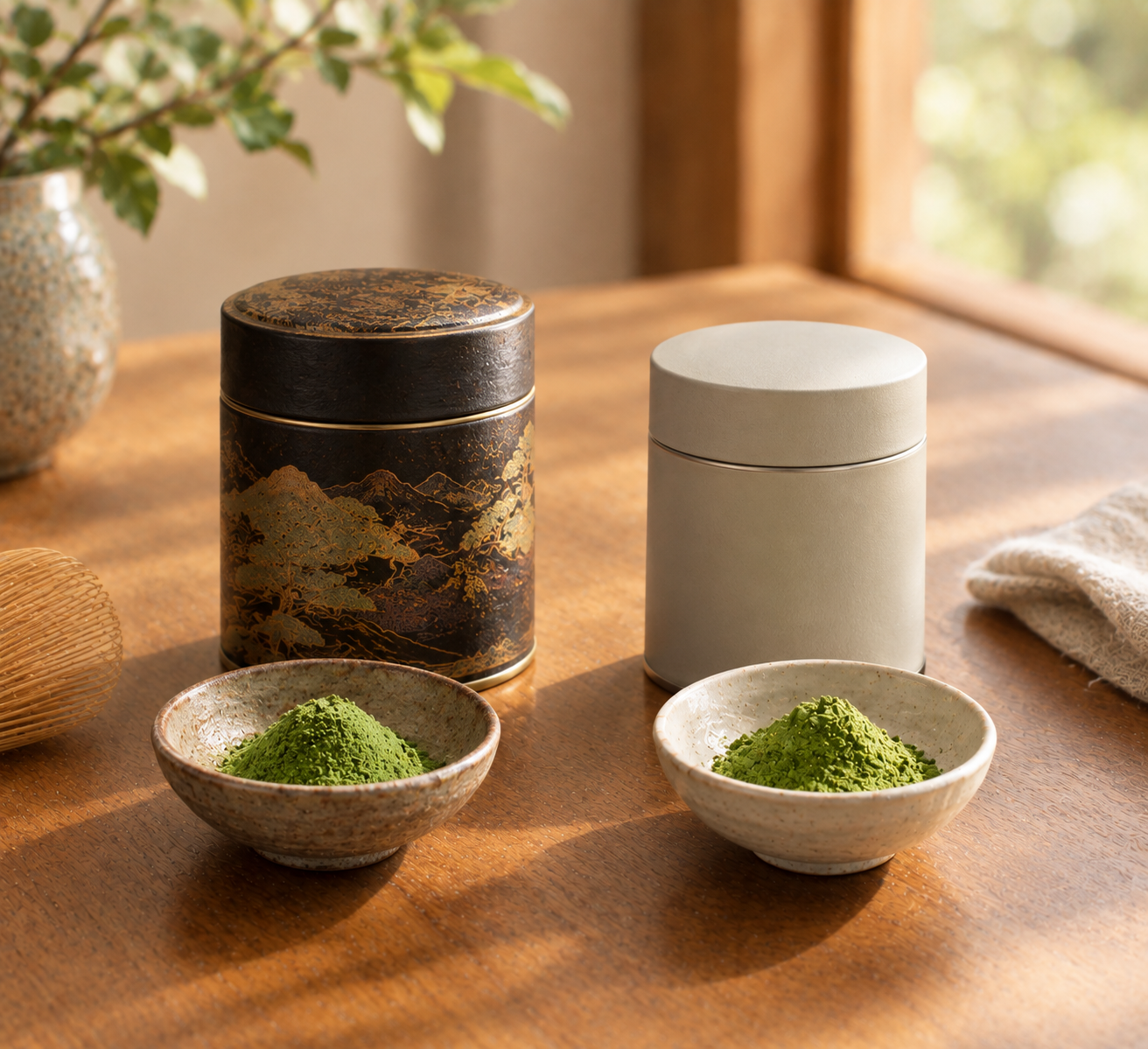
    A tin, a traditional chazutsu (Japanese tea caddy), or a resealable multi-ply bag lined with foil or glassine all work. Clear glass jars look nice on a shelf and are genuinely one of the worst choices for exactly that reason, since they let light straight through to the compounds light is busy destroying.

    Store Somewhere Cool and Dark, Not on a Sunny Counter

    A kitchen cabinet away from the stove is usually sufficient for daily-use tea. Avoid decorative open shelving near a window, however good it looks for the aesthetic.

    Portion Larger Quantities Into Smaller Containers

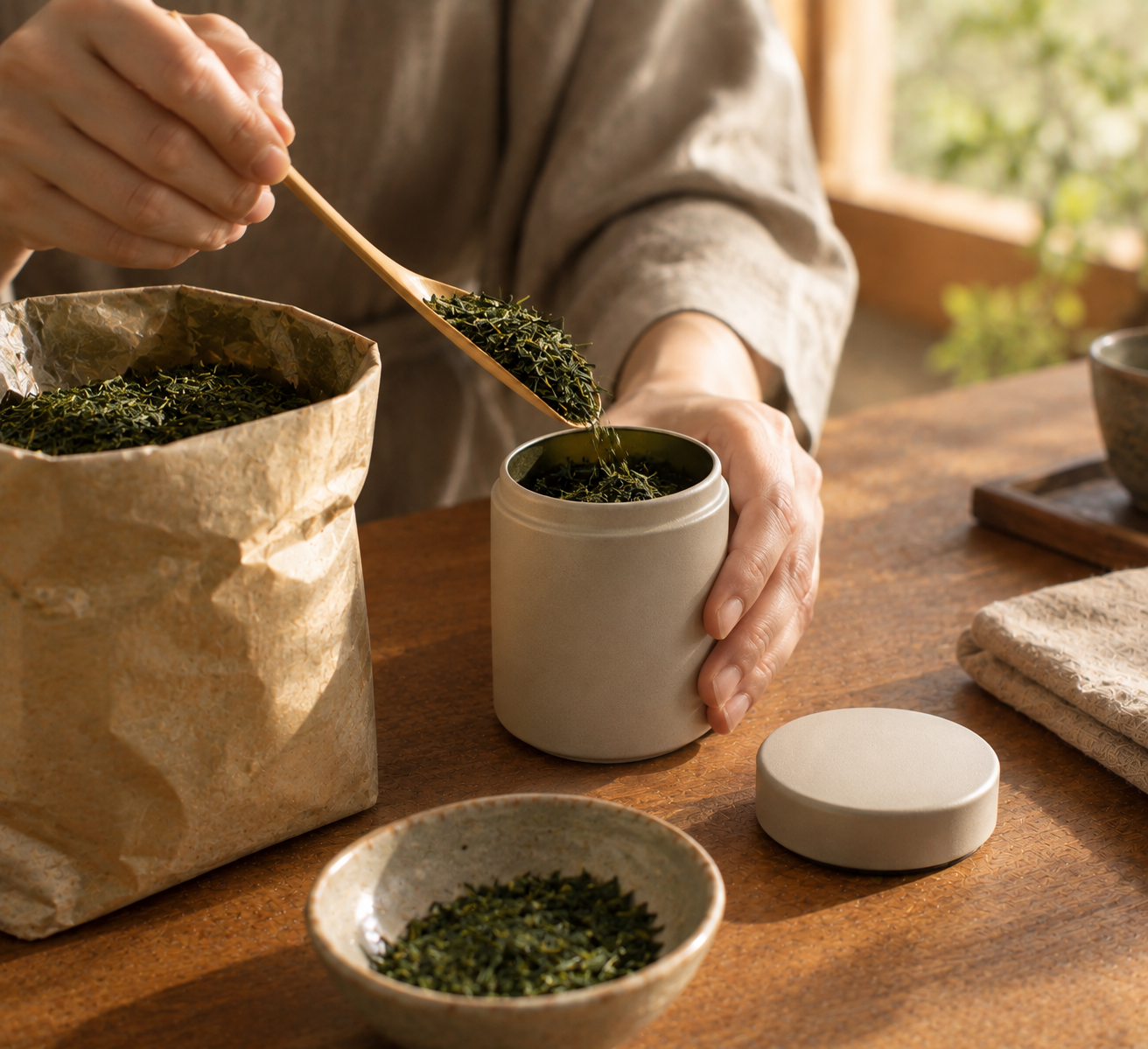
    This is one of the more overlooked tips, and it matters more than people expect. A half-full large container leaves your tea sitting in a growing pocket of air every time you dip in, and that air-to-tea ratio worsens as you work through the supply. If you buy a larger bag, split off a smaller daily-use portion and keep the rest sealed separately, untouched until you actually need it. A 50-gram daily container finished within a few weeks will consistently outperform a 200-gram bag left half-open on the counter for months, even if the total amount of tea and the storage location are otherwise identical.

    Should You Refrigerate or Freeze It?

    This is genuinely more nuanced for loose leaf than it is for matcha. Opened, daily-use tea is generally better kept out of the fridge, since the humidity and risk of condensation each time you open the container can do more harm than the cooler temperature helps. Unopened, factory-sealed tea, especially delicate shincha (first-flush spring tea), freezes well and can extend shelf life considerably, as long as you let it return to room temperature while still sealed before opening it, to avoid condensation hitting the leaves directly. The rule of thumb worth remembering: the fridge and freezer are for protecting tea you haven’t opened yet, not for extending the life of tea you’re actively working through day to day.

    Tools That Make This Easier

    Shop airtight tea storage canisters on Amazon →

    Shop traditional Japanese tea caddies (chazutsu) on Amazon →

    A Few Things People Ask Me

    Does hojicha really last longer than sencha, or is that just a rule of thumb? It’s a genuine, mechanism-based difference, not just a rule of thumb. Roasting breaks down many of the delicate compounds responsible for sencha’s fragile freshness, which is exactly what makes hojicha both more heat-tolerant to brew and more forgiving to store over time.

    How can I tell if my tea has actually gone stale versus just being a milder variety? Compare a fresh sample if you have one, or trust a few signals: faded color, a flat or dusty smell rather than fresh and grassy, and a thin, hollow taste that lacks the umami depth the tea had when you first opened it. None of these mean it’s unsafe, just past its best.

    Is it worth buying vacuum-sealed storage containers specifically for tea? If you go through tea slowly or buy in bulk, yes. A dedicated airtight canister, ideally one designed to compress out excess air as the contents shrink, genuinely extends usable freshness longer than a standard container with a loose-fitting lid.

    Can I store different types of green tea in the same container to save space? It’s better not to, since different teas can transfer aroma to each other in close proximity, particularly anything roasted stored near something delicate like gyokuro. Keep them in separate sealed containers even if they’re sitting in the same cabinet.

    Does the size of the tea leaf itself affect how fast it degrades? Somewhat — finely broken or cut leaf, common in some tea bag blends, has more surface area exposed to air relative to its volume than whole, unbroken leaf, which means it can degrade somewhat faster under otherwise identical storage conditions. Whole-leaf sencha and gyokuro generally hold up a bit better over time than a more processed, broken-leaf product.

    Where I Landed

    If you only change one habit after reading this, make it portioning. Splitting a larger bag into a smaller daily-use container and keeping the rest sealed and untouched solves more of the slow, invisible degradation than any other single change, more than the container material, more than fridge-versus-cabinet debates, more than anything else on this list.

    The tea I found forgotten behind the spice rack didn’t go bad because of one dramatic mistake. It went bad slowly, from sitting half-exposed to air in an oversized bag for months. A little more intention about where and how you keep tea between cups is a small amount of effort for protecting something you presumably bought because you actually wanted it to taste good, not just to have it quietly fade away in a cabinet you forgot to check.
  • How to Order a Genuinely Good Matcha Latte at a Café

    How to Order a Genuinely Good Matcha Latte at a Café

    Disclosure: This post contains affiliate links. If you buy through one of them, I may earn a small commission at no extra cost to you.

    I spent nine dollars on a matcha latte at a place with beautiful branding and a genuinely gorgeous cup, and it tasted like sweetened milk with a green food coloring afterthought. No bitterness, no umami, nothing that actually resembled matcha beyond the color. That experience taught me the uncomfortable truth about ordering matcha at most cafés: the price tag and the aesthetics tell you almost nothing about what’s actually in the cup, and a beautifully styled Instagram-ready drink can still be a genuinely mediocre one underneath.

    Unlike coffee, where most baristas can speak to origin and roast with some confidence, matcha knowledge varies wildly from one café to the next, and the burden of asking the right questions largely falls on you as the customer. This is a practical guide to actually doing that, without needing to become a matcha snob about it.

    The Problem You’re Actually Trying to Solve

    You’ve searched for how to order a good matcha latte because you’ve either had a genuinely disappointing one recently, sweetened, flat, more green-tinted milk than tea, or you’re about to order one somewhere new and want to avoid that same letdown. Either way, the fix isn’t complicated once you know what to look for and ask.

    Who This Article Is NOT For

    Let’s save you some scrolling if this isn’t quite your situation.

    • If you’re making matcha lattes at home rather than ordering them out, my how to make a matcha latte guide covers that side of things directly, including ratios and technique.
    • If you genuinely prefer a sweeter, dessert-style matcha drink, nothing here is meant to talk you out of that preference — this guide is for people specifically trying to taste the tea itself.

    If you’re past that, here’s where the actual guide starts.

    What to Look for Before You Even Order

    Watch for a Whisk and Bowl Behind the Counter

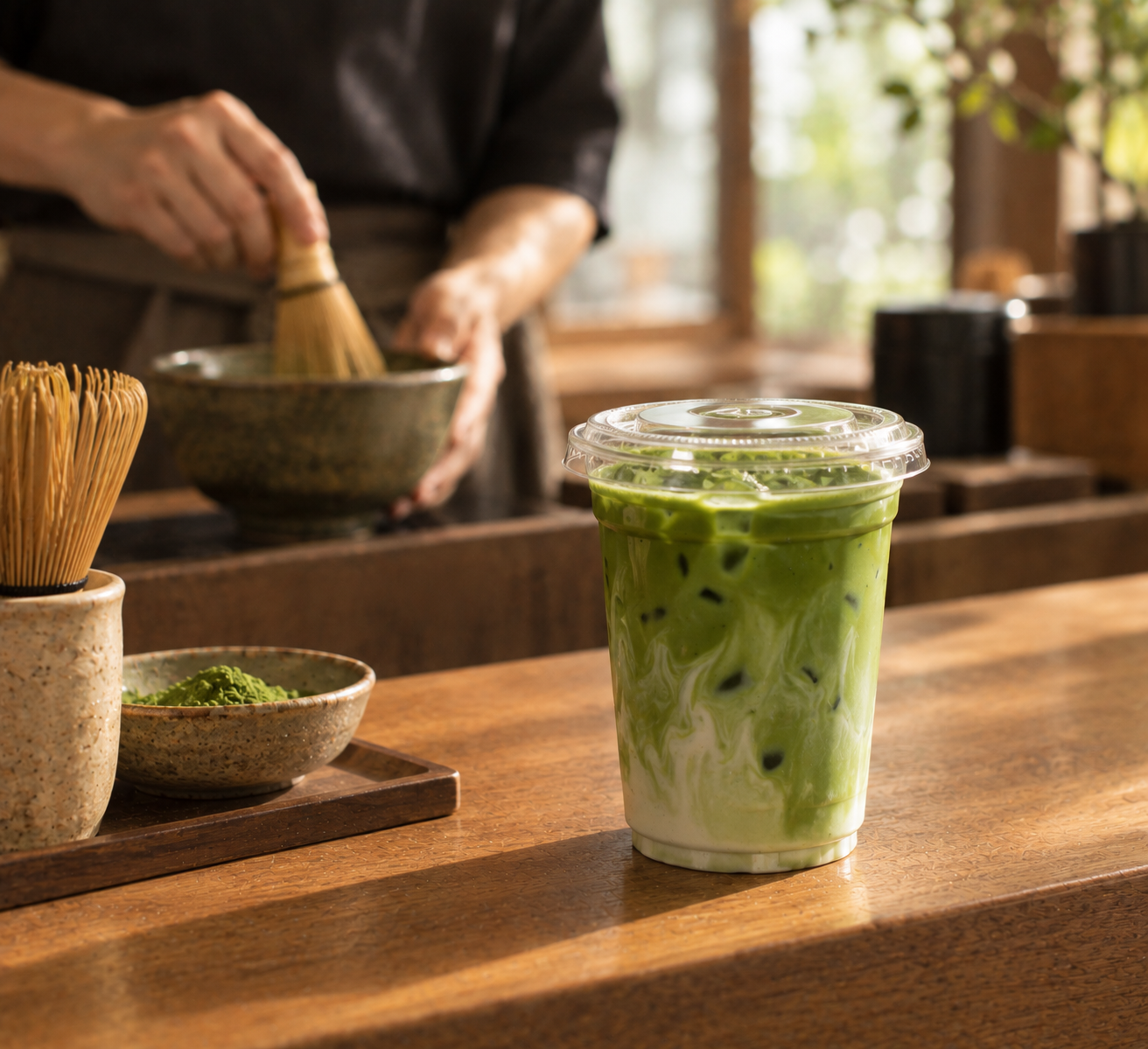
    If you can see a chasen (bamboo whisk) and a bowl set up near the register, that’s a strong signal drinks are prepared to order rather than poured from a pre-mixed batch sitting in the fridge. Smaller, specialty-focused cafés are more likely to whisk each drink individually; larger chains more often use a squeeze bottle or a pre-made paste. This single visual cue is often more reliable than anything printed on the menu, since it reflects an actual operational choice rather than marketing language.

    Check the Menu Language Itself

    Menus that specifically name a grade (“ceremonial,” “premium,” “latte-grade”) or a sourcing detail (a region, an importer, a specific farm) are signaling more transparency than a menu that just says “matcha latte” with no further detail. That’s not a guarantee of quality on its own, but it’s a meaningfully better starting point than total silence on sourcing. A café confident enough in its sourcing to print specifics has, at minimum, thought about the question before you asked it.

    Notice the Price Relative to the Café’s Coffee Menu

    A rough but useful heuristic: if a café’s matcha latte is priced noticeably lower than its comparable coffee drinks, that’s sometimes, though not always, a sign the matcha itself is a lower-cost, lower-quality ingredient relative to their coffee sourcing standards. This isn’t a hard rule, plenty of places price matcha competitively regardless of quality, but a matcha latte priced suspiciously below the café’s own espresso drinks is worth a bit more scrutiny before ordering.

    What to Actually Ask

    “Is this pre-sweetened, or can I get it without added sugar?” Many café matcha powders come pre-blended with sugar, which means even an “unsweetened” request might still land somewhat sweet. Asking this upfront tells you whether you’re tasting real matcha or a sweetened mix dressed up as one, and it forces the question to actually be considered rather than assumed away by a barista moving quickly through a rush.

    “Do you know what grade of matcha this is?” A confident, specific answer, even something modest like “it’s a latte-grade blend,” is a better sign than a blank look. It doesn’t guarantee excellence, but a barista who’s been told nothing about the product they’re serving is a reasonable yellow flag, and it often correlates with a café that hasn’t invested much thought into the ingredient beyond stocking it because customers ask for it.

    “Is this whisked to order, or from a pre-made batch?” Especially relevant at larger chains, since a batch sitting in a container for hours degrades in color and flavor the same way home-brewed matcha does if left out too long. A “made fresh” answer is worth taking at face value unless you have reason to doubt it, since most staff have no incentive to lie about something this specific.

    “Can I see the tin or bag it comes from?” This one feels bolder, and not every café will accommodate it, but if they’re willing, a printed grade, harvest date, or region on the actual packaging tells you more in five seconds than several minutes of questioning ever could.

    Reading the Cup Once It Arrives

    Color. A vivid, bright green points to fresher, better-quality matcha. A dull, olive, or yellowish tint suggests either lower-grade matcha or matcha that’s been sitting out too long, or brewed with water hot enough to degrade its chlorophyll. This is genuinely the fastest visual check available, and it’s worth glancing at the drink before your first sip rather than after.

    Sweetness balance. If the drink tastes sweet even after you specifically asked for no added sugar, the base powder itself was likely pre-sweetened rather than the barista simply forgetting your request. Real matcha carries its own natural sweetness, but it’s subtle, not dessert-level sweet on its own, and the two are genuinely easy to tell apart once you’ve tasted a properly unsweetened version for comparison.

    Aftertaste. Good matcha should leave a clean, slightly vegetal, faintly sweet aftertaste. A chalky, artificially green, or flatly bitter finish, especially paired with no real depth of flavor, points toward a lower-quality powder. Pay attention specifically to what lingers after the milk’s own flavor fades, since that’s where the tea itself, not the dairy, is actually doing the talking.

    Texture and foam. A well-whisked matcha base should carry a light foam layer, even once combined with milk. A completely flat, foam-free surface can indicate either a poorly whisked base or one that was simply stirred in rather than properly incorporated, which affects mouthfeel even when the underlying flavor is otherwise fine.

    Where This Gets Harder: Big Chains vs. Specialty Cafés

    Larger coffee chains generally optimize for consistency and speed across thousands of locations, which often means a shelf-stable, pre-sweetened matcha blend rather than a whisked-to-order ceremonial powder. That’s not automatically bad, it’s simply a different product built for a different purpose, closer to a flavored syrup category than to genuine tea. Smaller, specialty-focused cafés, particularly ones that treat matcha as a dedicated menu item rather than an afterthought, are more likely to invest in better sourcing and to-order preparation, though price alone isn’t a perfect predictor of which category a given café falls into — plenty of overpriced spots are still serving the same pre-mixed batch as a much cheaper chain down the street.

    Ordering Smart at Big Chains Specifically

    Since large chains are the most common place people actually order matcha, and also the place where quality control varies most, it’s worth a dedicated approach rather than lumping them in with specialty cafés.

    Specify “no classic” or “unsweetened base” explicitly. Many chains have a default sweetened matcha base built into their standard recipe, sometimes labeled internally as the “classic” version, which stacks on top of anything you add yourself. Asking for that base removed, not just “less sweet,” is the difference between a genuinely unsweetened drink and one that’s still secretly carrying a full dose of syrup.

    Choose milk deliberately, not by default. Whole milk and 2% tend to let matcha’s flavor come through most directly. Oat milk’s natural sweetness is popular but can flatten the tea character into something closer to a dessert drink, which is fine if that’s what you want, but worth knowing if you’re specifically trying to taste the matcha itself.

    Ask for any sweetener on the side rather than mixed in. This single request gives you control that “less sweet” alone doesn’t. A pump of syrup on the side lets you add exactly as much as you want, or none at all, rather than trusting a barista’s judgment of what “light” sweetness means.

    Don’t assume seasonal or limited-time matcha drinks use the same base as the standard menu item. Chains sometimes formulate limited releases differently, occasionally with better quality control precisely because they’re positioned as a premium or specialty offering rather than the everyday default.

    A Short Vocabulary Cheat Sheet

    A few terms are worth recognizing quickly, since café staff won’t always use consistent language and knowing what they mean helps you ask better follow-up questions.

    Ceremonial grade. Traditionally the highest tier, made from young, shade-grown leaves. This label isn’t officially regulated by any governing body, so it’s a starting signal rather than a guarantee.

    Culinary or latte grade. A bolder, more affordable tier specifically built to hold up against milk and sugar. Not a downgrade for latte purposes, it’s actually the more appropriate choice for this exact drink, and a café using it intentionally isn’t cutting corners so much as making a sensible choice.

    Pre-batched or “matcha paste.” A pre-mixed concentrate, sometimes stored in a squeeze bottle, used to speed up preparation during rushes. Not inherently bad, but quality degrades the longer a batch sits before use, which is part of why asking about preparation timing matters.

    What a Genuinely Good One Actually Tastes Like

    It’s worth describing this directly, since a lot of people who’ve only ever had mediocre café matcha don’t have a clear reference point for what they’re actually chasing. A well-made matcha latte should taste distinctly vegetal and slightly grassy upfront, followed by a rounder, savory-sweet umami note that lingers without turning bitter or chalky. The sweetness, if any, should feel like it’s supporting the tea rather than covering it up entirely. If you finish a cup and couldn’t identify a single flavor beyond “sweet and green,” that’s a strong sign the matcha itself was doing very little of the actual work in that drink.

    Traveling and Ordering Abroad

    If you’re ordering matcha while traveling, particularly outside Japan, expectations are worth adjusting slightly by region. Cafés in cities with an established specialty coffee culture, ones that already take sourcing seriously for their coffee beans, are statistically more likely to extend that same care to matcha. In regions where matcha is a newer trend item rather than an established specialty, don’t be surprised if quality is more inconsistent even at higher price points, since the supply chains and staff training simply haven’t caught up to demand yet.

    Building a Reliable Home Setup Instead

    Shop premium latte-grade matcha on Amazon →

    Shop portable matcha whisk and travel sets on Amazon →

    If you travel often or simply don’t trust the café near your office, a small travel whisk and a resealable pouch of good matcha genuinely solves this problem more reliably than any amount of careful ordering ever will. It’s a small amount of extra effort in exchange for never being at the mercy of an unfamiliar café’s sourcing decisions again.

    A Few Things People Ask Me

    Is it rude to ask a barista these questions? Not at all — it’s a completely normal customer question, similar to asking about milk alternatives or roast level for coffee. Most baristas either know the answer or will say so honestly, and either response tells you something useful.

    Why does the same “matcha latte” taste so different from one café to the next, even at similar prices? Price reflects overhead, branding, and location as much as ingredient quality, so it’s a weak signal on its own. The actual grade and freshness of the matcha powder, plus whether it’s whisked to order, matter far more than what’s printed on the price tag.

    Should I just bring my own matcha and ask them to make it for me? Some cafés will accommodate this, though many won’t for hygiene or liability reasons, and it’s worth asking rather than assuming either way. Bringing your own is a much more reliable option at home, which is where my matcha powder brands comparison is genuinely useful.

    Is it worth just making matcha lattes at home instead of dealing with this every time? If you’re consistently disappointed by café versions, yes — a home setup gives you full control over grade, sweetness, and preparation, and it pays for itself quickly compared to repeated nine-dollar disappointments.

    Does the type of milk affect how easy it is to judge quality? Somewhat — oat milk’s natural sweetness can mask a mediocre matcha more easily than a neutral milk like plain whole or skim, so if you’re specifically trying to evaluate the tea itself rather than just enjoy the drink, a less sweet milk option gives you a clearer read.

    Are there any visual cues on the menu board itself worth watching for? Photos showing a clearly vivid green drink, rather than a dull or brownish-green one, can be a loose hint, though menu photography is often stylized enough that it’s a weaker signal than actually asking the questions above in person.

    Where I Landed

    The single most useful habit here is asking about sweetening before you order, not after you’ve already been handed a syrup-loaded drink you didn’t want. That one question filters out a huge share of the disappointing versions before they ever reach your hands, and everything else, color, aftertaste, whether it’s whisked to order, is confirmation rather than the first line of defense.

    None of this requires turning every café visit into an interrogation. A couple of quick, polite questions, asked the same way you’d ask about oat milk availability, is genuinely enough to dramatically improve your odds without slowing down the line or making anyone uncomfortable. Most baristas, in my experience, actually appreciate a customer who seems to know and care about the drink, rather than finding the questions annoying.

    If café versions keep letting you down, twenty minutes learning the basics is worth it — once you know what a properly made one actually tastes like, it becomes a lot easier to tell when a café is cutting corners, and a lot easier to just make your own when the nearest good option isn’t within walking distance. Between a reliable home setup and a short list of the right questions to ask when you’re out, there’s no real reason to keep settling for sweetened green milk and calling it matcha.

  • Nio Teas Subscription Review: Matcha Club vs. Tea Club

    Nio Teas Subscription Review: Matcha Club vs. Tea Club

    Disclosure: This post contains affiliate links, including to Nio Teas. If you buy through one of them, I may earn a small commission at no extra cost to you.

    Nio Teas runs two separate subscriptions rather than one general “tea box,” and picking the wrong one for your actual habits is the easiest way to end up disappointed with an otherwise solid service. One is built around matcha specifically, the other around loose leaf, and they come with genuinely different included teaware, discount structures, and free starter gifts. This is a breakdown of both, so you’re not guessing which one actually fits how you drink tea, rather than defaulting to whichever one happens to be featured first on their homepage.

    The Problem You’re Actually Trying to Solve

    You’ve searched for a Nio Teas subscription review because you’re deciding whether to commit to a recurring tea delivery and want to know what you’re actually getting each month, not just the marketing headline of “free teaware” that shows up on the product page.

    Who This Article Is NOT For

    Let’s save you some scrolling if this isn’t quite your situation.

    • If you just want a one-time purchase rather than a recurring subscription, Nio Teas’ individual product listings work the same way as any standard order, without needing to commit to a subscription at all.
    • If you already know you strongly prefer one tea type and don’t want variety, a subscription’s whole value proposition is discovery — a single repeat order of your known favorite may serve you better than either club.

    If you’re past that, here’s where the actual review starts.

    The Two Subscriptions, Side by Side

    Monthly Matcha ClubMonthly Tea Club
    What arrives monthly2 packs of matcha (rotating selection)Curated loose leaf tea shipments
    First-month free giftBamboo whisk (chasen) and bamboo scoop (chashaku)Kyusu teapot
    Ongoing discount20% off matcha deliveries16% off tea shipments
    Best forMatcha-focused drinkers wanting varietyLoose leaf drinkers wanting variety
    FlexibilityCancel anytime once you’ve found a favoriteCancel anytime once you’ve found a favorite

    Monthly Matcha Club

    Shop the Monthly Matcha Club →

    Each month, this delivers two packs of matcha drawn from Nio Teas’ rotating selection, letting you sample different grades and sourcing without committing to a single full-size tin upfront. The first shipment includes a free bamboo whisk and scoop, which genuinely matters if you don’t already own proper matcha tools, since it removes a common first-purchase barrier covered in more depth in my matcha whisk buying guide.

    Why it works well: The included teaware solves the “I bought matcha but have nothing to prepare it with” problem a lot of first-time buyers run into, and the rotating selection means you’re not stuck reordering the same tin indefinitely without ever finding out if you’d prefer something else.

    The tradeoff: Because it’s matcha-only, this isn’t the right subscription if your actual interest is broader Japanese tea, sencha, gyokuro, hojicha, and the like.

    Monthly Tea Club

    Shop the Monthly Tea Club →

    This is the loose leaf counterpart, delivering curated tea shipments monthly with a free kyusu teapot included in the first delivery. It’s built around the same discovery model as the matcha club, letting the length of your subscription determine how deep into Nio Teas’ 50-plus tea catalog you actually get exposed to.

    Why it works well: A free kyusu solves the same first-purchase equipment problem the matcha club solves with a whisk, and it’s a genuinely useful inclusion if you’ve been drinking bagged tea and want to move into proper loose leaf without a separate teapot purchase upfront.

    The tradeoff: If you already own a kyusu you like, the free teapot loses some of its appeal relative to the discount and tea selection itself, which is really the core value once the novelty of the free gift wears off.

    What Actual Customers Say

    Review patterns across independent platforms are largely positive, with customers consistently praising tea and matcha freshness and responsive customer support. The most commonly repeated complaint isn’t about product quality but about occasional shipping delays or, less frequently, packaging issues on arrival, worth factoring in if you’re on a tight timeline for a gift or specific occasion rather than an ongoing personal subscription.

    Which One Should You Actually Sign Up For

    If matcha is your main interest and you don’t yet own a whisk: the Matcha Club, purely for the included teaware solving a real first-purchase problem.

    If you drink a broader range of Japanese tea, or want to explore beyond matcha specifically: the Tea Club, especially if you don’t already own a kyusu.

    If you already own both a whisk and a kyusu: the free teaware matters less, and the decision comes down to which product category, matcha or loose leaf, you’re more interested in exploring monthly.

    If you’re not sure you’ll stick with either long-term: both are described as cancel-anytime once you’ve found a favorite, which makes either a reasonably low-risk way to sample the catalog before committing to full-size tins on your own.

    A Few Things People Ask Me

    Can I switch between the two subscriptions later, or am I locked into my initial choice? Subscriptions are generally structured to let you cancel and start a different one rather than being permanently locked to your first choice, though it’s worth confirming current policy specifics before committing if switching flexibility matters to you.

    Is the free teaware actually good quality, or just a low-cost incentive? Based on available customer feedback, the included teaware is generally regarded as functional and appropriate for a beginner setup, not a token throwaway item, though it’s reasonable to expect it’s positioned as a starter-level tool rather than the premium end of what’s covered in my broader teaware buying guides.

    How long should I stay subscribed before deciding if it’s worth it? A few months is generally enough to sample a meaningful cross-section of either rotating selection and get a real sense of your own preferences, after which canceling and reordering your specific favorites directly becomes a reasonable next step if you don’t want to continue the discovery format indefinitely.

    Do the subscriptions ship internationally, or are they limited to certain regions? Nio Teas ships broadly across multiple regions, with pricing shown in local currency depending on your storefront, though exact shipping costs and delivery timelines vary by destination, so it’s worth checking current rates for your specific location before subscribing.

    Is there a risk of receiving duplicate teas if I stay subscribed for a long time? With a catalog of 50-plus teas and only two packs arriving per month for the matcha club, it would take a considerable stretch of consistent subscribing before genuine repeats become likely, though the exact rotation logic isn’t something Nio Teas publishes in detail.

    Where I Landed

    The deciding factor here isn’t really about which subscription is “better” in the abstract, it’s about which free starter gift you actually need. If you’re missing a whisk, the Matcha Club effectively pays for itself on the first box. If you’re missing a kyusu, the same logic applies to the Tea Club. Already have both tools? Then it’s simply a question of which category you want a rotating monthly excuse to keep exploring.

    Either way, both function as a genuinely lower-risk way to sample Nio Teas’ broader catalog before committing to full-size purchases on your own, which is exactly the kind of first step I’d recommend before diving into the deep end of a 50-plus tea catalog blind. The free teaware is a nice bonus, but the real value is letting the subscription do the exploring for you until you’ve narrowed down what you actually want to keep buying long-term.

  • Nio Teas Review: What’s Actually Worth Buying From Their Catalog

    Nio Teas Review: What’s Actually Worth Buying From Their Catalog

    Disclosure: This post contains affiliate links, including to Nio Teas. If you buy through one of them, I may earn a small commission at no extra cost to you.

    Most of the brands I’ve covered on this site specialize narrowly, one region, one product type, one specific grade. Nio Teas takes the opposite approach: over 50 different Japanese teas, direct relationships with individual farms, and a catalog that ranges from everyday sencha to genuinely rare styles most people outside Japan have never heard of, like awabancha or goishicha. That range is either exactly what you’re looking for or more than you need, depending on where you are in your own tea journey, and this review is about sorting out which, rather than just listing everything they sell.

    The Problem You’re Actually Trying to Solve

    You’ve searched for a Nio Teas review because the catalog is large enough to feel overwhelming, and you want to know what’s actually worth your first order rather than scrolling through fifty tea listings trying to guess. That’s a fair thing to want clarity on, especially from a brand whose entire pitch is breadth rather than a narrow, curated lineup.

    Who This Article Is NOT For

    Let’s save you some scrolling if this isn’t quite your situation.

    • If you already know exactly which specific tea you want, this general overview won’t add much — go straight to that product category.
    • If you want the deepest possible dive into one narrow category, like just ceremonial matcha grading, my matcha powder brands comparison covers that specific ground in more depth across multiple brands, Nio Teas included.

    If you’re past that, here’s where the actual review starts.

    What Actually Sets Nio Teas Apart

    Nio Teas’ core pitch is direct farmer sourcing: the company’s founders travel through Japan meeting individual tea farmers in person, and the brand specifically commits to sourcing from farms that grow without pesticides or chemicals. That’s a genuinely meaningful sourcing story, not just marketing language, since it means the catalog reflects actual relationships with specific growers rather than anonymous wholesale purchasing where the actual farm behind a listing is anyone’s guess.

    The practical result is a catalog with real depth in categories most brands don’t bother stocking at all: multiple sencha sub-styles (shincha, fukamushi, bancha), several stem tea varieties (kukicha, karigane, kuki hojicha), and rare fermented and regional teas that are genuinely hard to find through Western retailers otherwise. For someone who’s already worked through the basics covered elsewhere on this site, this is genuinely one of the more interesting places to keep exploring.

    Where to Actually Start

    Samplers, If You’re New or Undecided

    Shop Nio Teas’ loose leaf samplers →

    Given how large the catalog is, a sampler is genuinely the smartest first purchase rather than committing to a single full-size tin blind. Nio Teas’ samplers pull from across their range, letting you actually taste your way toward a preference instead of guessing based on a product description alone.

    Ceremonial Matcha

    Shop Nio Teas’ ceremonial matcha →

    Nio Teas’ ceremonial matcha lineup benefits from the same pesticide-free, direct-farm sourcing as the rest of the catalog, and it’s a reasonable entry point if matcha specifically is your focus, alongside the brands covered in my broader matcha comparison.

    Gyokuro, If You Want to Go Deeper

    Shop Nio Teas’ gyokuro →

    Gyokuro is one of the harder teas to find well-sourced outside Japan, and it’s a category where Nio Teas’ direct-farm model genuinely pays off, since gyokuro quality depends heavily on shading technique and harvest timing that’s easier to verify through a direct farmer relationship than through anonymous wholesale sourcing.

    Teaware, Sold Right Alongside the Tea

    Shop Nio Teas’ kyusu teapots →

    Unlike brands that focus purely on the tea itself, Nio Teas also stocks a reasonable teaware catalog, kyusu, chawan, chasen, and shiboridashi, which makes it a genuinely convenient one-stop option if you’re building out a home setup rather than piecing tools together from several different retailers.

    Where the Catalog Size Becomes a Genuine Downside

    Fifty-plus teas is a strength for exploration and a real friction point if you just want a straightforward, confident first purchase. Unlike a narrower specialist brand where the top pick is obvious, Nio Teas asks you to do a bit more of your own navigating, or lean on a sampler specifically to shortcut that process, which is exactly why I’d point most first-time buyers there rather than toward any single full-size product.

    A Few Things People Ask Me

    Is “pesticide-free” the same as certified organic? Not necessarily in a formal certification sense — it depends on the specific farm and whether they’ve pursued official organic certification versus simply farming without chemical inputs by practice. If formal certification matters specifically to your purchase, it’s worth checking the individual product listing rather than assuming the broader sourcing philosophy guarantees a specific certification.

    Does the direct-farmer sourcing actually show up in the cup, or is it mostly a nice story? Sourcing quality generally does show up in freshness and consistency, since a direct relationship with a specific farm allows for tighter quality control than buying from a wholesale blend of unnamed sources. That said, personal taste still varies tea to tea, and no sourcing story substitutes for actually trying a specific product yourself.

    Is Nio Teas a good fit if I only want one specific tea type, like just hojicha? Yes, the catalog is structured so you can shop a single category without needing to engage with the full breadth of what’s available, which makes it just as usable for a narrow, specific purchase as for broad exploration.

    How does Nio Teas compare to a narrower specialist brand for someone who already knows they love, say, sencha specifically? A narrower specialist may offer deeper expertise within that one category, but Nio Teas’ sencha lineup itself has real sub-variety (shincha, fukamushi, bancha) that a lot of specialist brands don’t bother stocking, so it holds up reasonably well even for a narrowly focused buyer.

    Is shipping and pricing competitive with other Japan-sourced tea brands? Pricing generally sits in a comparable mid-range for direct-sourced Japanese tea, though exact costs vary by product category and shipping destination, so it’s worth checking current rates for your specific location rather than assuming a fixed number.

    Where I Landed

    Nio Teas earns its place on this site specifically because the breadth is backed by a genuine sourcing story, not just a large catalog for its own sake. If you’re new to Japanese tea broadly, start with a sampler rather than guessing at a single product. If you already know your lane, whether that’s matcha, gyokuro, or a specific stem tea, the catalog has real depth to reward that focus too.

    Either way, this is a brand where the size of the catalog is a genuine advantage once you know how to navigate it, rather than a reason to feel overwhelmed and default to a smaller, narrower brand out of convenience alone. The direct-farm sourcing story is also worth remembering the next time you’re deciding whether a brand’s ethical claims are worth paying attention to versus just marketing noise — in this case, it’s a genuine, verifiable part of how the business actually operates.

  • The Oldest Tea Shops in Uji and Kyoto (Some Still Ship Internationally)

    The Oldest Tea Shops in Uji and Kyoto (Some Still Ship Internationally)

    Uji, just south of Kyoto, has been synonymous with Japanese tea for over 800 years, and unlike a lot of historic industries, several of the actual shops that built that reputation are still family-run in the same buildings, some of them literally centuries old. This is a look at five of the most historically significant, from a tea house founded by a retired samurai in 1160 to a 1717 Kyoto merchant that eventually became one of the most recognized matcha names outside Japan. None of these are marketing legends dressed up for a tin label — every one of them is a documented, verifiable business with a continuous operating history behind it.

    The Problem You’re Actually Trying to Solve

    You’ve searched for historic Uji and Kyoto tea shops because you’re either planning a trip and want to know which ones are worth the visit versus which are just tourist-trap adjacent, or you’ve encountered these names on matcha tins and packaging and want to understand the history behind them before deciding whether that heritage is worth paying for. Either way, this is a genuine, verifiable history, not marketing embellishment, though I’ll note where a shop’s fame outpaces easy access for anyone not physically in Japan.

    Who This Article Is NOT For

    Let’s save you some scrolling if this isn’t quite your situation.

    • If you want current product reviews and grading for specific matcha brands, this covers shop history rather than product comparison — my matcha powder brands comparison covers that ground instead.
    • If you’re looking for a full Uji travel itinerary, this focuses specifically on the tea shops themselves rather than broader sightseeing logistics.

    If you’re past that, here’s where the actual history starts.

    Tsuen Tea (Founded 1160)

    Tsuen Tea, located at the east side of the Uji Bridge, holds a genuinely remarkable claim: it’s considered the oldest continuously operating tea shop in the world, founded in 1160 by Furukawa Unai, a samurai who served under General Minamoto no Yorimasa. After his military career ended, he retired to Uji, changed his name to Tsuen, and opened the shop that’s now run by the 24th generation of his family.

    The current building dates to 1672, and the shop has served travelers, monks, and samurai crossing the historically significant Uji Bridge for centuries, later becoming known specifically for strong, traditionally prepared matcha. It’s genuinely one of the oldest continuously operating companies in the world, not just in tea.

    Worth knowing: Tsuen ships internationally through select retailers, though availability and shipping times vary considerably by destination, and it’s a far less common sight on Western shelves than more export-focused brands.

    Kanbayashi Shunsho Honten (Founded 16th Century)

    Kanbayashi Shunsho traces back roughly 450 years to the Eiroku era in the mid-1500s, founded by the Kanbayashi family, and rose to prominence when Ashikaga shoguns championed Uji tea specifically. Few tea houses can claim such direct historical ties to the earliest formal cultivation of Uji tea.

    Worth knowing: This is one of the more historically significant names in this list precisely because of its early role in shaping Uji tea culture itself, rather than simply being an old business in the region.

    Ippodo (Founded 1717)

    Ippodo, founded in Kyoto proper rather than Uji itself, began under the Watanabe family, originally known as Omiya, serving Kyoto aristocracy and everyday customers alike. It earned the name “Ippodo,” meaning roughly “one tea store,” from a prince in 1846 in recognition of its reputation. Today it’s one of the most internationally recognized Japanese tea brands.

    Worth knowing: Ippodo is the most accessible name on this list for anyone outside Japan, with a well-established English-language storefront and reliable international shipping, which is a big part of why it’s become the default entry point for many Western matcha drinkers.

    Shop Ippodo matcha on Amazon →

    Marukyu Koyamaen (Founded Late 1600s)

    Marukyu Koyamaen traces its roots to the Genroku era, roughly the 1680s to early 1700s, when the Koyama family’s first generation began cultivating tea in Uji. It’s grown into one of the most respected names specifically among serious matcha drinkers for its detailed grading system.

    Worth knowing: Unlike some historic shops that lean on heritage alone, Marukyu Koyamaen’s reputation today rests heavily on the technical depth of its product lineup, which rewards buyers willing to actually learn the grading system rather than just trusting the name.

    Shop Marukyu Koyamaen matcha on Amazon →

    Fukujuen (Founded 1790)

    Fukujuen was founded in 1790 by a tea merchant named Iyemon Fukui in Kamikoma, in the Yamashiro area of southern Kyoto. It’s grown into a larger, more broadly distributed operation than some of the smaller family shops on this list, while still maintaining its historical roots in the region.

    Worth knowing: Fukujuen tends to be more widely available through general retail channels than some of the more tourist-focused shops, making it a reasonably accessible option if you want a historically rooted brand without needing to track down a specialty importer.

    Shop Fukujuen tea on Amazon →

    Nakamura Tokichi (Founded 1854)

    Founded by its namesake, born in 1832, who began training at a tea house at age ten and opened his own store at 22, Nakamura Tokichi built a reputation partly through supplying tea to the Japanese royal family. It’s since expanded with locations in Kyoto, Tokyo, and Osaka, and its Uji main store remains a popular destination specifically for tea-based sweets and parfaits alongside traditional tea sales.

    Worth knowing: This is one of the more tourist-accessible shops on the list if you’re actually planning a visit to Uji, known as much for its matcha desserts as for the tea itself.

    Which One’s Reputation Actually Reaches You Outside Japan

    If you want the most accessible historic name with reliable international shipping: Ippodo, by a wide margin, given its established English-language presence.

    If you want serious grading depth and don’t mind researching a system before buying: Marukyu Koyamaen.

    If you’re physically visiting Uji and want the deepest historical experience: Tsuen Tea, for the sheer weight of its 1160 founding and unbroken family lineage, or Kanbayashi Shunsho for its direct ties to Uji tea’s earliest formal cultivation.

    If you want dessert and a memorable visit alongside the tea itself: Nakamura Tokichi’s Uji location is built for exactly that experience.

    A Few Things People Ask Me

    Does a shop’s age actually correlate with better tea quality today? Not automatically, though centuries of continuous operation generally reflects sustained expertise and reputation management that a newer brand hasn’t had time to build or fail at. Age is a meaningful signal, not a guarantee, and some of the most technically respected matcha today, like Marukyu Koyamaen’s, comes from careful grading systems developed and refined over generations, not just from having existed a long time.

    Can I actually order from these shops if I don’t live in Japan? It varies significantly. Ippodo has the most established international shipping and English support of the group. Others, like Tsuen, may only be reachable through third-party specialty retailers, with longer and less predictable shipping timelines.

    Is there a difference between a “tea house” you visit and a “tea shop” you buy from, in this context? Several of these businesses operate as both simultaneously, a retail shop selling packaged tea alongside a café or tasting room on-site. Nakamura Tokichi and Tsuen both lean into this dual identity, particularly for visitors, while others like Marukyu Koyamaen are more purely product-focused for the export market.

    Why does Uji specifically have so many historic tea shops compared to other regions? Uji pioneered the shading techniques behind gyokuro and tencha, the leaf that becomes matcha, centuries ago, and that early technical leadership attracted concentrated trade and shogunal patronage that other regions didn’t receive at the same scale or timing.

    Where I Landed

    What strikes me most about this list isn’t just the ages involved, though founding a business in 1160 and still having it family-run today is genuinely remarkable, it’s how differently each shop chose to age. Some, like Ippodo, leaned into global accessibility and became the default name most Western matcha drinkers actually recognize. Others, like Tsuen, stayed rooted almost entirely in their original location and identity, prioritizing continuity over expansion.

    Neither approach is more legitimate than the other, and knowing this history changes how a tin on your shelf actually reads once you know what centuries of continuous operation, or in some cases deliberate restraint from over-expanding, actually represents. The next time you see one of these names on a package, it’s worth remembering it’s not just branding — it’s a specific family, in a specific place, that’s been doing this for longer than most countries have had their current form of government.

  • Glass vs. Clay Kyusu: Which Actually Fits How You Drink Tea

    Glass vs. Clay Kyusu: Which Actually Fits How You Drink Tea

    Disclosure: This post contains affiliate links. If you buy through one of them, I may earn a small commission at no extra cost to you.

    I resisted buying a glass kyusu for a long time, treating it as somehow less legitimate than proper Tokoname clay, the way some coffee purists look down on a French press next to a proper espresso machine. Once I actually used one regularly, that snobbery didn’t hold up. Glass and clay aren’t a better-versus-worse pairing. They’re built around genuinely different priorities, and which one actually fits your routine depends on questions most buying guides skip past in favor of just declaring clay “more authentic” and calling it a day.

    This is a companion piece to my broader kyusu buying guide, zoomed in specifically on the material question, since it’s one of the decisions that shapes almost everything else about how the pot performs.

    The Problem You’re Actually Trying to Solve

    You’ve searched for a glass versus clay kyusu comparison because you’re trying to decide between the two before spending money, and most of what you’ve found either treats clay as automatically superior or glass as automatically more convenient, without explaining clearly which tradeoffs actually matter for your specific situation.

    Who This Article Is NOT For

    Let’s save you some scrolling if this isn’t quite your situation.

    • If you’ve already decided on clay and just want brand recommendations, my Japanese kyusu brands compared guide covers specific makers rather than the material question itself.
    • If you’re deciding on handle style or filter design rather than material, my kyusu buying guide covers those separate variables.
    • If you drink a wide variety of unrelated teas (black, oolong, herbal) and want one pot for everything, glazed ceramic or porcelain, not glass or unglazed clay specifically, is usually the more practical answer, and this article focuses on the glass-versus-unglazed-clay comparison specifically.

    If you’re past that, here’s where the actual comparison starts.

    Comparison Table

    Unglazed Clay (Tokoname/Banko)Glass
    Flavor impactGenuine, softens tannins and astringency over timeNone — fully neutral
    Heat retentionStrong, thick walls hold warmth through multiple infusionsWeaker, cools faster unless double-walled
    CleaningHot water only, no soap everEasy, dishwasher-safe in most cases
    Multi-tea useShould be dedicated to one tea categoryFully flexible across any tea
    Visual feedbackNone — you can’t see the leaves steepingFull view of leaves unfurling
    Typical price$30–150+ depending on maker and craftsmanship$25–80
    DurabilityFragile in its own way, but no thermal shock riskGenuinely fragile, some risk from rapid temperature change

    Why Clay Actually Changes the Tea

    This isn’t just tradition talking. Unglazed clay is genuinely porous, and that porousness does two real things: it interacts chemically with tannins in a way that measurably softens astringency and bitterness over repeated use, and it slowly absorbs oils and character from whatever tea you consistently brew in it, building a kind of flavor memory into the pot itself over months and years of use. This is a genuinely different mechanism than simple heat retention — it’s an active chemical relationship between the vessel and the tea, not just a passive container holding hot water.

    Denser, high-fired clays like yaki-shime Tokoname take this further, sealing the surface just enough to season slowly while still adding detectable mineral notes to the tea, something multiple side-by-side tastings have picked up on when compared directly against glass or glazed alternatives brewing the identical leaf.

    The tradeoff: that same porousness is exactly why clay needs to be dedicated to one general tea category and never touched with soap, both covered in more depth in my kyusu care guide. The flavor benefit and the maintenance responsibility are two sides of the same physical property, not separate concerns.

    Why Glass Doesn’t Do Any of That, and Why That’s Sometimes the Point

    Glass is fully non-porous and chemically neutral. It doesn’t season, doesn’t absorb, and doesn’t interact with the tea at all, which means the tea’s own quality has to stand entirely on its own without the softening effect clay provides. For a genuinely good, well-sourced tea, that neutrality lets its own character come through cleanly. For a mediocre tea, there’s no clay working quietly in the background to smooth over its rougher edges.

    Where glass genuinely wins: you can watch the leaves unfurl during the steep, which is both a nice ritual detail and a useful way to visually judge doneness as you’re learning to brew loose leaf tea. It’s also dishwasher-safe in most cases, and it’s the only sensible choice if you regularly brew a genuinely wide variety of teas in the same pot without wanting to dedicate separate vessels to each.

    The tradeoff: glass cools faster than clay’s thick walls do, unless you specifically buy a double-walled version, which matters more for teas that benefit from sustained warmth across several infusions, like gyokuro, than it does for a quick single steep. Quality also varies meaningfully by glass type: borosilicate resists the thermal shock of hot water hitting a cool pot, while cheaper soda-lime glass is more prone to cracking under that same stress.

    Heat Retention, in Practice

    Clay’s thick walls and slower heat conduction mean a clay kyusu holds brewing temperature more consistently through a multi-infusion session, which matters if you’re doing several short steeps back to back the way sencha or gyokuro traditionally call for. Glass loses heat more quickly by comparison, which isn’t a problem for a single infusion but can mean your second or third steep starts from a noticeably cooler baseline unless you’re reheating water each round anyway, which most careful multi-infusion brewing already involves.

    Which One Should You Actually Buy

    If you drink primarily one type of tea consistently, sencha or gyokuro especially: unglazed clay, ideally Tokoname for sencha-style teas or Banko if you’re leaning toward gyokuro specifically, will genuinely improve your cup over time in a way glass can’t replicate.

    If you drink a rotating variety of different teas and don’t want to dedicate separate pots to each: glass, since its neutrality means no flavor carryover between sessions regardless of how different consecutive teas are.

    If you’re new to loose leaf brewing and want visual feedback while you learn: glass gives you a genuine advantage here, letting you see how leaves actually behave and unfurl as you’re still calibrating steep times by feel.

    If soap-free, more careful cleaning feels like a dealbreaker for your routine: glass is the easier daily-use choice, dishwasher-safe and forgiving of a less disciplined cleaning routine than clay demands.

    Where to Buy Each

    Shop glass kyusu teapots on Amazon →

    Shop Tokoname clay kyusu on Amazon →

    A Few Things People Ask Me

    Is glazed ceramic a reasonable middle ground between glass and unglazed clay? Genuinely yes, and it’s worth considering if neither pure option feels quite right. Glazed ceramic offers glass’s flavor neutrality and easy cleaning while still bringing some of clay’s heat retention from its typically thicker walls, at the cost of losing both the flavor-softening effect of unglazed clay and the visual feedback glass provides.

    Does a cheap glass kyusu perform as well as an expensive one, unlike clay where price often reflects real craftsmanship? Largely yes for the material itself — glass’s quality differences show up mostly in durability (borosilicate versus cheaper soda-lime) and build quality rather than in a meaningful flavor difference the way clay quality genuinely does. You’re less likely to be disappointed by a budget glass kyusu than by a budget clay one cutting corners on clay quality or filter design.

    Can I switch a glass kyusu between teas without any cleaning concerns at all? Essentially yes, a quick rinse or trip through the dishwasher between different teas is sufficient, since there’s no porous surface holding onto previous flavors the way unglazed clay does.

    Is it worth owning both a glass and a clay kyusu rather than choosing just one? Plenty of regular tea drinkers do exactly this, keeping a dedicated clay pot for their everyday tea and a glass one for variety, guests, or teas they don’t want to commit a clay pot to long-term. It’s a genuinely sensible setup if you drink enough tea to justify two dedicated vessels.

    Does the size of the kyusu matter differently for glass versus clay? Not dramatically, though glass pots often run slightly larger on average since manufacturing constraints differ from hand-thrown clay. Both materials come in sizes suited to solo brewing and larger group servings, so size is more a function of the specific product than the material itself.

    Where I Landed

    My own answer ended up being both, which felt like a cop-out until I actually lived with the setup for a while and realized it wasn’t. The clay pot handles my everyday sencha, and it’s genuinely gotten better over the months I’ve used it consistently, the tea noticeably smoother than it was in the same pot’s first few uses. The glass one handles everything else, gift teas, whatever a friend brings over, gyokuro I’m still deciding whether to commit a clay pot to.

    If you can only justify one right now, let your actual drinking habits decide rather than a sense that clay is somehow the “more legitimate” choice. A glass kyusu used well and often beats a clay one bought for authenticity and left half-neglected in a cabinet, and there’s no prize for owning the more traditional option if it doesn’t actually match how you drink tea day to day.

  • A Simple Japanese Tea Ceremony You Can Actually Do at Home

    A Simple Japanese Tea Ceremony You Can Actually Do at Home

    Disclosure: This post contains affiliate links. If you buy through one of them, I may earn a small commission at no extra cost to you.

    The first time I read about chanoyu, the traditional Japanese tea ceremony, I assumed it was permanently out of reach for anyone without years of formal training, a tatami room, and a teacher to correct every hand movement. What I didn’t understand yet was that chanoyu at its most formal, the multi-hour chaji with a full meal and thick tea, is genuinely a serious, disciplined practice, but a simplified version, focused on the spirit rather than the exact choreography, is something anyone can do at home with a few basic tools and about twenty minutes, without pretending to have mastered something that takes years to actually learn properly.

    This isn’t a substitute for real training under a tea master, and I want to be upfront about that distinction from the start. What follows is a respectful, simplified home version built around the same core spirit, hospitality, mindfulness, and a deliberate pause from everything else, without requiring a formal tea room or years of study to attempt. Think of it as an honest introduction, not a shortcut to expertise.

    The Problem You’re Actually Trying to Solve

    You’ve searched for a simplified home tea ceremony guide because you’re drawn to the idea, maybe from a trip to Japan, a documentary, or simply an interest in matcha itself, but the formal version feels intimidatingly out of reach for a casual home attempt. That gap between curiosity and feeling qualified to try is exactly what this guide is meant to close, without pretending a home version is the same thing as the real, deeply trained tradition.

    Who This Article Is NOT For

    Let’s save you some scrolling if this isn’t quite your situation.

    • If you’re looking for formal instruction to actually study chanoyu, this isn’t that resource, and it shouldn’t be treated as one. Formal study happens under a qualified teacher, often through a specific school like Urasenke, over years, not from a blog post.
    • If you want the full, traditional chaji experience with kaiseki meal, koicha, and the complete multi-hour structure, this covers a simplified usucha-only home version, not the formal long-form gathering.
    • If you’re looking to recreate this for a large group, this guide is built around one host serving one or two guests, which is the more manageable starting point for a home setting.

    If you’re past that, here’s where the actual guide starts.

    The Spirit Behind It, Briefly

    Chanoyu is traditionally grounded in four principles, harmony, respect, purity, and tranquility, articulated by the 16th-century tea master Sen no Rikyu. In a simplified home version, you don’t need the formal vocabulary to honor the spirit: create a calm space, treat your guest and your tools with genuine care, and let the twenty minutes be genuinely undistracted rather than rushed.

    What You’ll Need

    • A chawan (matcha bowl)
    • A chasen (bamboo whisk)
    • A chashaku (bamboo scoop) or a small spoon
    • Good ceremonial-grade matcha
    • A clean cloth or small linen for the table
    • Hot water, cooled slightly below boiling

    My matcha whisk buying guide covers choosing these tools in more depth if you don’t already have them.

    The Simplified Steps

    1. Prepare the Space

    Clear a low table, lay a clean cloth, and set out your bowl, whisk, scoop, and matcha caddy in order. Turn off music, and put phones, both yours and your guest’s, in another room. The point of the ritual is a genuinely uninterrupted twenty minutes, not a photo opportunity.

    2. Welcome Your Guest

    Greet your guest and invite them to sit. A small bow, even an informal one, sets the tone for the rest of the interaction as something deliberate rather than casual.

    3. Serve a Small Sweet First

    Offer a small sweet, traditionally wagashi, before the tea itself. This isn’t just sequencing, it’s practical, since the sweetness balances matcha’s natural bitterness in the cup that follows. My wagashi beginner guide is a good resource if you want something authentic and approachable for this step.

    4. Sift and Measure the Matcha

    Sift roughly 2 grams (about one to one and a half teaspoons) of matcha into the bowl. This isn’t a step to skip for convenience, since unsifted clumps will show up in the finished tea.

    5. Add Water and Whisk

    Add a small amount of water, cooled to roughly 70–80°C, not boiling. Whisk in a brisk back-and-forth “W” or “M” motion, letting your wrist do the work rather than your whole arm. The chasen’s tip should barely brush the bottom of the bowl rather than pressing into it, which protects the whisk and produces a better, more even foam.

    6. Lift and Present

    Once the foam looks even, lift the whisk straight up through the center in one smooth motion. Rotate the bowl slightly so its most decorated side faces your guest, then present it with both hands and a small bow.

    7. Receive and Drink

    Your guest receives the bowl with both hands, turns it slightly before drinking as a small gesture of respect, and drinks in a few unhurried sips rather than gulping. At home, the full formal etiquette (specific rotation direction, wiping the rim with a special paper) is genuinely optional. Keeping it simple, both hands, unhurried sips, is enough to honor the spirit of the thing.

    8. Close Gently

    Once finished, gather the utensils calmly rather than rushing to clean up the moment the last sip is taken. The pause at the end is as much a part of the ritual as the pause at the beginning.

    What to Skip vs. What to Keep

    Worth keeping even in a simplified version: the phone-free environment, the deliberate slowness, serving a sweet before the tea, and presenting the bowl with both hands rather than setting it down casually.

    Reasonable to skip at home: kneeling in formal seiza posture if it’s uncomfortable, precise bowl-rotation direction and degree, the kaishi paper for wiping the rim, and any expectation of achieving temae-level whisking technique on your first attempt.

    Where to Get the Basics

    Shop chawan (matcha bowls) on Amazon →

    Shop matcha starter kits (whisk, bowl, scoop) on Amazon →

    A Few Things People Ask Me

    Do I need special equipment, or can I use what I already have? A proper chasen and chawan genuinely help, since a regular whisk and mug won’t produce the same texture or presentation, but you don’t need an elaborate or expensive set to get the spirit of this right.

    Is it disrespectful to do a simplified version without formal training? Approached with genuine care and respect rather than as a costume or gimmick, a simplified home version is generally seen as a sincere, welcoming way to engage with the tradition, not an appropriation of it. The distinction lies in treating it as an introduction to something deeper, not a claim to have mastered or replicated formal chanoyu.

    How long should the whole thing take? A simplified version for one host and one guest reasonably takes about twenty to twenty-five minutes from setup to close, considerably shorter than a formal chaji, which can run several hours with a full meal included. Resist the urge to rush through it faster than that just because it’s a home version — the unhurried pace is a central part of the point, not an incidental detail.

    Can I do this alone, without a guest, just for myself? Absolutely, and many people who practice a simplified version at home do exactly that as a personal ritual rather than a hosted event. The core value, an undistracted, deliberate pause built around preparing tea carefully, doesn’t require a second person to be meaningful, and a solo version removes any pressure to get the “presenting to a guest” steps exactly right.

    What if I make a mistake in front of a guest — does that ruin the experience? Not remotely. Even in formal training, mistakes happen regularly and are handled calmly rather than treated as failures. At home, a spilled bit of matcha or an uneven whisk is far less important than the overall spirit of care and attention you’re bringing to the moment.

    Where I Landed

    The gap between “I find this beautiful and want to try it” and “I need years of formal training before I’m allowed to attempt any version of this” is smaller than it first appears, as long as you’re honest with yourself and anyone you serve about what you’re actually doing: a respectful, simplified home version inspired by a much deeper tradition, not a recreation of it. That honesty is really the whole safeguard against turning something meaningful into a costume — approach it with genuine care, and the simplification itself isn’t the problem.

    If the idea genuinely resonates with you beyond a single attempt, seeking out actual instruction, many cities have tea ceremony schools or occasional beginner workshops, is a meaningful next step, and this home version can become a genuine on-ramp toward that rather than a substitute for it. In the meantime, my green tea brewing temperature guide and matcha powder brands comparison are good companions for getting the practical fundamentals right while you build toward it.

  • The Japanese Tea Set Gift Guide: Matching the Set to the Occasion

    The Japanese Tea Set Gift Guide: Matching the Set to the Occasion

    Disclosure: This post contains affiliate links. If you buy through one of them, I may earn a small commission at no extra cost to you.

    A Japanese tea set is one of those gifts that can go either way. Get it right and it becomes something someone actually uses every day for years, a small daily ritual you had a hand in starting. Get it wrong and it becomes decorative clutter, admired once and then quietly relegated to a cabinet. The difference almost always comes down to matching the set’s size and formality to the occasion and the recipient’s actual life, not to how impressive the set looks in photos or how ornate the box it arrives in happens to be.

    This is a companion piece to my broader Japanese tea gift guide, which covers what tea itself to give based on the recipient. This one is specifically about the teaware, the physical set, and which configuration actually fits which occasion — a question that comes up constantly once someone’s already decided teaware, not tea leaves, is the gift they want to give.

    The Problem You’re Actually Trying to Solve

    You’ve searched for a Japanese tea set gift guide because you want to give teaware specifically, not just a bag of tea, for a wedding, housewarming, anniversary, or another meaningful occasion, and you’re facing an overwhelming range of set sizes, cup counts, and styles without an obvious sense of which one actually fits your situation.

    Who This Article Is NOT For

    Let’s save you some scrolling if this isn’t quite your situation.

    • If you’re buying for yourself rather than gifting, my kyusu buying guide covers choosing a pot based on your own brewing habits rather than an occasion.
    • If you want tea itself as the gift, not teaware, my Japanese tea gift guide is the more relevant resource.
    • If the recipient already owns a full, well-loved tea set, duplicating what they have rarely lands well — consider a complementary piece like a single specialty cup or a whisk upgrade instead of a full new set.

    If you’re past that, here’s where the actual guide starts.

    What a Japanese Tea Set Actually Includes

    At its core, a Japanese tea set combines a brewing vessel, typically a kyusu, with matching serving cups, called yunomi. More elaborate sets add a tray, a yuzamashi (a small lidless vessel for cooling boiling water before it hits delicate leaves), or a built-in strainer. The two variables that matter most for gifting purposes are the number of cups included and the overall formality of the design. Beyond the standard yunomi, some sets use wider-brimmed kumidashi cups, meant to accentuate aroma, or sleeker modern shapes suited to a more contemporary interior, so it’s worth glancing at the cup style itself, not just the teapot, when picking a set.

    Set Sizes by Occasion

    OccasionSet SizeWhy
    Couple, anniversary, housewarming for twoKyusu + 2 cupsPersonal without being overly intimate; the classic “tea for two” gift
    Wedding, engagementKyusu + 2–4 cups, often nicer materialsSymbolic of shared daily ritual; slightly more formal presentation expected
    Housewarming for a family or shared householdKyusu + 4–5 cupsCovers a typical household’s daily needs without excess
    Retirement, milestone birthdayLarger, more formal or artisan setThe occasion itself often calls for something with more visible craftsmanship
    Hosting-focused recipientLarger kyusu (dobin-style) + several cupsSupports serving guests rather than just one or two people
    Thank-you gift, lower-stakes relationshipSmaller nested set (cups store inside the pot)Compact, practical, doesn’t require prior knowledge of the recipient’s taste

    Matching Material and Style to the Recipient

    For Someone New to Japanese Tea

    A straightforward porcelain kyusu and cup set, rather than unglazed clay, is the more forgiving gift here. Porcelain requires none of the special care unglazed clay demands, and it won’t punish a beginner for not yet knowing the no-soap rule that matters so much for genuine Tokoname or Banko ware. My kyusu care guide is worth mentioning if you do go the clay route, since it covers exactly what a first-time owner needs to know, and including a small note or card pointing them to it removes a lot of the intimidation factor a beginner might otherwise feel.

    For an Established Tea Enthusiast

    Someone who already owns basic teaware wants something with more visible craftsmanship, an artisan-made Tokoname or Banko clay set, ideally from a maker they wouldn’t have sought out themselves. My kyusu brands comparison is a useful reference here for specific makers worth considering, and leaning toward a maker’s more decorative or limited pieces rather than their entry-level catalog respects that this person already has the basics covered.

    For Someone Who Hosts Often

    Look toward a larger-capacity pot, sometimes called a dobin style, paired with four or five cups rather than the standard two. This fits a household that regularly serves tea to guests rather than just brewing for one or two people daily.

    Presentation Matters More Here Than With Most Gifts

    Because a tea set is inherently a ceremonial object even outside formal tea ceremony, presentation carries real weight. Look for sets that arrive in a proper gift box, ideally with some context, a small card or catalog explaining the kiln or maker, rather than teaware shipped loose in generic packaging. This matters disproportionately more for weddings, retirements, and other milestone occasions than it would for a casual thank-you gift, where practicality and ease of use matter more than ceremony.

    Where to Find These

    Shop Japanese kyusu and yunomi cup gift sets on Amazon →

    Shop porcelain kyusu tea sets on Amazon →

    A Few Things People Ask Me

    Is two cups too intimate a gift for a coworker or more casual relationship? For a lower-stakes relationship, a nested set (where the cups store inside the teapot itself) or a single elegant cup paired with a small tea sample is a better fit than a full two-cup “for two” set, which does carry a more personal connotation appropriate for couples or close friends.

    Should the tea set match the type of tea the recipient already drinks? Ideally yes, if you know it. A kyusu with a fine mesh filter suits sencha and most everyday green tea well, while someone who specifically drinks a lot of matcha would get more use out of a chawan and whisk set than a kyusu-based gift, which is a different gifting category entirely.

    Is porcelain or clay the safer default if I don’t know the recipient’s preference? Porcelain is generally the safer, more universally appropriate default for gifting specifically, since it requires no special care knowledge and won’t punish an unprepared recipient the way unglazed clay’s soap-avoidance rule can if they’re not warned about it.

    How many cups should a standard gift set include if I’m not sure of the occasion’s formality? Two to four cups covers the widest range of situations reasonably well. Below two feels incomplete as a gift, and above four starts to feel more specifically suited to hosting than to general gifting unless you know that’s the recipient’s actual habit.

    Does the tray matter, or is it a purely decorative add-on? A tray is genuinely functional, not just decorative — it catches drips during pouring and gives the whole set a cohesive presentation on a table, which matters more for a gift that will likely be used for guests occasionally than for one meant purely for solo daily use. For a couple’s everyday tea-for-two set, it’s a nice-to-have rather than essential.

    Is it appropriate to gift a Japanese tea set to someone who’s never had Japanese tea before, or does that feel presumptuous? It’s a genuinely welcoming way to introduce someone to the category, especially paired with a beginner-friendly tea sampler. Framing it as an invitation rather than an assumption, a note explaining what it’s for and how simple it is to use, goes a long way toward making the gift feel thoughtful rather than presumptuous.

    Where I Landed

    The single most useful filter for this whole category of gift: think about who will actually be drinking from this set and how often, not how impressive the box looks unwrapped. A modest two-cup porcelain set that gets used every morning is a better gift than an elaborate artisan set that ends up as a shelf display because it felt too precious to actually use.

    None of this means you need to overthink a well-intentioned gift into a research project. A quick honest read on the occasion’s formality and the recipient’s existing tea habits narrows the field fast, and from there, most of the specific choices, material, cup count, tray or no tray, are genuinely flexible rather than governed by a strict rule.

    If tea itself, rather than teaware, is what you’re deciding on next, my Japanese tea gift guide picks up where this one leaves off.

  • Uji Matcha vs. Other Regions: Is the Name on the Tin Actually Worth the Premium?

    Uji Matcha vs. Other Regions: Is the Name on the Tin Actually Worth the Premium?

    Disclosure: This post contains affiliate links. If you buy through one of them, I may earn a small commission at no extra cost to you.

    “Uji matcha” carries the kind of built-in prestige that “Champagne” carries in wine — a specific place name that’s become almost synonymous with the whole category, to the point where plenty of matcha from other regions gets marketed with “Uji-style” language just to borrow some of that reputation. After actually comparing specific brands rooted in Uji against equally legitimate brands from Nishio and Kagoshima, I came away with a more complicated answer than “Uji is simply the best,” which is what the marketing around it usually implies, and what I assumed myself before actually running the comparison side by side.

    This isn’t a rehash of my regional flavor comparison covering what each region generally tastes like. This is specifically about whether paying the Uji premium, at the brand level, actually buys you something a well-sourced non-Uji brand doesn’t, or whether you’re mostly paying for a name.

    The Problem You’re Actually Trying to Solve

    You’ve searched for a comparison of Uji matcha against other regions because you keep seeing “Uji” treated as shorthand for quality, and you want to know whether that reputation holds up against specific, well-regarded brands from elsewhere, or whether you’re just paying for a place name printed on a tin. That’s a fair thing to want answered directly, especially given how much price variation exists once you start comparing across regions.

    Who This Article Is NOT For

    Let’s save you some scrolling if this isn’t quite your situation.

    • If you want a broad overview of how different regions generally taste, my matcha by region guide covers Uji, Nishio, Shizuoka, Kagoshima, and Yame’s general flavor profiles in more depth than this brand-focused comparison does.
    • If brand heritage and prestige genuinely matter to you as part of the experience, that’s a legitimate preference, and nothing here is meant to talk you out of it — this is about value and quality specifically, not about dismissing what Uji represents culturally.
    • If you’re shopping purely by price and don’t care about region at all, this comparison won’t be especially useful to you either way.

    If you’re past that, here’s where the actual comparison starts.

    Why Uji Carries the Premium It Does

    Uji, in Kyoto Prefecture, is where shading tea plants specifically to produce tencha, the leaf that becomes matcha, was pioneered centuries ago. That head start gave Uji growers the longest runway of any region to refine ceremonial-grade processing, and Uji remains deeply tied to formal tea ceremony culture in a way most other regions aren’t. Part of what you’re paying for with genuine Uji matcha is real: centuries of specialized technique concentrated in one region. Part of it is also simply prestige and scarcity, since Uji’s tea-growing land is limited and production has been shrinking relative to larger regions.

    What the Other Regions Actually Bring

    Nishio (Aichi Prefecture) produces a striking share of Japan’s tencha despite far less name recognition outside Japan than Uji. Aiya, founded in 1888 and headquartered in Nishio, has grown into one of the largest matcha producers in the world specifically by focusing on consistent, well-processed matcha rather than trading on regional prestige the way some Uji brands do.

    Kagoshima, which recently overtook Kyoto Prefecture in tencha production, benefits from volcanic soil and a longer growing season than Kyoto’s more seasonal climate. Brands like Jade Leaf, which source from a blend of Uji and Kagoshima, lean on Kagoshima’s efficient, large-scale production to keep prices more accessible without sacrificing organic certification or quality control.

    Comparison Table

    Uji Brands (e.g. Ippodo, Marukyu Koyamaen)Nishio (Aiya)Kagoshima-Blended (Jade Leaf)
    HeritageCenturies-old, ceremony-focusedEstablished 1888, large-scale quality focusNewer to the export market, efficiency-focused
    Typical flavorDeep umami, creamy, naturally sweetBalanced, slightly bolder, reliableSmooth, approachable, latte-friendly
    Price rangeHigher, reflects prestige and scarcityMid-range, consistentMore accessible, especially for organic
    Best forTraditional ceremonial drinking, giftingHome lattes, baking, everyday useBudget-conscious organic buyers, lattes

    Where Uji Genuinely Earns Its Premium

    In my side-by-side tasting, Uji matcha from an established brand like Ippodo or Marukyu Koyamaen, both covered in more depth in my matcha powder brands comparison, does deliver a genuinely distinct character: a deeper, rounder umami and a smoothness that’s hard to fully replicate, likely a real product of that centuries-long specialization in ceremonial processing specifically. If you’re drinking matcha straight, plain, as the main event rather than as an ingredient in something else, that difference is noticeable enough to matter, and I’d lean toward Uji for that specific use case.

    Where the Premium Stops Paying Off

    For lattes, baking, or daily casual drinking, where matcha is competing against milk, sugar, or other ingredients, the gap narrows considerably. Aiya’s Nishio-sourced matcha performed reliably well in a latte, bold enough to hold its own against dairy without needing ceremonial-grade subtlety that would be wasted there anyway. Jade Leaf’s Kagoshima-blended matcha delivered a smooth, inoffensive latte at a noticeably lower price point, and in a blind taste test focused specifically on lattes rather than straight drinking, I doubt most people would reliably identify which cup came from the pricier Uji tin.

    Which Region’s Brands Should You Actually Buy

    If you drink matcha straight, plain, as a deliberate ritual: genuine Uji matcha from an established brand is worth the premium. This is the use case the region’s centuries of specialization were built around.

    If matcha is primarily going into lattes: Aiya (Nishio) offers a reliable, well-processed option that doesn’t ask you to pay for subtlety that milk will mute anyway.

    If budget and organic certification matter most: Jade Leaf’s Kagoshima-blended matcha delivers solid, approachable quality without Uji’s price tag.

    If you’re gifting or want the recognizable prestige name: Uji-branded matcha carries a cultural weight that a lesser-known Nishio or Kagoshima brand, however good, simply doesn’t communicate to someone unfamiliar with the category.

    Where to Buy These

    Shop Aiya matcha (Nishio) on Amazon →

    Shop Jade Leaf matcha (Kagoshima blend) on Amazon →

    A Few Things People Ask Me

    Is “Uji-style” matcha the same as genuine Uji matcha? No, and this distinction matters. “Uji-style” or “processed in the Uji tradition” language sometimes appears on matcha actually grown elsewhere, borrowing the reputation without the actual regional origin. Look for a brand that names the specific growing region clearly, not just a processing style loosely associated with it.

    Does a higher price always mean better quality regardless of region? Not reliably. Price reflects a mix of genuine production cost, scarcity, and brand reputation, and those three factors don’t move together perfectly. A well-sourced Nishio or Kagoshima matcha at a mid-range price can outperform an overpriced, poorly stored “Uji” tin from a less careful seller.

    Can I tell the region apart just by taste, without the label? With practice, somewhat — Uji tends toward deeper umami and creaminess, Kagoshima toward smoothness and mild sweetness, Nishio toward a balanced middle ground. But brand-level differences in processing quality within a single region can be just as noticeable as the regional character itself, so taste alone isn’t a fully reliable way to identify origin.

    Is it worth buying matcha from multiple regions to compare, or should I just pick one and stick with it? If you’re genuinely curious, a side-by-side comparison is the fastest way to actually understand these differences for yourself rather than taking any brand’s marketing at face value. Once you know your own preference, there’s nothing wrong with settling into one reliable brand for daily use.

    Does the region matter as much for culinary-grade matcha as it does for ceremonial grade? Less so. Culinary-grade matcha, regardless of region, is generally processed to hold up against competing flavors rather than to showcase regional subtlety, which flattens some of the differences that matter most at the ceremonial-grade level. If you’re buying specifically for baking, region is a lower priority than it would be for a tin you plan to drink straight.

    Are there other legitimate matcha regions beyond Uji, Nishio, and Kagoshima worth knowing about? Yes — Yame in Fukuoka and Shizuoka both produce genuine matcha with their own distinct character, covered in more depth in my broader regional comparison guide. This article focused specifically on Uji against Nishio and Kagoshima because those three have the clearest brand-level examples readily available for a direct comparison.

    Where I Landed

    The honest conclusion is that Uji’s reputation is earned, but it’s earned specifically for one use case, drinking matcha straight and deliberately, not as a blanket claim that Uji matcha is simply superior in every context. For lattes and baking, a well-sourced Nishio or Kagoshima brand does the job just as well, often for meaningfully less money, and paying the Uji premium there buys you prestige more than it buys you a noticeably better cup.

    That’s not a knock on Uji, and it’s not an argument that region names are meaningless marketing either. It’s simply a reminder that “best” depends on what you’re actually going to do with the tin once it’s in your kitchen, and a region’s centuries-old reputation was built around a specific use case that not every purchase actually calls for.

    Know which use case you’re actually buying for before you decide how much the region name on the tin is worth to you. My matcha powder brands comparison is a good next stop for going deeper on specific Uji-based brands if that’s the direction you’re leaning.

  • Does Japanese Tea Actually Help With Stress? The L-Theanine Research, Explained Carefully

    Does Japanese Tea Actually Help With Stress? The L-Theanine Research, Explained Carefully

    Disclosure: This post contains affiliate links. If you buy through one of them, I may earn a small commission at no extra cost to you. This article is for general information and isn’t a substitute for professional mental health care. If you’re managing an anxiety disorder or ongoing significant stress, please talk with a doctor or therapist rather than relying on general information like this.

    I used to assume the “calm” feeling people describe after a cup of good matcha was mostly the ritual talking — the slowing down, the small deliberate motions of whisking, nothing to do with the tea itself chemically. Then I read into the actual research behind L-theanine, the amino acid concentrated in green tea and especially matcha, and found there’s a real, measurable mechanism behind at least part of that feeling, alongside the ritual. Both things turn out to be true at once, and untangling which is which is genuinely useful if you’re deciding how much to expect from a cup of tea on a stressful day, rather than either dismissing the whole idea or expecting more than the research actually supports.

    The Problem You’re Actually Trying to Solve

    You’ve searched for whether Japanese tea actually helps with stress because you want to know if the calming reputation is backed by real research or if it’s mostly wellness marketing dressed up around an old cultural practice. That’s a fair thing to want clarity on, especially since “tea helps you relax” gets repeated so often that it’s easy to lose track of what’s actually been studied versus what’s just assumed.

    Who This Article Is NOT For

    Let’s save you some scrolling if this isn’t quite your situation.

    • If you’re managing a diagnosed anxiety disorder, the research on L-theanine specifically for clinical anxiety conditions is thin and inconsistent — this isn’t a substitute for therapy, medication, or other evidence-based treatment your doctor may recommend.
    • If you want a guaranteed, dramatic calming effect, the honest research shows a modest, real effect, not something that will resolve significant stress or anxiety on its own.
    • If you’re looking for dosing guidance for a concentrated L-theanine supplement, this article focuses on tea as a beverage, not supplement dosing, which is a separate conversation worth having with a doctor or pharmacist given individual variation and potential medication interactions.

    If you’re past that, here’s where the actual explanation starts.

    The Mechanism: What L-Theanine Actually Does

    L-theanine is an amino acid found almost exclusively in tea plants, and it’s present in meaningfully higher concentration in shaded teas like matcha and gyokuro than in sun-grown teas like standard sencha, since shading is specifically what boosts this compound in the leaf.

    Research using EEG and more precise brain imaging methods has found that L-theanine increases alpha brain wave activity, a pattern associated with a relaxed but alert mental state, sometimes described as similar to the state experienced during light meditation. Separate research has measured reductions in subjective stress ratings and salivary cortisol, a stress hormone, following L-theanine intake, generally within 30 to 60 minutes of consumption. One notable finding across several studies is that the effect tends to be more pronounced in people with higher baseline anxiety, suggesting it may do more for someone already keyed up than for someone already calm, rather than producing a uniform effect regardless of starting state.

    It’s worth being direct about the strength of this evidence rather than overstating it. Much of this research uses concentrated doses, commonly in the 100 to 400mg range, delivered as a supplement or nutrient drink in controlled trials, which is a higher concentration than what you’d get from casually sipping a single cup of tea. A quality cup of matcha or shaded green tea can reasonably deliver somewhere in the range of 20 to 50mg or more of L-theanine, meaningful but generally on the lower end of what most positive studies actually tested. A broader scientific review on the topic also notes that findings across the field are often inconsistent, and that evidence for L-theanine specifically helping diagnosed anxiety disorders remains sparse compared to its more consistently replicated effect on general alpha wave activity and situational stress.

    Why Matcha Specifically Stands Out

    Because matcha involves whisking the entire ground leaf into water rather than steeping and discarding it, you’re getting a higher concentration of L-theanine per serving than a steeped cup of standard green tea provides. Combined with matcha’s caffeine content, this pairing is part of why matcha is often described as producing a steadier, more sustained sense of alertness rather than the sharper spike-and-crash pattern some people experience with coffee or other caffeine sources alone. This caffeine-and-L-theanine combination is also one of the better-supported specific findings in this research area — several studies point to the pairing improving attention and blunting some of caffeine’s jittery edge, more so than either compound studied in total isolation.

    The Ritual Side, Which Genuinely Matters Too

    None of this is meant to dismiss the non-chemical part of what makes tea feel calming. The slower pace of properly brewing tea or whisking matcha, the small deliberate motions involved, and the built-in pause it creates in a day are real contributors to a sense of calm, independent of anything happening biochemically. Separating “the tea itself” from “the ritual around the tea” is somewhat artificial, since for most people, both are genuinely part of the same experience, working together rather than one being the “real” explanation and the other just decoration.

    A Reasonable Way to Think About This

    Japanese tea, particularly shaded varieties like matcha and gyokuro, offers a real, modest, research-supported relaxation effect through L-theanine, alongside a genuinely calming ritual independent of the chemistry. It’s a reasonable, low-risk addition to a stress-management routine that also includes the fundamentals — sleep, movement, and, where needed, professional support — not a replacement for any of those.

    A Few Things People Ask Me

    Which Japanese tea has the most L-theanine? Gyokuro and high-grade matcha generally lead, both due to intensive shading before harvest, which is specifically what boosts this compound in the leaf. Standard sencha, grown in more sun, contains less by comparison, though still more than most non-shaded teas generally.

    Does decaffeinated green tea still offer the calming L-theanine effect? Yes, the L-theanine content isn’t dependent on caffeine, so a decaffeinated version would still deliver the amino acid, though you’d lose the specific caffeine-and-L-theanine pairing effect some research points to for sustained, steady alertness.

    How much tea would I need to drink to match what the studies actually used? Most positive studies used concentrated doses beyond what a single casual cup delivers, so multiple cups of a shaded tea like matcha or gyokuro across a day would get you closer to studied amounts than one occasional cup, though exact equivalency is hard to pin down given how much L-theanine content varies by tea quality and preparation.

    Is it safe to drink tea specifically for anxiety alongside prescribed anxiety medication? This is genuinely a conversation to have with your doctor or pharmacist rather than general information like this, since L-theanine and caffeine can interact with some medications, and your doctor can advise based on your specific prescription and health situation.

    Does hojicha, being roasted, still contain L-theanine? Yes, roasting affects caffeine content more than it affects L-theanine, so hojicha still offers some of this amino acid, generally paired with a much gentler caffeine profile than matcha or standard sencha, which some people specifically prefer for an evening wind-down.

    Does hojicha, being roasted, still contain L-theanine? Yes, roasting affects caffeine content more than it affects L-theanine, so hojicha still offers some of this amino acid, generally paired with a much gentler caffeine profile than matcha or standard sencha, which some people specifically prefer for an evening wind-down. My best hojicha brands guide is a good starting point if that combination appeals to you.

    Is there a best time of day to drink tea specifically for the calming effect? Since the research shows effects emerging within roughly 30 to 60 minutes of intake and generally not lasting indefinitely, timing tea around a specific stressful moment, before a demanding meeting or task, is a reasonable approach based on the studied timeframes, rather than assuming a morning cup carries the effect through an entire day.

    Why do I sometimes feel more alert than calm after matcha, even knowing about L-theanine? Matcha still contains real caffeine alongside its L-theanine, and individual sensitivity to that caffeine varies quite a bit. If alertness rather than calm is your dominant experience, you may be more caffeine-sensitive than average, in which case a lower-caffeine option like hojicha might better showcase the calming side of this research for you personally.

    Where I Landed

    The honest version of this story sits comfortably between two extremes: Japanese tea isn’t a scientifically unproven wellness myth, and it also isn’t a substitute for real stress management or mental health care when that’s genuinely what’s needed. The L-theanine research is real, modest, and worth knowing about, and the ritual side of preparing tea carries its own separate, equally real value, even without a single molecule involved.

    It’s worth holding both of those truths at once rather than picking a side. You don’t need to resolve whether it’s “really” the chemistry or “really” the ritual doing the work — for most people reaching for a cup on a stressful afternoon, both are quietly contributing at the same time, and neither one needs to be the sole explanation for the other to matter.

    If you’re drawn to this specifically for matcha’s higher L-theanine concentration, my matcha powder brands comparison is a good next stop, and my how to make a matcha latte guide covers a version worth making slowly, on purpose, as part of the ritual itself rather than rushed through on the way out the door.