Disclosure: This post contains affiliate links. If you buy through one of them, I may earn a small commission at no extra cost to you. I only recommend tools I’d genuinely tell a friend to buy — everything below is based on my own research and, where noted, my own kitchen counter.
My first matcha whisk was a metal milk frother I already owned, because I figured foam is foam and a chasen was just an overpriced kitchen gadget dressed up in tradition. My matcha clumped, tasted bitter in the middle of the cup where the powder never fully dissolved, and I genuinely thought I just didn’t like matcha for almost a year. Then I actually bought a real bamboo whisk, and the difference wasn’t subtle — it was like realizing you’d been making coffee with the wrong grind size the entire time.
That’s the thing nobody tells you when you’re getting into matcha: the tea itself only gets you halfway there. The tools matter more than people expect, and buying the wrong ones, or buying nothing at all and improvising, is the single most common reason people decide they “don’t like matcha” when really they just never gave it a fair shot.
I’ve since talked to enough people who had the exact same experience — a bitter, clumpy first cup, a quiet conclusion that matcha “just isn’t for them,” and no idea that the actual culprit was sitting in their utensil drawer the whole time. So before you write off matcha, or before you spend money on a random bundle that showed up first in a search, here’s what each of these tools actually does, and which ones are worth your money.
The Problem You’re Actually Trying to Solve
You’ve searched for a matcha whisk buying guide because you’re standing in front of a wall of options — bamboo whisks with different prong counts, bowls in every shape and price point, tiny bamboo scoops that seem almost decorative, and you have no idea which of these actually matter versus which ones are just upsells designed to make your cart bigger.
Here’s the part that makes this genuinely confusing: some of these tools make a real, tasteable difference, and some genuinely don’t matter much for a casual home routine. A wide, uneven splash pattern from whisking in the wrong shaped bowl is a real problem. A hand-carved bamboo scoop instead of a plain teaspoon is mostly aesthetic. This guide is here to tell you which is which, so you spend money where it actually improves your cup and skip the stuff that’s just pretty packaging.
Who This Article Is NOT For
Let’s save you some scrolling if this isn’t quite your situation.
- If you exclusively make iced matcha lattes in a shaker bottle or blender, you genuinely don’t need a chasen at all. A cocktail shaker or milk frother does that job fine, and buying ceremonial tools for a latte routine is like buying a chef’s knife to open mail.
- If you already own a full tea ceremony set and are just looking to upgrade one specific piece, this broad starter guide will feel too basic — you probably already know more about prong counts than most of what’s below.
- If budget is your only concern and you want the single cheapest way to make drinkable matcha, a metal whisk or a milk frother will technically work, just without the texture a bamboo chasen gives you. This guide is for people willing to spend a little to get it right, not for the absolute rock-bottom option.
If you’re past that, here’s where the actual guide starts.
What I Actually Judged These On
Three criteria, same as every guide on this site, because vague “best of” lists with ten fuzzy factors don’t actually help anyone decide.
1. Does it change the taste or texture of your matcha? Some tools genuinely affect the final cup. Others are nice to have but wouldn’t change what’s in front of you if you skipped them. I weighted tools that touch this directly — the whisk, the sifter — much higher than tools that are mostly about ritual and presentation.
2. Durability for a beginner’s hands. A lot of these are handmade from natural materials, and a beginner who doesn’t yet know proper whisking technique can snap a delicate whisk within weeks. I looked at which options forgive an unpracticed hand versus which ones are for people who already know what they’re doing.
3. Price relative to actual necessity. Not every tool on a “complete tea ceremony set” list is something you need on day one. I sorted these by what genuinely earns its place in a beginner’s kit versus what you can add later once you know you’re sticking with matcha.
Comparison Table
| Tool | Do You Actually Need It? | Price Range | What It Actually Affects |
|---|---|---|---|
| Chasen (bamboo whisk) | Yes, essential | ~$10–35 | Texture, foam, clump-free mixing |
| Furui (sifter) | Yes, close to essential | ~$8–20 | Removes clumps before whisking, smoother texture |
| Chawan (matcha bowl) | Helpful, not mandatory | ~$15–60+ | Whisking angle and space, presentation |
| Chashaku (bamboo scoop) | Nice to have | ~$5–15 | Consistent measuring, mostly ritual |
| Naoshi / whisk stand | Nice to have | ~$5–12 | Preserves whisk shape between uses |
The Tools, One by One
Chasen (Bamboo Whisk)
Shop bamboo matcha whisks on Amazon →
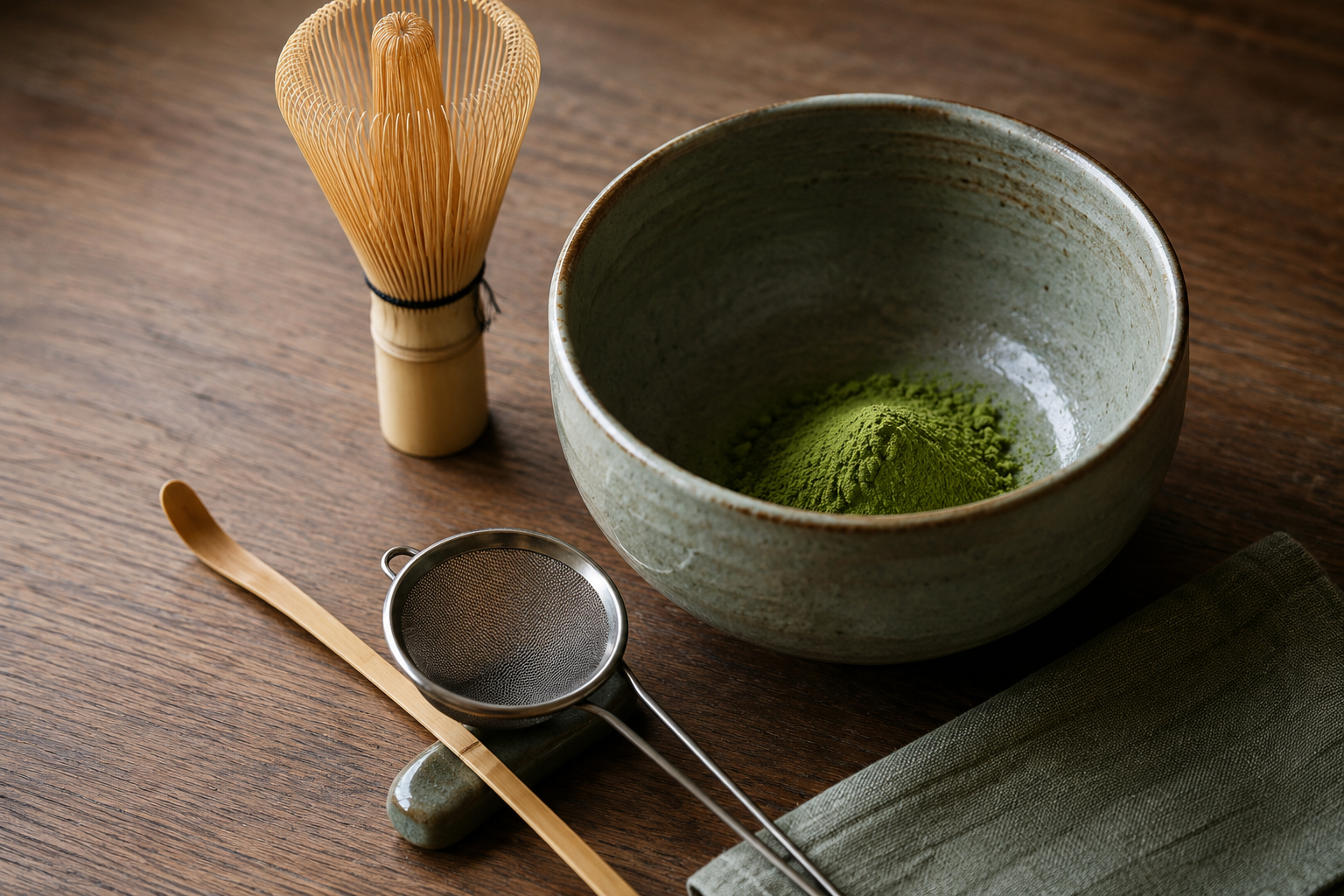
This is the one tool on this list that actually changes what’s in your cup, not just how you feel making it. A chasen is carved from a single piece of bamboo into anywhere from 60 to 120 (occasionally more) delicate prongs, and that prong count genuinely changes texture: fewer prongs, like 60 to 80, produce a coarser, denser foam suited to thick koicha-style matcha, while higher prong counts like 100 to 120 create a finer, silkier froth better suited to the thin, everyday usucha style most people drink at home.
What I liked: For a first whisk, 80 to 100 prongs is genuinely the sweet spot — sturdy enough that a beginner’s imperfect technique won’t destroy it in a week, and fine enough to give you real foam instead of a clumpy mess. In my experience, this single purchase did more for my matcha than any brand or grade upgrade I made afterward.
What bugged me: Cheap machine-cut whisks exist everywhere, and they look nearly identical to handcrafted ones in a product photo. They tend to shed prongs and lose their shape within a few weeks of regular use, which ends up costing you more in replacements than just buying a properly made one upfront.
Bottom line: Buy one 80 to 100-prong bamboo chasen before you buy anything else on this list. It’s the one non-negotiable tool, and everything else in this guide is secondary to getting this one right.
Furui (Sifter)
Shop matcha sifters on Amazon →
A furui is a small fine-mesh sifter, sometimes with a decorative charm on top, that you use to sift matcha powder before whisking. It sounds like a step you could skip, and for a while I did skip it, which is exactly why my early cups had that gritty, clumpy texture I blamed on the tea itself.
What I liked: This is the cheapest fix for the most common beginner complaint about matcha — clumps that never fully dissolve no matter how hard you whisk. Sifting breaks up compacted powder before water even touches it, and the improvement is immediate and obvious the very first time you try it. Matcha compacts naturally just sitting in its tin, so this isn’t a sign you bought bad tea — it’s just what fine powder does over time.
What bugged me: It’s one more small item to store and clean, and if you’re someone who forgets extra kitchen tools exist, it’ll end up in a drawer unused. The habit matters more than the tool itself.
Bottom line: Cheap enough that there’s no real reason to skip it. Pairs directly with the chasen as the second half of “actually necessary.”
Chawan (Matcha Bowl)
Shop matcha bowls (chawan) on Amazon →
A chawan is a wide, shallow bowl specifically shaped to give a chasen room to move in a proper “W” or zigzag motion without splashing everywhere. You can technically whisk matcha in any mug, but the shape matters more than you’d expect.
What I liked: Once I switched from a narrow mug to an actual wide-mouthed bowl, whisking got noticeably easier and less messy — there’s simply more room for the whisk to move freely, which translates to better foam with less effort. It’s also just a nicer way to start your morning than hunching over a coffee mug.
What bugged me: This is where price can spiral fast if you’re not careful. Handmade ceramic chawan from known potters can run well over a hundred dollars, and none of that premium touches the taste of your tea. A simple, wide, mid-priced bowl does the same functional job as an expensive artisan piece.
Bottom line: Worth having, but resist the urge to buy the prettiest, priciest option first. A plain wide bowl works exactly as well functionally.
Chashaku (Bamboo Scoop)
Shop chashaku bamboo scoops on Amazon →
A chashaku is a slender bamboo scoop traditionally used to measure matcha powder, usually two scoops per serving in casual use.
What I liked: It’s an elegant little object, and if you care about the ritual side of matcha as much as the drinking side, it adds something a plastic measuring spoon doesn’t.
What bugged me: Functionally, a regular teaspoon measures matcha just as accurately. This is squarely in “nice to have” territory, not “changes your tea” territory, and I’d rank it well below the whisk and sifter in priority.
Bottom line: A pleasant add-on once you already have the essentials, not something to prioritize early.
Naoshi (Whisk Stand)
Shop matcha whisk stands (naoshi) on Amazon →
A naoshi is a small ceramic or bamboo stand that holds your chasen upright between uses, keeping the prongs curved outward in their proper shape instead of drying flat or bent.
What I liked: If you’re actually going to keep a bamboo whisk for a long time, this genuinely extends its life by preventing the prongs from drying in a bent or crushed position, which is one of the most common ways a chasen degrades early.
What bugged me: It’s easy to forget to use it consistently, and if you do, the whisk dries however it happens to be sitting, which defeats the purpose. It only helps if it actually becomes part of your routine.
Bottom line: A smart cheap investment if you’re committed to keeping your whisk in good shape long-term, skippable if you’re still deciding whether matcha is a habit that’s going to stick.
Which Tools Should You Actually Buy
If you’re buying your very first matcha setup and want the minimum that actually works: an 80 to 100-prong bamboo chasen plus a furui sifter. That combination alone fixes the two most common beginner complaints — bitterness from bad technique and clumps from unsifted powder.
If you’re past the basics and want the full at-home ritual: add a wide chawan next. It’s the next tool that actually changes your experience, not just your shelf display.
If you’re already committed and want to protect your investment long-term: add a naoshi whisk stand so your chasen doesn’t degrade prematurely.
If you’re mostly in it for the aesthetic and ritual, not just the tea: the chashaku is worth adding once the functional basics are covered, purely for the experience of it.
A Few Things People Ask Me
Can I use a metal whisk or milk frother instead of a bamboo chasen? You can, and it’ll technically produce foam, but it won’t aerate matcha the same way. Bamboo’s flexible prongs fold air into the tea gently as they move, where a metal whisk tends to just stir the powder around without the same fine, even froth. If you’re making straight usucha-style matcha with just water, the difference is noticeable. If you’re drowning it in milk for a latte, it matters a lot less.
How long does a bamboo whisk actually last? With reasonable care — rinsing right after use, letting it dry properly shaped (ideally on a naoshi), and not leaving matcha residue caked in the prongs — a decent chasen can last a year or more of daily use before the prongs start losing their spring. Cheap machine-cut ones tend to fail much sooner, sometimes within weeks.
Do I need a different whisk for koicha versus usucha, or can one whisk do both? An 80 to 100-prong whisk can reasonably handle both styles if you’re just drinking at home casually. Serious practitioners tend to keep a lower-prong whisk (60-80) specifically for the dense, paste-like koicha and a higher-prong one (100+) for everyday thin usucha, but that’s a refinement for later, not a day-one requirement.
Is a “matcha starter kit” bundle worth buying instead of individual pieces? Sometimes, if the bundle’s whisk and sifter are decent quality — check reviews on the specific bundle rather than assuming bundling automatically means good value. I’ve seen bundles where the bowl and scoop are nice but the whisk itself is the cheap machine-cut kind that won’t last, which defeats the purpose of buying a “complete” set in the first place.
Where I Landed
If I could go back and redo my own matcha starter kit, I’d have skipped the milk frother phase entirely and just bought a proper 100-prong bamboo whisk and a cheap sifter on day one. Those two tools alone would have saved me a year of wrongly assuming I didn’t like matcha. Everything else on this list — the bowl, the scoop, the stand — genuinely makes the experience nicer, but none of it will fix bad matcha the way the whisk and sifter will.
Start with those two. Everything after that is you deciding how deep into the ritual you actually want to go, and there’s no wrong answer there — just don’t let a fancy chawan distract you from the one tool that’s doing the actual work. Matcha rewards patience with the right setup a lot faster than most people expect; you don’t need years of practice, you just need the whisk and sifter doing what they’re supposed to do from your very first cup.