Disclosure: This post contains affiliate links. If you buy through one of them, I may earn a small commission at no extra cost to you. This article is for general information and isn’t a substitute for professional mental health care. If you’re managing an anxiety disorder or ongoing significant stress, please talk with a doctor or therapist rather than relying on general information like this.
I used to assume the “calm” feeling people describe after a cup of good matcha was mostly the ritual talking — the slowing down, the small deliberate motions of whisking, nothing to do with the tea itself chemically. Then I read into the actual research behind L-theanine, the amino acid concentrated in green tea and especially matcha, and found there’s a real, measurable mechanism behind at least part of that feeling, alongside the ritual. Both things turn out to be true at once, and untangling which is which is genuinely useful if you’re deciding how much to expect from a cup of tea on a stressful day, rather than either dismissing the whole idea or expecting more than the research actually supports.
The Problem You’re Actually Trying to Solve
You’ve searched for whether Japanese tea actually helps with stress because you want to know if the calming reputation is backed by real research or if it’s mostly wellness marketing dressed up around an old cultural practice. That’s a fair thing to want clarity on, especially since “tea helps you relax” gets repeated so often that it’s easy to lose track of what’s actually been studied versus what’s just assumed.
Who This Article Is NOT For
Let’s save you some scrolling if this isn’t quite your situation.
- If you’re managing a diagnosed anxiety disorder, the research on L-theanine specifically for clinical anxiety conditions is thin and inconsistent — this isn’t a substitute for therapy, medication, or other evidence-based treatment your doctor may recommend.
- If you want a guaranteed, dramatic calming effect, the honest research shows a modest, real effect, not something that will resolve significant stress or anxiety on its own.
- If you’re looking for dosing guidance for a concentrated L-theanine supplement, this article focuses on tea as a beverage, not supplement dosing, which is a separate conversation worth having with a doctor or pharmacist given individual variation and potential medication interactions.
If you’re past that, here’s where the actual explanation starts.
The Mechanism: What L-Theanine Actually Does
L-theanine is an amino acid found almost exclusively in tea plants, and it’s present in meaningfully higher concentration in shaded teas like matcha and gyokuro than in sun-grown teas like standard sencha, since shading is specifically what boosts this compound in the leaf.
Research using EEG and more precise brain imaging methods has found that L-theanine increases alpha brain wave activity, a pattern associated with a relaxed but alert mental state, sometimes described as similar to the state experienced during light meditation. Separate research has measured reductions in subjective stress ratings and salivary cortisol, a stress hormone, following L-theanine intake, generally within 30 to 60 minutes of consumption. One notable finding across several studies is that the effect tends to be more pronounced in people with higher baseline anxiety, suggesting it may do more for someone already keyed up than for someone already calm, rather than producing a uniform effect regardless of starting state.
It’s worth being direct about the strength of this evidence rather than overstating it. Much of this research uses concentrated doses, commonly in the 100 to 400mg range, delivered as a supplement or nutrient drink in controlled trials, which is a higher concentration than what you’d get from casually sipping a single cup of tea. A quality cup of matcha or shaded green tea can reasonably deliver somewhere in the range of 20 to 50mg or more of L-theanine, meaningful but generally on the lower end of what most positive studies actually tested. A broader scientific review on the topic also notes that findings across the field are often inconsistent, and that evidence for L-theanine specifically helping diagnosed anxiety disorders remains sparse compared to its more consistently replicated effect on general alpha wave activity and situational stress.
Why Matcha Specifically Stands Out
Because matcha involves whisking the entire ground leaf into water rather than steeping and discarding it, you’re getting a higher concentration of L-theanine per serving than a steeped cup of standard green tea provides. Combined with matcha’s caffeine content, this pairing is part of why matcha is often described as producing a steadier, more sustained sense of alertness rather than the sharper spike-and-crash pattern some people experience with coffee or other caffeine sources alone. This caffeine-and-L-theanine combination is also one of the better-supported specific findings in this research area — several studies point to the pairing improving attention and blunting some of caffeine’s jittery edge, more so than either compound studied in total isolation.
The Ritual Side, Which Genuinely Matters Too
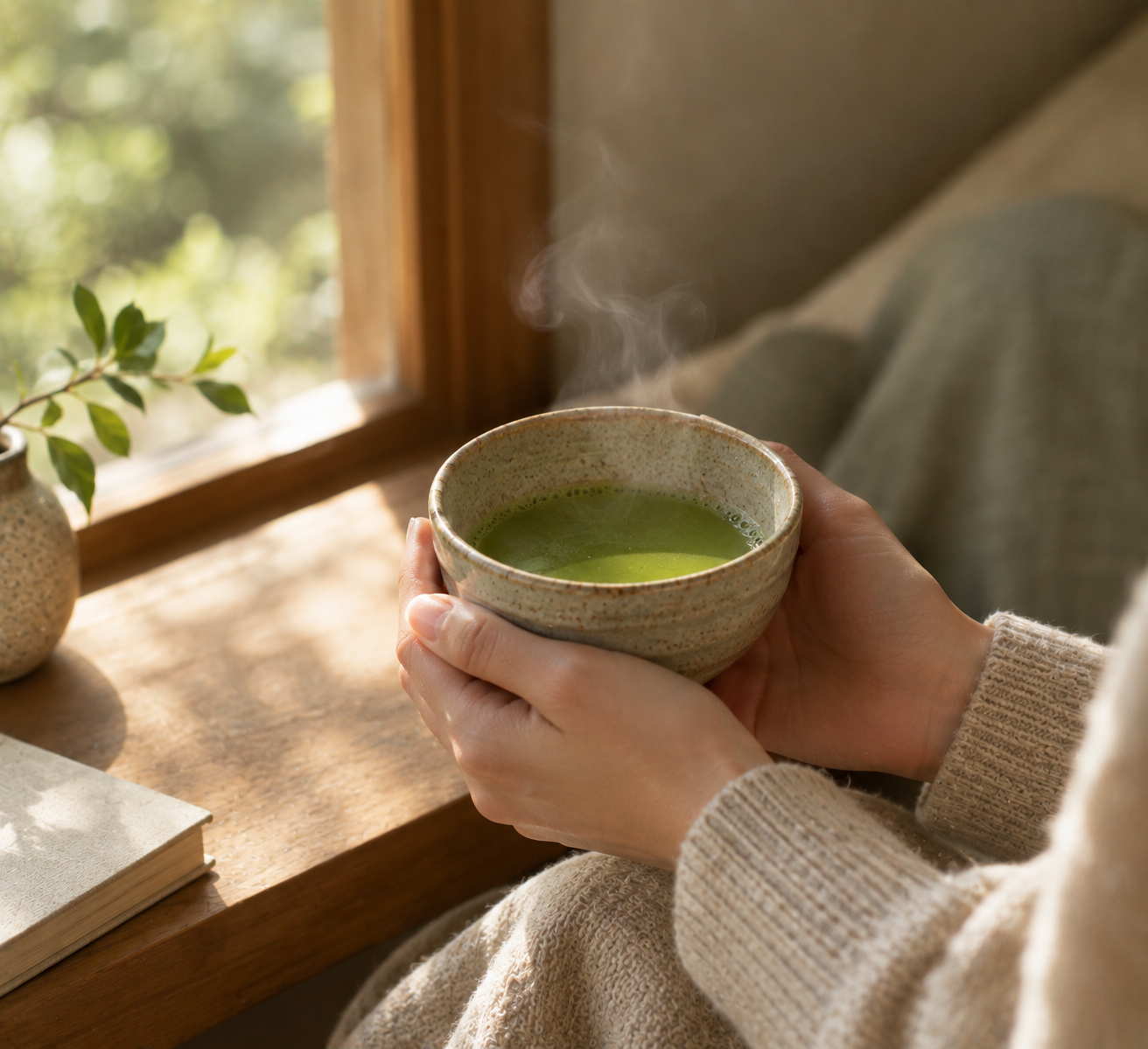
None of this is meant to dismiss the non-chemical part of what makes tea feel calming. The slower pace of properly brewing tea or whisking matcha, the small deliberate motions involved, and the built-in pause it creates in a day are real contributors to a sense of calm, independent of anything happening biochemically. Separating “the tea itself” from “the ritual around the tea” is somewhat artificial, since for most people, both are genuinely part of the same experience, working together rather than one being the “real” explanation and the other just decoration.
A Reasonable Way to Think About This
Japanese tea, particularly shaded varieties like matcha and gyokuro, offers a real, modest, research-supported relaxation effect through L-theanine, alongside a genuinely calming ritual independent of the chemistry. It’s a reasonable, low-risk addition to a stress-management routine that also includes the fundamentals — sleep, movement, and, where needed, professional support — not a replacement for any of those.
A Few Things People Ask Me
Which Japanese tea has the most L-theanine? Gyokuro and high-grade matcha generally lead, both due to intensive shading before harvest, which is specifically what boosts this compound in the leaf. Standard sencha, grown in more sun, contains less by comparison, though still more than most non-shaded teas generally.
Does decaffeinated green tea still offer the calming L-theanine effect? Yes, the L-theanine content isn’t dependent on caffeine, so a decaffeinated version would still deliver the amino acid, though you’d lose the specific caffeine-and-L-theanine pairing effect some research points to for sustained, steady alertness.
How much tea would I need to drink to match what the studies actually used? Most positive studies used concentrated doses beyond what a single casual cup delivers, so multiple cups of a shaded tea like matcha or gyokuro across a day would get you closer to studied amounts than one occasional cup, though exact equivalency is hard to pin down given how much L-theanine content varies by tea quality and preparation.
Is it safe to drink tea specifically for anxiety alongside prescribed anxiety medication? This is genuinely a conversation to have with your doctor or pharmacist rather than general information like this, since L-theanine and caffeine can interact with some medications, and your doctor can advise based on your specific prescription and health situation.
Does hojicha, being roasted, still contain L-theanine? Yes, roasting affects caffeine content more than it affects L-theanine, so hojicha still offers some of this amino acid, generally paired with a much gentler caffeine profile than matcha or standard sencha, which some people specifically prefer for an evening wind-down.
Does hojicha, being roasted, still contain L-theanine? Yes, roasting affects caffeine content more than it affects L-theanine, so hojicha still offers some of this amino acid, generally paired with a much gentler caffeine profile than matcha or standard sencha, which some people specifically prefer for an evening wind-down. My best hojicha brands guide is a good starting point if that combination appeals to you.
Is there a best time of day to drink tea specifically for the calming effect? Since the research shows effects emerging within roughly 30 to 60 minutes of intake and generally not lasting indefinitely, timing tea around a specific stressful moment, before a demanding meeting or task, is a reasonable approach based on the studied timeframes, rather than assuming a morning cup carries the effect through an entire day.
Why do I sometimes feel more alert than calm after matcha, even knowing about L-theanine? Matcha still contains real caffeine alongside its L-theanine, and individual sensitivity to that caffeine varies quite a bit. If alertness rather than calm is your dominant experience, you may be more caffeine-sensitive than average, in which case a lower-caffeine option like hojicha might better showcase the calming side of this research for you personally.
Where I Landed
The honest version of this story sits comfortably between two extremes: Japanese tea isn’t a scientifically unproven wellness myth, and it also isn’t a substitute for real stress management or mental health care when that’s genuinely what’s needed. The L-theanine research is real, modest, and worth knowing about, and the ritual side of preparing tea carries its own separate, equally real value, even without a single molecule involved.
It’s worth holding both of those truths at once rather than picking a side. You don’t need to resolve whether it’s “really” the chemistry or “really” the ritual doing the work — for most people reaching for a cup on a stressful afternoon, both are quietly contributing at the same time, and neither one needs to be the sole explanation for the other to matter.
If you’re drawn to this specifically for matcha’s higher L-theanine concentration, my matcha powder brands comparison is a good next stop, and my how to make a matcha latte guide covers a version worth making slowly, on purpose, as part of the ritual itself rather than rushed through on the way out the door.