Author: arino

  • The Best Mugicha (Japanese Barley Tea) to Buy: Tea Bags, Brands and What to Look For

    The Best Mugicha (Japanese Barley Tea) to Buy: Tea Bags, Brands and What to Look For

    Disclosure: This post contains affiliate links. If you buy through one of them, I may earn a small commission at no extra cost to you. Allergy note: mugicha is made from barley, which contains gluten – it is not suitable for people with celiac disease or a wheat/barley allergy.

    Quick Picks

    • Easiest to find abroad: Ito En Mugicha tea bags – caffeine-free, made for hot or cold brewing, and sold in large packs. Ito En Mugicha on Amazon
    • Best for Japanese-grown barley: Japanese-brand mugicha that lists barley from Japan on the label. Japanese barley tea bags on Amazon
    • Best for a toastier, fuller cup: whole-grain (marumugi) mugicha made for boiling. Whole grain mugicha on Amazon
    • Best for organic: organic roasted barley tea – look for organic certification on the pack.
    • Want a low-caffeine real tea too? Nio Teas’ kukicha collection has gentle stem teas from small Japanese farms. At the time of writing, ordering through the links on this page automatically applies a 10% discount at checkout – no code needed. (Nio Teas doesn’t sell mugicha; the discount applies to its teas. Offers can change, so check the final price in your cart.)

    Below: how to choose mugicha, the main types and brands, how much you get per bag, and how to brew it so it tastes like the mugicha in a Japanese fridge.


    In Japan, summer smells like roasted barley. Almost every household keeps a pitcher of cold mugicha in the fridge from early summer onward, and many keep drinking it all year. It’s caffeine-free, sugar-free, cheap, and easy to make by the liter.

    Outside Japan, though, buying good mugicha is confusing. Some bags are meant for cold water, some for boiling. Some contain whole roasted grains, others ground barley. Some are Japanese, some Korean, and some are blends with other grains. This guide sorts it out so you buy the right bag the first time.

    The Problem You’re Actually Trying to Solve

    You’ve tried mugicha – or read about it – and want to keep a pitcher in the fridge. But the Amazon listings all look similar, and you don’t know whether to buy cold-brew bags or boiling bags, ground or whole grain, Japanese or Korean, or which brand tastes best.

    Who This Article Is NOT For

    • If you want to know what mugicha is and how to make it from scratch, my mugicha guide covers the basics.
    • If you want to compare all of Japan’s caffeine-free drinks, my caffeine-free Japanese tea guide covers mugicha, sobacha, kuromamecha and more.
    • If you avoid gluten, mugicha isn’t for you. Barley contains gluten. Sobacha (buckwheat tea) is gluten-free, but buckwheat is a serious allergen of its own.

    How to Choose Mugicha

    1. Cold-brew bags vs. boiling bags

    This is the most important choice.

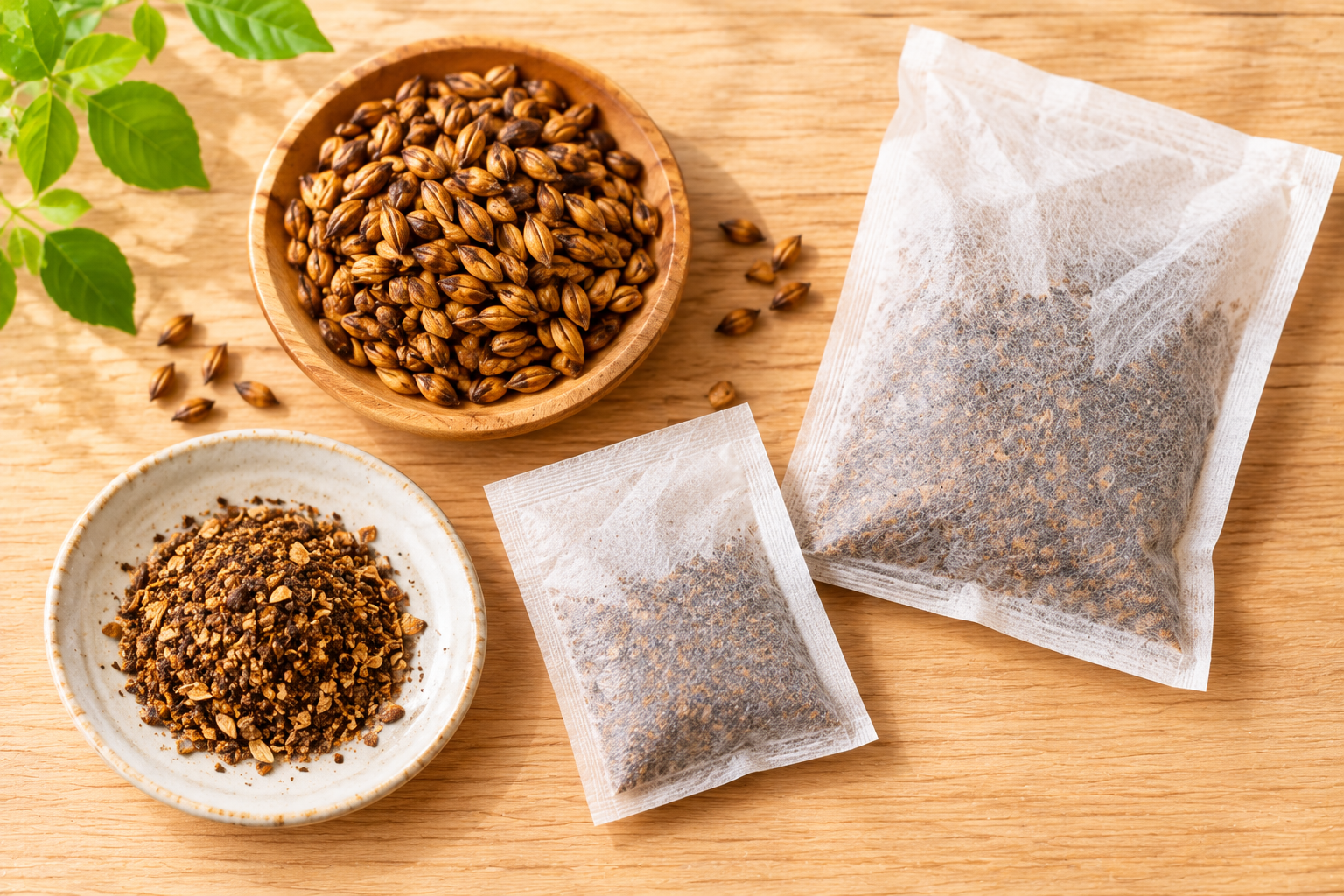
    • Cold-brew (mizudashi) bags are made from finely ground or cut barley, so flavor comes out in cold water. You drop a bag in a pitcher of cold water and refrigerate. Easy, but usually a lighter flavor.
    • Boiling (nidashi) bags often use whole or coarsely cracked roasted grains. You simmer them for several minutes, then cool. More effort, but a deeper, toastier taste.
    • Hot-or-cold bags work both ways and are a good all-rounder.

    Check the pack: Japanese bags usually say 水出し (cold brew), 煮出し (boil) or both.

    2. Bag size: how much tea it makes

    Japanese mugicha bags are usually sized for a whole pitcher – often around 1 liter per bag (some brands make bags for 2 liters). Check the size so you don’t end up with tea that’s too weak or too strong. A pack of 50 bags can last a family a whole summer.

    3. Whole grain vs. ground barley

    • Whole roasted grains (marumugi) give a rounder, toastier flavor and a clear, amber tea. They’re usually meant for boiling.
    • Ground or cut barley releases flavor fast and suits cold brew and quick hot brewing.

    4. Roast level

    Some brands roast lightly for a soft, sweet flavor; others roast deeply, sometimes more than once, for a stronger, almost coffee-like toastiness. If you like a bold cup, look for words like “deep roast” or “double roasted.”

    5. Where the barley comes from

    Many mugichas use imported barley processed in Japan. If you prefer Japanese-grown barley, look for “barley (Japan)” or 国産大麦 on the label. Most Japanese mugicha uses six-row barley (rokujo omugi), which gives the classic toasty flavor.

    6. Pure barley vs. blends

    Some products blend barley with other grains or ingredients – for example multi-grain teas. They can be delicious, but if you want classic mugicha, check that barley is the only ingredient.

    The Main Options

    OptionTypeBest forWatch out for
    Ito En MugichaTea bags, hot or coldEasy everyday mugicha, widely available abroadCheck bag size and brewing method on the pack
    Japanese-grown barley mugicha (various Japanese brands)Tea bagsPeople who want Japanese-grown barleyUsually a little pricier
    Whole-grain mugicha (e.g. Hakubaku Marumugicha)Whole grains in bags, mainly for boilingDeeper, toastier flavorNeeds boiling and cooling
    Organic mugichaTea bagsOrganic-focused buyersLess common outside Japan
    Korean borichaLoose roasted barley or bagsA very similar, often cheaper alternativeFlavor and roast differ slightly from Japanese mugicha

    Ito En Mugicha

    Ito En is Japan’s largest green tea company, and its mugicha tea bags are among the easiest Japanese mugichas to buy abroad. Its US store lists a 54-bag pack that’s naturally caffeine-free and suitable for both hot and cold brewing. In Japan, Ito En’s Kenko Mineral Mugicha is one of the best-known bottled and bagged barley teas, and you may find it in Japanese grocery stores abroad.

    Japanese-Grown Barley Mugicha

    Several Japanese brands sell mugicha made only from barley grown in Japan – Ujien’s roasted barley tea bags, for example, list barley from Japan as the ingredient. These are a good choice if origin matters to you.

    Whole-Grain Mugicha

    Hakubaku, a Japanese grain company, is known in Japan for Marumugicha – whole roasted six-row barley in bags designed to leave little residue. Whole-grain mugicha takes a few minutes of boiling but rewards you with a deeper flavor.

    Korean Boricha

    Korean roasted barley tea (boricha) is a close cousin of mugicha and is often easier to find in Asian supermarkets. It’s a perfectly good substitute – just expect small differences in roast and flavor.

    How to Brew Mugicha Like a Japanese Household

    Cold brew (easiest):

    1. Put one bag in a pitcher with the amount of cold water shown on the pack (often 1 liter).
    2. Refrigerate for 1-3 hours, depending on the brand.
    3. Remove the bag so it doesn’t turn bitter.

    Boiled (tastiest):

    1. Bring the water to a boil, add the bag, and simmer for about 3-5 minutes (or as the pack says).
    2. Remove the bag, cool the tea quickly, then refrigerate.

    Food safety tip: mugicha has no tea leaves, sugar or preservatives, but it can spoil. Keep it in the fridge in a clean pitcher, and drink it within about two days.

    A pitcher with a built-in filter or a dedicated cold-brew bottle makes the daily routine easier. The same pitcher works for cold-brewed green tea, too.

    Ways to Enjoy Mugicha Beyond a Plain Glass

    • Mugicha with a squeeze of lemon – a refreshing, sugar-free summer drink.
    • Half mugicha, half green tea – a gentle, toasty blend with a little caffeine.
    • Mugicha “latte” – brew it strong, then add warm milk and a little honey for a cozy, caffeine-free evening drink.
    • Mugicha ice cubes – freeze mugicha in an ice tray so your iced mugicha never gets watered down.
    • With rice crackers or onigiri – in Japan, mugicha is the default drink with simple, salty snacks.

    A Few Things People Ask Me

    Is mugicha caffeine-free? Yes. It’s made from roasted barley, not tea leaves.

    Is mugicha gluten-free? No. Barley contains gluten.

    Which is better, cold-brew or boiling bags? Cold-brew bags are easier; boiled mugicha tastes deeper and toastier. Many Japanese households use whichever fits the day.

    Can I drink mugicha hot? Yes. It’s lovely hot in winter, especially after a meal.

    Is Korean barley tea the same as mugicha? Very similar – both are roasted barley tea. Roast levels and flavor can differ slightly.

    Where I Landed

    The best mugicha is the one that fits your routine. For most people outside Japan, Ito En’s mugicha bags are the easy starting point. If you want Japanese-grown barley, read the label; if you want the richest flavor, try whole-grain mugicha and boil it. Whichever you choose, keep a pitcher in the fridge – it’s the simplest way to drink like a Japanese household all summer long.
  • Ito En Review: Oi Ocha, Tea Bags and Matcha – Which Ito En Teas Are Actually Worth Buying?

    Ito En Review: Oi Ocha, Tea Bags and Matcha – Which Ito En Teas Are Actually Worth Buying?

    Disclosure: This post contains affiliate links. If you buy through one of them, I may earn a small commission at no extra cost to you. Product lineups vary by country and change over time – check the current label and listing before you buy.

    Quick Verdict

    • Is Ito En worth it? Yes, for convenient, unsweetened Japanese green tea you can find almost anywhere. It’s Japan’s largest green tea company, and its bottled Oi Ocha is one of the best ready-to-drink green teas sold abroad.
    • Best overall: Oi Ocha unsweetened green tea – zero sugar, clean and consistent. Ito En Oi Ocha on Amazon
    • Best for brewing at home: Ito En green tea bags, including the matcha-blended green tea bags. Ito En green tea bags on Amazon
    • Not ideal if: you want the depth of freshly brewed, high-grade loose-leaf sencha. Bottled and bagged tea is about convenience.
    • Ready to try fresh loose-leaf sencha? Nio Teas’ sencha collection ships teas from small Japanese farms. At the time of writing, ordering through the links on this page automatically applies a 10% discount at checkout – no code needed. Offers can change, so check the final price in your cart.

    Below: who Ito En is, its main product lines, which ones are worth buying, the honest downsides, and when to upgrade to loose leaf.


    If you’ve seen a tall bottle of unsweetened Japanese green tea in an American supermarket, convenience store or office fridge, there’s a good chance it was Ito En’s Oi Ocha. Ito En is to Japanese green tea what a giant coffee chain is to coffee: everywhere, consistent and easy to grab.

    That makes it one of the most useful brands to know – and one of the easiest to misunderstand. Some of its products are excellent at what they do. Others are fine but not special. Here’s how to tell them apart.

    The Problem You’re Actually Trying to Solve

    You want a healthy, unsweetened drink or an easy cup of Japanese tea without fuss, and Ito En is the brand you see most often. You want to know which of its products are actually good, whether bottled green tea is “real” tea, and when it’s worth switching to loose leaf.

    Who This Article Is NOT For

    Who Is Ito En?

    Ito En is a Japanese tea and beverage company with its roots in Shizuoka, Japan’s historic tea capital. A few milestones explain why it matters:

    • 1966 – The company’s predecessor was founded in Shizuoka.
    • 1985 – It began selling canned green tea, using a process that removes oxygen from the can to keep the tea from spoiling – a breakthrough for ready-to-drink green tea.
    • 1989 – The canned green tea was renamed Oi Ocha.
    • 1996 – Oi Ocha launched in plastic bottles.
    • 1987 and 2001 – Ito En expanded into the US, first in Hawaii and later across the mainland through Ito En (North America).

    Today, Ito En is described as Japan’s largest green tea company. It has also invested in tea-growing regions in Japan, supporting large-scale tea farms in places like Miyazaki, Oita and Shizuoka – part of how it secures a steady supply of tea leaves.

    Ito En’s Main Product Lines

    Product lineWhat it isBest for
    Oi Ocha (bottled)Unsweetened Japanese green teaEveryday drinking, office, travel
    Oi Ocha variantsUnsweetened bottled teas such as stronger-brewed or roasted styles (varies by market)Variety without sugar
    Teas’ TeaIto En’s flavored and blended bottled tea linePeople who want flavor without much sugar – check the label
    Tea bagsGreen tea, matcha-blended green tea and other Japanese teasEasy cups at home or work
    Loose leaf and matchaJapanese teas for brewingEveryday home brewing

    Not every product is sold in every country, and lineups change often.

    What’s Worth Buying

    Oi Ocha unsweetened green tea is Ito En’s standout product. It’s clean, lightly grassy and slightly bitter in a refreshing way, with no sugar – exactly what you’d drink with a meal in Japan. It’s one of the best alternatives to soda or sweetened iced tea.

    Ito En matcha green tea bags are a smart everyday option. The added matcha gives the cup more body and a greener color than a plain green tea bag, and they’re easy to find.

    Ito En hojicha and genmaicha (where available) are forgiving, toasty everyday teas.

    Teas’ Tea and flavored lines are fine if you want variety, but read the label – some blends contain added sweeteners or flavors.

    What’s Genuinely Good

    • Unsweetened by default. Oi Ocha is real green tea with no sugar – rare among bottled teas.
    • Everywhere. Asian supermarkets, many regular supermarkets, convenience stores and online.
    • Consistent. Every bottle tastes the same, which is exactly what you want from an everyday drink.
    • Japanese tea expertise. Decades of experience and its own investment in tea-growing regions.
    • Affordable tea bags. A practical everyday cup at a low price.

    The Honest Downsides

    • Bottled isn’t fresh-brewed. Ready-to-drink tea is processed for shelf life, so it can’t match the aroma of freshly brewed sencha.
    • Mass-produced. Ito En’s products are designed for consistency, not for the nuance of a single farm or harvest.
    • Price per serving. Bottled tea costs much more per cup than brewing loose leaf at home.
    • Plastic. Daily bottled tea creates a lot of waste. A reusable bottle of homemade cold brew is a greener habit.
    • Flavored lines vary. Not everything Ito En sells is unsweetened. Check before you buy.

    Bottled vs. Brewed: When to Upgrade

    Ito En is a great everyday habit, but if you find yourself drinking several bottles a day, brewing your own tea is cheaper, greener and often tastier.

    Bottled Oi OchaIto En tea bagsLoose-leaf sencha
    ConvenienceHighestHighLower
    FlavorClean, consistentGoodBest, most aromatic
    Cost per cupHighestLowLow to moderate
    WasteMostLowLowest
    Best forOn the goOffice and homeEnjoying tea properly

    An easy middle ground: cold-brew tea at home. Put a tea bag or a spoonful of loose sencha in a bottle of cold water, refrigerate for a few hours, and you have your own “Oi Ocha” for a fraction of the price.

    How to Make Ito En Tea Bags Taste Better

    A few small changes make an everyday tea bag taste noticeably better:

    • Use cooler water. Let boiled water stand for a few minutes, to around 70-80°C (158-176°F). Boiling water makes green tea bitter.
    • Use a smaller cup. About 150ml per bag gives a fuller flavor than a big mug.
    • Steep briefly. One to two minutes is enough. Don’t squeeze the bag.
    • Try it cold. Drop two bags into a bottle of cold water and refrigerate for two to three hours for a smooth, sweet cold brew.
    • Keep the box sealed. Store opened bags in an airtight container to keep the aroma fresh.

    A Few Things People Ask Me

    Is Oi Ocha healthy? It’s unsweetened green tea with no sugar, which makes it a better everyday choice than soda or sweetened drinks. It does contain caffeine.

    Does Oi Ocha have caffeine? Yes – it’s real green tea. If you’re sensitive, drink it earlier in the day.

    Is Ito En real Japanese tea? Yes. Ito En is a Japanese tea company, and its core green teas are made from Japanese tea leaves.

    Which is better, Ito En tea bags or loose leaf? Loose leaf tastes better and offers more variety; tea bags are faster and easier. Many people keep both.

    Where I Landed

    Ito En is the brand that makes Japanese green tea easy. Its unsweetened Oi Ocha is one of the best bottled drinks you can grab, and its tea bags are a sensible everyday cup. It won’t give you the depth of freshly brewed, high-grade sencha – but it doesn’t try to. Keep Oi Ocha for on the go, keep tea bags at work, and when you’re ready to taste what Japanese tea can really be, try a fresh loose-leaf sencha at home.

  • Kettl Review: Is the Brooklyn Japanese Tea Shop Worth Its Premium Prices?

    Kettl Review: Is the Brooklyn Japanese Tea Shop Worth Its Premium Prices?

    Disclosure: This post contains affiliate links. If you buy through one of them, I may earn a small commission at no extra cost to you. Links to Kettl itself are not affiliate links. Prices and policies below are from Kettl’s website at the time of writing (November 2026) and change often – check before you buy.

    Quick Verdict

    • Is Kettl worth it? Yes, if you want some of the best Japanese tea available in the US and don’t mind paying for it. Kettl buys directly from producers it visits in Japan, packs tea in Fukuoka, and air-ships it to the US.
    • Best for: tea lovers in the US who want high-grade matcha, gyokuro and sencha from named Japanese producers, plus ceramics and tea tools.
    • Not ideal for: budget shoppers or people who mostly make sweet lattes – you’d be paying for quality you won’t taste.
    • Best first order: one matcha or sencha from a named producer, plus a tea tool or teaware piece to reach free shipping (over $150 at the time of writing).
    • Want to read before you buy? Kettl founder Zach Mangan’s book, Stories of Japanese Tea on Amazon, is a beautiful introduction to Japanese tea regions and growers.
    • Prefer to buy shipped straight from Japan, often for less? Nio Teas ships teas from small Japanese farms. At the time of writing, ordering through the links on this page automatically applies a 10% discount at checkout – no code needed. Offers can change, so check the final price in your cart.

    Below: who runs Kettl, what makes it different, the honest downsides, and how it compares with other places to buy Japanese tea.


    Ask serious tea drinkers in the US where to buy Japanese tea, and Kettl’s name comes up quickly. It’s a Brooklyn-based company with cafés in New York and Los Angeles, an office in Fukuoka, and a reputation for sourcing teas that are hard to find outside Japan. It’s also noticeably more expensive than most other options.

    So what are you actually paying for – and is it worth it for you?

    The Problem You’re Actually Trying to Solve

    You want genuinely high-quality Japanese tea in the US, from people who know the producers, and you’re willing to pay more for it. But you want to know whether Kettl’s prices reflect real quality, which teas are worth buying, and whether a cheaper shop would serve you just as well.

    Who This Article Is NOT For

    • If you’re comparing several places to buy sencha, my sencha brand comparison covers the main options.
    • If you’re comparing matcha brands rather than shops, my matcha brand comparison puts the big names side by side.
    • If you’re on a tight budget, Kettl’s prices may be hard to justify for everyday drinking.

    Who Runs Kettl

    Kettl was founded by Zach Mangan and his wife Minami, and at the time of writing it describes itself as being in its 15th year. Zach began his tea career at a Japanese tea shop in Manhattan and has since written Stories of Japanese Tea: The Regions, the Growers, and the Craft (Princeton Architectural Press, 2022), with chapters on sencha, matcha and gyokuro and interviews with growers.

    The company has offices in Fukuoka, Japan, Brooklyn and Los Angeles, and runs cafés and shops in:

    • Greenpoint, Brooklyn
    • Kettl Matcha Sen Mon Ten, Brooklyn – a matcha-focused shop
    • Los Feliz, Los Angeles

    How Kettl Sources Its Tea

    This is what sets Kettl apart:

    • Direct relationships. Kettl buys from growers and producers it knows personally and visits several times a year. The founders spent two years building those relationships before launching.
    • A short supply chain. Tea is received and hand-packed by Kettl’s team in Fukuoka, then shipped by air to its Brooklyn warehouse, with deliveries arriving weekly.
    • Named producers. Many teas are sold under the name of the producer or region, so you know where your tea comes from.
    • Fresh processing in New York. Kettl has milled matcha and roasted hojicha at its Brooklyn shop, and runs a matcha subscription built around fresh milling.

    In short, Kettl works more like a specialty coffee roaster than a typical tea brand: fewer middlemen, more information about the source, and a focus on freshness.

    What You Can Buy

    • Matcha – a wide range, from everyday to rare high-grade tins (at the time of writing, prices ranged from around $45 to $85 and up for a tin)
    • Loose-leaf teas – sencha, gyokuro, hojicha and other Japanese green teas, plus black, oolong and caffeine-free options
    • Tea bags
    • Ceramics and tea tools – kyusu, matcha bowls, whisks and more
    • Sweets, incense and kombucha
    • Classes and events – in-person tea and latte classes in New York, plus virtual matcha classes
    • Subscriptions – which ship free in the US

    What’s Genuinely Good

    • Exceptional sourcing. Direct relationships with named producers mean access to teas rarely sold outside Japan.
    • Freshness. Air shipping, weekly deliveries and fresh milling help keep tea vibrant.
    • Expertise. The founder has written a book on Japanese tea, and the team clearly knows its producers.
    • Beautiful teaware. A well-chosen selection of ceramics and tools.
    • Learning opportunities. Classes and events help you get more out of your tea.
    • US-based shipping. No international customs to deal with for US customers, and free shipping over $150 at the time of writing.

    The Honest Downsides

    • Price. Kettl is one of the more expensive places to buy Japanese tea in the US. You’re paying for sourcing, freshness and expertise – but it adds up.
    • Overkill for lattes. High-grade matcha shines with water; in a sweet latte, much of what you pay for is lost.
    • Popular items sell out. Some matcha is sold on pre-order or in limited quantities.
    • Mainly for US customers. If you’re outside the US, buying from Japan is usually simpler and cheaper.
    • Easy to overspend. The range of beautiful teaware and rare teas makes it tempting to buy more than you need.

    What to Order First

    If you like…TryWhy
    Matcha straightOne of Kettl’s everyday matcha tinsA clear step up from supermarket matcha
    SenchaA sencha from a named producerShows how much producer and region matter
    Sweet, rich teaA gyokuroKettl’s sourcing shines with shaded teas
    Roasted teaHojichaGentle, easy to brew, and lovely in the evening
    LearningA class or a subscriptionGuided tasting teaches more than reading

    How to Get the Most Out of an Expensive Tea

    If you’re paying premium prices, a few habits make sure you taste what you paid for:

    • Weigh the tea. Use a small kitchen scale – about 2g of matcha per bowl, or 4-5g of leaf per small pot.
    • Control the water temperature. Around 80°C (175°F) for matcha and sencha, 50-60°C (122-140°F) for gyokuro.
    • Drink it straight first. Taste a high-grade tea with water before deciding whether to add milk.
    • Re-steep leaf teas. Good sencha and gyokuro give two or three delicious infusions, which makes the price per cup much lower.
    • Store it well. Keep tins sealed in the fridge and finish opened matcha within a month.

    Kettl vs. Other Ways to Buy

    KettlDen’s TeaNio TeasSazen Tea
    Ships fromUS (Brooklyn)US (California)JapanJapan
    StrengthDirect relationships, rare high-grade teasProducer-owned Shizuoka teaSmall-farm teas, easy to browseFamous Uji brands at Japanese prices
    Price levelPremiumMidMidJapanese retail + shipping
    Best forSpecial teas, experienced drinkersEveryday senchaExploring farmsFamous matcha, teaware

    A Few Things People Ask Me

    Is Kettl matcha worth the price? For drinking straight, its higher-grade matcha is among the best you can buy in the US. For sweet lattes, cheaper matcha is fine.

    Where are Kettl’s shops? At the time of writing: Greenpoint and Sen Mon Ten in Brooklyn, and Los Feliz in Los Angeles.

    Does Kettl ship outside the US? It’s focused on US customers. Check its site for current shipping destinations.

    Is Zach Mangan’s book worth reading? If you want to understand Japanese tea regions and the people who make the tea, yes – it’s one of the best English-language introductions available.

    Where I Landed

    Kettl is where you go when you want the special stuff. Its direct sourcing, fresh shipping and genuine expertise make it one of the best places in the US to buy high-grade Japanese tea – and its prices reflect that. Start with one tea you’ll drink straight, from a named producer, and taste the difference. For everyday sencha or latte matcha, a more affordable shop will do the job just as well.

    You can browse Kettl’s range at kettl.co.

  • Jade Leaf Matcha Review: Culinary vs. Ceremonial, and Which One You Should Actually Buy

    Jade Leaf Matcha Review: Culinary vs. Ceremonial, and Which One You Should Actually Buy

    Disclosure: This post contains affiliate links. If you buy through one of them, I may earn a small commission at no extra cost to you. Product names, sizes and prices change often – check the current listing before you buy.

    Quick Verdict

    • Is Jade Leaf worth it? Yes – as long as you buy the right grade. It’s organic Japanese matcha at a fair price, widely available in the US, and one of the best-selling matcha brands on Amazon. Its culinary grade is great for lattes and baking but disappointing on its own.
    • Best for baking, smoothies and sweet lattes: Jade Leaf Culinary – the best seller, and good value. Jade Leaf Culinary on Amazon
    • Best for drinking with water: Jade Leaf Ceremonial – smoother and brighter. Jade Leaf Ceremonial on Amazon
    • Avoid by mistake: the sweetened latte mixes, if you want pure matcha. Check the ingredients.
    • Ready for single-origin matcha with more depth? Nio Teas’ matcha collection is a good next step. At the time of writing, ordering through the links on this page automatically applies a 10% discount at checkout – no code needed. Offers can change, so check the final price in your cart.

    Below: Jade Leaf’s grades and editions, which one fits which use, the honest downsides, and how it compares with other popular brands.


    If you’ve bought matcha in an American supermarket or on Amazon, there’s a good chance it was Jade Leaf. Its green pouches and single-serve sticks are everywhere, and its culinary matcha has tens of thousands of reviews. For many people, it’s the matcha that started their matcha habit.

    The most common mistake people make with Jade Leaf isn’t the brand – it’s buying the wrong grade. Get that right, and it’s an easy recommendation.

    The Problem You’re Actually Trying to Solve

    You want an affordable, organic matcha you can trust, and Jade Leaf is everywhere. But there are several grades and “editions,” plus latte mixes, and the reviews are mixed – some people love it, others say it tastes bitter. You want to know which product to buy for how you actually drink matcha.

    Who This Article Is NOT For

    • If you’re comparing several brands at once, my matcha brand comparison covers Ippodo, Marukyu Koyamaen, Encha and DoMatcha.
    • If you mainly bake with matcha, my guide to baking with matcha covers how to keep the color and flavor in cookies and cakes.
    • If you want koicha-grade matcha or deep, complex usucha, a Kyoto tea house will suit you better.

    About Jade Leaf

    Jade Leaf is a US matcha brand built around a simple promise: premium organic Japanese matcha at a fair price. Co-founder Marc St Raymond, a former software engineer, started drinking matcha for focus during long workdays and built the company around making good matcha accessible.

    Key facts:

    • Organic Japanese matcha
    • Sourced from Uji and Kagoshima, through a network of partner farms
    • Sold widely – through its own site, Amazon (including Subscribe & Save) and many US grocery stores
    • Several grades and formats, from culinary to ceremonial, plus single-serve sticks and flavored latte products

    The Grades and Editions, Explained

    ProductWhat it isBest for
    CulinaryOrganic matcha made for mixing; muted green, more bitter on its ownBaking, smoothies, sweet lattes
    Ceremonial (Classic)Organic first-harvest matcha; brighter, smootherDrinking with water, clean lattes
    Ceremonial Teahouse EditionA ceremonial grade aimed at straight drinkingUsucha
    Organic Ceremonial Barista EditionCeremonial matcha designed for café lattesLattes at home or in cafés
    Single-serve sticksPre-portioned matchaWork, travel, trying the brand
    Latte mixes and infusionsMatcha blended with sugar or other ingredientsConvenience – but not pure matcha

    Not every product is available in every store, and the lineup changes from time to time.

    The culinary vs. ceremonial difference

    This is the most important thing to understand about Jade Leaf.

    • Culinary is noticeably more bitter and astringent with water alone, and its color is duller. In milk, sugar, smoothies and baking, those qualities don’t matter much – and its bolder flavor actually helps it come through.
    • Ceremonial is brighter green, smoother and less harsh, so it’s the one to choose if you whisk matcha with water.

    Many disappointed reviews come from people who bought culinary matcha and drank it with water. If that’s how you drink matcha, buy ceremonial.

    Which Jade Leaf Should You Buy?

    You mostly…BuyWhy
    Bake, blend smoothies or make sweet iced lattesCulinaryBold enough for other ingredients, best value
    Make lattes and want a cleaner flavorCeremonial or Barista EditionSmoother under milk
    Whisk matcha with waterCeremonial or Teahouse EditionLess bitter, brighter color
    Want to try it firstSingle-serve sticksNo open bag going stale
    Want a quick sweet drinkLatte mixConvenient – but check the sugar

    What’s Genuinely Good

    • Organic at a fair price. One of the most affordable ways to buy organic Japanese matcha.
    • Easy to find. Widely sold online and in US stores.
    • A strong culinary grade. Excellent value for baking, smoothies and sweet lattes.
    • Clear range. Culinary for mixing, ceremonial for drinking, editions for specific uses.
    • Convenient formats. Single-serve sticks and larger bags for regular users.

    The Honest Downsides

    • Culinary grade isn’t for drinking straight. It’s bitter on its own – and it’s the product most people find first.
    • Limited depth. Even the ceremonial grades are approachable rather than complex. Experienced drinkers may find them one-dimensional compared with top Kyoto matcha.
    • Latte mixes aren’t pure matcha. Some contain sugar or functional ingredients. Read the label.
    • Bag packaging. Larger pouches mean more exposure to air once opened. Squeeze out the air and keep the bag in the fridge.
    • Less sourcing detail than single-farm brands. You know the regions, not the specific farm or cultivar.

    Three Easy Ways to Use Jade Leaf Culinary

    Because culinary grade is the product most people end up with, here’s how to get the most out of it:

    • Matcha banana bread or cookies. Replace about 1-2 tablespoons of flour with culinary matcha. Bake at a slightly lower temperature and keep the bake short to protect the green color.
    • Iced matcha lemonade. Whisk 2g with a little cold water until smooth, then pour over ice with lemonade. The sweetness and acidity balance culinary matcha’s bitterness.
    • Matcha overnight oats. Stir 1 teaspoon into oats, milk and a little honey, then refrigerate overnight.

    Jade Leaf vs. Other Popular Brands

    Jade LeafNaokiDoMatchaEncha
    OrganicYesSome productsMany productsYes
    SourcingUji and Kagoshima partner farmsJapanese (Uji on main blend)Several Japanese partnersOwn farm in Uji
    Standout productCulinary for mixingSmooth ceremonial blendHonest Summer HarvestPurpose-built latte grade
    Best forBaking, smoothies, valueBeginner usucha and lattesGrocery-store convenienceOrganic lattes

    If Jade Leaf ceremonial gets you hooked on drinking matcha straight, a Kyoto tea house’s entry grade is the natural next step for more depth.

    How to Prepare It

    Ceremonial (usucha): sift about 2g into a bowl, add about 70ml of water at around 80°C (175°F), and whisk briskly in a zigzag until frothy.

    Culinary latte: whisk 2g with a splash of warm water into a smooth paste, then add about 150ml of milk and a little sweetener – culinary grade tastes best with a touch of sweetness.

    Smoothie: blend 1 teaspoon of culinary matcha with banana, spinach, milk and ice.

    Storage: keep the bag sealed in the fridge and use it within a month or two of opening.

    A Few Things People Ask Me

    Is Jade Leaf real Japanese matcha? Yes. It’s organic matcha sourced from Uji and Kagoshima.

    Why does my Jade Leaf taste bitter? You probably have the culinary grade, or your water is too hot. Use ceremonial for drinking with water, and cool the water to around 80°C.

    Is Jade Leaf good for lattes? Yes. Culinary grade works well in sweet lattes; ceremonial or the Barista Edition gives a cleaner flavor.

    Is Jade Leaf better than Naoki? They suit different needs. Jade Leaf is strongest for culinary use and organic value; Naoki’s best-known blend is a smooth everyday ceremonial matcha.

    Where I Landed

    Jade Leaf is a reliable, affordable, organic matcha – as long as you buy the right grade. For baking, smoothies and sweet lattes, its culinary matcha is one of the best values around. For drinking with water, step up to ceremonial. And if you find yourself wanting more depth than either can offer, that’s the moment to explore Kyoto tea houses and single-origin farm matcha.

  • Naoki Matcha Review: Is Amazon’s Favorite Matcha Actually Good?

    Naoki Matcha Review: Is Amazon’s Favorite Matcha Actually Good?

    Disclosure: This post contains affiliate links. If you buy through one of them, I may earn a small commission at no extra cost to you. Product names, sizes and prices change often on Amazon – check the current listing before you buy.

    Quick Verdict

    • Is Naoki Matcha worth it? For most everyday drinkers, yes. It’s one of the most-reviewed matcha brands on Amazon, and its best-known tin is smooth, mild and fairly priced. It isn’t a replacement for top Kyoto tea-house matcha.
    • Best for daily usucha and lattes: Superior Ceremonial Blend – the brand’s best seller, smooth and low in bitterness. Naoki Superior Ceremonial Blend on Amazon
    • Best for baking and smoothies: the culinary “All Purpose” blend. Naoki All Purpose Blend on Amazon
    • Not ideal if: you already drink matcha straight every day and want depth and complexity – a premium Kyoto tea-house grade will satisfy you more.
    • Want to try single-origin matcha from small farms? Nio Teas’ matcha collection is a good next step. At the time of writing, ordering through the links on this page automatically applies a 10% discount at checkout – no code needed. Offers can change, so check the final price in your cart.

    Below: what Naoki sells, which blend fits which use, the honest downsides, and how it compares with Ippodo and other brands.


    Search for matcha on Amazon and Naoki is almost always near the top – with thousands of reviews and a high star rating. For many people, it’s the first “real” matcha they ever buy. That popularity is a good sign, but star ratings don’t tell you everything: plenty of five-star reviews come from people who mostly make sweet lattes, where almost any decent matcha tastes fine.

    So how good is Naoki, really – and is it the right matcha for you?

    The Problem You’re Actually Trying to Solve

    You want a matcha that’s genuinely Japanese, tastes good, and doesn’t cost as much as famous Kyoto brands. Naoki’s ratings look great, but you’re not sure whether to trust them, which of its blends to buy, or whether you’d be better off spending a little more.

    Who This Article Is NOT For

    • If you’re comparing several brands at once, my matcha brand comparison covers Ippodo, Marukyu Koyamaen, Encha and DoMatcha side by side.
    • If you’re confused by “ceremonial,” “premium” and “culinary” labels, my guide to telling matcha grades apart explains why the label alone won’t tell you much.
    • If you want koicha-grade matcha for thick tea, Naoki’s everyday blends aren’t designed for that.

    What Naoki Matcha Is

    Naoki Matcha is a matcha brand sold mainly online, especially through Amazon. Its products are Japanese matcha sold as named “blends,” each aimed at a different use. Product listings describe its best-known blend as first-harvest matcha from Uji, Kyoto; some third-party reviews also mention Kagoshima as a source region, so check the label of the specific product you’re buying if origin matters to you.

    The main products you’re likely to see include:

    BlendPositioned asBest for
    Superior Ceremonial BlendFirst-harvest ceremonial matcha, the best sellerDaily usucha, lattes, cold brew
    Organic Ceremonial First Spring BlendOrganic first-harvest matchaOrganic-minded daily drinkers
    Organic All Purpose BlendCulinary gradeBaking, smoothies, cooking
    Ujitawara SpecialThe brand’s top-end matchaDrinking straight, special occasions

    Product names and sizes on Amazon change from time to time, and some listings are sold by third parties – check that you’re buying from the brand or a reputable seller.

    How the Superior Ceremonial Blend Tastes

    Most reviewers describe the Superior Ceremonial Blend in similar terms: smooth, mild, lightly sweet, with little bitterness. That’s exactly what most new matcha drinkers want. It whisks into a pleasant, easy bowl of usucha and works well in lattes and cold-brew matcha.

    What it doesn’t have is the deep, savory umami and long finish of top-grade matcha from historic Kyoto tea houses. Experienced drinkers sometimes find it a little too mild. Think of it as an excellent everyday matcha rather than a special-occasion one.

    Which Naoki Should You Buy?

    You mostly…BuyWhy
    Drink matcha with water, just starting outSuperior Ceremonial BlendSmooth, forgiving, fairly priced
    Make hot or iced lattesSuperior Ceremonial BlendGentle enough for milk without wasting a premium tin
    Want organicOrganic Ceremonial First Spring BlendOrganic first-harvest option
    Bake or blend smoothiesOrganic All Purpose BlendCulinary grade – don’t waste ceremonial in a cake
    Want Naoki’s bestUjitawara SpecialIts top-end blend for drinking straight

    If you’re unsure, start with the Superior Ceremonial Blend – it’s the blend most people’s reviews are about, and it covers both straight matcha and lattes.

    What’s Genuinely Good

    • Easy to love. Smooth and low in bitterness – a gentle introduction to matcha.
    • Fair price for daily use. Good value compared with famous Kyoto brands.
    • Easy to buy. Fast delivery through Amazon in many countries.
    • Clear use-based blends. Ceremonial, organic and culinary options make it easy to buy the right product.
    • Versatile. The best seller works for usucha, lattes and cold brew.

    The Honest Downsides

    • Less depth than premium matcha. If you already know and love top-grade Uji matcha, Naoki will feel mild.
    • Limited sourcing detail. You get a region, but not the farm, cultivar or producer that more transparent brands share.
    • “Ceremonial” is a marketing term. It isn’t regulated, so Naoki’s “ceremonial” isn’t directly comparable to a Kyoto tea house’s top grade.
    • Marketplace freshness risk. As with any matcha on Amazon, tins can sit in warehouses. Check the best-before date and recent reviews.
    • Health claims on listings. Some listings promote energy and focus benefits. Treat matcha as a pleasant drink, not a supplement.

    How to Read Amazon Reviews for Matcha

    Star ratings are useful, but for matcha they can mislead. A few habits help:

    • Check how reviewers drink it. A five-star review from someone making sweet iced lattes tells you little about how the matcha tastes with water alone.
    • Look for color and freshness comments. Words like “dull,” “yellowish” or “stale” in recent reviews are warning signs about storage, not just taste.
    • Sort by most recent. Older reviews may describe a different batch or packaging.
    • Watch the seller name. Buy from the brand’s own storefront or a reputable seller rather than an unknown third party.

    Naoki vs. Other Brands

    NaokiIppodoDoMatchaEncha
    Typical styleSmooth, mildBalanced, consistentEveryday, honest gradesOrganic, single farm
    Sourcing detailRegionKyoto tea-house blendsSeveral Japanese partnersOwn farm in Uji
    Price levelAffordable to midMid to premiumAffordableMid
    Best forEasy daily matcha on AmazonDrinking straightGrocery-store convenienceOrganic, lattes

    If Naoki’s Superior Ceremonial Blend is the matcha that gets you hooked, Ippodo’s Sayaka is a natural next step: a little more expensive, with more depth.

    How to Prepare It

    Usucha: sift about 2g (a heaped teaspoon) into a bowl, add about 70ml of water at around 80°C (175°F), and whisk briskly in a zigzag until a fine foam forms.

    Latte: whisk 2g with a splash of warm water into a smooth paste, then add about 150ml of hot or cold milk. Sweeten lightly – a mild matcha is easy to overpower with sugar.

    Cold brew: shake 2g of matcha with 200ml of cold water in a sealed bottle until smooth. Naoki’s mild style works well cold.

    Storage: keep it sealed in the fridge and finish within about a month or two of opening.

    A Few Things People Ask Me

    Is Naoki real Japanese matcha? Yes. Its listings describe Japanese-grown matcha, with Uji named as the source of its best-known blend.

    Is Naoki good for beginners? Very. Its smooth, low-bitterness style is one of the easiest ways to start enjoying matcha.

    Is Naoki as good as Ippodo? For everyday drinking, it’s close enough for many people and costs less. For depth and complexity, Ippodo’s higher grades are a clear step up.

    Why does my Naoki taste bitter? Usually water that’s too hot or too much powder for the water. Cool the water to around 80°C and sift the powder first.

    Where I Landed

    Naoki Matcha earns its popularity. Its Superior Ceremonial Blend is smooth, approachable and fairly priced, which makes it one of the easiest matchas to recommend to beginners and latte drinkers. If you find yourself drinking matcha straight every day and wanting more depth, that’s the moment to move up to a Kyoto tea house or a single-origin farm matcha. Until then, Naoki is a very good place to start.

  • Sazen Tea Review: Buying Kyoto Matcha and Teaware From Japan at Japanese Prices

    Sazen Tea Review: Buying Kyoto Matcha and Teaware From Japan at Japanese Prices

    Disclosure: This post contains affiliate links. If you buy through one of them, I may earn a small commission at no extra cost to you. Links to Sazen Tea itself are not affiliate links. Shipping, prices and policies below are from Sazen Tea’s website at the time of writing (October 2026) and change often – check the current terms at checkout.

    Quick Verdict

    • Is Sazen Tea worth it? Yes, especially for matcha and teaware. It’s a Japan-based shop that sells matcha from famous Uji makers – including Marukyu Koyamaen, Kanbayashi Shunsho and Hekisuien – at prices it says match Japanese domestic retail, and ships worldwide.
    • Best for: matcha lovers who want well-known Uji brands without reseller markups, and anyone looking for handmade Japanese teaware.
    • Not ideal for: small, urgent orders. Preparation takes days, international shipping adds more, and you’re responsible for any customs charges.
    • Best first order: one or two matcha tins from a famous Uji maker, plus a whisk or teaware piece to reach the free-shipping threshold.
    • Prefer a smaller, curated shop of farm teas? Nio Teas ships teas from small Japanese farms. At the time of writing, ordering through the links on this page automatically applies a 10% discount at checkout – no code needed. Offers can change, so check the final price in your cart.

    Below: who runs Sazen Tea, what it sells, shipping and customs in plain English, the honest downsides, and how to order smart.


    If you’ve ever tried to buy Marukyu Koyamaen or another famous Uji matcha outside Japan, you’ve probably seen the problem: sold-out listings, marketplace sellers charging two or three times the Japanese price, and tins of uncertain age. Sazen Tea is one of the shops matcha drinkers recommend most often as the way around that. It’s based in Japan, sells at Japanese prices, and ships to customers around the world.

    The Problem You’re Actually Trying to Solve

    You want authentic Japanese matcha or teaware from well-known makers, at a fair price, from a seller you can trust – and you’re willing to wait for international shipping if it means avoiding inflated reseller prices. You want to know whether Sazen Tea is reliable and what to expect with shipping and customs.

    Who This Article Is NOT For

    Who Runs Sazen Tea

    Sazen Tea Co., Ltd. was founded in 2014 by Motonari Jotatsu, a historian and qualified Japanese tea instructor, and his wife Agnes Balogh, a graphic artist who serves as managing director. The company describes itself as Kyoto-based, and its head office and warehouse are in Moriyama, Shiga Prefecture, close to Kyoto.

    Its model is straightforward:

    • Sell famous Japanese tea brands and artisan teaware online, in English and Japanese
    • Price products at Japanese domestic retail levels, according to the company
    • Ship directly from Japan to customers worldwide

    The owner says he personally selects and tests the teaware the shop sells.

    What You Can Buy

    Matcha from well-known Uji makers, including:

    • Marukyu Koyamaen
    • Kanbayashi Shunsho
    • Hekisuien
    • Hokoen
    • Yamamasa Koyamaen

    Japanese leaf teas: gyokuro, kabusecha, sencha, kukicha, genmaicha, hojicha, kamairicha and more.

    Chinese and Taiwanese teas: oolongs and other styles – unusual for a Japanese tea shop.

    Teaware: teapots, cups, matcha bowls, whisks, scoops, tea caddies, trays and sets, including handmade pieces from Japanese craftspeople.

    What’s Genuinely Good

    • Famous brands at fair prices. Buying Marukyu Koyamaen or Kanbayashi Shunsho at roughly Japanese prices is often far cheaper than buying from overseas resellers, even after shipping.
    • A wide choice of Uji makers in one place. Comparing several historic matcha houses side by side is hard to do anywhere else.
    • Excellent teaware selection. Handmade bowls, kyusu and accessories you won’t find in Western stores.
    • Free shipping over a threshold. At the time of writing, international orders over about $150 USD (or €120) shipped free – though the threshold shown on the site has varied, so check the banner.
    • Small extras. USD orders include a free tea sample, and registered customers earn reward points (1% of purchase value) on orders.
    • DDP option. With DHL or FedEx, you can choose to pay duties and taxes at checkout so there are no surprise charges on delivery (where available).

    The Honest Downsides

    • Slow preparation. Orders usually take several business days to prepare before shipping – Sazen’s site says 3-10 business days after payment, and longer at busy times.
    • Customs are your responsibility. As the importer, you may owe duties, VAT or handling fees, depending on your country – unless you choose DDP where it’s offered.
    • Responsibility passes when it leaves Japan. Sazen ships on FOB terms, so claims for lost or damaged parcels go through the courier. Adding signature and insurance is recommended for expensive orders.
    • No refunds on tea for personal reasons. Perishable items like tea can’t be returned unless they arrive wrong or damaged.
    • Limits on popular items. Sought-after matcha and handmade teaware may be limited per customer or sell out quickly.
    • Short cancellation window. Orders can only be changed or canceled within 12 hours.

    Shipping and Customs, in Plain English

    StepWhat to expect
    PreparationUsually 3-10 business days after payment
    CouriersDHL, FedEx or Japan Post EMS, depending on your country
    TransitUsually fast once shipped (express couriers)
    CustomsYou may owe duties or taxes on arrival
    DDP (DHL/FedEx)Pay duties at checkout – no surprises on delivery, where available
    TrackingSent after shipment

    Sazen’s own shipping guide also notes that splitting a large order into smaller packages can sometimes keep each one below your country’s duty threshold – worth checking against your local rules.

    How to Order Smart

    1. Aim for the free-shipping threshold. Combine matcha with a whisk, scoop or teaware piece.
    2. Choose DDP if it’s offered for your country. It costs more upfront but avoids surprise charges and delays.
    3. Add insurance for expensive teaware. Responsibility passes to you once the parcel leaves Japan.
    4. Order before you run out. With preparation and shipping, plan on one to three weeks overall.
    5. Register an account to collect reward points on future orders.
    6. Check the “Limited” label on popular items – they can sell out between visits.

    What to Buy First

    If you want…Look forWhy
    A famous matcha at a fair priceMarukyu Koyamaen or Kanbayashi Shunsho usucha gradesHard to find abroad without reseller markups
    To compare Uji housesTwo small tins from different makersTasting side by side shows each house’s style
    A first matcha setA whisk, scoop and bowl with one tinReaches free shipping and covers everything you need
    A special giftA handmade matcha bowl or kyusuTeaware is where Sazen really stands out

    Sazen Tea vs. Other Ways to Buy

    Sazen TeaNio TeasMarketplace resellers
    Ships fromJapanJapanVaries
    StrengthFamous Uji brands at Japanese prices, great teawareSmall farm teas, easy to browseFast delivery
    PriceJapanese retail + shippingShop price + shippingOften heavily marked up
    FreshnessShipped from JapanShipped from JapanUncertain
    Best forFamous matcha brands, teawareDiscovering farm teasUrgent, small purchases

    A Few Things People Ask Me

    Is Sazen Tea legit? Yes. It’s a registered Japanese company that has been selling tea internationally since 2014, with clear published policies on shipping, customs and returns.

    Is Sazen Tea cheaper than Amazon for Marukyu Koyamaen? Often, yes – especially for larger orders that reach free shipping. Compare the total including shipping and any customs charges for your country.

    How long does Sazen Tea take to arrive? Plan for preparation of several business days plus courier transit and customs – typically one to three weeks in total, and longer in busy seasons.

    Will I pay customs? Possibly. It depends on your country and order value. Choosing DDP with DHL or FedEx, where available, lets you pay at checkout instead of on delivery.

    Where I Landed

    Sazen Tea is one of the best ways to buy famous Uji matcha and Japanese teaware from abroad without paying reseller prices. It’s not the fastest option, and you need to understand customs for your country, but for well-known matcha brands and handmade teaware, the combination of fair prices and trustworthy sourcing is hard to beat. Plan your order, reach the free-shipping threshold, and choose DDP if you can.

    You can browse the full range at Sazen Tea.

  • Hojicha Co. Review: Is the Hojicha Latte Brand Worth It?

    Hojicha Co. Review: Is the Hojicha Latte Brand Worth It?

    Disclosure: This post contains affiliate links. If you buy through one of them, I may earn a small commission at no extra cost to you. Product details below are from public information about Hojicha Co. at the time of writing (October 2026); the range and prices may change.

    Quick Verdict

    • Is Hojicha Co. worth it? Yes, if you want to make hojicha lattes at home. It’s a brand built around one thing – Kyoto hojicha, especially hojicha powder – and its powder is designed to stand up to milk.
    • Best for lattes and baking: Hojicha Co. hojicha powder – their best seller. Hojicha Co. powder on Amazon
    • Best for drinking straight: their loose-leaf hojicha, including the Gold Roast. Hojicha Co. loose leaf on Amazon
    • Not ideal if: you mostly drink hojicha plain and want a gentle, delicate cup – a refined stem hojicha from a Kyoto tea house may suit you better.
    • Want a gentle real tea for evenings too? Nio Teas’ kukicha collection has low-caffeine stem teas from small farms. At the time of writing, ordering through the links on this page automatically applies a 10% discount at checkout – no code needed. Offers can change, so check the final price in your cart.

    Below: who’s behind Hojicha Co., what it sells, how the powder works in a latte, the honest downsides, and how it compares with other hojicha brands.


    A few years ago, hojicha was almost unknown outside Japan. Today, hojicha lattes are on café menus across North America – and Hojicha Co. is one of the brands that helped make that happen. Rather than selling every kind of Japanese tea, it focused on one: roasted green tea from Kyoto, with a powder made for lattes.

    That focus is its biggest strength. It’s also why it isn’t the right choice for everyone.

    The Problem You’re Actually Trying to Solve

    You’ve had a hojicha latte at a café and want to make it at home, or you’ve seen Hojicha Co. recommended and want to know if it’s worth buying. You’re wondering whether its powder actually tastes good, whether it works for drinking straight, and how it compares with the hojicha sold by traditional Japanese tea houses.

    Who This Article Is NOT For

    • If you want to compare several hojicha brands side by side, my hojicha brand comparison covers Ippodo, Marukyu Koyamaen, Kaga Boucha, Hojicha Co. and Ito En.
    • If you’re mainly wondering how much caffeine hojicha has, my matcha vs. hojicha caffeine comparison covers that.
    • If you need a completely caffeine-free drink, hojicha isn’t it – it’s lower than many teas in a typical cup, but not zero.

    Who’s Behind Hojicha Co.

    Hojicha Co. was founded in 2018 in Toronto, Canada, by Danielle Geva and Francois Mathieu. The idea came from a trip to Japan: they brought hojicha home, shared it with friends, ran out quickly, and found nothing fresh and authentic in local shops.

    A few points about the company:

    • Kyoto sourcing. Its hojicha is sourced from Kyoto Prefecture, where hojicha has a long tradition. The founders chose producers by tasting and comparing samples.
    • A focus on powder. Hojicha powder – finely ground roasted green tea – quickly became its best seller, and the company has worked to bring it into North American cafés.
    • Recognition. It won “Best Tea” at the Toronto Coffee & Tea Expo in 2019, and its Gold Roast hojicha placed in a blind tasting at the Toronto Tea Festival in 2020.
    • A link to Marukyu Koyamaen. In 2023, Hojicha Co. announced a partnership with the Uji matcha maker Marukyu Koyamaen, becoming an official distributor of its matcha outside Japan – useful if you’ve struggled to find Marukyu Koyamaen from trustworthy sellers.

    What It Sells

    • Hojicha powder – the flagship product, for lattes and baking
    • Loose-leaf hojicha – several varieties, including the Gold Roast
    • Uji matcha from Marukyu Koyamaen
    • Japanese-made tea accessories and teaware

    How the Powder Works

    Hojicha powder is to hojicha what matcha is to green tea: the whole roasted leaf, ground fine. You don’t steep it – you whisk or stir it into liquid. That makes it fast and convenient, and it gives a fuller, toastier flavor than a latte made from brewed hojicha.

    Basic hojicha latte:

    1. Add about 1-2 teaspoons (2-4g) of hojicha powder to a mug.
    2. Pour in a splash of hot water (around 80°C / 175°F or hotter – roasted tea tolerates heat) and whisk into a smooth paste.
    3. Add about 200ml of steamed or cold milk.
    4. Sweeten with a little maple syrup or honey if you like – maple and hojicha are a particularly good match.

    The same powder works in baking, smoothies, ice cream and overnight oats – anywhere you’d use matcha but want a toasty, caramel-like flavor instead of a grassy one.

    Three Ways to Use Hojicha Powder Beyond the Basic Latte

    Iced maple hojicha latte. Whisk 3g of powder with 30ml of hot water and 1-2 teaspoons of maple syrup until smooth. Pour over a glass of ice, then top with about 200ml of cold milk. The maple brings out hojicha’s caramel notes, and it’s a good choice for warm days.

    Hojicha affogato. Whisk 2g of powder with 30ml of hot water into a thick shot, then pour it over a scoop of vanilla ice cream. It’s a fast, impressive dessert – and a good way to taste the powder’s roasted flavor clearly.

    Hojicha overnight oats. Stir 1 teaspoon of powder into 50g of oats, 150ml of milk and a little honey, then refrigerate overnight. The toasty flavor works especially well with banana, walnuts or a spoonful of nut butter.

    As a rule, use a little more hojicha powder than you would matcha: its flavor is gentler, so it needs a bit more to come through milk and sugar.

    What’s Genuinely Good

    • Built for lattes. The powder is designed to taste good under milk, which is how most people outside Japan drink hojicha.
    • Kyoto-sourced. Kyoto is hojicha’s traditional home, and the brand sources only from there.
    • Focused expertise. A brand that does one tea is more likely to do it carefully.
    • Easy to buy in North America. Shipping from within North America is faster and simpler than ordering from Japan.
    • Approachable. For coffee drinkers, a hojicha latte is one of the easiest “first Japanese teas” to enjoy.

    The Honest Downsides

    • Bold for drinking plain. The powder is designed for milk, so it can feel strong and a little heavy whisked with water alone.
    • More expensive than supermarket hojicha. You’re paying for a specialist brand and quality powder.
    • Narrower range. If you want to explore many styles of Japanese tea, a broader shop offers more.
    • Not caffeine-free. Hojicha is often marketed as very low in caffeine, but Japan’s official food composition tables list brewed hojicha at about 20mg per 100ml – similar to sencha under their standard brewing method. And with powder, you consume the whole leaf, so a strong powder latte isn’t as gentle as a lightly brewed cup.
    • Powder fades. Like matcha, hojicha powder loses aroma once opened. Keep it sealed and finish it within a few weeks to a couple of months.

    Hojicha Co. vs. Other Hojicha Brands

    Hojicha Co.Ippodo Kuki-HojichaKaga BouchaIto En
    Best forLattes, bakingRefined straight cupsBold, smoky characterBudget everyday
    FormPowder and loose leafLoose leaf (stems)Loose leaf (stems)Tea bags, leaf
    StyleToasty, built for milkGentle, biscuit-likeDeeply roastedConsistent, mild
    OriginKyotoKyotoKanazawaJapan (large producer)

    A Few Things People Ask Me

    Is Hojicha Co. powder good for drinking with just water? It can be, but it’s built for lattes. For plain hojicha, a loose-leaf hojicha usually tastes more balanced.

    How is hojicha powder different from matcha? Matcha is ground shade-grown green tea; hojicha powder is ground roasted green tea. Hojicha powder tastes toasty and caramel-like rather than grassy and is usually less bitter.

    Is hojicha good for the evening? Many people drink it in the evening because it’s gentle, but it does contain caffeine. If you’re sensitive, keep servings small or choose a caffeine-free grain tea instead.

    Does Hojicha Co. sell matcha? Yes – it distributes Uji matcha from Marukyu Koyamaen outside Japan.

    Where I Landed

    Hojicha Co. is the brand I’d point anyone to who wants to make a café-style hojicha latte at home. Its powder is made for exactly that, it’s sourced from Kyoto, and it’s easy to buy in North America. If you mostly drink hojicha plain, a gentle loose-leaf hojicha will serve you better. But for lattes, baking and a toasty alternative to matcha, it’s an easy recommendation.

  • Yunomi.life Review: Is It Worth Buying Japanese Tea Direct From Small Farms?

    Yunomi.life Review: Is It Worth Buying Japanese Tea Direct From Small Farms?

    Disclosure: This post contains affiliate links. If you buy through one of them, I may earn a small commission at no extra cost to you. Links to Yunomi.life itself are not affiliate links. Shipping methods, fees and policies below are from Yunomi.life’s website at the time of writing (October 2026) and change often – always check at checkout.

    Quick Verdict

    • Is Yunomi.life worth it? Yes, if you want variety. It’s an online marketplace based in Tokyo that sells tea from small Japanese farms, factories and shops to customers in 100+ countries – including teas you almost never see outside Japan.
    • Best for: adventurous tea drinkers who want to explore regions, farms and unusual teas, and who are happy to wait for international delivery.
    • Not ideal for: people who want one cheap bag quickly. International shipping costs make small orders expensive.
    • Best first order: a sampler, plus one or two teas you can’t find anywhere else – for example, a single-farm sencha or a regional specialty.
    • Prefer a simpler, curated shop with fewer choices? Nio Teas also ships tea from small Japanese farms, with a smaller, easier-to-browse selection. At the time of writing, ordering through the links on this page automatically applies a 10% discount at checkout – no code needed. Offers can change, so check the final price in your cart.

    Below: how Yunomi.life works, what it does well, the honest downsides, and how to order without overpaying for shipping.


    Quick note: this is a review of Yunomi.life, the online tea shop. If you’re looking for the Japanese teacup called a yunomi, that’s a different article.

    Most Japanese tea sold abroad comes from a handful of big brands. But Japan has thousands of small tea farms and family factories, and almost none of them sell overseas – they don’t have English websites, export paperwork, or international shipping. Yunomi.life exists to fix that. It’s one of the main ways tea lovers outside Japan can buy directly from the small producers who actually grow and make the tea.

    The Problem You’re Actually Trying to Solve

    You’ve tried the well-known brands and want to go further – single-farm teas, unusual regional styles, things you’ve read about but can’t find. Yunomi.life comes up again and again, but you want to know whether it’s trustworthy, how shipping works, and whether it’s worth the cost.

    Who This Article Is NOT For

    • If you want a monthly box rather than choosing teas yourself, my Japanese tea subscription box guide compares the main options.
    • If you just want one good everyday sencha from a domestic US seller, a US-based shop with faster, cheaper shipping will suit you better.
    • If you’re new to Japanese tea and overwhelmed by choice, a smaller curated shop is an easier starting point.

    How Yunomi.life Works

    Yunomi.life is run by Yunomi Life Co., Ltd., based in Tokyo, with Ian Chun as CEO. It grew out of an earlier project selling tea for a farm in Wazuka, Kyoto, around 2010, and launched as a broader marketplace a few years later.

    The idea is simple:

    • Small Japanese producers list their teas – family farms, tea factories, teaware studios and long-established shops.
    • Yunomi handles the hard parts – English descriptions, promotion, export rules and international shipping.
    • You buy from many producers in one place, and Yunomi ships to you from Japan.

    The company also translates customer reviews into Japanese and passes them on to the producers – a small detail that shows the “people-to-people” focus behind the business.

    By early 2026, Yunomi.life was approaching its 50,000th order.

    What You Can Buy

    The range is enormous:

    • Green teas: sencha, fukamushi, gyokuro, kabusecha, kamairicha, tamaryokucha, bancha, kukicha, genmaicha, hojicha
    • Matcha from multiple regions and producers
    • Black tea, oolong and rare styles, including fermented teas like goishicha and awa bancha (my guide to Japan’s fermented teas explains these)
    • Herbal and grain teas, teaware, snacks and samplers
    • A quarterly subscription box – at the time of writing, each box contained 11 teas (10g each), 2 tisanes and 2 snacks

    What’s Genuinely Good

    • Unmatched variety. If a Japanese tea exists, there’s a good chance you’ll find it here – including teas from small farms with no other way to reach overseas buyers.
    • Direct from producers. You can often see which farm or factory made your tea, sometimes with photos and background.
    • Great for learning. Comparing several senchas from different regions or farms side by side teaches you more than any article can.
    • Supports small farms. Japan’s tea industry is shrinking and ageing – Yunomi cites figures showing the number of tea farms has fallen dramatically over recent decades. Buying direct helps small producers stay in business.
    • Delivery guarantee. Yunomi states that it guarantees delivery of retail orders: if a parcel is lost and can’t be reshipped, it offers a refund, and damaged items reported with a photo are replaced or refunded.

    The Honest Downsides

    • Shipping costs. International courier shipping isn’t cheap, and it makes small orders expensive. You’ll get much better value by ordering several teas at once.
    • Fewer shipping options for the US. At the time of writing, Yunomi’s site said Japan Post mail wasn’t available for the USA, so US orders go by courier – faster, but usually pricier.
    • Possible duties and taxes. Depending on your country, you may pay import taxes or fees on delivery. Check your country’s rules before placing a large order.
    • Waiting time. Orders typically take 1-5 days to fulfill before shipping, plus delivery time – and out-of-stock items or customs checks can add more.
    • Quality varies by producer. It’s a marketplace, not a single brand. Most teas are good, but you’re choosing among many sellers, so read descriptions and reviews carefully.
    • Overwhelming choice. The huge catalog is a strength for enthusiasts but can be confusing for beginners.

    How to Order Smart

    1. Make one bigger order instead of several small ones. Shipping is the main cost, so combine teas.
    2. Start with a sampler. It’s the cheapest way to taste several producers before committing to full bags.
    3. Sign up for the newsletter. At the time of writing, Yunomi offered a discount coupon for new newsletter members.
    4. Compare shipping methods at checkout. Prices and speeds differ a lot between couriers.
    5. Read producer descriptions and reviews. Look for harvest date, region and cultivar – the same signals of quality you’d look for anywhere.
    6. Order fresh teas in spring and early summer. That’s when new-season sencha (shincha) is available.

    What to Try First

    If you like…Look forWhy it’s worth ordering from Japan
    SenchaTwo senchas from different regions (e.g. Shizuoka and Kagoshima)Tasting them side by side shows how much region matters
    MatchaA small tin from a farm-direct producerFresher and more specific than supermarket matcha
    Something newA regional specialty like kamairicha or tamaryokuchaRarely sold outside Japan
    Roasted teaA single-farm hojichaSmall roasters often have distinctive styles
    AdventureA fermented tea such as awa banchaAlmost impossible to find elsewhere

    Yunomi.life vs. Other Ways to Buy

    Yunomi.lifeNio TeasUS-based Japanese tea shop
    Ships fromJapanJapanWithin the US
    SelectionHuge marketplace of many producersCurated selection from small farmsUsually one producer or region
    Best forExploring and rare teasEasy-to-browse farm teasFast, cheap everyday reorders
    ShippingInternational courier, variesInternationalDomestic, cheaper
    DrawbackOverwhelming, shipping costsSmaller rangeLess variety

    A Few Things People Ask Me

    Is Yunomi.life legit? Yes. It’s a registered Japanese company based in Tokyo that has been selling tea internationally for over a decade, with tens of thousands of orders and a published delivery guarantee.

    How long does shipping take? It depends on the courier and your country. Orders generally take 1-5 days to fulfill, plus delivery time shown at checkout.

    Will I pay customs fees? Possibly, depending on your country. Yunomi notes that buyers may owe duties or taxes on delivery.

    Is the subscription box worth it? If you enjoy discovering new teas, yes – it’s a curated way to try many small producers. If you already know what you like, buying individual teas gives you more control.

    Is it better than buying from one brand? For variety, yes. For simplicity and speed, a single trusted brand is easier.

    Where I Landed

    Yunomi.life is the closest thing to walking through Japan’s tea country from your kitchen. For anyone who’s outgrown the big brands and wants to taste the difference between farms, regions and unusual styles, it’s an excellent resource – especially if you order several teas at once to make shipping worthwhile. If you’d rather have a smaller, simpler selection, a curated shop is easier. But if you want to explore, this is where to start.

    You can browse the full catalog on Yunomi.life.

  • DoMatcha Review: Is the Supermarket-Shelf Matcha Actually Good, and Which Tin Should You Buy?

    DoMatcha Review: Is the Supermarket-Shelf Matcha Actually Good, and Which Tin Should You Buy?

    Disclosure: This post contains affiliate links. If you buy through one of them, I may earn a small commission at no extra cost to you. Product details and prices vary by country and retailer and change often – check the current listing before you buy.

    Quick Verdict

    • Is DoMatcha worth it? Yes, as an everyday matcha you can find easily in North American stores. It’s genuinely Japanese, widely certified organic, and honestly labeled by harvest. It isn’t trying to compete with top Kyoto tea houses for special-occasion bowls.
    • Best value daily matcha: Summer Harvest – a later-harvest tea sold honestly as an everyday matcha, not dressed up as “ceremonial.” DoMatcha Summer Harvest on Amazon
    • Best for drinking straight: DoMatcha Ceremonial – smoother and sweeter, for whisking with water. DoMatcha Ceremonial on Amazon
    • Best for baking: DoMatcha Culinary.
    • Want to explore single-origin teas from small farms? Nio Teas’ matcha collection offers more variety. At the time of writing, ordering through the links on this page automatically applies a 10% discount at checkout – no code needed. Offers can change, so check the final price in your cart.

    Below: who makes DoMatcha, how its lines differ, the honest downsides, and how it compares with Encha, Ippodo and Marukyu Koyamaen.


    If you’ve ever looked for matcha in a Canadian or American grocery store, health-food shop or café, there’s a good chance you’ve seen DoMatcha’s small tins. It was one of the first brands to bring Japanese matcha to North American shelves, long before matcha lattes were everywhere.

    That makes it one of the most convenient matcha brands to buy – but convenience raises a fair question. Is a matcha you can pick up next to the coffee beans actually good? Or is it the kind of “green powder” that gives matcha a bad name?

    The Problem You’re Actually Trying to Solve

    You want decent matcha without ordering from Japan or paying Kyoto tea-house prices, and DoMatcha is the brand you keep seeing in stores. You want to know whether it’s real Japanese matcha, which of its tins to buy, and whether it’s good enough to drink straight or only for lattes.

    Who This Article Is NOT For

    • If you’re comparing several brands at once, my matcha brand comparison puts DoMatcha alongside Ippodo, Marukyu Koyamaen and Encha.
    • If you’re not sure what “ceremonial” or “culinary” really mean, my guide to telling matcha grades apart explains why the label alone won’t tell you.
    • If you want koicha-grade matcha or a long ladder of premium grades, DoMatcha isn’t built for that.

    Who Makes DoMatcha

    DoMatcha was introduced in 2007 by Andrews & George, a long-established company with roots in trade with Japan, led by John Harrison. Based in Canada, it set out to bring authentic Japanese matcha to North American shoppers at a time when most people there had never heard of it.

    According to the company’s own history, it works with tea partners in Japan, including producers in Uji and an organically certified family business in Kagoshima. Its matcha is stone-ground in Japan, and many of its products carry organic certification.

    DoMatcha also says it popularized simple grade names in North America – Ceremonial, Summer Harvest and Culinary – to help shoppers understand what they’re buying.

    The Main Lines, Explained

    LineWhat it isBest for
    CeremonialHigher-grade, shade-grown matcha for whisking with waterUsucha, drinking straight
    Summer HarvestPicked later in the season; bolder and more affordableDaily matcha, lattes
    CulinaryMade for cooking and bakingBaking, smoothies, desserts
    Organic versionsCertified organic matchaOrganic-focused buyers
    Master’s DecafDecaffeinated matchaEvening drinkers, caffeine-sensitive people
    Travel packetsSingle-serve sachetsWork, travel, trying the brand

    The lineup varies by country and store, so you may not see every product everywhere.

    Why “Summer Harvest” is a smart idea

    Most matcha brands only use the words “ceremonial” and “culinary” – and slap “ceremonial” on almost everything, because it sells. DoMatcha does something more honest: it sells a later-harvest matcha under its own name. Later-harvest leaves are bolder and slightly more astringent than spring leaves, which makes them less ideal for a delicate bowl of usucha but perfectly good for daily drinking and lattes – at a lower price.

    If you’re looking for an everyday matcha, that honesty is worth rewarding.

    The decaf option

    Decaffeinated matcha is rare. DoMatcha’s Master’s Decaf is one of the few widely sold options, and it’s genuinely useful if you love matcha but can’t have caffeine in the evening. Expect it to taste a little different from regular matcha – decaffeination affects flavor – and don’t expect it to be completely caffeine-free.

    Which DoMatcha Should You Buy?

    You mostly…BuyWhy
    Drink matcha with waterCeremonialSmoother and sweeter
    Make daily lattesSummer HarvestBold enough for milk, better value
    Bake or make smoothiesCulinaryNo point paying for ceremonial in a cake
    Want organicAn organic Ceremonial or Summer HarvestCertified organic options in both lines
    Avoid caffeine in the eveningMaster’s DecafOne of the few decaf matchas available
    Just want to try itTravel packetsLow commitment, no open tin going stale

    What’s Genuinely Good

    • Easy to find. Widely sold in North American grocery stores, health-food shops and online – no waiting for an international order.
    • Honest grade names. Summer Harvest tells you what it is instead of pretending to be ceremonial.
    • Organic options. Many products carry organic certification.
    • Small tins. Easier to finish while fresh than large bags.
    • A decaf option. Rare, and useful.
    • Good entry point. A sensible, affordable step up from generic supermarket “green tea powder.”

    The Honest Downsides

    • Not top-tier. DoMatcha’s ceremonial grade is good for everyday drinking, but it doesn’t match the depth of Ippodo’s or Marukyu Koyamaen’s higher grades.
    • Less sourcing detail per tin. Encha names one farm; DoMatcha works with several partners, so you know less about where a particular tin came from.
    • Freshness depends on the store. Tins on a warm grocery shelf may have been there for a while. Check the best-before date and avoid dusty stock.
    • Lineup varies by country. What’s sold in Canada may differ from what’s available in the US.
    • Lower grades lean generic. The flavor is pleasant and reliable rather than distinctive.

    How DoMatcha Compares

    DoMatchaEnchaIppodoMarukyu Koyamaen
    Organic optionsYesYes (all)NoNo
    SourcingSeveral Japanese partnersOwn farm in UjiKyoto tea-house blendsOwn tea in Uji
    Price levelAffordableMidMid to premiumMid to premium
    Easy to find in storesVeryOnline, some retailersOnlineOften sold out
    Best forEveryday matcha, beginnersOrganic, lattesDrinking straightLearning grades, koicha

    How to Prepare It

    Ceremonial: sift about 2g (a heaped teaspoon) into a bowl, add about 70ml of water at around 80°C (175°F), and whisk briskly in a zigzag until frothy.

    Summer Harvest latte: whisk 2g of matcha with a splash of warm water into a smooth paste, then add about 150ml of hot or cold milk. A little honey or maple syrup balances the bolder flavor.

    Storage: keep the tin tightly closed in the fridge and finish it within about a month or two of opening.

    A Few Things People Ask Me

    Is DoMatcha real Japanese matcha? Yes. It’s grown and stone-ground in Japan, sold by a Canadian company working with Japanese tea partners.

    Is DoMatcha Summer Harvest good? For everyday drinking and lattes, yes – and it’s honestly labeled. Just don’t expect it to taste like a premium spring-harvest ceremonial matcha.

    Is DoMatcha organic? Many DoMatcha products are certified organic, but not every product is. Check the label of the specific tin.

    DoMatcha or Encha? Both are organic-friendly North American brands. Encha is single-farm and has a well-designed latte grade; DoMatcha is easier to find in stores, offers a decaf option and has the honest Summer Harvest line.

    Where I Landed

    DoMatcha isn’t trying to be the best matcha in the world – it’s trying to be good, honest matcha you can actually find. On that, it succeeds. Summer Harvest is a smart buy for daily drinking and lattes, Ceremonial is a solid everyday bowl, and the decaf fills a gap almost no other brand covers. When you’re ready for deeper, sweeter matcha, a Kyoto tea house is the next step. Until then, DoMatcha is a perfectly good place to start.

  • Den’s Tea Review: Is This Shizuoka-Owned Shop the Best Place to Buy Japanese Tea in the US?

    Den’s Tea Review: Is This Shizuoka-Owned Shop the Best Place to Buy Japanese Tea in the US?

    Disclosure: This post contains affiliate links. If you buy through one of them, I may earn a small commission at no extra cost to you. Links to Den’s Tea’s own website are not affiliate links. Details below are from Den’s Tea’s website at the time of writing (October 2026) and may change.

    Quick Verdict

    • Is Den’s Tea worth it? Yes, especially for sencha. It’s the US arm of a Shizuoka tea company that has been in business since 1923, so the tea comes straight from a Japanese producer rather than through layers of importers.
    • Best for: sencha and fukamushi sencha lovers in North America who want fresh, authentic everyday Japanese tea delivered quickly.
    • Best first order: a fukamushi sencha and a genmaicha – the styles Shizuoka does best. Den’s Tea also sells matcha comparison sets if you want to taste grades side by side.
    • Where to buy: directly from Den’s Tea’s website (free shipping on orders of $50 or more at the time of writing), or look for Den’s Tea on Amazon.
    • Want teas from many regions and small farms instead? Nio Teas’ sencha collection covers more regions. At the time of writing, ordering through the links on this page automatically applies a 10% discount at checkout – no code needed. Offers can change, so check the final price in your cart.

    Below: who’s behind Den’s Tea, what it does well, the honest downsides, and what to order first.


    If you live in the US and want good Japanese green tea, you quickly run into a problem: most of what’s on store shelves is old, generic, or not really Japanese at all. Ordering from Japan works, but it takes time and shipping costs add up. Den’s Tea is one of the names that keeps coming up as the answer – a California-based shop that sells Japanese tea from its own family company in Shizuoka.

    Here’s what makes it different, and whether it’s the right place for you to buy.

    The Problem You’re Actually Trying to Solve

    You want fresh, authentic Japanese tea without paying international shipping or waiting weeks, and you want to be sure the seller actually knows Japanese tea. Den’s Tea looks promising, but you want to know who’s behind it, how fresh the tea is, and what’s worth ordering.

    Who This Article Is NOT For

    • If you’re comparing several places to buy sencha, my sencha brand comparison covers the main options side by side.
    • If you’re outside North America, Den’s Tea is set up mainly for US customers; a shop that ships internationally from Japan may suit you better.
    • If you’re mainly after rare single-estate teas from many different regions, Den’s Tea’s strength is breadth within Shizuoka-style tea rather than a wide map of small farms.

    Who’s Behind Den’s Tea

    Den’s Tea isn’t a reseller that happens to like Japanese tea. It’s part of a Japanese tea company:

    • Shirakata Denshiro Shoten (SDS) is a tea company in Shizuoka, Japan’s historic tea capital, founded by Denshiro Shirakata. Den’s Tea dates the company’s operations to 1923.
    • Den Masanori Shirakata, Denshiro’s grandson, has led SDS since 1996 and owns Den’s Tea.
    • Den’s Tea was established in California in 2000 as SDS’s North American subsidiary.

    Most of its teas are grown in Shizuoka and processed and packed by SDS, then imported directly to California. Den himself holds the Japan Tea Association’s “Japanese Tea Instructor” qualification, and in 2018 he received a Japanese government award, the Minister’s Award for Overseas Promotion of Japanese Food.

    In short: when you buy from Den’s Tea, you’re buying from a Japanese tea producer’s own shop.

    What They Sell

    The range is broad for a single company:

    • Leaf teas: sencha, fukamushi sencha, gyokuro, bancha, hojicha, genmaicha, kukicha, guricha (tamaryokucha), GABA tea, Japanese black tea, oolong and more
    • Matcha: usucha and koicha grades, including matcha from several regions, plus comparison sets that let you taste grades side by side
    • Organic teas – SDS is certified organic under Japan’s JAS program
    • Tea bags, caffeine-free teas, teaware and gifts

    What’s Genuinely Good

    • Producer-direct. Fewer middlemen means you’re closer to the source, and the people selling the tea are the people who process it.
    • Fresh, carefully stored tea. Den’s Tea says it keeps its teas in climate-controlled storage in California after they arrive from Shizuoka.
    • Strong in fukamushi sencha. Deep-steamed sencha is a Shizuoka specialty, and it’s where Den’s Tea shines. Independent reviewers have rated its organic fukamushi sencha highly for flavor and aroma. (More on fukamushi sencha.)
    • Matcha comparison sets. Usucha, koicha and organic sets are an affordable way to learn grades without buying full tins.
    • US shipping. Domestic shipping is faster and simpler than ordering from Japan, with free shipping over $50 at the time of writing.
    • Organic, kosher and halal options. SDS facilities are certified kosher and halal, and many teas are JAS organic.
    • Monthly deals. A “Tea of the Month” is often discounted.

    The Honest Downsides

    • Shizuoka-centric. Most of the teas come from Shizuoka. That’s a strength for sencha, but if you want to compare Kagoshima, Yame, Uji and smaller regions, a multi-farm shop offers more variety.
    • Prices are US retail prices. You’re paying for import, storage and domestic shipping. It’s fair for what you get, but it’s more than buying the same tea in Japan.
    • A basic website. It’s functional rather than polished, and some product descriptions are brief, so beginners may need to research before ordering.
    • Mainly for North America. International customers will usually find better options elsewhere.
    • Limited independent reviews. There are fewer detailed third-party reviews than for big brands like Ippodo, so you’re relying partly on the company’s reputation.

    What to Order First

    If you like…TryWhy
    Rich, smooth green teaA fukamushi senchaShizuoka’s specialty, deep green and mellow
    Classic, fresh senchaA standard senchaA benchmark for everyday Japanese tea
    Toasty, gentle teaGenmaicha or hojichaForgiving and easy to brew
    Learning matchaA matcha comparison setTaste grades side by side for less than a full tin
    Sweet, shaded teaGyokuro or kariganeA step up in umami and sweetness

    A good first order is one sencha you’ll drink every day plus one tea you’ve never tried – which, with free shipping above $50, is easy to reach.

    Tips for Ordering

    • Check the Tea of the Month. It’s usually discounted, and it’s a low-risk way to try something new.
    • Order sizes you can finish. Opened sencha is best within a few weeks, so two smaller bags beat one large one.
    • Store it properly when it arrives. Keep unopened bags in the fridge, let them reach room temperature before opening, and move opened tea into an airtight canister away from light.
    • Brew fukamushi briefly. Deep-steamed sencha releases flavor fast – around 30-45 seconds at 70-80°C (158-176°F) is plenty. Longer steeps turn it bitter.
    • Buy matcha in small amounts. Matcha fades faster than leaf tea, so the comparison sets or small tins are the smart way to start.

    Den’s Tea vs. Other Ways to Buy

    Den’s TeaNio TeasBuying direct from Japan
    Ships fromCaliforniaJapanJapan
    StrengthProducer-direct Shizuoka tea, fast US deliverySmall farms across many regionsWidest choice, lowest base prices
    Best forEveryday sencha in the USExploring regions and farmsExperienced buyers who don’t mind waiting
    DrawbackMostly ShizuokaInternational shipping timeShipping costs and customs

    A Few Things People Ask Me

    Is Den’s Tea actually Japanese? Yes. It’s the US subsidiary of a Shizuoka tea company founded by the owner’s grandfather, and most of its tea is grown in Shizuoka and processed by the family company.

    Is Den’s Tea good for matcha? It sells a range of usucha and koicha matcha, including from several regions. Its comparison sets are especially useful for learning.

    Does Den’s Tea ship internationally? It’s focused on North American customers. Check its shipping page for current destinations.

    Is it better than buying from Japan? For US buyers who want fresh tea quickly, often yes. For the widest variety and lowest base prices, buying from Japan can win.

    Where I Landed

    Den’s Tea is one of the most trustworthy places in the US to buy Japanese tea, because it isn’t really a middleman at all – it’s a Shizuoka tea family’s own shop. If you drink sencha, and especially fukamushi sencha, it’s an easy recommendation. If you want to explore tea from many regions and small farms, pair it with a shop that covers more of Japan. Either way, start with one everyday sencha and one tea you’ve never tried.