Disclosure: This post contains affiliate links. If you buy through one of them, I may earn a small commission at no extra cost to you.
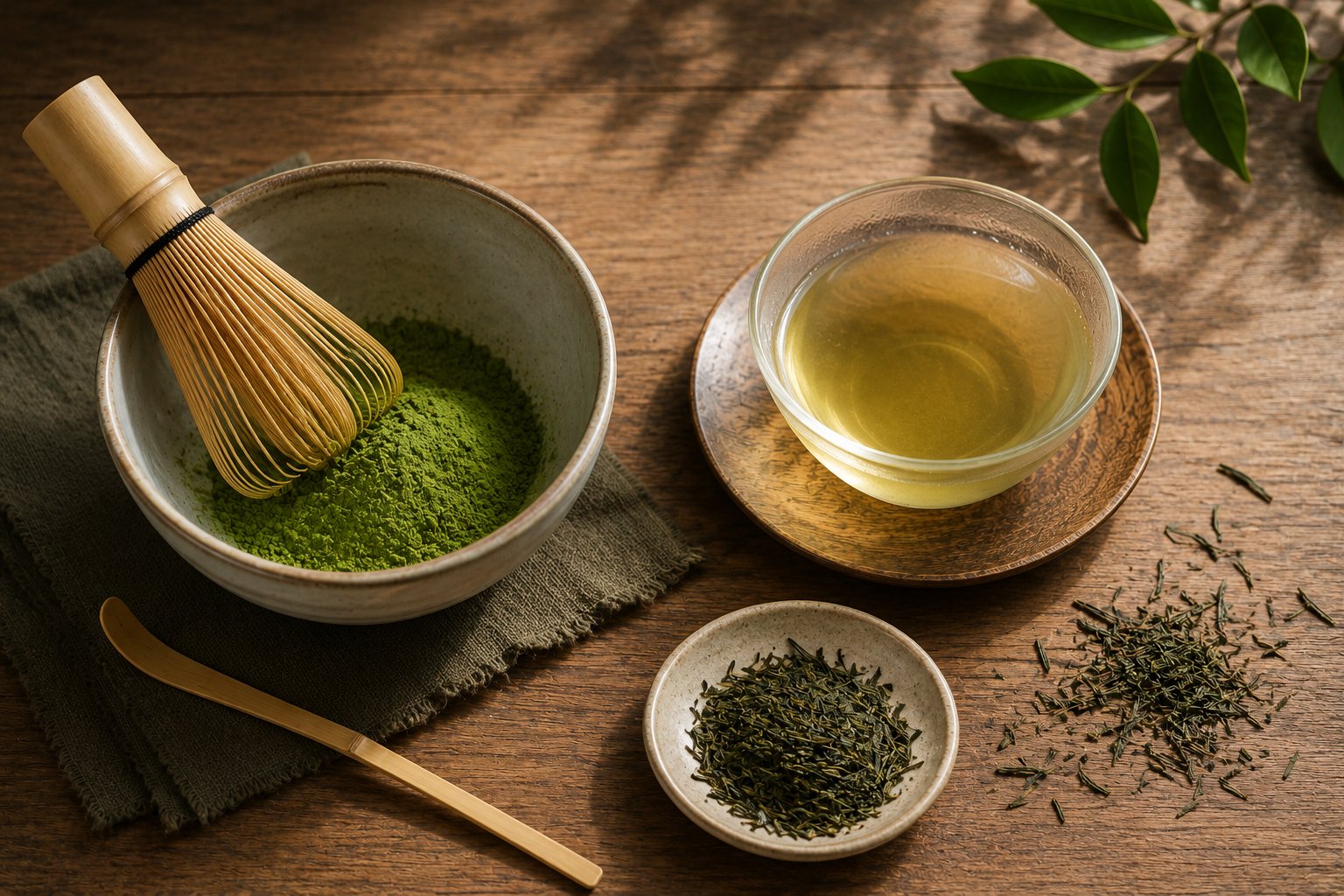
Someone once told me matcha was “just stronger green tea,” the way espresso is stronger coffee, and I let that idea sit unquestioned in my head for way longer than I should have. It’s not true, and once you actually understand why, a lot of confusing label claims and wildly different price tags suddenly make sense. Matcha and green tea come from the exact same plant. That’s about where the similarities stop.
I get why the confusion sticks around. Every grocery store green tea box says “made from the finest green tea leaves,” every matcha tin says roughly the same thing, and both liquids end up some shade of green in your cup. The marketing language is nearly identical even though the products underneath it are genuinely different. If you’ve ever wondered why matcha costs three or four times as much as sencha, or why one makes you jittery and the other doesn’t, or which one you should actually be reaching for on a given morning, this is the article that untangles it.
The Problem You’re Actually Trying to Solve
You’ve searched “matcha vs green tea” because somewhere along the way, you got curious enough to want the real answer instead of another vague “they’re basically the same, just different forms” line. Maybe you’re trying to decide which one to buy. Maybe you read a health claim about one of them and want to know if it’s actually true or just marketing. Maybe you had both back to back and noticed they tasted nothing alike and want to know why.
The short, honest answer is that matcha is a specific, more intensive version of green tea production — same plant, dramatically different growing method, processing, and how you actually consume it. Once you understand those three differences, most of the confusing claims you’ve run into online start to make sense on their own.
Who This Article Is NOT For
Let’s save you some scrolling if this isn’t quite your situation.
- If you already know the production differences and just want to know which specific brand to buy, skip ahead to my matcha powder brands comparison or my best hojicha brands guide instead — this article is about the category-level differences, not brand picks.
- If you’re looking for a deep dive into the chemistry and clinical research, this is a practical explainer, not a scientific literature review. I’ll cover what the actual compound differences are, but I won’t be citing dosage-specific studies or making medical claims.
- If you’re only interested in flavored or bottled green tea drinks, most of what’s below assumes you’re drinking loose leaf or whisked matcha, not a sweetened bottled beverage — the comparisons don’t map cleanly onto those products.
If you’re past that, here’s where the actual explanation starts.
What Actually Makes Them Different
There isn’t a long list of vague factors here — the differences boil down to three things, and once you understand these, everything else about matcha versus green tea follows naturally.
1. How the plant is grown. This is the biggest, earliest divergence, and it happens weeks before either tea is even picked.
2. How the leaf is processed after harvest. This is where “green tea” splits into dozens of styles (sencha, bancha, gyokuro) while matcha stays on its own single track.
3. How you actually consume it. This is the difference most people notice first, even if they don’t realize it’s downstream of the first two.
Comparison Table
| Matcha | Green Tea (e.g. Sencha) | |
|---|---|---|
| Growing method | Shaded 3–4 weeks before harvest | Grown in full sun |
| Processing | Steamed, dried, deveined, stone-ground into powder | Steamed, rolled, dried into whole or cut leaves |
| How you drink it | Whole leaf consumed, whisked into water | Leaves steeped, then discarded |
| Caffeine | Higher (whole leaf ingested) | Lower (only what leaches into the water) |
| L-theanine | Higher (shading boosts it significantly) | Present, but at lower levels |
| Flavor | Concentrated umami, vegetal, slightly bitter | Lighter, grassy, sometimes floral or nutty |
| Typical price | Significantly higher per serving | Generally more affordable |
The Differences, One by One
The Growing Method
Ordinary green tea grows in full sun, the way most people picture a tea field — rolling green hills under open sky. Matcha starts life the same way, but a few weeks before harvest, the plants are covered to block most of the sunlight. That shading is not a minor detail; it’s the single decision that sets everything else about matcha in motion.
Why it matters: Blocking sunlight forces the plant to produce more chlorophyll to compensate, which is a big part of why matcha has that intensely vivid green color that ordinary green tea leaves don’t share. Shading also increases the leaf’s L-theanine content, an amino acid responsible for a lot of the calm, smooth “umami” character matcha is known for, while suppressing the compounds that would otherwise make the tea taste sharply bitter or astringent.
What this means for you: If you’ve ever wondered why matcha tastes rounder and more savory while sencha tastes brighter and grassier, this is the root cause. It’s not a different plant — it’s a plant grown under deliberately different conditions to push its chemistry in a specific direction. It also explains why matcha’s growing season is more limited and labor-intensive than ordinary green tea’s, since the shading structures have to be built, maintained, and timed precisely around harvest — another reason matcha commands a higher price before it’s even been processed.
The Processing
After harvest, both teas get steamed almost immediately to stop oxidation and lock in that green color — this part is actually similar. From there, the paths split completely.
Ordinary green tea gets rolled, shaped, and dried into the whole or cut leaves you recognize from a tea bag or loose-leaf tin. Matcha’s leaves, called tencha before processing, skip the rolling step entirely. Instead, the leaves are dried flat, have their stems and veins removed, and are then stone-ground into the ultra-fine powder that defines matcha. That grinding process alone is slow and labor-intensive — traditional stone mills produce only a small amount of matcha per hour, which is a real part of why matcha costs what it does.
Why it matters: This processing difference is the reason matcha and green tea aren’t interchangeable in recipes or brewing methods, even though they come from the same plant. You can’t “steep” matcha the way you’d steep sencha, because there’s no discrete leaf to strain out — it’s already a powder meant to be fully suspended in the water. It also explains the price gap more directly than anything else on this list: grinding tencha into matcha the traditional way, on granite stone mills, is genuinely slow. A single traditional stone mill typically produces only a small amount of true ceremonial-grade matcha per hour, which is part of why higher-end matcha carries a price tag that ordinary rolled-leaf green tea never approaches.
How You Actually Consume It
This is the difference most people notice immediately, even before they understand why it’s happening. With green tea, you steep leaves in hot water, let the flavor infuse, and then discard the spent leaves. You’re only getting whatever compounds successfully dissolved into the water during that steeping window.
With matcha, there’s no discarding step. You whisk the entire ground leaf directly into water, which means you’re consuming the whole leaf, not just what leached out of it. That’s the real reason matcha delivers noticeably more caffeine and L-theanine per serving than an equivalent amount of steeped green tea — you’re not filtering anything out.
Why it matters: This is also why matcha hits differently than a cup of green tea. The caffeine comes in alongside a much higher dose of L-theanine, which is often described as producing a calmer, more sustained energy than the sharper jolt-and-crash some people get from coffee or plain caffeine. Whether that’s the case for you personally varies, but the mechanism — whole leaf versus steeped-and-discarded — is the actual explanation, not just marketing language. It’s also worth knowing this cuts both ways: because you’re consuming everything in the leaf, matcha also concentrates whatever else was present in that leaf, which is part of why sourcing and growing conditions matter more for matcha than they do for a tea you’re only partially extracting.
Why the Price Gap Is So Large
This is worth calling out on its own, because it’s the practical question underneath a lot of “matcha vs green tea” searches: why does a tin of matcha cost what four or five bags of sencha cost?
It comes down to the three differences above stacking on top of each other. Shading the plants requires physical infrastructure and reduces how much usable leaf a farm produces per season. Only the youngest, most tender leaves are typically selected for higher-grade matcha, which narrows the harvest window further. And the grinding process itself, done properly, is slow by design. None of that applies to ordinary green tea, which can be harvested more broadly, processed faster, and doesn’t require specialized milling equipment. You’re not paying extra for a fancier label — the entire production chain is genuinely more constrained at every step.
That’s also why “cheap ceremonial-grade matcha” is worth being skeptical of. If the price doesn’t reflect that constrained production process, something in the chain was almost certainly cut — often the shading period, the leaf selection, or the grinding method.
Which One Should You Actually Reach For
If you want a daily ritual that feels calm and deliberate: matcha. The whisking process itself, plus the L-theanine-driven steadiness many people report, makes it suited to a slower morning routine rather than a rushed one.
If you want something light, easy, and affordable to drink multiple times a day: green tea, specifically a straightforward sencha. It’s gentler, cheaper, and doesn’t require special equipment the way whisking matcha does.
If you want the most caffeine for the least effort: matcha, since you’re consuming the whole leaf rather than a partial steeped extraction — though if pure caffeine content is genuinely your top priority, coffee will still outpace both.
If you’re cooking or baking: green tea, or a culinary-grade matcha rather than ceremonial grade. Ceremonial matcha’s subtlety gets lost against other ingredients, so save that grade for drinking it straight, and use a cheaper culinary grade or plain green tea leaves in recipes instead.
If you’re just starting out and unsure which you’ll actually like: green tea is the lower-commitment entry point — no whisk required, cheaper to experiment with, and a more familiar starting flavor for most people coming from black tea or coffee.
A Few Things People Ask Me
Is matcha just “stronger” green tea? Not exactly — it’s a different growing and processing method applied to the same plant, which changes the flavor profile and nutrient concentration, not just the strength. A very strong cup of steeped sencha still won’t taste like matcha, because the shading and whole-leaf consumption change the actual chemistry, not just the intensity.
Does matcha really have more antioxidants than green tea? Because you consume the whole leaf with matcha instead of a partial water-soluble extraction, you generally do end up with more of the leaf’s compounds per serving, antioxidants included. That said, be wary of any specific numeric claim (“10x the antioxidants!”) without a cited source — a lot of marketing rounds this up aggressively.
Which one has less caffeine, if I’m sensitive to it? Green tea, by a meaningful margin, since you’re only getting what dissolves during steeping rather than the whole ground leaf. If caffeine sensitivity is a real concern, a lighter steeped green tea, or hojicha specifically (which is roasted in a way that further reduces caffeine), are both gentler options than matcha.
Can I substitute one for the other in a recipe? Not cleanly. Matcha’s concentrated powder form behaves very differently in baking and cooking than steeped green tea leaves or liquid would, and the flavor intensity is much higher. If a recipe calls for one, swapping in the other usually throws off both the texture and the taste.
Is one of them more “authentic” or traditional than the other? Not really — both have deep roots in Japanese tea culture, just in different contexts. Matcha is closely tied to formal tea ceremony, while steeped green teas like sencha are the everyday, at-home tea most people in Japan actually drink day to day. Neither one is a lesser or more “real” version of the other; they simply developed for different occasions.
Where I Landed
Neither one is objectively “better” — they’re suited to different moments, and honestly, I keep both in my kitchen for exactly that reason. Matcha is what I reach for when I want a slower, more deliberate morning, something closer to a ritual than a beverage. Green tea, usually a simple sencha or a good hojicha, is what I drink the rest of the day when I just want something pleasant without the ritual attached, or when I’m on my third cup and don’t want to whisk anything.
The confusion around these two was never really about the tea itself — it was about the language brands use to describe them, which tends to flatten two genuinely different products into interchangeable-sounding marketing copy. Now that you know where the actual differences come from — the shading, the grinding, the whole-leaf consumption — you can read past that marketing copy a lot more easily, and price tags that used to seem arbitrary will start to make a lot more sense.
If you’d rather just taste the difference for yourself before reading another word about it, a simple side-by-side works well: a basic loose-leaf sencha next to a starter tin of ceremonial-grade matcha will make everything above click into place faster than any explanation can.
If you’ve read this far because you’re trying to decide what to actually buy rather than just understand the difference, that’s the natural next step — take a look at my matcha powder brands comparison if matcha’s the direction you’re leaning, or my best hojicha brands guide if you want something gentler and more everyday. Either way, now you’ll actually know why they taste as different as they do.