Tag: Matcha Benefits

  • Matcha vs CBD vs Adaptogen Drinks: What Each One Actually Does

    Matcha vs CBD vs Adaptogen Drinks: What Each One Actually Does

    Disclosure: This post contains affiliate links. If you buy through one of them, I may earn a small commission at no extra cost to you. This article is for general information and isn’t a substitute for advice from your doctor. CBD’s legal status varies by location, and its regulation and quality control differ significantly from matcha and most tea products — always check your local laws and product testing before purchasing.

    I got curious about this comparison after noticing my usual matcha shop had started stocking ashwagandha lattes and CBD-infused sparkling drinks right next to the ceremonial-grade tins, all loosely filed under the same “calm energy” marketing language. It made me realize how differently these three categories actually work, even though they’re increasingly sold side by side as interchangeable wellness options, often with strikingly similar packaging and near-identical promises printed on the label.

    They’re not interchangeable. Matcha, CBD, and adaptogens come from entirely different origins, work through different mechanisms, and have wildly different levels of research and regulation behind them. This guide sorts out what’s actually known about each, rather than treating them as one blurry wellness trend that happens to come in similar-looking cans.

    The Problem You’re Actually Trying to Solve

    You’ve searched for a comparison of matcha, CBD, and adaptogen drinks because the wellness beverage aisle has started blending all three into the same vague “calm, focused energy” pitch, and you want to understand what each one actually is and does before picking one, or several, to try. That’s a reasonable thing to want clarity on, since these three categories genuinely don’t belong in the same bucket despite frequently being marketed together.

    Who This Article Is NOT For

    Let’s save you some scrolling if this isn’t quite your situation.

    • If you’re looking for specific CBD dosing guidance, that’s genuinely outside what a general comparison article should provide — CBD dosing varies by product, individual, and local regulation, and it’s worth discussing with a doctor or pharmacist, particularly if you take other medications.
    • If you’re on medication that could interact with any of these, especially CBD, which has known interaction potential with several drug classes, check with a doctor or pharmacist before adding any of these to your routine.
    • If you want a definitive “which one is best” answer, they’re not competing for the same job — this article explains what each one is actually for, rather than crowning a winner.

    If you’re past that, here’s where the actual comparison starts.

    The Three Categories, Side by Side

    MatchaCBDAdaptogens
    What it isGround, shade-grown green tea leafCompound derived from hemp or cannabisVarious herbs/mushrooms (ashwagandha, reishi, lion’s mane, etc.)
    Contains caffeineYesNoGenerally no (some blends pair adaptogens with matcha or coffee)
    Regulatory oversightFood product, well-establishedVaries significantly by region; limited FDA oversight in the USSold as supplements; limited pre-market testing requirements
    Research depthSubstantial, decades of studyGrowing, but far more limited than matchaHighly variable by specific herb
    Legal statusLegal everywhere tea is soldVaries by state/country, sometimes significantlyGenerally legal, though efficacy claims are lightly regulated

    Matcha: What It Actually Is

    Matcha is shade-grown green tea, harvested, steamed, dried, and stone-ground into a fine powder, then whisked directly into water rather than steeped and discarded. It’s a whole food product with a long, well-documented history and a correspondingly deep body of research behind its caffeine content, catechin profile, and general safety, covered in more depth in my matcha vs coffee caffeine comparison and matcha health benefits guides.

    What sets it apart in this comparison: Matcha is the only one of the three with well-established regulatory status as a food, decades of nutritional research, and a caffeine content you can reasonably estimate and control through how much powder you use.

    CBD: What It Actually Is

    CBD (cannabidiol) is a compound derived from hemp or cannabis plants, sold in drinks, oils, and other products, generally marketed around relaxation, sleep, and stress relief. Unlike matcha, CBD doesn’t contain caffeine and is often marketed as a calming counterpart to stimulant-based wellness drinks.

    What sets it apart in this comparison: CBD sits in a genuinely different regulatory category than matcha. Oversight and quality control vary significantly by region and product, third-party lab testing isn’t universally required, and legal status differs meaningfully depending on where you live and whether the product is hemp-derived or cannabis-derived. Research into CBD’s effects is real and growing but remains considerably less extensive than the decades of nutritional research behind something like green tea. If you’re considering CBD specifically, checking product testing transparency and your local legal status matters more here than it does with matcha or most adaptogens.

    Adaptogens: What They Actually Are

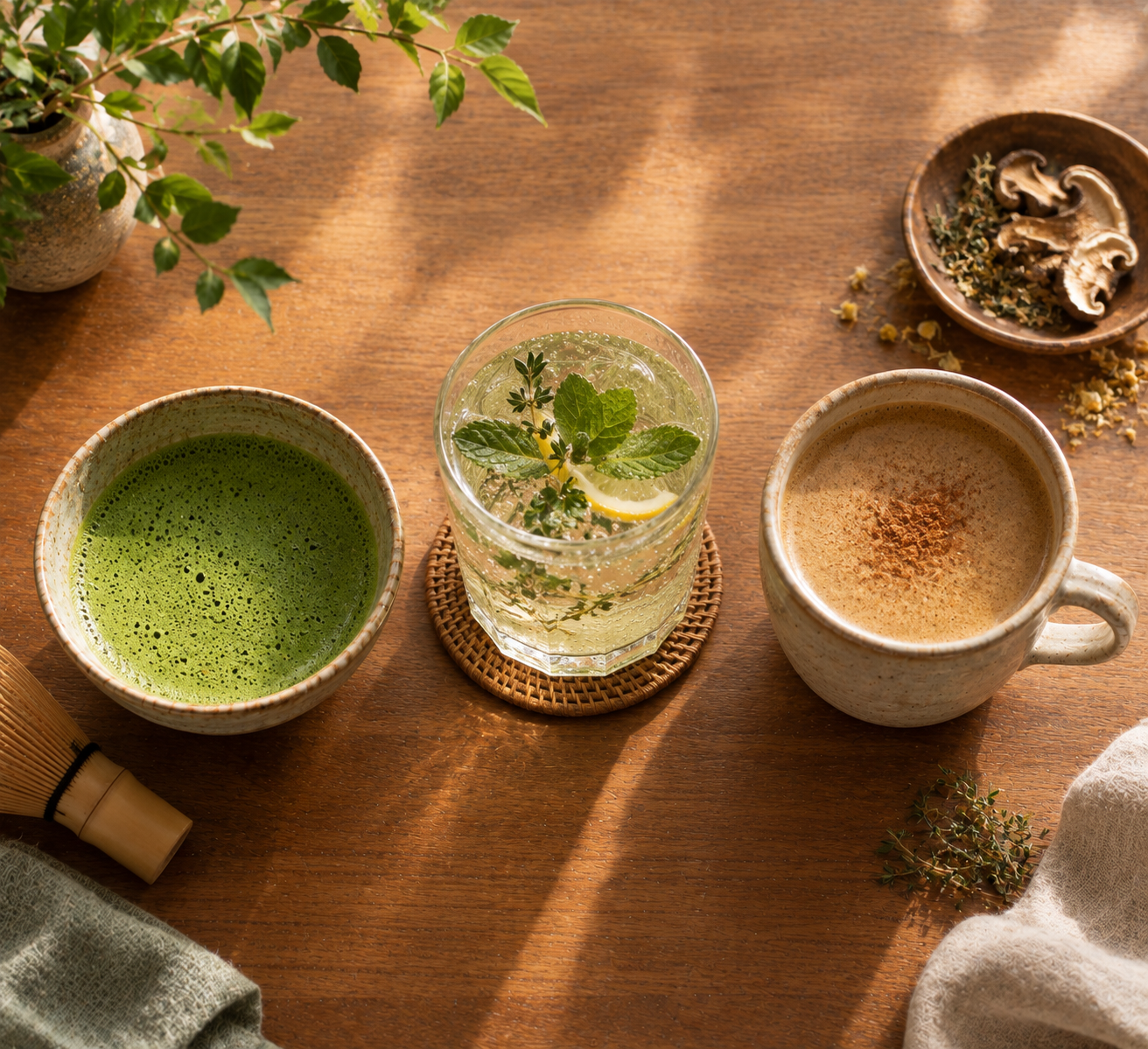
    Adaptogens are a category of herbs and mushrooms, ashwagandha, reishi, lion’s mane, rhodiola, and others, traditionally used and increasingly marketed around the idea of helping the body “adapt” to stress. They’re commonly blended into lattes, tonics, and powdered drink mixes, sometimes alongside matcha itself.

    What sets it apart in this comparison: Research depth varies enormously by specific herb. Some, like ashwagandha, have a reasonable and growing body of clinical research behind specific claims. Others carry much thinner scientific backing despite confident marketing language. Because adaptogens are sold as supplements rather than regulated foods or pharmaceuticals in most places, pre-market testing requirements are generally lighter than what applies to food products like matcha, which is worth factoring into how much weight you put on any single brand’s specific claims.

    How They’re Actually Being Combined

    A growing number of products blend these categories rather than keeping them separate, matcha with adaptogenic mushrooms, or CBD-infused beverages marketed as a calming afternoon alternative to caffeine. This blending is largely a marketing and flavor-pairing trend rather than evidence that combining them multiplies any individual benefit. Each ingredient in a blended product still carries its own separate research base, quality considerations, and regulatory status, even when they’re packaged together under one unified “wellness” label.

    The confident, unified branding on these blended products can make it easy to assume the whole formula has been studied together as a combination, when in reality most of the underlying research, where it exists at all, was conducted on individual ingredients in isolation, not on the specific combined blend a brand happens to be selling.

    Which One Actually Fits What You’re Looking For

    If you want a well-researched, reliable energy source with a long track record: matcha remains the most established option of the three, with the most predictable, well-documented effects.

    If you’re specifically looking for something caffeine-free to help with relaxation or sleep, and you’re comfortable navigating variable product quality and regional legal differences: CBD is worth researching further, ideally with input from a doctor or pharmacist given interaction potential with some medications.

    If you’re drawn to the idea of stress resilience through traditional herbal ingredients: adaptogens are worth exploring, though it’s worth researching the specific herb’s evidence base individually rather than trusting the category as a whole, since quality of research varies dramatically between, say, ashwagandha and less-studied ingredients marketed alongside it.

    If you’re not sure and want to start somewhere low-risk: matcha is the most straightforward starting point of the three, given its established safety profile, predictable caffeine content, and the fact that it’s regulated as an ordinary food product rather than a supplement or a substance with variable regional legal status.

    A Few Things People Ask Me

    Is it safe to combine matcha with CBD or adaptogens? This genuinely depends on the specific products and your individual health situation, so it’s worth checking with a doctor or pharmacist rather than assuming general safety, particularly given CBD’s documented interaction potential with certain medications. Many commercial blended products are formulated with typical safe dosing in mind, but “many products are fine” isn’t the same as a guarantee for your specific situation.

    Why does CBD have less research behind it than matcha, given how popular it’s become? Largely regulatory history — matcha and green tea have been studied as food products for decades across many countries, while CBD’s legal status has shifted more recently and unevenly across different regions, which has limited the scale and consistency of research compared to a long-established food product.

    Are adaptogen claims regulated the same way food claims are? Generally not as strictly. Products sold as dietary supplements in many countries, including the US, face lighter pre-market testing and claim substantiation requirements than either conventional foods or pharmaceuticals, which is part of why the strength of evidence behind specific adaptogen claims can vary so widely from one product to the next.

    Should I be skeptical of a product that combines all three into one “super blend”? Not automatically skeptical, but it’s worth reading past the marketing copy to understand what’s actually in the product and at what dose, rather than assuming the combination is inherently more effective than any single ingredient consumed on its own. A confident blend name doesn’t substitute for actual dosing transparency.

    Does the caffeine in matcha cancel out the calming effect of CBD or adaptogens if they’re combined in one drink? Not necessarily, since caffeine and something like CBD or ashwagandha work through largely different mechanisms rather than directly opposing each other. That said, if your goal is genuine relaxation or winding down, pairing a stimulant like matcha with a calming ingredient sends somewhat mixed signals to your body, and a simpler, single-purpose drink might serve that specific goal more directly than a combined product marketed to do everything at once.

    Where I Landed

    Of the three, matcha is genuinely the one with the clearest, most established research behind it and the fewest regulatory question marks, which is a big part of why it’s the entire focus of this site rather than a broader wellness-drink blog. CBD and adaptogens both have real, if more variable, research behind specific claims, but they ask more of you as a consumer in terms of checking product quality, sourcing, and how they interact with anything else you’re taking.

    None of this means CBD or adaptogens are bad choices — plenty of people find genuine value in both. It just means they come with a different set of homework attached than something as long-established and well-regulated as matcha does, and it’s worth knowing that going in rather than assuming a shared “wellness” label means a shared level of scrutiny behind the scenes.

    If matcha specifically is where you want to focus, my matcha powder brands comparison and how to tell matcha grades apart guides are good next stops for actually choosing a good one.
  • Does Matcha Actually Help With Weight Loss? What the Research Actually Says

    Does Matcha Actually Help With Weight Loss? What the Research Actually Says

    Disclosure: This post contains affiliate links. If you buy through one of them, I may earn a small commission at no extra cost to you. This article is for general information and isn’t a substitute for advice from your doctor, especially if you’re pregnant, managing a health condition, or taking medication.

    I went through a stretch where I drank matcha specifically because I’d read it would help me lose weight, and when the number on the scale didn’t move much, I felt a little cheated, like the tea had failed to deliver on a promise. Looking back, the promise itself was the problem, not the tea. What the actual research supports is a modest, supporting effect, not the dramatic fat-burning story a lot of marketing copy implies, and I’d have been far less disappointed if I’d known that going in.

    That gap between marketing claims and actual research is really the whole reason this article exists. Matcha does have real, measurable effects on metabolism, and it’s a genuinely reasonable part of a healthy routine. It’s just not what a lot of headlines make it sound like, and separating the two matters if you’re deciding how much to actually expect from a daily habit.

    The Problem You’re Actually Trying to Solve

    You’ve searched for matcha’s health benefits, likely around weight loss specifically, because you’ve seen strong claims online and want to know how much of it is actually backed by research versus how much is marketing exaggeration built on top of a real but modest effect. That’s a genuinely reasonable thing to want clarity on, especially given how much matcha-branded weight loss content exists that’s written to sell a product rather than inform a reader.

    Who This Article Is NOT For

    Let’s save you some scrolling if this isn’t quite your situation.

    • If you’re looking for matcha as a treatment for a diagnosed medical condition, this isn’t that resource — talk to your doctor about anything condition-specific, and don’t substitute general dietary habits for medical care.
    • If you want a guaranteed number on the scale, no honest article can promise that. This covers what research actually supports, which is a modest supporting effect, not a specific weight-loss outcome.
    • If you’re pregnant, nursing, sensitive to caffeine, or managing a heart condition, general information like this doesn’t replace personalized guidance on safe caffeine intake from your doctor.

    If you’re past that, here’s where the actual guide starts.

    What the Research Actually Shows

    The Mechanism: EGCG and Thermogenesis

    Matcha’s most-studied compound in this context is EGCG (epigallocatechin gallate), a catechin present in notably higher concentration in matcha than in steeped green tea, since you’re consuming the whole ground leaf rather than a partial water extraction. Research suggests EGCG, particularly alongside caffeine, may modestly increase thermogenesis, the process by which your body generates heat and burns a small amount of extra energy at rest. The proposed mechanism involves EGCG affecting an enzyme that would otherwise break down norepinephrine, a hormone involved in signaling fat cells to release stored energy — though it’s worth noting that proposed biochemical mechanisms don’t always translate into large real-world effects, which is exactly why the actual measured outcomes matter more than the mechanism alone.

    The foundational research in this area, most commonly cited back to a 1999 study on green tea extract and energy expenditure, found an increase in 24-hour energy expenditure of roughly 3 to 4 percent in the studied group, alongside evidence of increased fat oxidation, meaning the body drawing on stored fat for fuel slightly more than usual. For an average adult, that’s been estimated at somewhere around 60 to 80 additional calories burned per day, a real but genuinely modest effect, not a dramatic one — roughly equivalent to a short walk, not a substitute for one.

    Fat Oxidation During Exercise

    Separately from resting thermogenesis, some research has looked at matcha’s effect on fat oxidation specifically during exercise, with modest positive findings in small studies — participants showing somewhat increased fat use as fuel during moderate activity after matcha consumption compared to a placebo. This is a genuinely interesting area of research, though it’s worth noting these studies tend to be small, and effect sizes in nutrition research often shrink or become less consistent as more, larger studies are conducted over time.

    What the Research Does NOT Show

    It’s worth being direct about the limits here, since this is exactly where marketing tends to overreach. Matcha does not burn fat directly or dramatically — it modestly amplifies existing metabolic processes by single-digit percentages. It doesn’t work independently of diet and activity, and it can’t offset a genuine caloric surplus. Most importantly, the research showing measurable effects generally used consistent daily consumption over weeks or months, not a single cup expecting an immediate result.

    The Biggest Practical Trap: Sweetened Matcha Drinks

    This is worth its own section because it’s the single most common way people undo whatever modest benefit matcha actually offers. A typical sweetened matcha latte from a coffee chain can carry 250 to 350 calories and 30 to 45 grams of added sugar. The EGCG is still present in that drink, but the caloric surplus from milk and sugar comfortably outweighs any metabolic benefit matcha itself might contribute. If weight management is genuinely your goal, plain or lightly sweetened matcha, prepared with water or a small amount of milk rather than a full-sugar café-style latte, is where the actual research-supported benefit lives.

    A Reasonable Way to Think About This

    Matcha is a genuinely useful, low-risk, enjoyable habit that can offer a small metabolic edge as part of an already reasonable routine — consistent sleep, regular movement, and a generally balanced diet. It’s not a substitute for those fundamentals, and no realistic amount of matcha will compensate for their absence. Think of it as a supporting player in a larger routine, not the main event.

    A Few Things People Ask Me

    How much matcha should I drink for any metabolic benefit to actually show up? Most of the research showing measurable effects used consistent daily consumption over 8 to 12 weeks, generally in the range of 1 to 3 cups a day, rather than a single serving expecting an immediate result. Consistency over time appears to matter more than any single dose.

    Is matcha extract or supplement form more effective than drinking the tea itself? Concentrated extracts deliver a much higher dose of EGCG than a typical cup of matcha, which changes both the potential effect and the risk profile. High-dose EGCG supplements, generally cited above roughly 800mg per day, have been associated in some case reports with liver stress in sensitive individuals, which isn’t a risk typically associated with drinking matcha in normal beverage amounts. If you’re considering a supplement rather than the beverage itself, that’s a conversation worth having with your doctor specifically.

    Does matcha target belly fat specifically? No, and be skeptical of any source claiming it does. Research supports a general increase in overall fat oxidation, not localized or “spot” fat reduction from a specific area. No food or beverage can target fat loss to one part of the body.

    Is regular green tea just as good as matcha for this, or is matcha genuinely better? Because matcha involves consuming the whole ground leaf, it does deliver notably more EGCG per serving than steeped green tea, where you’re only getting what dissolved into the water during infusion. That said, regular green tea consumption is also linked to similar, generally modest metabolic benefits in research, just at a lower per-serving concentration. My matcha vs green tea guide covers that broader comparison if you want the full picture.

    Does timing matter — is there a best time of day to drink matcha for this purpose? Some people prefer drinking matcha before moderate exercise specifically, since the research on fat oxidation during activity is a reasonably active area of study, though the effect size remains modest rather than dramatic. If caffeine sensitivity is a concern for your sleep, avoiding matcha within several hours of bedtime is a sensible general precaution regardless of any metabolic timing considerations.

    Should I be worried about caffeine if I’m drinking matcha specifically for this reason, on top of my regular coffee? It’s worth being mindful of your total daily caffeine intake if you’re adding matcha on top of an existing coffee habit rather than replacing it. General safety guidelines for healthy adults commonly cite a total daily caffeine ceiling, and it’s worth checking that your combined intake stays within a reasonable range for your own tolerance and any guidance from your doctor.

    Where I Landed

    The honest version of this story is less exciting than the marketing version, but it’s also more useful: matcha offers a real, modest metabolic boost, genuinely worth having as part of a broader healthy routine, and genuinely not worth expecting dramatic results from on its own. My own disappointment years ago came from believing an oversold promise, not from the tea itself failing to deliver what research actually supports.

    If you’re drinking matcha specifically with this in mind, keep it simple and mostly unsweetened rather than defaulting to a syrup-heavy café latte, and give it weeks rather than days before judging whether it’s doing anything for you. The research that actually shows measurable effects was built on consistency over time, not a single dramatic cup, and treating it the same way in your own routine is the most realistic path to actually noticing whatever modest benefit is genuinely there.

    My how to make a matcha latte guide covers a version worth making at home that won’t undercut the benefit with added sugar the way a typical café order often does.

  • Matcha vs Coffee: The Actual Caffeine Numbers

    Matcha vs Coffee: The Actual Caffeine Numbers

    Disclosure: This post contains affiliate links. If you buy through one of them, I may earn a small commission at no extra cost to you. This article is for general information and isn’t a substitute for advice from your doctor, especially if you’re pregnant, managing a health condition, or sensitive to caffeine.

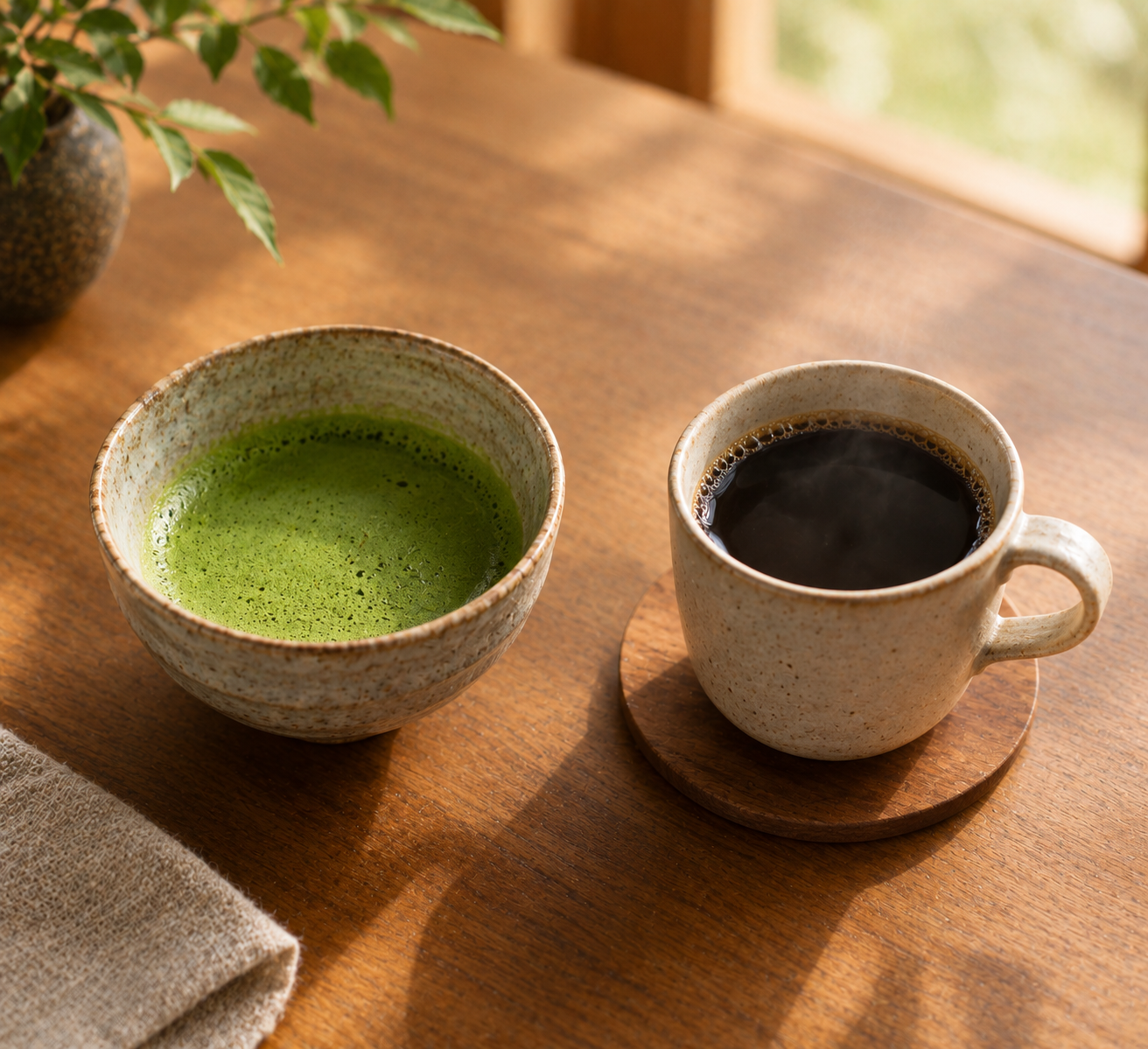
    I switched from a morning coffee to a morning matcha expecting a noticeably gentler jolt, and what actually surprised me was how close the two felt in the moment, even though every chart I’d seen beforehand suggested matcha was the clearly weaker option. It turns out both things are true at once: matcha generally does have less caffeine than a standard cup of drip coffee, but the gap is smaller than the popular narrative suggests, and how the caffeine actually feels matters just as much as the raw number on a chart.

    This is a topic where the numbers genuinely vary a lot depending on how you prepare each drink, so instead of giving you one flat number, here’s the actual range and what drives it — because a single confident-sounding figure, the kind that gets repeated across dozens of blog posts without much scrutiny, tends to hide more than it reveals.

    The Problem You’re Actually Trying to Solve

    You’ve searched for a matcha vs coffee caffeine comparison because you’re either trying to switch from one to the other for a gentler or stronger effect, or you’re managing your total daily caffeine intake and want to know how the two actually stack up rather than relying on the vague “matcha has less caffeine” line that gets repeated everywhere without much detail behind it.

    Who This Article Is NOT For

    Let’s save you some scrolling if this isn’t quite your situation.

    • If you have a diagnosed heart condition, are pregnant, or are managing caffeine sensitivity under a doctor’s guidance, general comparison numbers like these aren’t a substitute for personalized medical advice about your specific safe intake level.
    • If you’re looking for a precise number to track exact daily milligrams, both matcha and coffee’s caffeine content vary enough by preparation that any single number is really a midpoint of a range, not a lab-verified constant you can rely on to the milligram.
    • If you want to know which one is “healthier”, that’s a different, broader question than caffeine content alone — this article stays specifically focused on the caffeine comparison.

    If you’re past that, here’s where the actual comparison starts.

    The Actual Numbers

    DrinkTypical ServingCaffeine Range
    Matcha (whisked bowl)1–2g powder35–90mg
    Steeped green tea8oz cup20–30mg
    Hojicha8oz cup7–8mg
    Drip coffee8oz cup70–150mg
    Espresso shot1oz60–80mg
    Instant coffee8oz cup30–90mg

    These ranges are wide on purpose — caffeine content genuinely varies by brand, grade, growing conditions, and how much of the powder or grounds you actually use, so treat these as realistic bands rather than fixed numbers.

    Why the Ranges Are So Wide

    Matcha’s Variables

    Matcha’s caffeine content depends heavily on how much powder goes into a serving, generally somewhere between 1 and 2 grams for a standard bowl, and roughly 20 to 35mg of caffeine per gram of powder. A lighter 1-gram serving and a stronger, café-style 3 to 4-gram serving can differ by a factor of three or more in total caffeine, which is a bigger swing than most people expect from what looks like a fairly standardized drink. Grade and growing conditions add further variation on top of that, since shading intensity and harvest timing both influence the leaf’s underlying caffeine concentration before it’s ever ground into powder.

    Because matcha is whole ground leaf rather than a partial water extraction, you’re consuming everything in that leaf, which is part of why matcha carries more caffeine per gram than most conventional steeped green tea, even though a full cup of matcha still generally lands below a full cup of coffee.

    Coffee’s Variables

    Coffee’s range is arguably even wider than matcha’s. A standard 8-ounce drip coffee typically falls between 70 and 150mg, but that swings meaningfully based on the roast, grind, brew method, and how much ground coffee actually went into the pot. Counterintuitively, lighter roasts often retain slightly more caffeine than darker roasts, since roasting itself breaks down a small amount of caffeine over time, though this effect is modest compared to the impact of simply using more or less coffee per cup. Espresso, despite its reputation for intensity, is actually more concentrated per ounce but lower in total caffeine per shot than a full cup of drip coffee, simply because you’re drinking a much smaller volume.

    The Closer Comparison: Matcha vs Espresso

    This is where the numbers get genuinely interesting. A standard 2-gram matcha serving and a single espresso shot land in a strikingly similar range, both typically somewhere around 60 to 80mg. If your mental model of matcha is “much weaker than coffee,” that model holds up against a full drip coffee, but breaks down almost entirely against a single shot of espresso.

    Why the Caffeine Feels Different Even at Similar Amounts

    Even when the milligram counts land close together, matcha and coffee tend to feel different in practice, and the most commonly cited explanation is L-theanine, an amino acid present in much higher concentration in matcha than in coffee. L-theanine is thought to work alongside caffeine to produce a steadier, more sustained alertness, without the sharper spike-and-crash pattern some people experience with coffee alone.

    It’s worth being straightforward about the strength of this claim: the L-theanine-smoothing effect is a genuinely common and widely reported experience, and there’s real research interest in how L-theanine and caffeine interact, but individual response varies, and it’s not a guarantee that matcha will feel gentler for everyone specifically because of this mechanism.

    Which One Makes Sense for You

    If you want the gentlest possible caffeine option: steeped green tea or hojicha, both meaningfully lower than either matcha or coffee, with hojicha in particular landing close to caffeine-free in comparison to the others on this list.

    If you want noticeably less caffeine than coffee but still a real dose: a standard 1 to 2-gram matcha serving, understanding that a stronger café-style preparation closes much of that gap.

    If you want maximum caffeine in the smallest volume: espresso, which delivers a comparable amount to matcha but in a fraction of the liquid volume and time to drink it.

    If you’re managing total daily intake and want predictability: track your actual preparation method rather than relying on a single “coffee has X mg” or “matcha has Y mg” number, since both vary enough that a rough average can be meaningfully off from what you’re actually drinking.

    Measuring Your Own Matcha Amount

    Shop digital kitchen scales (0.1g precision) on Amazon →

    If predictability matters more to you than convenience, weighing your matcha rather than eyeballing a scoop is the single most reliable way to keep your caffeine intake consistent from one cup to the next.

    A Few Things People Ask Me

    Can I just switch from coffee to matcha and expect the exact same energy? Not reliably, given how much both ranges overlap and vary. A light matcha serving will feel noticeably gentler than a strong drip coffee, but a robust, café-style matcha can land close to a full cup of coffee in raw caffeine. If a predictable switch matters to you, start by measuring your matcha amount consistently rather than eyeballing it.

    Is it safe to drink both matcha and coffee in the same day? For most healthy adults, yes, as long as total caffeine intake stays within general safety guidelines, commonly cited around 400mg per day for healthy adults. A matcha in the 60–70mg range plus a coffee in the 100–150mg range comfortably fits within that for most people, though your own tolerance and any medical guidance you’ve received should take priority over a general guideline.

    Does the caffeine in matcha hit faster or slower than coffee? Anecdotally, many people report matcha’s effects building more gradually and lasting longer rather than hitting all at once, which lines up with the L-theanine explanation above, though rigorous head-to-head timing data comparing the two is more limited than the general caffeine content numbers.

    Why does my matcha latte from a café sometimes feel stronger than the numbers suggest it should? Café preparations often use more matcha powder per serving than a typical home recipe, sometimes in the 3 to 4-gram range rather than 1 to 2 grams, which can push a single drink’s caffeine content noticeably higher than the lighter end of the range this article covers.

    Does hojicha make a good caffeine-free-ish alternative if I love the flavor of Japanese tea but want to cut back? Yes, and it’s genuinely one of the more effective swaps on this list. Roasting breaks down a meaningful portion of hojicha’s caffeine, landing it at just 7 to 8mg per cup compared to matcha’s 35 to 90mg range, while still delivering a distinct, satisfying flavor rather than feeling like a compromise. My best hojicha brands guide is a good place to start if this appeals to you.

    Is decaf coffee a fairer comparison to low-caffeine teas than regular coffee? In terms of raw caffeine content, yes — decaf coffee typically lands in the single digits to low teens of milligrams, closer to hojicha than to matcha or regular coffee. It’s worth keeping in mind if you’re specifically trying to minimize caffeine rather than just choosing a gentler option than a full cup of regular coffee.

    Where I Landed

    The honest takeaway is less dramatic than most headlines make it sound: matcha generally has less caffeine than coffee, but the two overlap enough, especially against espresso, that “matcha is the weak option” isn’t automatically true depending on how each is prepared. If caffeine amount is your main concern, measuring your matcha rather than eyeballing it gives you far more control than the ingredient itself does.

    It’s also worth remembering that caffeine content is only one piece of why people choose one drink over the other. Flavor, ritual, and how the caffeine actually feels once it kicks in all matter just as much as the milligram count, and none of those show up on a comparison chart no matter how detailed it gets.

    If you’re deciding which matcha to actually keep in your kitchen for this, my matcha powder brands comparison is a good next stop, and my how to make a matcha latte guide covers the ratios if you want to dial in a specific strength rather than guessing.

  • Matcha vs Green Tea: What’s Actually Different (And Which One You Should Be Drinking)

    Matcha vs Green Tea: What’s Actually Different (And Which One You Should Be Drinking)

    Disclosure: This post contains affiliate links. If you buy through one of them, I may earn a small commission at no extra cost to you.

    Someone once told me matcha was “just stronger green tea,” the way espresso is stronger coffee, and I let that idea sit unquestioned in my head for way longer than I should have. It’s not true, and once you actually understand why, a lot of confusing label claims and wildly different price tags suddenly make sense. Matcha and green tea come from the exact same plant. That’s about where the similarities stop.

    I get why the confusion sticks around. Every grocery store green tea box says “made from the finest green tea leaves,” every matcha tin says roughly the same thing, and both liquids end up some shade of green in your cup. The marketing language is nearly identical even though the products underneath it are genuinely different. If you’ve ever wondered why matcha costs three or four times as much as sencha, or why one makes you jittery and the other doesn’t, or which one you should actually be reaching for on a given morning, this is the article that untangles it.

    The Problem You’re Actually Trying to Solve

    You’ve searched “matcha vs green tea” because somewhere along the way, you got curious enough to want the real answer instead of another vague “they’re basically the same, just different forms” line. Maybe you’re trying to decide which one to buy. Maybe you read a health claim about one of them and want to know if it’s actually true or just marketing. Maybe you had both back to back and noticed they tasted nothing alike and want to know why.

    The short, honest answer is that matcha is a specific, more intensive version of green tea production — same plant, dramatically different growing method, processing, and how you actually consume it. Once you understand those three differences, most of the confusing claims you’ve run into online start to make sense on their own.

    Who This Article Is NOT For

    Let’s save you some scrolling if this isn’t quite your situation.

    • If you already know the production differences and just want to know which specific brand to buy, skip ahead to my matcha powder brands comparison or my best hojicha brands guide instead — this article is about the category-level differences, not brand picks.
    • If you’re looking for a deep dive into the chemistry and clinical research, this is a practical explainer, not a scientific literature review. I’ll cover what the actual compound differences are, but I won’t be citing dosage-specific studies or making medical claims.
    • If you’re only interested in flavored or bottled green tea drinks, most of what’s below assumes you’re drinking loose leaf or whisked matcha, not a sweetened bottled beverage — the comparisons don’t map cleanly onto those products.

    If you’re past that, here’s where the actual explanation starts.

    What Actually Makes Them Different

    There isn’t a long list of vague factors here — the differences boil down to three things, and once you understand these, everything else about matcha versus green tea follows naturally.

    1. How the plant is grown. This is the biggest, earliest divergence, and it happens weeks before either tea is even picked.

    2. How the leaf is processed after harvest. This is where “green tea” splits into dozens of styles (sencha, bancha, gyokuro) while matcha stays on its own single track.

    3. How you actually consume it. This is the difference most people notice first, even if they don’t realize it’s downstream of the first two.

    Comparison Table

    MatchaGreen Tea (e.g. Sencha)
    Growing methodShaded 3–4 weeks before harvestGrown in full sun
    ProcessingSteamed, dried, deveined, stone-ground into powderSteamed, rolled, dried into whole or cut leaves
    How you drink itWhole leaf consumed, whisked into waterLeaves steeped, then discarded
    CaffeineHigher (whole leaf ingested)Lower (only what leaches into the water)
    L-theanineHigher (shading boosts it significantly)Present, but at lower levels
    FlavorConcentrated umami, vegetal, slightly bitterLighter, grassy, sometimes floral or nutty
    Typical priceSignificantly higher per servingGenerally more affordable

    The Differences, One by One

    The Growing Method

    Ordinary green tea grows in full sun, the way most people picture a tea field — rolling green hills under open sky. Matcha starts life the same way, but a few weeks before harvest, the plants are covered to block most of the sunlight. That shading is not a minor detail; it’s the single decision that sets everything else about matcha in motion.

    Why it matters: Blocking sunlight forces the plant to produce more chlorophyll to compensate, which is a big part of why matcha has that intensely vivid green color that ordinary green tea leaves don’t share. Shading also increases the leaf’s L-theanine content, an amino acid responsible for a lot of the calm, smooth “umami” character matcha is known for, while suppressing the compounds that would otherwise make the tea taste sharply bitter or astringent.

    What this means for you: If you’ve ever wondered why matcha tastes rounder and more savory while sencha tastes brighter and grassier, this is the root cause. It’s not a different plant — it’s a plant grown under deliberately different conditions to push its chemistry in a specific direction. It also explains why matcha’s growing season is more limited and labor-intensive than ordinary green tea’s, since the shading structures have to be built, maintained, and timed precisely around harvest — another reason matcha commands a higher price before it’s even been processed.

    The Processing

    After harvest, both teas get steamed almost immediately to stop oxidation and lock in that green color — this part is actually similar. From there, the paths split completely.

    Ordinary green tea gets rolled, shaped, and dried into the whole or cut leaves you recognize from a tea bag or loose-leaf tin. Matcha’s leaves, called tencha before processing, skip the rolling step entirely. Instead, the leaves are dried flat, have their stems and veins removed, and are then stone-ground into the ultra-fine powder that defines matcha. That grinding process alone is slow and labor-intensive — traditional stone mills produce only a small amount of matcha per hour, which is a real part of why matcha costs what it does.

    Why it matters: This processing difference is the reason matcha and green tea aren’t interchangeable in recipes or brewing methods, even though they come from the same plant. You can’t “steep” matcha the way you’d steep sencha, because there’s no discrete leaf to strain out — it’s already a powder meant to be fully suspended in the water. It also explains the price gap more directly than anything else on this list: grinding tencha into matcha the traditional way, on granite stone mills, is genuinely slow. A single traditional stone mill typically produces only a small amount of true ceremonial-grade matcha per hour, which is part of why higher-end matcha carries a price tag that ordinary rolled-leaf green tea never approaches.

    How You Actually Consume It

    This is the difference most people notice immediately, even before they understand why it’s happening. With green tea, you steep leaves in hot water, let the flavor infuse, and then discard the spent leaves. You’re only getting whatever compounds successfully dissolved into the water during that steeping window.

    With matcha, there’s no discarding step. You whisk the entire ground leaf directly into water, which means you’re consuming the whole leaf, not just what leached out of it. That’s the real reason matcha delivers noticeably more caffeine and L-theanine per serving than an equivalent amount of steeped green tea — you’re not filtering anything out.

    Why it matters: This is also why matcha hits differently than a cup of green tea. The caffeine comes in alongside a much higher dose of L-theanine, which is often described as producing a calmer, more sustained energy than the sharper jolt-and-crash some people get from coffee or plain caffeine. Whether that’s the case for you personally varies, but the mechanism — whole leaf versus steeped-and-discarded — is the actual explanation, not just marketing language. It’s also worth knowing this cuts both ways: because you’re consuming everything in the leaf, matcha also concentrates whatever else was present in that leaf, which is part of why sourcing and growing conditions matter more for matcha than they do for a tea you’re only partially extracting.

    Why the Price Gap Is So Large

    This is worth calling out on its own, because it’s the practical question underneath a lot of “matcha vs green tea” searches: why does a tin of matcha cost what four or five bags of sencha cost?

    It comes down to the three differences above stacking on top of each other. Shading the plants requires physical infrastructure and reduces how much usable leaf a farm produces per season. Only the youngest, most tender leaves are typically selected for higher-grade matcha, which narrows the harvest window further. And the grinding process itself, done properly, is slow by design. None of that applies to ordinary green tea, which can be harvested more broadly, processed faster, and doesn’t require specialized milling equipment. You’re not paying extra for a fancier label — the entire production chain is genuinely more constrained at every step.

    That’s also why “cheap ceremonial-grade matcha” is worth being skeptical of. If the price doesn’t reflect that constrained production process, something in the chain was almost certainly cut — often the shading period, the leaf selection, or the grinding method.

    Which One Should You Actually Reach For

    If you want a daily ritual that feels calm and deliberate: matcha. The whisking process itself, plus the L-theanine-driven steadiness many people report, makes it suited to a slower morning routine rather than a rushed one.

    If you want something light, easy, and affordable to drink multiple times a day: green tea, specifically a straightforward sencha. It’s gentler, cheaper, and doesn’t require special equipment the way whisking matcha does.

    If you want the most caffeine for the least effort: matcha, since you’re consuming the whole leaf rather than a partial steeped extraction — though if pure caffeine content is genuinely your top priority, coffee will still outpace both.

    If you’re cooking or baking: green tea, or a culinary-grade matcha rather than ceremonial grade. Ceremonial matcha’s subtlety gets lost against other ingredients, so save that grade for drinking it straight, and use a cheaper culinary grade or plain green tea leaves in recipes instead.

    If you’re just starting out and unsure which you’ll actually like: green tea is the lower-commitment entry point — no whisk required, cheaper to experiment with, and a more familiar starting flavor for most people coming from black tea or coffee.

    A Few Things People Ask Me

    Is matcha just “stronger” green tea? Not exactly — it’s a different growing and processing method applied to the same plant, which changes the flavor profile and nutrient concentration, not just the strength. A very strong cup of steeped sencha still won’t taste like matcha, because the shading and whole-leaf consumption change the actual chemistry, not just the intensity.

    Does matcha really have more antioxidants than green tea? Because you consume the whole leaf with matcha instead of a partial water-soluble extraction, you generally do end up with more of the leaf’s compounds per serving, antioxidants included. That said, be wary of any specific numeric claim (“10x the antioxidants!”) without a cited source — a lot of marketing rounds this up aggressively.

    Which one has less caffeine, if I’m sensitive to it? Green tea, by a meaningful margin, since you’re only getting what dissolves during steeping rather than the whole ground leaf. If caffeine sensitivity is a real concern, a lighter steeped green tea, or hojicha specifically (which is roasted in a way that further reduces caffeine), are both gentler options than matcha.

    Can I substitute one for the other in a recipe? Not cleanly. Matcha’s concentrated powder form behaves very differently in baking and cooking than steeped green tea leaves or liquid would, and the flavor intensity is much higher. If a recipe calls for one, swapping in the other usually throws off both the texture and the taste.

    Is one of them more “authentic” or traditional than the other? Not really — both have deep roots in Japanese tea culture, just in different contexts. Matcha is closely tied to formal tea ceremony, while steeped green teas like sencha are the everyday, at-home tea most people in Japan actually drink day to day. Neither one is a lesser or more “real” version of the other; they simply developed for different occasions.

    Where I Landed

    Neither one is objectively “better” — they’re suited to different moments, and honestly, I keep both in my kitchen for exactly that reason. Matcha is what I reach for when I want a slower, more deliberate morning, something closer to a ritual than a beverage. Green tea, usually a simple sencha or a good hojicha, is what I drink the rest of the day when I just want something pleasant without the ritual attached, or when I’m on my third cup and don’t want to whisk anything.

    The confusion around these two was never really about the tea itself — it was about the language brands use to describe them, which tends to flatten two genuinely different products into interchangeable-sounding marketing copy. Now that you know where the actual differences come from — the shading, the grinding, the whole-leaf consumption — you can read past that marketing copy a lot more easily, and price tags that used to seem arbitrary will start to make a lot more sense.

    If you’d rather just taste the difference for yourself before reading another word about it, a simple side-by-side works well: a basic loose-leaf sencha next to a starter tin of ceremonial-grade matcha will make everything above click into place faster than any explanation can.

    If you’ve read this far because you’re trying to decide what to actually buy rather than just understand the difference, that’s the natural next step — take a look at my matcha powder brands comparison if matcha’s the direction you’re leaning, or my best hojicha brands guide if you want something gentler and more everyday. Either way, now you’ll actually know why they taste as different as they do.