Disclosure: This post contains affiliate links. If you buy through one of them, I may earn a small commission at no extra cost to you.
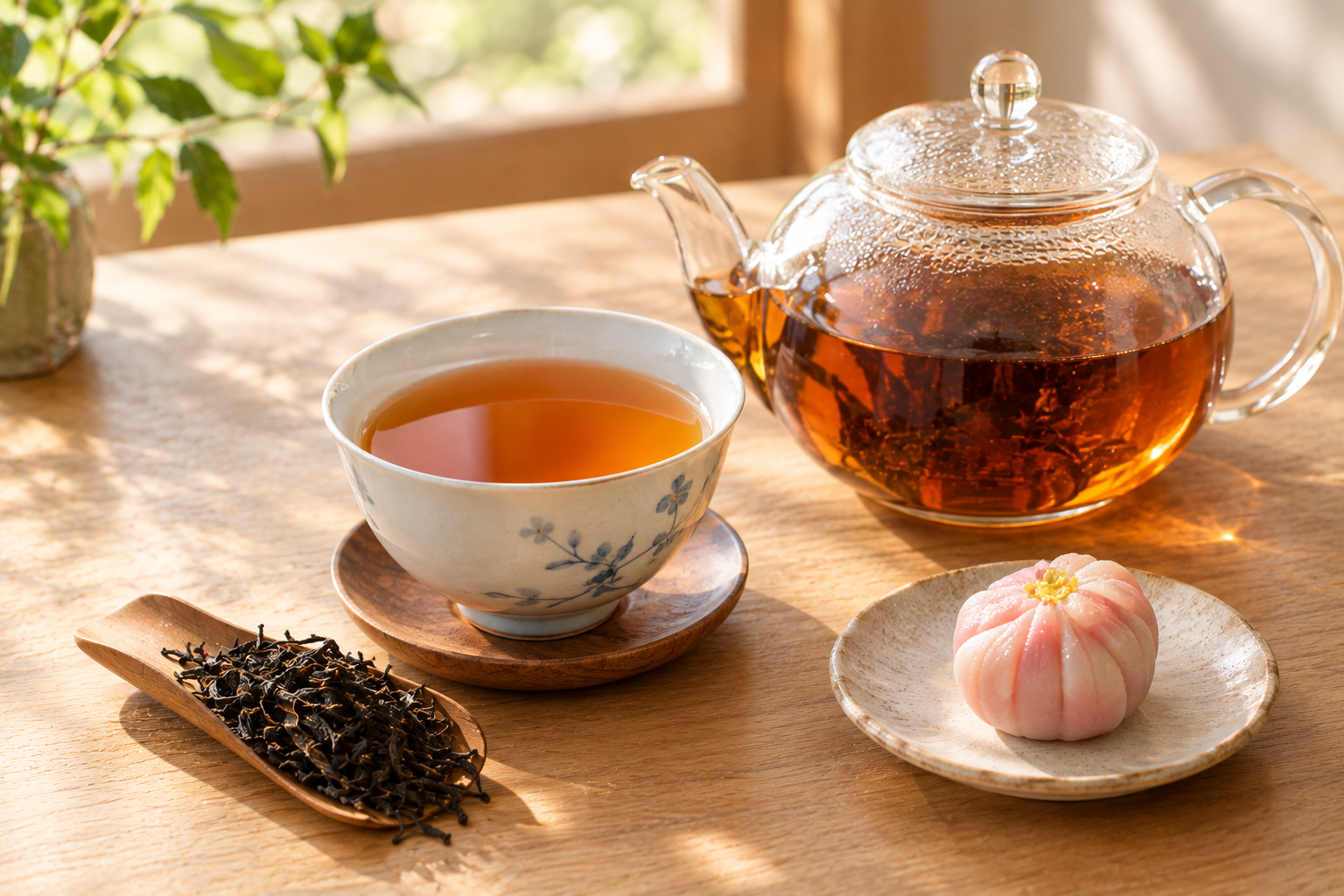
When people think of Japanese tea, they think of green: sencha, matcha, gyokuro. So the first time I was handed a cup of Japanese black tea, I expected something like a weaker Assam. Instead it was clear amber, softly sweet, almost floral, with none of the drying bite I associated with black tea. I drank it without milk, without sugar, and went back for a second cup.
That tea was wakocha (和紅茶, also written wakoucha) – black tea made in Japan, often from the same tea bushes used for green tea. It has an unusual history, a recent revival, and a style that’s quite different from the black teas most of the world drinks.
The Problem You’re Actually Trying to Solve
Most people who look up wakocha have either spotted it on a Japanese tea shop’s menu and wondered why a green tea country makes black tea, or they love black tea and are curious whether Japan’s version is worth seeking out. The short answer is yes – but it helps to know what makes it different, because if you brew it like an Assam, with boiling water and a long steep, you’ll miss most of what makes it good.
Who This Article Is NOT For
- If you want a strong, malty breakfast tea to take with milk, most wakocha is too gentle for that. A robust Assam will serve you better.
- If you’re looking for low caffeine, wakocha isn’t the answer. It’s made from the same plant as green tea and contains caffeine.
- If you’ve never tried Japanese green tea, start there. My Japanese vs. Chinese tea comparison explains what makes Japanese tea processing distinctive, which helps put wakocha in context.
Same Plant, Different Process
Green tea and black tea come from the same plant, Camellia sinensis. What separates them is oxidation.
To make Japanese green tea, freshly picked leaves are steamed almost immediately. The heat stops the enzymes in the leaf from oxidizing it, which keeps the leaves green and the flavor fresh and vegetal.
To make black tea, the leaves are instead withered, rolled to break the cell walls, and left to oxidize fully before drying. The leaves turn dark, and the flavor shifts toward sweet, fruity, malty and floral notes. The brewed tea turns red-amber – which is why black tea is called kōcha, “red tea,” in Japanese.
Wakocha is simply black tea made this way in Japan, using Japanese-grown leaf.
A Short History: Boom, Bust and Revival
The export era. Japan began producing black tea in the 1870s, early in the Meiji period, when the government saw tea as a valuable export. In 1874 it distributed instructions on making black tea to growers, and Chinese tea specialists were brought in to teach the techniques. A former shogunate retainer named Tada Motokichi was sent to China, and later to India and Ceylon, to study black tea production and bring back seeds, including the Assam variety. Because Assam plants struggled with Japanese winters, they were crossbred with local tea plants to create hardier varieties.
The peak. After the Second World War, black tea production was encouraged again, partly through a rule that required importers of foreign black tea to buy an equal amount of Japanese black tea. Production peaked in the mid-1950s at more than 8,000 tons a year.
The collapse. In 1971, imports of black tea were liberalized. Cheaper teas from India and Sri Lanka flooded in, the purchase requirement disappeared, and Japanese farmers switched to green tea, which sold more reliably. Within a few years, Japanese black tea had almost vanished.
The revival. In the 1990s, as demand for green tea at home began to fall, some farmers started making black tea again – often as a way to use later-harvest leaves that wouldn’t sell for much as green tea. This time the focus was on quality and character rather than volume. Production has grown steadily since, and the name wakocha came into use to describe this new generation of Japanese black tea. Today it’s made all over Japan, from the north of Honshu down to Kyushu and Okinawa, mostly by small farms.
What Wakocha Tastes Like
Compared with typical Indian and Sri Lankan black teas, wakocha is usually:
- Gentler – lower in astringency, with little of the drying, brisk bite of Assam or Ceylon
- Sweeter – often with honey, stone fruit or floral notes
- Lighter in body – a clear, bright amber cup rather than a deep, dark one
- Made to drink straight – most wakocha is at its best without milk or sugar
There’s a lot of variety, though, and it largely comes down to the cultivar.
The Cultivars That Matter
Benifuuki. The best-known Japanese black tea cultivar, developed with Assam-type heritage and registered in the 1990s. It makes a bolder, more aromatic black tea with real depth – the closest wakocha gets to a classic black tea, while still being smoother.
Benihikari and Izumi. Other cultivars bred with black tea in mind, also on the bolder side.
Yabukita and other green tea cultivars. Many farms make wakocha from the same cultivars they use for sencha – Yabukita above all. These teas are usually lighter and more delicate, sometimes with a faintly green, almost sencha-like sweetness underneath. They vary more from farm to farm, which is part of the fun.
Zairai (native seed-grown plants). Some small producers use old, unregistered seed-grown bushes, which can give distinctive, unusual results.
Where It’s Made
You’ll find wakocha from nearly every tea region in Japan, but a few areas have built a reputation for it:
- Kyushu – Kagoshima, Kumamoto (including Ashikita) and Ureshino in Saga, known for gentle, sweet black teas
- Shikoku – areas of Kōchi, such as Niyodogawa
- Shizuoka and central Honshu – Japan’s biggest tea region, with many green tea farms also making black tea
- Tottori and western Honshu – home to Benihikari black tea
Because so much wakocha comes from small farms, the region is often less useful than the producer and cultivar listed on the bag.
How to Brew Wakocha
The most common mistake is brewing it like Assam. Wakocha’s appeal is in its delicate aroma, and very hot water and long steeps tend to flatten it and bring out bitterness.
- Leaf: about 3g per 200ml (roughly a heaped teaspoon)
- Water: around 85-90°C (185-194°F) – just off the boil, not at a rolling boil
- Steep: 2-3 minutes; start at 2 and taste
- Second infusion: add about 30 seconds to the first time
Use a teapot with room for the leaves to open, and pour the tea out completely so it doesn’t keep steeping. Drink it straight first; if you want to try milk, a bolder Benifuuki is the one to try it with.
Wakocha also makes excellent iced tea. Brewed cold or chilled quickly, its natural sweetness comes through, and it stays smooth rather than bitter.
How It Fits Into Japanese Tea
Part of what makes wakocha interesting is that it connects to everything else on the green tea side. It’s often made from later-harvest leaves – the same summer flushes that make lower-priced green tea, as I explained in my ichibancha vs. nibancha guide – which is one reason farmers turned to it. Summer leaves, which can taste rough as green tea, often have exactly the character that makes good black tea. In that sense, wakocha is a way of turning leaf that would be ordinary green tea into something special.
It’s also lovely with Japanese sweets. Its softness doesn’t overpower delicate flavors the way a strong breakfast tea would, and its sweetness works well with red bean paste and castella.
A Few Things People Ask Me
Is wakocha the same as hojicha? No. Hojicha is green tea that has been roasted after processing; it’s brown but not oxidized. Wakocha is fully oxidized black tea. They taste very different – hojicha is toasty and nutty, wakocha is sweet and fruity or floral.
Does wakocha have caffeine? Yes. It’s made from the same plant as green tea, so it contains caffeine, roughly comparable to other black teas brewed the same way.
Why is it more expensive than supermarket black tea? Most wakocha is made in small batches by small farms, often by hand or with limited machinery, and Japan’s labor and land costs are high. You’re paying for small-scale production, not a commodity blend.
Where can I buy it? Japanese tea shops increasingly carry it, and wakocha on Amazon includes several options, including Benifuuki teas. A glass teapot on Amazon is a nice way to brew it, so you can see the bright amber color and watch the leaves open.
Where I Landed
Wakocha surprised me because it doesn’t try to compete with the great black teas of India and Sri Lanka. It’s softer, sweeter and more delicate – the kind of black tea you drink slowly and on its own. Its history, from an export industry to near-extinction to a small-farm revival, makes every cup a little more interesting. If you love Japanese green tea, it’s the natural next step: same plant, same farms, a completely different cup.