Disclosure: This post contains affiliate links. If you buy through one of them, I may earn a small commission at no extra cost to you.
Almost every Japanese green tea you’ve ever had – sencha, gyokuro, matcha, bancha – starts the same way: the freshly picked leaves are steamed. That single step is what gives Japanese tea its bright green color and its fresh, grassy, sometimes ocean-like flavor. So the first time I tasted kamairicha, I was confused. It was clearly Japanese green tea, but it tasted toasty and round, pale gold rather than green, with almost no bitterness. It reminded me more of a Chinese green tea than of sencha.
That’s because kamairicha (釜炒り茶, “pan-fired tea”) skips the steaming. Instead, the leaves are tossed in a hot iron pan – the Chinese method – and the result is one of Japan’s rarest and most distinctive teas. It makes up less than 1% of Japanese tea production, and it’s almost entirely made on the southern island of Kyushu.
The Problem You’re Actually Trying to Solve
Most people come to kamairicha from one of two directions. Some love sencha and want to explore beyond it. Others prefer Chinese green teas like Longjing and are curious whether Japan makes anything similar. Kamairicha answers both – but because it’s rare outside Japan, information about it is scattered, and it’s often confused with hojicha (which is roasted after processing) or with tamaryokucha (a curled-leaf tea that can be either steamed or pan-fired).
Who This Article Is NOT For
- If you love the bright, grassy, deep-green character of fukamushi sencha, kamairicha goes the other way: lighter, toastier, less “green.” My fukamushi sencha guide covers the far end of the steamed spectrum.
- If you want a strongly roasted, nutty tea, you’re looking for hojicha. Kamairicha’s toastiness is gentle, not dark.
- If you’re after rich umami, shaded teas like gyokuro are the better choice. Kamairicha’s appeal is aroma and lightness, not savoriness.
Steamed vs. Pan-Fired: The One Step That Changes Everything
Every green tea – Japanese or Chinese – has to be heated soon after picking. This “kill-green” step stops the enzymes in the leaf from oxidizing it, which is what keeps green tea green rather than letting it turn into black tea.
There are two main ways to do it:
- Steaming (Japan’s standard): moist heat for a short time. It preserves a vivid green color and fresh, vegetal flavors.
- Pan-firing (China’s standard): dry heat in a hot pan. It gives a pale gold liquor and a warm, toasty aroma.
Kamairicha is the Japanese tea made the Chinese way. My Japanese vs. Chinese tea comparison explains why this first minute of processing shapes so much of the final flavor.
How Kamairicha Is Made
- First firing. Fresh leaves go into an iron pan heated to around 300°C at the surface and are kept constantly moving so they don’t scorch. This takes a few minutes and stops oxidation.
- Rolling. While still warm, the leaves are kneaded and turned, which spreads moisture evenly and starts shaping them.
- Drying and second firing. The leaves are dried gradually, often in a rotating drum, and then given a final firing in a hot pan. This is what develops kamairicha’s characteristic aroma.
Today, most kamairicha is made with machines that recreate the pan-firing process, though a few producers still work by hand.
Unlike sencha, which is rolled into straight, needle-like shapes, kamairicha isn’t pressed straight. Its leaves curl into a loose comma or magatama (curved bead) shape.
The Aroma: Kamaka
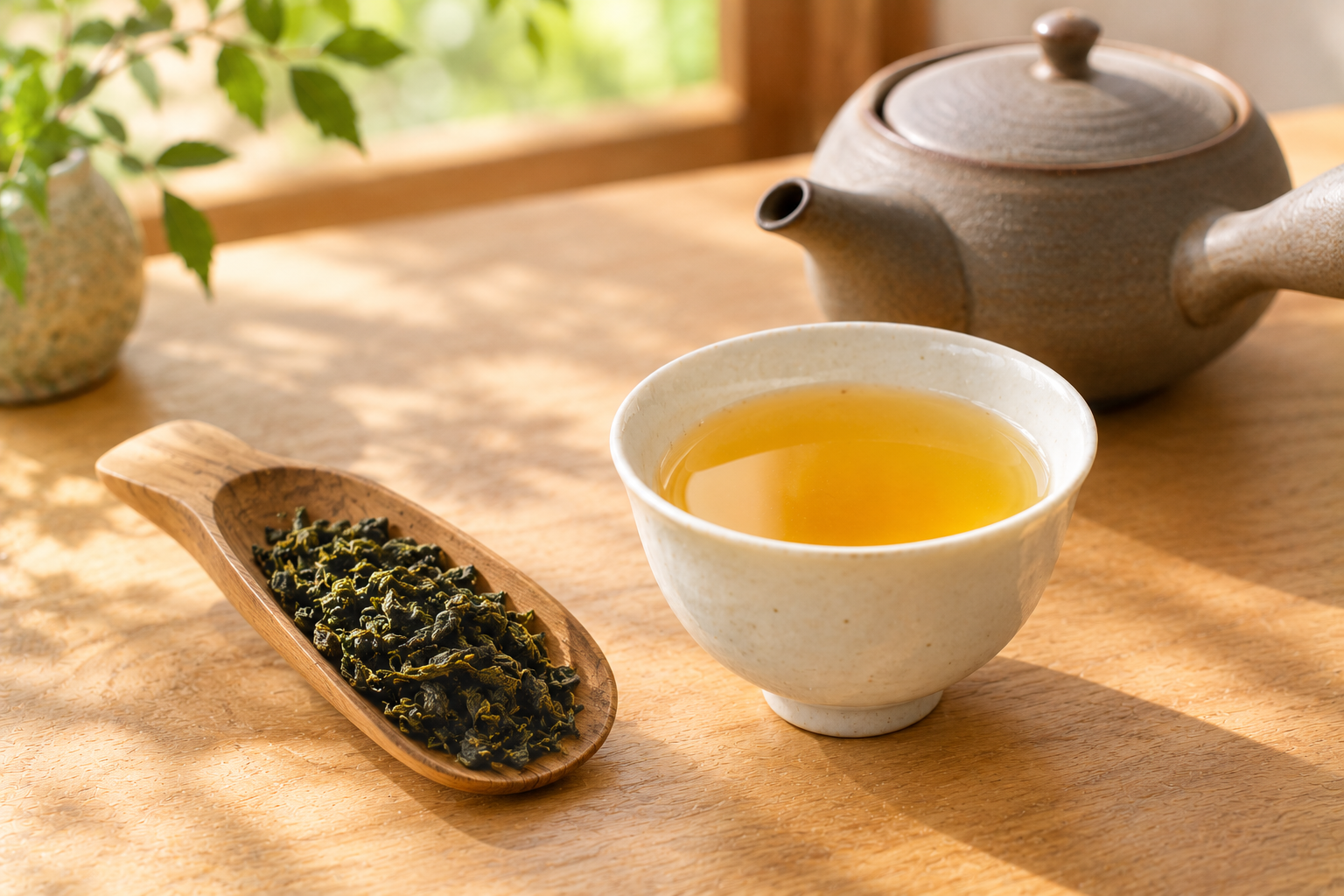
The defining feature of kamairicha is a scent called kamaka (釜香) – literally “pan aroma.” It’s warm, lightly toasted and grain-like, often compared to roasted chestnuts or lightly toasted sesame.
It’s important to understand that kamaka is not the same as roasting. Hojicha is green tea roasted after it’s already been made, which gives it a deep brown color and a strong, nutty, almost coffee-like flavor. Kamairicha’s toastiness comes from the dry heat during processing itself, so it stays light and gentle – a green tea with a warm edge, not a roasted tea.
What Kamairicha Tastes Like
- Mellow and round, with a soft sweetness
- Low in astringency – noticeably less bite than sencha
- Lightly toasty, thanks to kamaka
- Clear golden-yellow in the cup, rather than green
- Less grassy, with none of the marine or seaweed notes some steamed teas have
It’s one of the most approachable Japanese green teas for people who find sencha too bitter or too “green.”
Two Traditional Styles
Kamairicha has two historic styles, named after the pans and methods they used:
Ureshino style. Associated with Saga and Nagasaki prefectures, around the town of Ureshino. The pan is tilted at an angle toward the tea maker. Traditionally, Ureshino tea was firm and tightly rolled, with a brighter, more vivid flavor.
Aoyagi style. Associated with Kumamoto and Miyazaki prefectures. The pan is kept flat, parallel to the floor. Aoyagi tea traditionally had longer, more open leaves and a fresh aroma, and its method spread more widely.
Each style comes with its own origin story. Ureshino’s is said to begin with Chinese potters who settled in the area in the 15th and early 16th centuries and brought pan-firing with them. Aoyagi tea has legends linking it to craftsmen brought from the continent by a feudal lord. The exact history is uncertain, but both point to the same thing: Kyushu’s closeness to China.
Where It’s Made Today
Kamairicha is still made almost entirely in Kyushu:
- Miyazaki – the largest producer today, especially mountainous areas like Takachiho, Gokase and Kobayashi
- Saga – Ureshino, the historic home of the Ureshino style
- Kumamoto and Nagasaki – smaller amounts
- Fukuoka – including some in the Yame area
The mountain climate, with large swings between day and night temperatures, suits the tea well.
Why It Became So Rare
Kamairicha was once made across Japan and was even prized by the upper classes. Its decline came with the rise of tea exports in the 19th century, when straight-leaf steamed tea became the standard for trade. Steamed sencha took over domestic production as well, and pan-firing survived mainly in the mountains of Kyushu, where local producers kept the tradition alive.
How to Brew Kamairicha
Kamairicha is forgiving, partly because it’s low in astringency:
- Leaf: about 5g (two teaspoons) for 150-200ml of water
- Water: 70-85°C (158-185°F). Start around 80°C; go hotter if you want more of the toasty aroma.
- Steep: about 45-60 seconds for the first infusion
- Later infusions: 20-30 seconds each; it gives two or three good cups
Because the leaves are curled rather than finely broken, the brew stays clear, and you don’t need a very fine filter. A regular kyusu or teapot works well.
Kamairicha With Food
Kamairicha’s gentle toastiness makes it unusually easy to pair with food. Where sencha’s brisk, grassy edge works best with lighter Japanese dishes, kamairicha also sits comfortably next to richer, more savory food:
- Grilled and fried dishes – yakitori, tempura, karaage – where the toasty notes echo the char and the low astringency doesn’t clash with oil
- Rice dishes and onigiri, especially with miso or soy-based flavors
- Chinese food, which makes sense given its pan-fired roots
- Simple sweets like castella, rice crackers or chestnut confections, which bring out its chestnut-like aroma
It’s also a good everyday tea to keep on the table through a meal, because it doesn’t turn harsh as it cools.
Hot or Iced?
Kamairicha is at its best hot, when the kamaka aroma is most noticeable. Opinions differ on cold brewing: some producers don’t recommend it because the toasty aroma doesn’t come through in cold water, while others enjoy it as a mild, sweet iced tea. If you want it cold, a good compromise is to brew it hot at the usual strength and then chill it quickly over ice. You’ll keep more of the aroma that makes it special.
A Few Things People Ask Me
Is kamairicha the same as hojicha? No. Hojicha is roasted after processing and is brown, strongly toasty and low in caffeine. Kamairicha is pan-fired during processing and stays a green tea, with only a light toasty note.
Is kamairicha the same as tamaryokucha? Not exactly. Tamaryokucha describes curled-leaf Japanese green tea, made in Kyushu. Some tamaryokucha is pan-fired (essentially kamairicha), but most is steamed and then curled. If you see “kamairi” on the label, it’s pan-fired.
Does it taste like Chinese green tea? It shares the pan-fired toastiness of teas like Longjing, but it’s usually softer and rounder, and it’s made from Japanese cultivars such as Yabukita, so it has its own character.
Where can I buy it? Nio Teas’ Pan Fired Kamairicha from Miyazaki Sabou is a good, well-described example, with notes of sweet roasted soybean. You can also find more options as kamairicha on Amazon.
Where I Landed
Kamairicha shows how much a single step can change a tea. Same leaves, same Japanese farms – but swap steam for an iron pan, and you get a lighter, warmer, gentler cup that tastes like a bridge between Japan and China. It’s rare, but it’s worth seeking out, especially if you’ve ever found sencha a little too sharp. One cup, and you’ll understand why the farmers of Kyushu have kept making it for centuries.