Tag: Caffeine-Free Japanese Tea

  • Caffeine-Free Japanese Tea: Five Drinks With Zero Caffeine (and a Few That Come Close)

    Caffeine-Free Japanese Tea: Five Drinks With Zero Caffeine (and a Few That Come Close)

    Disclosure: This post contains affiliate links. If you buy through one of them, I may earn a small commission at no extra cost to you. Several of these drinks are made from common allergens – barley, buckwheat and soy – so please check the allergy column in the table before trying one.

    When people tell me they love Japanese tea but can’t have caffeine after lunch, they usually assume the answer is “decaf sencha.” It’s rarely necessary. Japan has a whole family of everyday drinks that are called cha but aren’t made from the tea plant at all – roasted grains, roasted beans, seaweed, even pickled cherry blossoms – and none of them contain any caffeine. They’re not niche health products, either. They’re what Japanese families pour at dinner, give to children, and keep in the fridge all summer.

    The Problem You’re Actually Trying to Solve

    The confusing part is the word cha. In Japanese it’s used for almost any hot infusion, so “mugicha” and “sencha” sound like close relatives when one has no caffeine and the other has plenty. On top of that, several low-caffeine Japanese teas get described online as “caffeine-free” when they aren’t. If you’re avoiding caffeine for sleep, pregnancy advice from your doctor, or any other reason, it helps to know exactly which drinks are truly zero and which are only low.

    Who This Article Is NOT For

    • If you’re fine with a little caffeine and just want a gentler green tea, you don’t need to leave the tea plant – kukicha, or twig tea, is one of the lowest-caffeine real teas there is.
    • If you’re looking for a drink with medical benefits, none of these should be treated as a remedy. They’re pleasant caffeine-free drinks, nothing more.
    • If you have a barley, buckwheat or soy allergy, or celiac disease, skip the drinks in this list that contain those ingredients.

    The Five Zero-Caffeine Options at a Glance

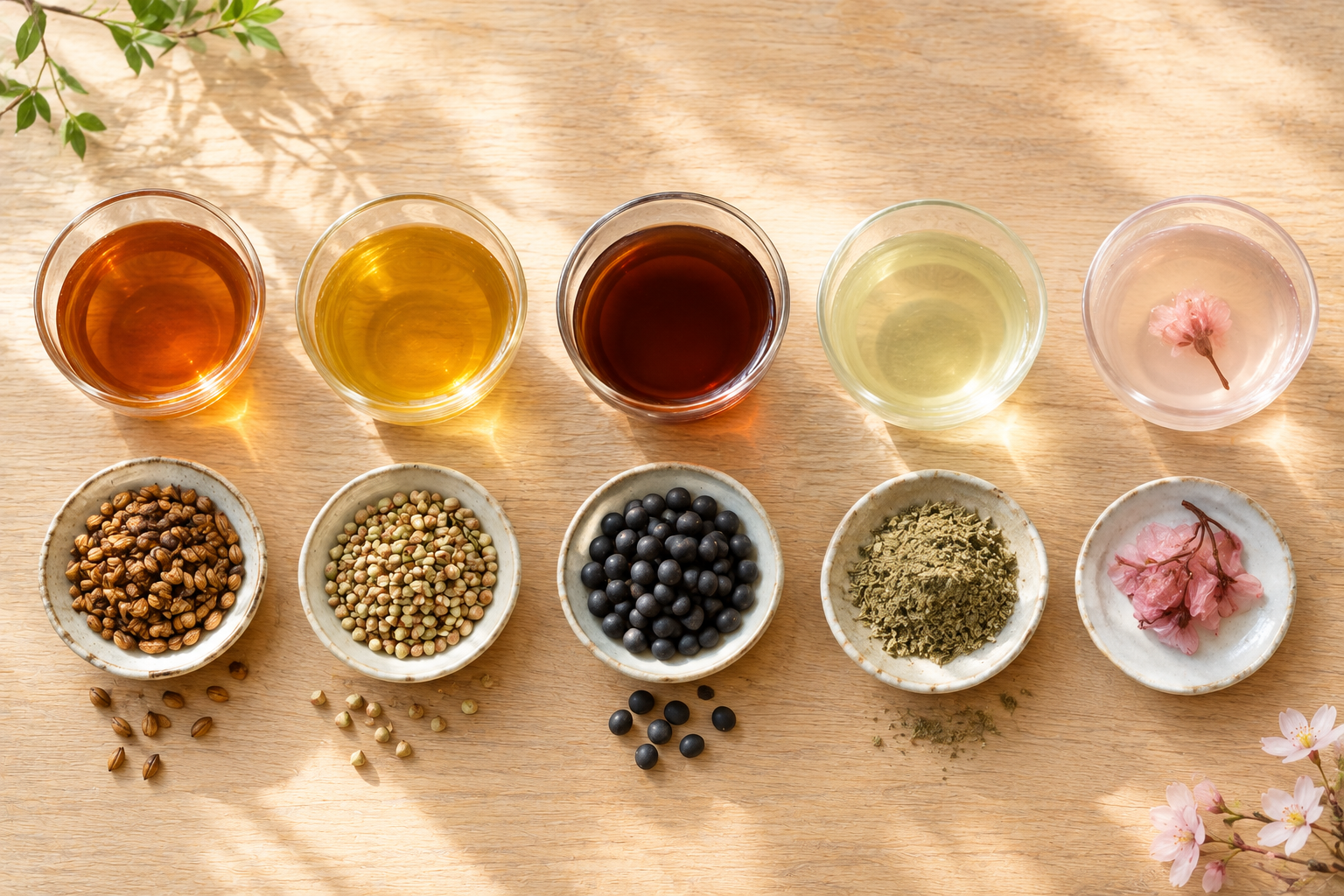
    DrinkMade fromTastes likeBest forWatch out for
    MugichaRoasted barleyToasty, grain-forward, slightly bitterBig jugs of cold tea in summerContains gluten
    SobachaRoasted buckwheatNutty, lightly sweet, no bitternessA cup after dinner, hot or coldBuckwheat allergy can be severe
    KuromamechaRoasted black soybeansToasted, gently sweet, mellowA hearty, warming cupSoy allergy
    KonbuchaPowdered kelpSavory, salty, umami-richA brothy cup on a cold dayUsually contains salt, often MSG
    SakurayuSalt-pickled cherry blossomsLight, slightly salty, floralCelebrations and special occasionsSalty; rinse blossoms if you prefer

    Mugicha: The Everyday One

    Roasted barley tea is the most common caffeine-free drink in Japan, especially in summer, when many households keep a pitcher of it in the fridge from June to September. It’s toasty and slightly bitter hot, and softer and sweeter cold. The usual method is one tea bag per liter of cold water, left in the fridge overnight. Brewed mugicha doesn’t keep long, so it’s best finished within a day or two.

    The important caution is gluten: barley contains it, so mugicha isn’t suitable for anyone with celiac disease or a gluten intolerance. My full mugicha guide covers hot, cold and loose-barley brewing, plus how to keep a jug fresh.

    Sobacha: The Nutty One

    Sobacha is made from roasted buckwheat kernels and is often served in soba restaurants after a meal. It’s nutty and lightly sweet with almost no bitterness, and the softened kernels can be eaten after brewing. Buckwheat itself is gluten-free, which makes sobacha the usual alternative to mugicha for people avoiding gluten – but buckwheat allergy can cause severe reactions, so it isn’t for everyone. My full sobacha guide covers the regular vs. dattan (tartary) varieties and how to brew both.

    Kuromamecha: The Hearty One

    Kuromamecha is tea made from roasted black soybeans. Beans from Tamba in Hyogo Prefecture are considered among the best – large, glossy and naturally sweet. The flavor is toasted and gently sweet with no bitterness or astringency, rounder and fuller than sobacha.

    To brew it, use about 10-15g of beans per 400ml of near-boiling water (around 95°C) and steep for about five minutes; the same beans can give a second, lighter cup. Like sobacha, the softened beans can be eaten afterward, added to rice or salads. People with a soy allergy should avoid it.

    Konbucha: The Savory One

    This is the one most often confused with something else. Japanese konbucha (also spelled kombucha) is not the fermented, fizzy drink sold in bottles in the West. It’s a hot drink made from powdered or finely cut kombu kelp, and it tastes savory and salty, closer to a light broth than to tea. A teaspoon of powder dissolved in hot water makes a cup, and some blends add dried umeboshi plum for a sour note.

    Most commercial konbucha contains salt and often MSG, so it’s a drink to enjoy in moderation, and worth checking the label if you’re watching your sodium intake. It also works as a seasoning – a pinch in ochazuke or a quick pickle is a classic use.

    Sakurayu: The Celebratory One

    Sakurayu, also called sakura-cha, is made by pouring hot water over cherry blossoms that have been pickled in salt and plum vinegar and then dried. In the cup, the blossoms slowly unfurl and float, and the drink is light, slightly salty and faintly floral.

    It’s traditionally served at weddings and engagement ceremonies in place of green tea. One explanation is linguistic: the Japanese expression ocha wo nigosu – literally “to make the tea cloudy” – means to be evasive, which isn’t a phrase anyone wants associated with a marriage. Cherry blossoms, on the other hand, stand for new beginnings. If the saltiness is too strong for you, give the blossoms a quick rinse before adding the water.

    Low Caffeine Isn’t No Caffeine

    Several Japanese teas are often described as caffeine-free when they’re actually just low:

    • Kukicha (twig tea) is made from stems, which contain much less caffeine than leaves – but still some.
    • Hojicha is roasted green tea and is lower in caffeine than sencha or matcha, but it isn’t caffeine-free.
    • Bancha, made from later-harvest leaves, has roughly half the caffeine of sencha.

    These are good choices if you want to cut back, but if you need to avoid caffeine completely, stick to the five drinks above.

    A Few Things People Ask Me

    Which caffeine-free Japanese tea tastes most like green tea? None of them really does, because none come from the tea plant. If you want green tea flavor with the least caffeine, kukicha is the closest compromise.

    Which one is best for children? In Japan, mugicha is the classic choice and is given to children routinely. As with any food, check allergies first – barley for mugicha, buckwheat for sobacha, soy for kuromamecha.

    Can I drink these during pregnancy? They’re caffeine-free, but that’s a question for your doctor or midwife rather than a tea blog, especially with allergens or added salt involved.

    Where can I buy them? Mugicha and sobacha tea bags are widely available. For something a little different, kuromamecha on Amazon – look for Tamba beans if you can – and Japanese konbucha kelp tea on Amazon are both easy to find.

    Where I Landed

    You don’t need decaf green tea to enjoy Japanese tea culture in the evening. Mugicha for summer jugs, sobacha after dinner, kuromamecha when you want something warming, konbucha when you’d rather have a savory cup, and sakurayu for special occasions – between them, there’s a caffeine-free option for almost any moment. Just check the allergens first, and remember that “low caffeine” teas like hojicha and kukicha aren’t the same as zero.

  • Mugicha: Japan’s Caffeine-Free Barley Tea, and How to Make It Properly

    Mugicha: Japan’s Caffeine-Free Barley Tea, and How to Make It Properly

    Disclosure: This post contains affiliate links. If you buy through one of them, I may earn a small commission at no extra cost to you. Important: mugicha is made from barley and contains gluten – please read the note below if you have celiac disease or a gluten intolerance.

    If you open a fridge in a Japanese home in summer, there’s a good chance you’ll find a plastic pitcher of something pale brown inside. It isn’t iced coffee or black tea. It’s mugicha – roasted barley tea – and for a lot of Japanese families it’s the default cold drink from June to September, poured for kids, adults and guests alike. It has no caffeine, it costs almost nothing, and once you get used to its toasty, slightly bitter flavor, plain water starts to feel a little boring.

    The Problem You’re Actually Trying to Solve

    Most people outside Japan meet mugicha in one of two ways: a free glass at a Japanese restaurant, or a bag of tea packets at an Asian grocery store with instructions they can’t read. The drink itself is simple, but there are a few things that make the difference between a clean, refreshing jug and a flat or slightly sour one – mainly how you brew it, how long you leave the bag in, and how long you keep it.

    Who This Article Is NOT For

    • If you have celiac disease, mugicha isn’t safe for you. Barley contains gluten (in the form of a protein called hordein), and celiac organizations advise against barley drinks regardless of how little ends up in the cup. Sobacha, roasted buckwheat tea, is the closest gluten-free alternative – but read its own allergy note first.
    • If you want a roasted flavor with real tea in it, hojicha is the better choice – my matcha vs. hojicha caffeine comparison shows how little caffeine it actually has.
    • If you’re looking for a health drink, mugicha is best thought of as a pleasant, caffeine-free alternative to water – not a remedy.

    What Mugicha Actually Is

    Mugicha (麦茶, literally “barley tea”) is made by roasting barley grains until they’re dark brown and then steeping them in water. Like sobacha, it’s called “cha” but doesn’t come from the tea plant at all, which is why it has no caffeine.

    It also has a long history. Roasted barley drinks go back to the Heian period, when they were enjoyed at the imperial court, and by the Edo period street vendors were selling it to ordinary people. The modern habit of keeping a cold jug in the fridge took off after the Second World War, as refrigerators became common in Japanese homes – which is why mugicha today is so strongly tied to summer.

    How It Tastes

    Toasty, grain-forward and slightly bitter, with a clean, dry finish – often compared to a very weak, unsweetened coffee or toasted cereal. Served cold, the bitterness softens and a gentle sweetness comes forward, which is why most people prefer it chilled.

    Compared with sobacha, mugicha is darker in color, fuller and more roasted; sobacha is lighter, nuttier and sweeter. Compared with hojicha, mugicha is simpler and more cereal-like, without hojicha’s caramel and tea notes.

    How to Make It

    Most mugicha outside Japan is sold in tea bags, usually sized for a liter or more. Check the package, since some bags are designed only for boiling and others work for cold brewing too.

    Cold brew (the most common way in Japan):

    • 1 tea bag per liter of cold water
    • Refrigerate for about 6-8 hours, or overnight
    • Remove the bag once it’s done, so the flavor doesn’t keep getting stronger and more bitter

    Hot brew:

    • Bring water to a boil, add 1 tea bag per 500ml (or per the package), and steep 3-5 minutes
    • For a stronger, more classic flavor, some families simmer the bag for a few minutes on the stove
    • Let it cool, then refrigerate if you’re going to drink it cold

    Loose roasted barley:

    • About 30-40g per liter, simmered for around 10 minutes, then strained
    • Loose barley gives the deepest, most roasted flavor, but it’s more work and harder to find outside Japan

    Many Japanese households use a simple brewing pitcher with a lid that fits in the fridge door. Any clean, sealed jug works.

    The Part Most Guides Skip: Keep It Fresh

    Mugicha is very easy to make and very easy to keep too long. Unlike green tea, it doesn’t contain the catechins that slow spoilage, so a jug left in the fridge for days can start to taste sour. A few habits keep it safe and tasting good:

    • Drink it within about a day or two of brewing, and keep it refrigerated
    • Use a clean pitcher every time – wash and dry it between batches rather than topping up an old jug
    • Don’t leave it out at room temperature for long, especially in summer
    • Pour, don’t drink from the jug

    If it smells or tastes sour, throw it out and make a fresh batch. That’s the main reason Japanese families brew it so often: it’s cheap enough to make every day.

    A Few Things People Ask Me

    Does mugicha have caffeine? No. It’s made from barley, not tea leaves, so there’s no caffeine at all. That’s why it’s served to children and drunk in the evening in Japan.

    Is mugicha gluten-free? No. Barley contains gluten, so mugicha isn’t suitable for people with celiac disease or a gluten intolerance, even though only a small amount ends up in the drink. Sobacha is the usual alternative.

    Can I drink it hot? Yes, and some people prefer it in winter. Hot mugicha tastes more roasted and a little more bitter than cold.

    Where can I buy it? Japanese mugicha tea bags, including well-known brands like Ito En, are easy to find as mugicha tea bags on Amazon. If you plan to make it regularly, a cold-brew pitcher on Amazon that fits in your fridge door makes the habit much easier.

    Where I Landed

    Mugicha isn’t a tea you sit and analyze. It’s the jug in the fridge that quietly replaces sugary drinks and plain water in summer, and that’s exactly what makes it worth knowing. Brew it cold overnight, take the bag out, finish it within a day or two, and start a new batch. It’s the simplest habit in Japanese tea culture – and, for a lot of people, the one they keep long after they’ve stopped buying fancy sencha.

  • Sobacha (Buckwheat Tea): What It Is, How It Tastes and How to Brew It

    Sobacha (Buckwheat Tea): What It Is, How It Tastes and How to Brew It

    Disclosure: This post contains affiliate links. If you buy through one of them, I may earn a small commission at no extra cost to you. Important: sobacha is made from buckwheat, a common and potentially severe allergen – please read the allergy note below before trying it.

    Sobacha in 30 Seconds

    Sobacha (そば茶) is Japanese roasted buckwheat tea. It’s made from buckwheat kernels roasted until golden, not from the tea plant, so it’s naturally caffeine-free. It tastes nutty, toasty and lightly sweet, with no bitterness. Before you try it, though, read the allergy note below – buckwheat is one of the more serious food allergens.

    Quick Picks

    • Easiest first try: sobacha tea bags – no strainer needed. Buckwheat tea bags on Amazon
    • Best flavor: loose roasted kernels – toastier, and you can eat them after brewing. Loose sobacha on Amazon
    • Rounder, earthier cup: dattan (Tartary) sobacha. Dattan sobacha on Amazon
    • Want a gentle real tea too? Kukicha (stem tea) is one of the lowest-caffeine green teas. Nio Teas’ kukicha collection – at the time of writing, ordering through the links on this page automatically applies a 10% discount at checkout, no code needed. (Nio Teas doesn’t sell sobacha; the discount applies to their teas. Offers can change, so check the final price in your cart.)

    Below: the allergy note, regular vs dattan sobacha, how it tastes, how to brew it hot or cold, and what to do with the kernels afterward.

    The first time I had sobacha was at the end of a meal in a soba restaurant, where it arrived unasked, in a plain cup, the way water does in most places. I assumed it was some kind of hojicha. It wasn’t – it was roasted buckwheat, with a toasty, slightly sweet flavor and no bitterness at all, and it turned out to contain no caffeine whatsoever. That last part is what eventually made it a regular in my kitchen: it’s the Japanese “tea” I drink when I don’t want tea.

    The Problem You’re Actually Trying to Solve

    Most people looking up sobacha want one of two things: a caffeine-free drink that still feels like part of Japanese tea culture, or an explanation of what they were served at a soba shop. Sobacha answers both, but it gets confused with hojicha and mugicha constantly, and the labeling – “sobacha” versus “dattan sobacha” – isn’t explained on most packages.

    Who This Article Is NOT For

    • If you want a roasted flavor but don’t mind a bit of caffeine, hojicha is the closer “real tea” option – my matcha vs. hojicha caffeine comparison explains how much it actually contains.
    • If you’d prefer a genuine green tea that’s simply low in caffeine rather than caffeine-free, kukicha is the gentler step down.

    Buckwheat Allergy: Read This First

    If you have a buckwheat allergy, or don’t know whether you do, please don’t try sobacha casually. Buckwheat allergy can cause severe reactions, including anaphylaxis, and it’s serious enough that buckwheat is one of the allergens Japan requires food labels to declare. Brewing doesn’t make it safe, and even the steam from cooking buckwheat can affect very sensitive people. If in doubt, talk to a doctor first. If you’re serving sobacha to guests, tell them what it is before they drink it.

    What Sobacha Actually Is

    Sobacha is an infusion made from buckwheat kernels that have been dry-roasted until golden brown. Despite being called “cha” (tea), it doesn’t come from the tea plant (Camellia sinensis) at all – which is exactly why it has no caffeine. In that sense it belongs to the same family as mugicha (roasted barley tea): a roasted grain drink that’s part of everyday Japanese life, rather than a tea in the botanical sense.

    It’s also served routinely in soba restaurants, often complimentary with or after the meal – which is where most visitors to Japan first encounter it.

    Regular vs. Dattan Sobacha (Tartary Buckwheat): The Difference

    You’ll see two kinds on the shelf, and they’re genuinely different plants:

    Regular sobachaDattan (Tartary) sobacha
    PlantCommon buckwheat (Fagopyrum esculentum)Tartary buckwheat (Fagopyrum tataricum)
    KernelsLargerSmaller, rounder, thinner hulls
    Brew colorWarm amberLighter, with a faint yellow-green tinge
    FlavorStronger toasted-grain characterRounder, earthier, slightly bitter edge
    Rutin contentLowerMuch higher – often cited as 50-100x common buckwheat

    Rutin is a plant flavonoid, and it’s the main reason dattan sobacha is marketed as the “healthier” option. I’d treat that cautiously: having more of a compound in the cup isn’t the same as a proven health effect from drinking it. Choose dattan if you prefer its taste, not because of a label promise.

    How It Tastes

    Nutty, lightly sweet, with almost no bitterness – somewhere between toasted sesame and a mild barley tea, sometimes with a hint of popcorn. It’s a clean, palate-cleansing drink that sits alongside food without competing with it, which is exactly why soba shops serve it.

    How to Brew It

    Hot:

    • About 1 tablespoon of kernels per 240ml (8oz) of water
    • Water just off the boil, around 93°C (200°F) – unlike green tea, there’s no bitterness to avoid by cooling the water
    • Steep 3-5 minutes: 3 for lighter, 5 for deeper. Some people go as long as 10 for a strong cup
    • Use a mesh strainer or infuser – the kernels are small and slip through wide filters

    Cold:

    • Double the amount of kernels, steep in the fridge for 4-8 hours
    • The result is noticeably sweeter and smoother than hot-brewed
    • Drink within about 2 days

    Don’t Throw Away the Kernels: How to Eat Them

    Once steeped, the kernels are soft and fully edible. It’s one of the few teas where the “leaves” are as good as the drink:

    • On yogurt or oatmeal for a nutty crunch (dry them briefly in a pan first)
    • Mixed into rice while it’s still hot
    • On salads, like toasted seeds
    • In soup, stirred in just before serving

    Sobacha Latte

    Brew a strong cup – about 2 tablespoons of kernels in 120ml of near-boiling water for 5 minutes – then top with an equal amount of steamed milk or oat milk. A little honey brings out the toasted-grain sweetness. It’s a cozy, caffeine-free alternative to a hojicha latte for the evening.

    A Few Things People Ask Me

    Is sobacha gluten-free? Buckwheat itself isn’t related to wheat and contains no gluten. That said, buckwheat is sometimes processed in facilities that also handle wheat, so if you have celiac disease, check the package for a gluten-free label rather than assuming.

    What’s the difference between sobacha and hojicha? Hojicha is roasted green tea and contains some caffeine. Sobacha is roasted buckwheat and contains none. Both taste toasty, but hojicha has a slight tea-like depth that sobacha lacks, while sobacha is sweeter and more grain-like.

    Can I drink it at night, or give it to kids? With no caffeine, it’s a common choice for evenings and for all ages in Japan – with the same important caveat as above: buckwheat allergy is serious, so introduce it carefully and only if you know it’s safe for you.

    Where can I buy it? Dattan sobacha on Amazon is the easiest place to find both types outside Japan. If you’d rather have a gentle drink that’s actual tea, Nio Teas’ kukicha is a low-caffeine alternative – and the link-only 10% discount mentioned at the top applies there.

    Where I Landed

    Sobacha took me a while to appreciate because I kept judging it as a tea, and as a tea it’s simple. As what it really is – a roasted grain drink built to sit quietly beside a meal – it’s very good. I keep a jar of it for evenings and for the times when a full-flavored green tea would be too much. It’s the closest thing to drinking the end of a soba-shop meal at home, and the kernels at the bottom of the pot are a small bonus I’ve come to look forward to.