Disclosure: This post contains affiliate links. If you buy through one of them, I may earn a small commission at no extra cost to you.
When people say “Japanese tea ceremony,” they almost always mean chanoyu: a quiet tatami room, a bamboo whisk, and a bowl of frothy matcha. But Japan has a second tea ceremony that most visitors – and plenty of tea lovers – have never heard of. It uses loose-leaf green tea, a tiny teapot and thimble-sized cups, and it grew out of a rebellion against the formality of the matcha ceremony.
It’s called senchado (煎茶道), “the way of sencha.” This guide explains where it came from, how it differs from the matcha ceremony, what actually happens during one, and how you can try the spirit of it at home.
The Problem You’re Actually Trying to Solve
You’ve probably read about the matcha tea ceremony, but you drink mostly sencha or gyokuro – and you’re curious whether there’s a traditional, mindful way to enjoy leaf tea too. English information on senchado is scarce, and what exists is often either very academic or a brief mention in a matcha article.
Who This Article Is NOT For
- If you’re looking for the matcha tea ceremony and how to behave as a guest, that’s chanoyu – a different tradition with different rules.
- If you just want the best everyday brewing method for sencha, you don’t need any ceremony. My green tea temperature guide covers that more directly.
- If you want a strict, step-by-step manual for one school’s procedure, that’s best learned from a teacher. Senchado has many schools, and their details differ.
Where Senchado Came From
Senchado’s roots go back to China and to Zen Buddhism.
Ingen and the Obaku school. In 1654, the Chinese Zen master Ingen (Yinyuan Longqi) arrived in Japan. He founded the Obaku school of Zen, one of Japan’s three main Zen schools, and its head temple, Manpuku-ji, in Uji, south of Kyoto. Along with Buddhism, Ingen and his followers brought Chinese culture with them – including the Ming-dynasty custom of steeping loose tea leaves rather than whisking powdered tea.
Baisao, the “Old Tea Seller.” The figure most associated with senchado is Baisao (売茶翁, “old tea seller”), an Obaku monk born in 1675 in what is now Saga Prefecture. In 1735, at about 61, he set up a small tea stall in Kyoto. Rather than running a formal shop, he carried his tea and utensils to scenic spots around the city and served anyone who stopped – aristocrats, merchants and ordinary people alike – while talking about Zen. Famously, he didn’t set a price; his sign said he would accept whatever people chose to pay, “anything from a hundred gold coins down to half a sen,” and if they paid nothing, that was fine too.
Baisao openly criticized how the matcha ceremony of his day had become expensive, rigid and focused on status. For him, tea was a way of living freely and simply, not a display of rare utensils. In 1755, when he was about 81, he stopped selling tea and burned his utensils so they wouldn’t be treated as treasures after his death.
Nagatani Sōen and modern sencha. Around the same period, in 1738, Nagatani Sōen of Ujitawara developed the steaming-and-rolling method that became the basis of today’s sencha. Baisao visited him in 1742. Better tea and Baisao’s free-spirited style together helped sencha spread.
From free spirit to formal “way.” Ironically, after Baisao’s death, sencha drinking became popular among Edo-period intellectuals, poets and painters – the bunjin (literati) – who loved its connection to Chinese scholarly culture. Over the 19th century, schools formed and created their own procedures and utensils, and senchado became a formal tradition of its own. Baisao is now honored as its founding figure, and Manpuku-ji remains its spiritual home, hosting large sencha gatherings.
Senchado vs. Chanoyu: The Key Differences
| Chanoyu (matcha ceremony) | Senchado (sencha ceremony) | |
|---|---|---|
| Tea | Powdered matcha, whisked | Loose-leaf tea (sencha or gyokuro), steeped |
| Main utensils | Chawan (bowl), chasen (whisk), chashaku (scoop) | Small teapot, tiny cups, saucers, brazier and kettle |
| Roots | Japanese Zen and the tea masters of the 16th century | Chinese tea culture, Obaku Zen, Baisao |
| Aesthetic | Wabi-sabi: rustic, restrained | Often lighter and influenced by Chinese literati culture |
| Atmosphere | Highly formal, set movements | Still structured, but often seen as more relaxed |
| Seating | Usually tatami; some schools offer table-style | Tatami or table-style, depending on the school |
The biggest difference you’ll notice is the cup. In senchado, especially with gyokuro, guests may receive only a few sips of very concentrated tea in a cup not much bigger than a thimble – the point is to taste every drop carefully.
The Utensils of Senchado
Each school has its own preferences, but these are the utensils you’ll usually see:
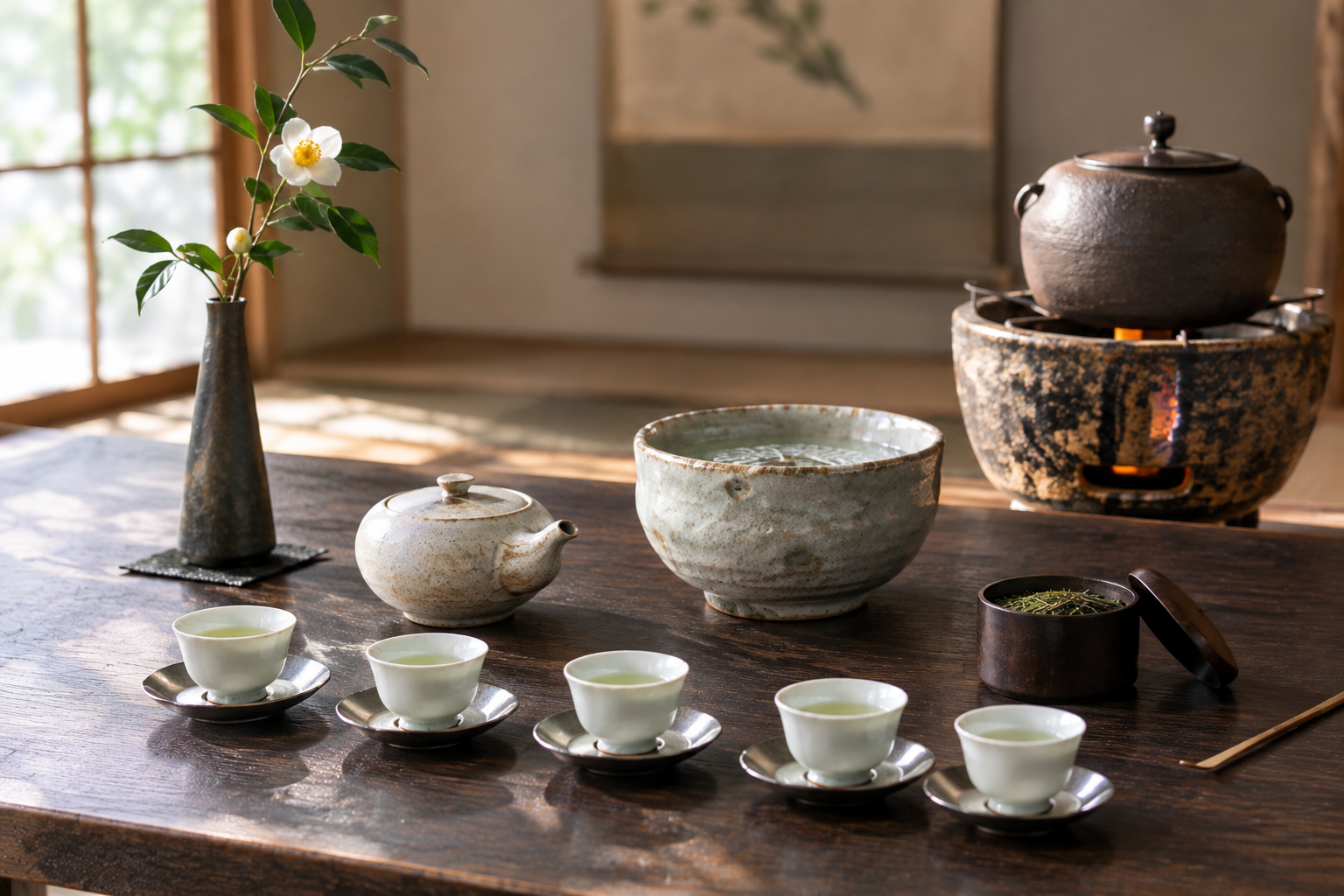
- Ryoro (涼炉): a small portable brazier, traditionally burning charcoal, used to heat the water.
- Bofura (ボーフラ): a small, round, unglazed clay kettle that sits on the ryoro.
- Kyusu or houhin: a small teapot. A houhin has no handle and is often used for gyokuro.
- Yuzamashi: a cooling bowl for bringing water down to the right temperature.
- Small cups (senchawan): usually five, thin and delicate, often white inside so you can see the color of the tea.
- Chataku: saucers for the cups, often metal or lacquered wood.
- Chagu tray and tea caddy: for setting out the utensils and holding the leaf.
Many of these are simply refined versions of things you might already use for good sencha at home – which is part of senchado’s appeal.
What Happens During a Sencha Ceremony
Procedures vary between schools, but a typical senchado gathering follows a general flow:
- Preparing the space. Utensils are arranged neatly, sometimes with a scroll, a flower arrangement or seasonal decoration.
- Warming the utensils. Hot water is poured into the teapot and cups to warm them, then discarded.
- Cooling the water. The water is cooled in the yuzamashi to the right temperature – especially low for gyokuro.
- Adding the leaves. The host measures the tea into the pot with care.
- Steeping. The cooled water is poured over the leaves and left to steep quietly.
- Pouring evenly. The tea is poured into the cups a little at a time, going back and forth, so every cup has the same strength. The last drops, the richest, are shaken out carefully.
- Serving. Cups are placed on saucers and offered to guests, who receive them with a bow and drink slowly, often in a few small sips.
- Second infusion. The host often brews the same leaves again, letting guests notice how the flavor changes.
- Sweets. A small sweet is often served to accompany the tea.
The movements are calm, efficient and deliberate. Some practitioners describe senchado as “meditation in motion” – the focus on each simple action helps quiet the mind.
Where to Experience Senchado
- Manpuku-ji, Uji. The head temple of the Obaku school is the historic center of senchado and hosts sencha gatherings and events, especially in spring and autumn. It’s easy to combine with a visit to Uji’s tea shops.
- Kyoto and other cities. Some senchado teachers offer lessons or experiences for visitors, including in English. Search for “senchado experience” with the city name, and book ahead.
- Tea events and cultural centers. Japanese cultural centers abroad occasionally host senchado demonstrations.
Because many senchado schools offer table-style seating, it can be more comfortable than a traditional matcha ceremony if sitting on tatami is hard for you.
Bringing the Spirit of Senchado Home
You don’t need a ryoro or a teacher to enjoy the essence of senchado. Try this the next time you brew a good sencha or gyokuro:
- Make it a separate moment. Clear the table and put away your phone.
- Warm everything first. Pour hot water into the pot and cups, then discard it.
- Cool the water deliberately. Pour it into a cooling bowl or a spare cup and watch the steam settle.
- Use small cups. Smaller servings make you slow down and notice the flavor.
- Pour back and forth. Fill the cups a little at a time so each is the same strength, and shake out the last drops.
- Brew a second time. Taste how the tea changes.
A good teapot makes this easier – my kyusu buying guide covers what to look for.
A Few Things People Ask Me
Is senchado older than the matcha ceremony? No. The matcha ceremony took shape earlier, in the 15th and 16th centuries. Senchado developed from the 17th and 18th centuries onward.
Is senchado less formal than chanoyu? It began as a reaction against formality, and many people find it more relaxed. But today’s senchado schools do have set procedures, so it’s still a structured practice.
Can senchado use gyokuro? Yes. Many schools serve gyokuro as well as sencha, often in very small, concentrated cups.
What should I buy to try it at home? A small handle-less houhin teapot on Amazon is ideal for small, careful servings, and a high-quality leaf like Nio Teas’ gyokuro is what senchado is really made for.
Where I Landed
What I love about senchado is its origin story: a monk walking around Kyoto with a basket of tea, serving anyone for whatever they could pay, because he believed tea belonged to everyone. The ceremony that grew up after him is more formal than he might have liked, but its heart is still simple – good leaf, carefully cooled water, small cups and full attention. You can bring that into your own kitchen this afternoon.