Tag: Japanese Tea Ceremony

  • Senchado: Japan’s Other Tea Ceremony, Made With Sencha Instead of Matcha

    Senchado: Japan’s Other Tea Ceremony, Made With Sencha Instead of Matcha

    Disclosure: This post contains affiliate links. If you buy through one of them, I may earn a small commission at no extra cost to you.

    When people say “Japanese tea ceremony,” they almost always mean chanoyu: a quiet tatami room, a bamboo whisk, and a bowl of frothy matcha. But Japan has a second tea ceremony that most visitors – and plenty of tea lovers – have never heard of. It uses loose-leaf green tea, a tiny teapot and thimble-sized cups, and it grew out of a rebellion against the formality of the matcha ceremony.

    It’s called senchado (煎茶道), “the way of sencha.” This guide explains where it came from, how it differs from the matcha ceremony, what actually happens during one, and how you can try the spirit of it at home.

    The Problem You’re Actually Trying to Solve

    You’ve probably read about the matcha tea ceremony, but you drink mostly sencha or gyokuro – and you’re curious whether there’s a traditional, mindful way to enjoy leaf tea too. English information on senchado is scarce, and what exists is often either very academic or a brief mention in a matcha article.

    Who This Article Is NOT For

    • If you’re looking for the matcha tea ceremony and how to behave as a guest, that’s chanoyu – a different tradition with different rules.
    • If you just want the best everyday brewing method for sencha, you don’t need any ceremony. My green tea temperature guide covers that more directly.
    • If you want a strict, step-by-step manual for one school’s procedure, that’s best learned from a teacher. Senchado has many schools, and their details differ.

    Where Senchado Came From

    Senchado’s roots go back to China and to Zen Buddhism.

    Ingen and the Obaku school. In 1654, the Chinese Zen master Ingen (Yinyuan Longqi) arrived in Japan. He founded the Obaku school of Zen, one of Japan’s three main Zen schools, and its head temple, Manpuku-ji, in Uji, south of Kyoto. Along with Buddhism, Ingen and his followers brought Chinese culture with them – including the Ming-dynasty custom of steeping loose tea leaves rather than whisking powdered tea.

    Baisao, the “Old Tea Seller.” The figure most associated with senchado is Baisao (売茶翁, “old tea seller”), an Obaku monk born in 1675 in what is now Saga Prefecture. In 1735, at about 61, he set up a small tea stall in Kyoto. Rather than running a formal shop, he carried his tea and utensils to scenic spots around the city and served anyone who stopped – aristocrats, merchants and ordinary people alike – while talking about Zen. Famously, he didn’t set a price; his sign said he would accept whatever people chose to pay, “anything from a hundred gold coins down to half a sen,” and if they paid nothing, that was fine too.

    Baisao openly criticized how the matcha ceremony of his day had become expensive, rigid and focused on status. For him, tea was a way of living freely and simply, not a display of rare utensils. In 1755, when he was about 81, he stopped selling tea and burned his utensils so they wouldn’t be treated as treasures after his death.

    Nagatani Sōen and modern sencha. Around the same period, in 1738, Nagatani Sōen of Ujitawara developed the steaming-and-rolling method that became the basis of today’s sencha. Baisao visited him in 1742. Better tea and Baisao’s free-spirited style together helped sencha spread.

    From free spirit to formal “way.” Ironically, after Baisao’s death, sencha drinking became popular among Edo-period intellectuals, poets and painters – the bunjin (literati) – who loved its connection to Chinese scholarly culture. Over the 19th century, schools formed and created their own procedures and utensils, and senchado became a formal tradition of its own. Baisao is now honored as its founding figure, and Manpuku-ji remains its spiritual home, hosting large sencha gatherings.

    Senchado vs. Chanoyu: The Key Differences

    Chanoyu (matcha ceremony)Senchado (sencha ceremony)
    TeaPowdered matcha, whiskedLoose-leaf tea (sencha or gyokuro), steeped
    Main utensilsChawan (bowl), chasen (whisk), chashaku (scoop)Small teapot, tiny cups, saucers, brazier and kettle
    RootsJapanese Zen and the tea masters of the 16th centuryChinese tea culture, Obaku Zen, Baisao
    AestheticWabi-sabi: rustic, restrainedOften lighter and influenced by Chinese literati culture
    AtmosphereHighly formal, set movementsStill structured, but often seen as more relaxed
    SeatingUsually tatami; some schools offer table-styleTatami or table-style, depending on the school

    The biggest difference you’ll notice is the cup. In senchado, especially with gyokuro, guests may receive only a few sips of very concentrated tea in a cup not much bigger than a thimble – the point is to taste every drop carefully.

    The Utensils of Senchado

    Each school has its own preferences, but these are the utensils you’ll usually see:

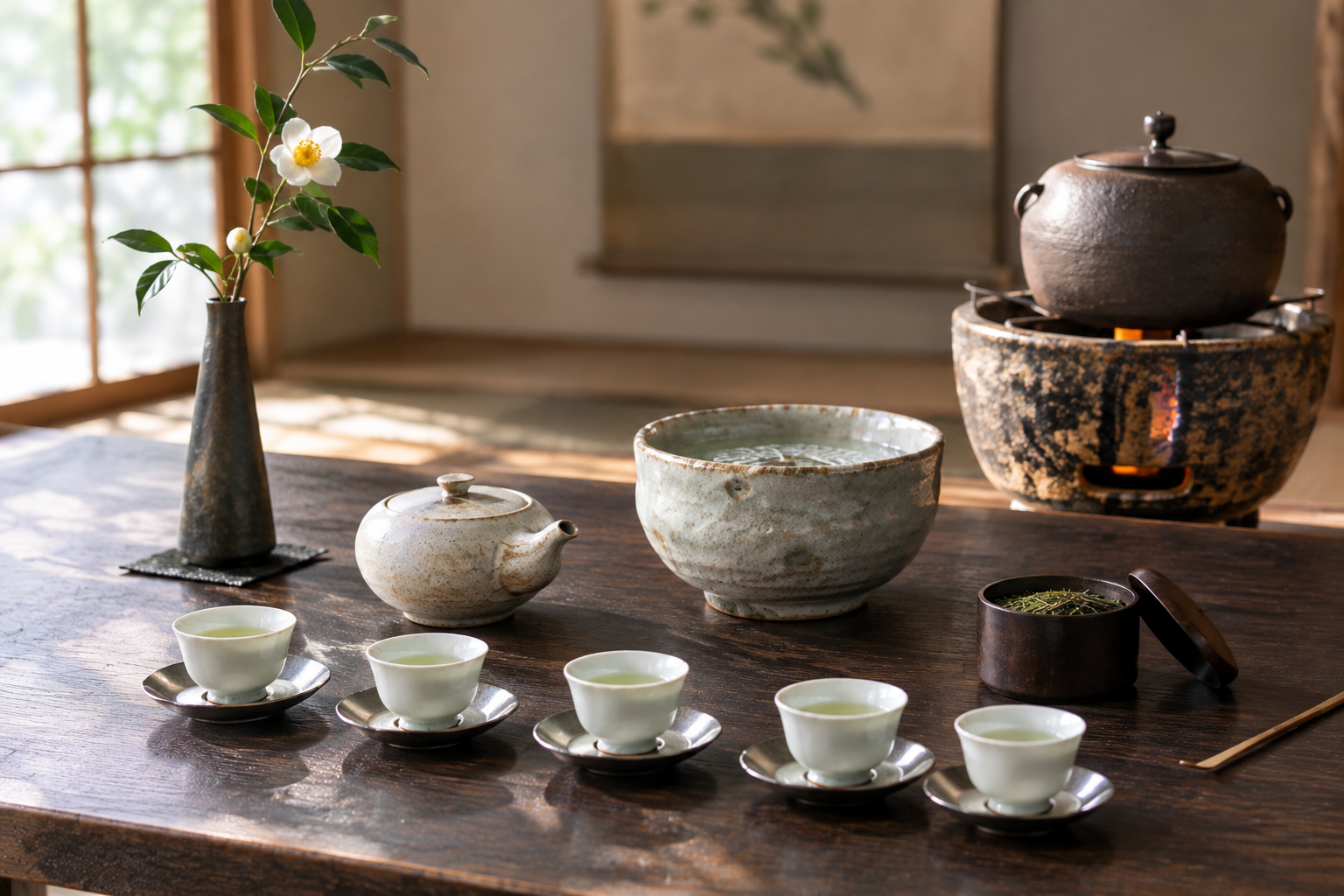
    • Ryoro (涼炉): a small portable brazier, traditionally burning charcoal, used to heat the water.
    • Bofura (ボーフラ): a small, round, unglazed clay kettle that sits on the ryoro.
    • Kyusu or houhin: a small teapot. A houhin has no handle and is often used for gyokuro.
    • Yuzamashi: a cooling bowl for bringing water down to the right temperature.
    • Small cups (senchawan): usually five, thin and delicate, often white inside so you can see the color of the tea.
    • Chataku: saucers for the cups, often metal or lacquered wood.
    • Chagu tray and tea caddy: for setting out the utensils and holding the leaf.

    Many of these are simply refined versions of things you might already use for good sencha at home – which is part of senchado’s appeal.

    What Happens During a Sencha Ceremony

    Procedures vary between schools, but a typical senchado gathering follows a general flow:

    1. Preparing the space. Utensils are arranged neatly, sometimes with a scroll, a flower arrangement or seasonal decoration.
    2. Warming the utensils. Hot water is poured into the teapot and cups to warm them, then discarded.
    3. Cooling the water. The water is cooled in the yuzamashi to the right temperature – especially low for gyokuro.
    4. Adding the leaves. The host measures the tea into the pot with care.
    5. Steeping. The cooled water is poured over the leaves and left to steep quietly.
    6. Pouring evenly. The tea is poured into the cups a little at a time, going back and forth, so every cup has the same strength. The last drops, the richest, are shaken out carefully.
    7. Serving. Cups are placed on saucers and offered to guests, who receive them with a bow and drink slowly, often in a few small sips.
    8. Second infusion. The host often brews the same leaves again, letting guests notice how the flavor changes.
    9. Sweets. A small sweet is often served to accompany the tea.

    The movements are calm, efficient and deliberate. Some practitioners describe senchado as “meditation in motion” – the focus on each simple action helps quiet the mind.

    Where to Experience Senchado

    • Manpuku-ji, Uji. The head temple of the Obaku school is the historic center of senchado and hosts sencha gatherings and events, especially in spring and autumn. It’s easy to combine with a visit to Uji’s tea shops.
    • Kyoto and other cities. Some senchado teachers offer lessons or experiences for visitors, including in English. Search for “senchado experience” with the city name, and book ahead.
    • Tea events and cultural centers. Japanese cultural centers abroad occasionally host senchado demonstrations.

    Because many senchado schools offer table-style seating, it can be more comfortable than a traditional matcha ceremony if sitting on tatami is hard for you.

    Bringing the Spirit of Senchado Home

    You don’t need a ryoro or a teacher to enjoy the essence of senchado. Try this the next time you brew a good sencha or gyokuro:

    • Make it a separate moment. Clear the table and put away your phone.
    • Warm everything first. Pour hot water into the pot and cups, then discard it.
    • Cool the water deliberately. Pour it into a cooling bowl or a spare cup and watch the steam settle.
    • Use small cups. Smaller servings make you slow down and notice the flavor.
    • Pour back and forth. Fill the cups a little at a time so each is the same strength, and shake out the last drops.
    • Brew a second time. Taste how the tea changes.

    A good teapot makes this easier – my kyusu buying guide covers what to look for.

    A Few Things People Ask Me

    Is senchado older than the matcha ceremony? No. The matcha ceremony took shape earlier, in the 15th and 16th centuries. Senchado developed from the 17th and 18th centuries onward.

    Is senchado less formal than chanoyu? It began as a reaction against formality, and many people find it more relaxed. But today’s senchado schools do have set procedures, so it’s still a structured practice.

    Can senchado use gyokuro? Yes. Many schools serve gyokuro as well as sencha, often in very small, concentrated cups.

    What should I buy to try it at home? A small handle-less houhin teapot on Amazon is ideal for small, careful servings, and a high-quality leaf like Nio Teas’ gyokuro is what senchado is really made for.

    Where I Landed

    What I love about senchado is its origin story: a monk walking around Kyoto with a basket of tea, serving anyone for whatever they could pay, because he believed tea belonged to everyone. The ceremony that grew up after him is more formal than he might have liked, but its heart is still simple – good leaf, carefully cooled water, small cups and full attention. You can bring that into your own kitchen this afternoon.
  • Tea Ceremony Etiquette for Guests: What to Do (and What Not to Worry About)

    Tea Ceremony Etiquette for Guests: What to Do (and What Not to Worry About)

    Disclosure: This post contains affiliate links. If you buy through one of them, I may earn a small commission at no extra cost to you. Etiquette differs between tea schools – the steps below are the common basics, and your host’s instructions always come first.

    The first time I sat in on a tea ceremony as a guest, I spent most of it worrying. Which way do I turn the bowl? Do I eat the sweet now or later? Is it rude to finish everything? I was so focused on not making a mistake that I barely tasted the tea. Later, the host told me something I wish I’d known before I walked in: nobody expects a first-time guest to know the steps. What matters is attention and respect – and a few basic gestures, which are easy to learn in advance.

    The Problem You’re Actually Trying to Solve

    Most people reading this have booked a tea ceremony experience in Kyoto, Tokyo or Kamakura, or have been invited to one, and want to avoid embarrassing themselves. Online guides tend to either overwhelm you with every movement of a formal ceremony or skip the practical questions: what to wear, what to say, and what to actually do when the bowl is placed in front of you.

    Who This Article Is NOT For

    • If you want to host a simple tea ceremony yourself, my guide to a tea ceremony you can do at home covers the host’s side.
    • If you want to know what all the tools in the room are, my tea ceremony utensils guide explains each one.
    • If you’re formally studying with a school, follow your teacher. The Urasenke, Omotesenke and Mushakōjisenke schools – and many others – differ in details, and your instructor’s way is the right way.

    Before You Go: What to Wear and Bring

    Clothing. You don’t need a kimono. For tourist experiences, clean, comfortable clothes are fine. Choose loose trousers or a skirt long enough to cover your knees when kneeling, since you’ll likely sit in seiza on tatami. Avoid very short skirts and tight jeans.

    Socks. Wear or bring clean socks – white is traditional. Bare feet on tatami are generally considered inappropriate, and some hosts ask guests to change into fresh socks before entering, so a spare pair is a good idea.

    Jewelry and watches. Take off rings, bracelets and watches before entering. Tea bowls can be old and valuable, and metal can scratch them.

    Perfume. Skip it. Strong scents interfere with the aroma of the tea and incense.

    What to bring (for more formal gatherings): kaishi, a small pad of folded paper used as a plate for sweets and for wiping, and a kashikiri, a small pick for cutting sweets. Tourist experiences usually provide these.

    The Sweets Come First

    You’ll be served a Japanese sweet (wagashi) before the tea. Eat it before the matcha arrives – its sweetness is meant to balance the tea’s bitterness, and it’s considered part of the experience, not a dessert afterward.

    • Say “Osaki ni” (“excuse me for going first”) with a small bow to the guest next to you before you start.
    • Place the sweet on your kaishi, hold it in your left hand, and cut soft sweets into small pieces with the pick.
    • Fold any used paper and take it home with you rather than leaving it behind.

    Receiving and Drinking the Tea

    This is the part people worry about most. A common sequence looks like this:

    1. Acknowledge the next guest. Before drinking, a small bow and “Osaki ni” to the person after you.
    2. Thank the host. Bow and say “Otemae chōdai itashimasu” (“I gratefully receive your tea”), or simply a respectful “Itadakimasu.”
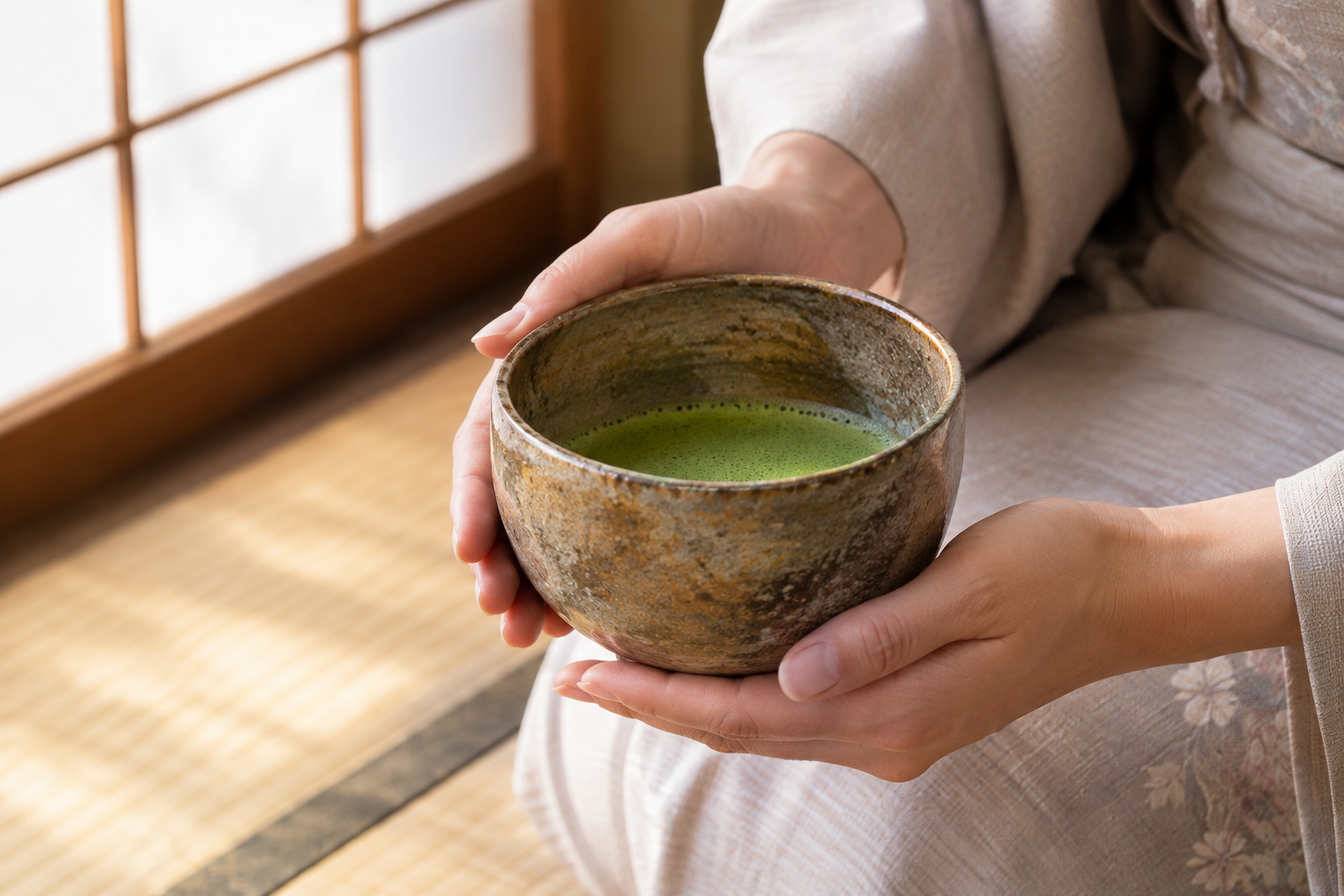
    3. Pick up the bowl with your right hand and place it on your left palm. Rest your right hand lightly on its side. Always use two hands.
    4. Turn the bowl clockwise, usually twice. The bowl is served with its most beautiful side – the “front” – facing you. Turning it means you don’t drink from the front, a gesture of humility and respect for the host and the bowl.
    5. Drink in a few sips. Three to four sips is typical for thin tea. In some schools, the last sip is drawn in with a light, audible slurp to show you’ve finished and enjoyed it.
    6. Wipe the rim. Gently wipe where your lips touched with your right thumb and finger, then wipe your fingers on your kaishi.
    7. Turn the bowl back. Rotate it in the opposite direction so the front faces the host again, and set it down in front of you.

    If you lose track of the turns, don’t panic. Turning the bowl in roughly the right direction, with care, is what counts.

    Admiring the Bowl and the Room

    After drinking, it’s polite to look at the bowl before it’s returned. Place it in front of you, bow slightly, and lift it low – keeping your elbows on your knees, close to the tatami, so it can’t fall far. Look at its shape, glaze and the base, then set it down and turn it so the front faces the host.

    The same goes for the hanging scroll, the flowers and the other utensils: they’re chosen for the season and the occasion, and noticing them is part of being a good guest. Admire them with your eyes, and touch nothing unless invited.

    Things First-Time Guests Worry About Too Much

    • Sitting in seiza. Hosts know it’s hard. Many tourist experiences offer chairs (ryūrei style) or let you shift your legs. Ask if you need to.
    • Getting the words wrong. A sincere bow and “thank you” (arigatō gozaimasu) cover almost everything.
    • Not liking the taste. Matcha can be bitter. Finishing the bowl is polite, but no one will judge your face.
    • Doing it “wrong.” Different schools do things differently. Watch the guest before you, and follow your host.

    A Few Things to Avoid

    • Taking photos without asking first – ask on arrival what’s allowed
    • Talking loudly or checking your phone
    • Touching or picking up utensils unless invited
    • Stepping on the edges of the tatami mats, if you can avoid it
    • Leaving food or paper behind

    A Few Things People Ask Me

    Do I need to know Japanese? No. Tourist experiences usually explain everything in English, and a few phrases – osaki ni, itadakimasu, arigatō gozaimasu – are more than enough.

    Which way do I turn the bowl? Clockwise before drinking, usually twice, and back again afterward. Some schools differ slightly; follow the host’s demonstration.

    Do I have to finish the tea? Finishing it is the polite norm, and the portions of thin tea are small. If you truly can’t, that’s understandable – just drink what you can with care.

    How can I practice before I go? Making matcha at home a few times helps more than anything – you’ll know what the bowl and whisk feel like. Nio Teas’ matcha tools have a good starter set, and a pad of kaishi paper on Amazon is useful if you’re attending a more formal gathering.

    Where I Landed

    The rules of a tea ceremony look complicated from the outside, but most of them come down to the same few ideas: respect for the host, care for the utensils, and attention to the moment. Learn the basic steps – sweets first, a word to the next guest, turn the bowl, drink, wipe, turn it back – and then let go of worrying. My best tea ceremony was the one where I stopped thinking about the rules and actually tasted the tea.

  • Japanese Tea Ceremony Utensils: What Each One Actually Does

    Japanese Tea Ceremony Utensils: What Each One Actually Does

    Disclosure: This post contains affiliate links. If you buy through one of them, I may earn a small commission at no extra cost to you.

    The first time I saw a proper tea ceremony setup laid out, I counted at least seven distinct tools before I even got to the bowl and whisk I already recognized – a small silk cloth, a bamboo scoop, a lidded container that wasn’t the bowl, a second bamboo tool shaped like a ladle. It looked like more equipment than the actual drink could possibly justify. It isn’t excess, though – each piece has a specific, singular job, and most of them exist because chanoyu (the tea ceremony) treats the entire preparation, not just the drinking, as the point.

    You don’t need all of this to make good matcha at home – a bowl and a whisk genuinely cover the basics. But understanding what each ceremonial tool does makes it much easier to recognize what you’re looking at if you ever see a full set, whether in a shop, a museum, or an actual ceremony.

    The Problem You’re Actually Trying to Solve

    Most casual explanations of tea ceremony either overwhelm with the full ritual choreography (which utensil moves where, in what order, with what gesture) or undersell it down to just “bowl and whisk,” skipping the several other tools that have real, specific functions. If you want to actually understand what you’re looking at in a tea ceremony set without committing to studying the full ceremonial practice, a plain-language rundown of each piece’s job is the more useful starting point.

    Who This Article Is NOT For

    • If you already own a chawan and chasen and just want to make good matcha at home casually, my matcha whisk buying guide covers the two tools that actually matter for that, without needing the rest of this list.
    • If you want to learn the actual ceremonial choreography and etiquette rather than just what each tool is called and does, my simplified home tea ceremony guide is a better starting point for that.
    • If you’re shopping for a complete ceremonial set to actually practice chanoyu formally, this is background knowledge rather than a buying guide – working with an instructor is the better route for building out a proper set.

    The Core Utensils, One at a Time

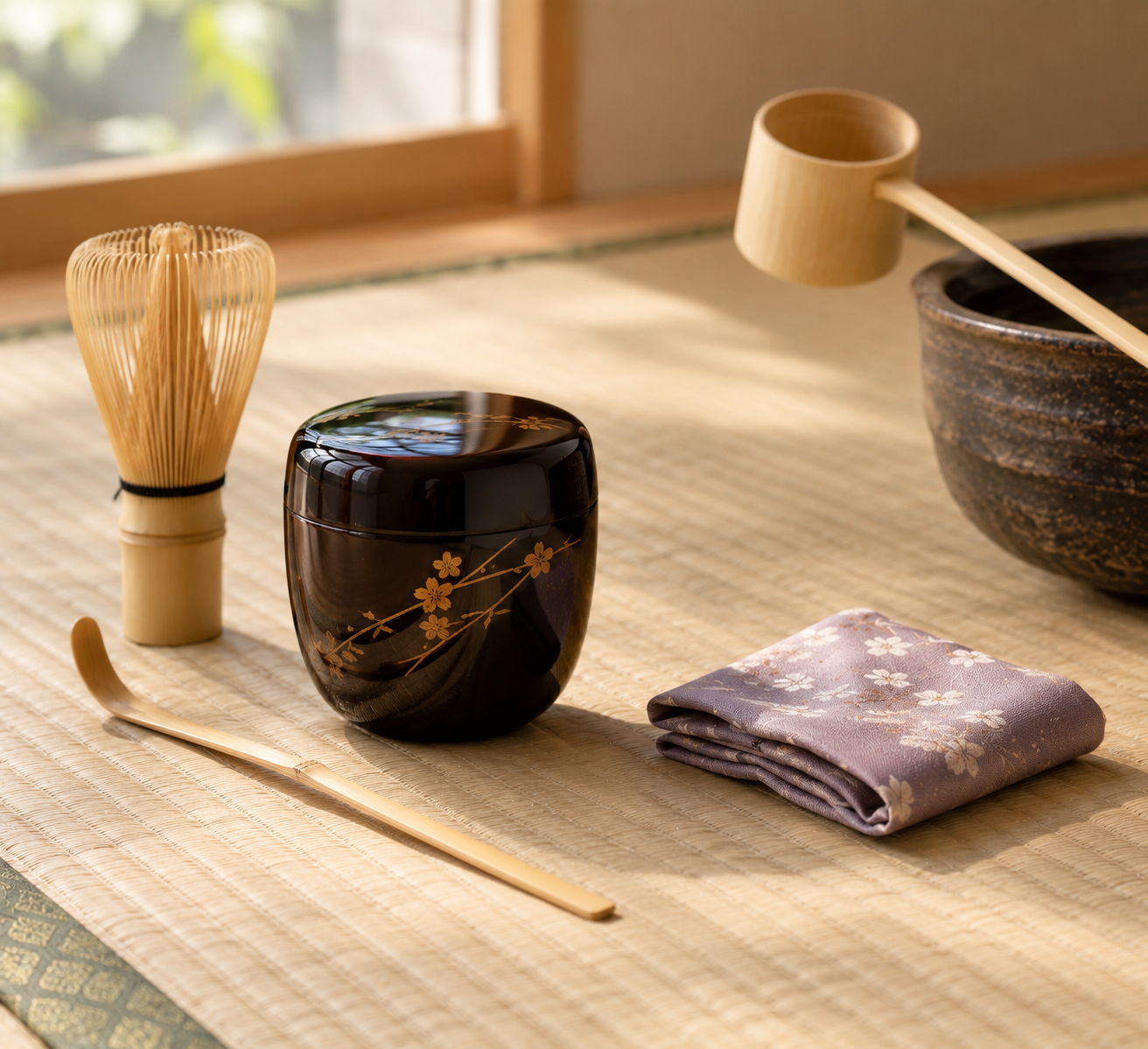
    Chasaku (bamboo scoop). A long, narrow bamboo scoop used to measure and transfer matcha from its caddy into the bowl – typically holding around two grams per scoop. These are often hand-carved, sometimes by tea masters themselves, and can carry real personal or artistic significance well beyond their simple function.

    Natsume. A lacquered wooden tea caddy used specifically for usucha (thin tea, the more casual and common style of matcha preparation). Named for its resemblance to the natsume (jujube) fruit, it’s typically finished in black or red urushi lacquer, often decorated with seasonal motifs that change with the time of year – tying back to the same seasonal sensibility that shows up in chawan and wagashi choices.

    Chaire. A ceramic tea caddy used exclusively for koicha (thick tea, a more concentrated and ceremonially formal preparation), distinct from the natsume both in material and in which style of tea it’s reserved for. Traditionally oblong with an ivory lid, a chaire is often stored in its own protective drawstring pouch when not in use.

    Hishaku. A long-handled bamboo ladle used to transfer hot water from the kettle (kama) to the tea bowl, and to scoop water for cooling. Its handling is one of the more codified parts of the ceremony – specific grips and motions are prescribed depending on what the ladle is doing at that moment.

    Fukusa. A folded silk cloth used to ritually purify the natsume, chasaku, and other utensils before and during the ceremony. It must stay dry throughout – it’s a purification tool, not a cleaning cloth for wiping up spills – and its color traditionally signals the practitioner’s gender (purple for men, orange or red for women, broadly speaking).

    Chakin. A damp linen cloth used to wipe the tea bowl itself between preparations. Where the fukusa purifies dry, the chakin is the tool that actually touches and cleans the bowl with moisture – the two serve related but distinct purification roles and aren’t interchangeable.

    Kensui. A wastewater vessel, made of clay, metal, or wood, into which used rinse water is poured after cleaning the bowl during the ceremony – essentially the practice’s built-in waste container, keeping used water contained and out of view rather than disposed of elsewhere mid-ceremony.

    Mizusashi. A lidded water container, made from ceramic, glass, metal, or wood, holding fresh cold water primarily used to refill the kettle as needed throughout the ceremony.

    Futaoki. A small rest for the kettle’s lid and the hishaku ladle when they’re not actively in use, typically made of bamboo, ceramic, or porcelain – a small detail, but one more example of the ceremony having a designated place for literally everything involved in the process.

    Why So Many Separate Tools

    The pattern across nearly all of these is separation of function and purity: a distinct tool for measuring, a distinct tool for purifying, a distinct tool for handling water, a distinct tool for waste. Nothing does double duty. That’s less about needing that many tools functionally and more about chanoyu treating the entire preparation sequence, not just the finished cup, as the meaningful part of the practice – each tool’s precise, singular role is part of what makes the process itself deliberate and unhurried rather than efficient.

    A Few Things People Ask Me

    Do I need any of these beyond a chawan and chasen to make matcha at home? No – a bowl and whisk are genuinely sufficient for casual home matcha. The rest of this list matters for understanding or practicing formal chanoyu, not for making a good everyday cup.

    What’s the actual difference between the fukusa and the chakin if they’re both cloths? The fukusa is dry and used for ceremonial purification of utensils like the natsume and chasaku; the chakin is damp and used specifically to wipe the tea bowl. They’re not interchangeable, and using one for the other’s job would be a real departure from proper practice.

    Is a chaire always more valuable or formal than a natsume? Generally, yes, in the sense that koicha (which the chaire is used for) is considered the more advanced, formal preparation compared to usucha – but that doesn’t make an individual natsume less well-crafted or valuable on its own terms; the two serve genuinely different tea styles rather than existing on a strict hierarchy.

    Where would I actually start if I wanted to build toward owning some of these pieces? A chasen and chawan first, since those are the tools any regular matcha drinker actually uses. Nio Teas’ matcha tools covers that starting point well, and a natsume-style tea caddy on Amazon is a reasonable next piece if you want something a step beyond the basics without committing to a full ceremonial set.

    Where I Landed

    What struck me most, once I understood what each piece actually did, was how little of it was decorative. Every tool in a full tea ceremony set is solving one specific problem – measuring, purifying, transporting water, containing waste – and none of them overlap in function the way household items so often do. It’s a genuinely efficient system dressed up as an elaborate one, which is a different thing than I expected walking into it.

  • A Simple Japanese Tea Ceremony You Can Actually Do at Home

    A Simple Japanese Tea Ceremony You Can Actually Do at Home

    Disclosure: This post contains affiliate links. If you buy through one of them, I may earn a small commission at no extra cost to you.

    The first time I read about chanoyu, the traditional Japanese tea ceremony, I assumed it was permanently out of reach for anyone without years of formal training, a tatami room, and a teacher to correct every hand movement. What I didn’t understand yet was that chanoyu at its most formal, the multi-hour chaji with a full meal and thick tea, is genuinely a serious, disciplined practice, but a simplified version, focused on the spirit rather than the exact choreography, is something anyone can do at home with a few basic tools and about twenty minutes, without pretending to have mastered something that takes years to actually learn properly.

    This isn’t a substitute for real training under a tea master, and I want to be upfront about that distinction from the start. What follows is a respectful, simplified home version built around the same core spirit, hospitality, mindfulness, and a deliberate pause from everything else, without requiring a formal tea room or years of study to attempt. Think of it as an honest introduction, not a shortcut to expertise.

    The Problem You’re Actually Trying to Solve

    You’ve searched for a simplified home tea ceremony guide because you’re drawn to the idea, maybe from a trip to Japan, a documentary, or simply an interest in matcha itself, but the formal version feels intimidatingly out of reach for a casual home attempt. That gap between curiosity and feeling qualified to try is exactly what this guide is meant to close, without pretending a home version is the same thing as the real, deeply trained tradition.

    Who This Article Is NOT For

    Let’s save you some scrolling if this isn’t quite your situation.

    • If you’re looking for formal instruction to actually study chanoyu, this isn’t that resource, and it shouldn’t be treated as one. Formal study happens under a qualified teacher, often through a specific school like Urasenke, over years, not from a blog post.
    • If you want the full, traditional chaji experience with kaiseki meal, koicha, and the complete multi-hour structure, this covers a simplified usucha-only home version, not the formal long-form gathering.
    • If you’re looking to recreate this for a large group, this guide is built around one host serving one or two guests, which is the more manageable starting point for a home setting.

    If you’re past that, here’s where the actual guide starts.

    The Spirit Behind It, Briefly

    Chanoyu is traditionally grounded in four principles, harmony, respect, purity, and tranquility, articulated by the 16th-century tea master Sen no Rikyu. In a simplified home version, you don’t need the formal vocabulary to honor the spirit: create a calm space, treat your guest and your tools with genuine care, and let the twenty minutes be genuinely undistracted rather than rushed.

    What You’ll Need

    • A chawan (matcha bowl)
    • A chasen (bamboo whisk)
    • A chashaku (bamboo scoop) or a small spoon
    • Good ceremonial-grade matcha
    • A clean cloth or small linen for the table
    • Hot water, cooled slightly below boiling

    My matcha whisk buying guide covers choosing these tools in more depth if you don’t already have them.

    The Simplified Steps

    1. Prepare the Space

    Clear a low table, lay a clean cloth, and set out your bowl, whisk, scoop, and matcha caddy in order. Turn off music, and put phones, both yours and your guest’s, in another room. The point of the ritual is a genuinely uninterrupted twenty minutes, not a photo opportunity.

    2. Welcome Your Guest

    Greet your guest and invite them to sit. A small bow, even an informal one, sets the tone for the rest of the interaction as something deliberate rather than casual.

    3. Serve a Small Sweet First

    Offer a small sweet, traditionally wagashi, before the tea itself. This isn’t just sequencing, it’s practical, since the sweetness balances matcha’s natural bitterness in the cup that follows. My wagashi beginner guide is a good resource if you want something authentic and approachable for this step.

    4. Sift and Measure the Matcha

    Sift roughly 2 grams (about one to one and a half teaspoons) of matcha into the bowl. This isn’t a step to skip for convenience, since unsifted clumps will show up in the finished tea.

    5. Add Water and Whisk

    Add a small amount of water, cooled to roughly 70–80°C, not boiling. Whisk in a brisk back-and-forth “W” or “M” motion, letting your wrist do the work rather than your whole arm. The chasen’s tip should barely brush the bottom of the bowl rather than pressing into it, which protects the whisk and produces a better, more even foam.

    6. Lift and Present

    Once the foam looks even, lift the whisk straight up through the center in one smooth motion. Rotate the bowl slightly so its most decorated side faces your guest, then present it with both hands and a small bow.

    7. Receive and Drink

    Your guest receives the bowl with both hands, turns it slightly before drinking as a small gesture of respect, and drinks in a few unhurried sips rather than gulping. At home, the full formal etiquette (specific rotation direction, wiping the rim with a special paper) is genuinely optional. Keeping it simple, both hands, unhurried sips, is enough to honor the spirit of the thing.

    8. Close Gently

    Once finished, gather the utensils calmly rather than rushing to clean up the moment the last sip is taken. The pause at the end is as much a part of the ritual as the pause at the beginning.

    What to Skip vs. What to Keep

    Worth keeping even in a simplified version: the phone-free environment, the deliberate slowness, serving a sweet before the tea, and presenting the bowl with both hands rather than setting it down casually.

    Reasonable to skip at home: kneeling in formal seiza posture if it’s uncomfortable, precise bowl-rotation direction and degree, the kaishi paper for wiping the rim, and any expectation of achieving temae-level whisking technique on your first attempt.

    Where to Get the Basics

    Shop chawan (matcha bowls) on Amazon →

    Shop matcha starter kits (whisk, bowl, scoop) on Amazon →

    A Few Things People Ask Me

    Do I need special equipment, or can I use what I already have? A proper chasen and chawan genuinely help, since a regular whisk and mug won’t produce the same texture or presentation, but you don’t need an elaborate or expensive set to get the spirit of this right.

    Is it disrespectful to do a simplified version without formal training? Approached with genuine care and respect rather than as a costume or gimmick, a simplified home version is generally seen as a sincere, welcoming way to engage with the tradition, not an appropriation of it. The distinction lies in treating it as an introduction to something deeper, not a claim to have mastered or replicated formal chanoyu.

    How long should the whole thing take? A simplified version for one host and one guest reasonably takes about twenty to twenty-five minutes from setup to close, considerably shorter than a formal chaji, which can run several hours with a full meal included. Resist the urge to rush through it faster than that just because it’s a home version — the unhurried pace is a central part of the point, not an incidental detail.

    Can I do this alone, without a guest, just for myself? Absolutely, and many people who practice a simplified version at home do exactly that as a personal ritual rather than a hosted event. The core value, an undistracted, deliberate pause built around preparing tea carefully, doesn’t require a second person to be meaningful, and a solo version removes any pressure to get the “presenting to a guest” steps exactly right.

    What if I make a mistake in front of a guest — does that ruin the experience? Not remotely. Even in formal training, mistakes happen regularly and are handled calmly rather than treated as failures. At home, a spilled bit of matcha or an uneven whisk is far less important than the overall spirit of care and attention you’re bringing to the moment.

    Where I Landed

    The gap between “I find this beautiful and want to try it” and “I need years of formal training before I’m allowed to attempt any version of this” is smaller than it first appears, as long as you’re honest with yourself and anyone you serve about what you’re actually doing: a respectful, simplified home version inspired by a much deeper tradition, not a recreation of it. That honesty is really the whole safeguard against turning something meaningful into a costume — approach it with genuine care, and the simplification itself isn’t the problem.

    If the idea genuinely resonates with you beyond a single attempt, seeking out actual instruction, many cities have tea ceremony schools or occasional beginner workshops, is a meaningful next step, and this home version can become a genuine on-ramp toward that rather than a substitute for it. In the meantime, my green tea brewing temperature guide and matcha powder brands comparison are good companions for getting the practical fundamentals right while you build toward it.