Tag: Sencha Brewing Tools

  • How to Season and Care for a Kyusu (Before You Ruin It With Soap)

    How to Season and Care for a Kyusu (Before You Ruin It With Soap)

    Disclosure: This post contains affiliate links. If you buy through one of them, I may earn a small commission at no extra cost to you.

    I washed my first Tokoname clay kyusu with regular dish soap exactly once, the same way I’d wash any other mug, before I found out that unglazed clay is porous enough to actually absorb detergent permanently. Every cup of tea I made in that pot afterward carried a faint soapy edge that never fully went away, no matter how many times I rinsed it. That one pot never really recovered, and it’s the reason I now treat every new kyusu with a level of care that would have seemed excessive to me a year earlier.

    The good news is that proper kyusu care is genuinely simple once you know the two or three rules that actually matter. It’s less about a complicated ritual and more about avoiding a small number of specific mistakes that are very easy to make if nobody’s told you about them first — and once those habits are in place, caring for a kyusu takes barely longer than rinsing out a regular mug.

    The Problem You’re Actually Trying to Solve

    You’ve searched for how to season or care for a kyusu because you’ve either just bought your first one and want to start off right, or you’ve read somewhere that unglazed clay needs special handling and want to understand what that actually means in practice. Both are good instincts — a kyusu, especially an unglazed clay one, behaves differently from a regular mug or Western teapot, and treating it the same way can genuinely damage it or ruin the flavor of every cup you brew in it going forward.

    Who This Article Is NOT For

    Let’s save you some scrolling if this isn’t quite your situation.

    • If your kyusu is glazed porcelain or ceramic rather than unglazed clay, most of the strict soap-avoidance rules below don’t apply as urgently to you — glazed surfaces aren’t porous in the same way, though gentle care is still worth practicing.
    • If you already have an established seasoning routine for your unglazed clay pots, this is a beginner-focused guide, not new information for an experienced clay teapot owner.
    • If you’re deciding which kyusu to buy in the first place, my kyusu teapot buying guide covers that decision — this article assumes you already have one in hand.

    If you’re past that, here’s where the actual guide starts.

    What Actually Matters With Kyusu Care

    Three rules cover almost everything you need to know, and once they’re second nature, kyusu care stops feeling like a fragile ritual and just becomes a quick habit after each cup.

    1. Never use soap on unglazed clay. This is the single most important rule on this entire page. Unglazed clay, like Tokoname or Banko, is porous enough to absorb detergent permanently, and that absorbed soap leaches back into every future cup of tea. There’s no reliable fix once it’s happened, which is exactly why this rule gets repeated so many times throughout this guide.

    2. Dedicate an unglazed clay pot to one general tea category. The same porousness that ruins a pot with soap also means it slowly absorbs the character of whatever tea you brew in it, which is desirable when it’s the same tea over time, and a problem when you switch between very different teas. Think of it as the clay slowly building a flavor memory specific to one type of tea, rather than staying neutral.

    3. Dry it properly between uses. Trapped moisture in a sealed, damp pot is the fastest route to mold or musty odor, which undoes a lot of the careful seasoning you’ve built up, sometimes within just a few weeks of neglect.

    Seasoning a New Kyusu Before First Use

    A brand-new clay kyusu can carry a faint raw-clay taste or a trace of kiln smoke from manufacturing, and seasoning removes that while beginning the process of building the pot’s long-term character.

    Step 1: Initial Rinse

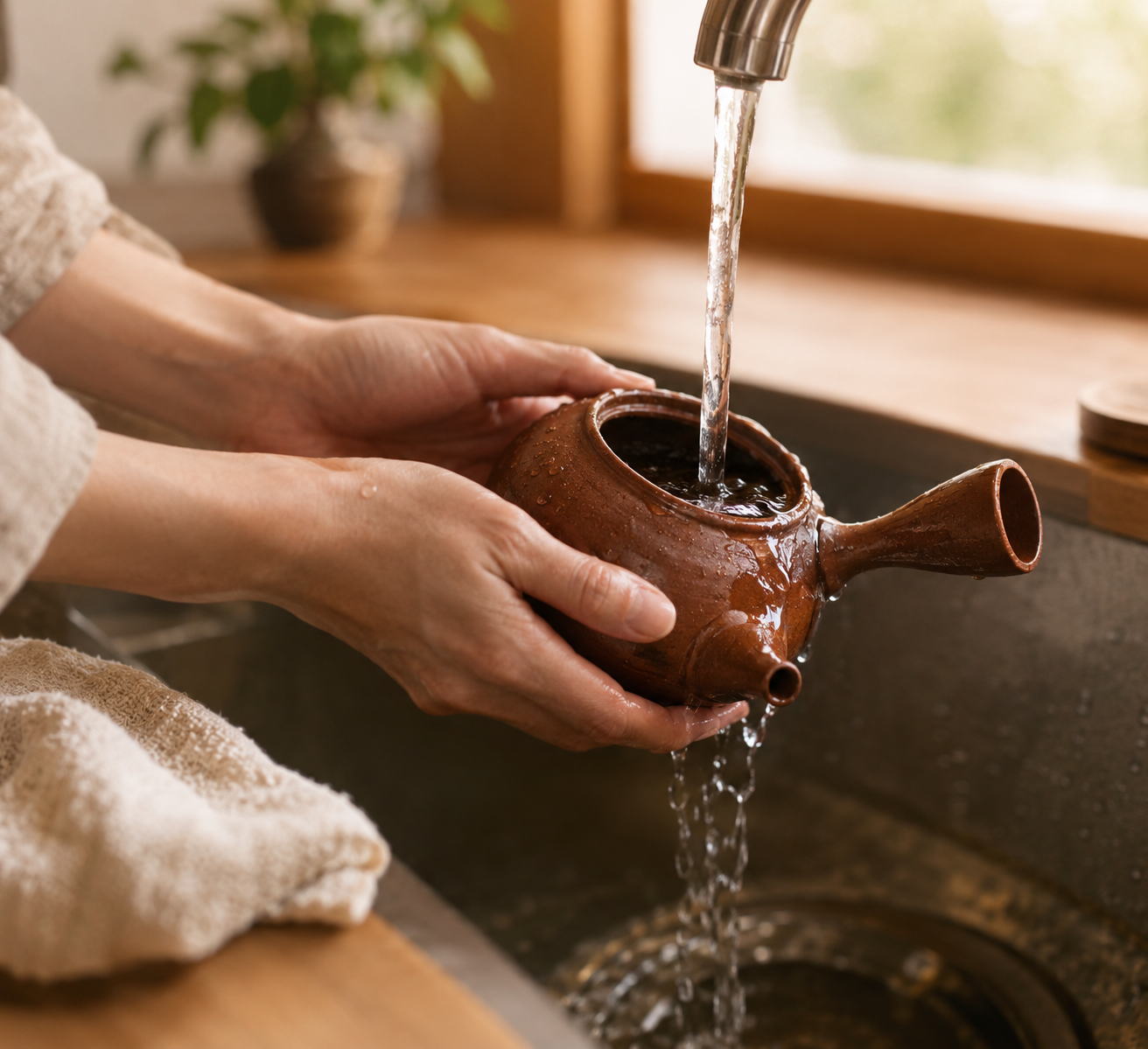
    Rinse the kyusu, inside and outside, with warm water, using your finger or a soft brush to gently wipe the interior walls. This clears out any dust or loose clay particles left over from manufacturing and shipping. No soap, at any point in this process.

    Step 2: A Warm Water Soak

    Fill a basin with warm, not boiling, water and let the kyusu soak for 15 to 20 minutes, lid separated from the body. This hydrates the clay, helps close any micro-cracks from the drying process during manufacturing, and starts washing out any lingering kiln taste.

    Step 3: Brew With the Tea You’ll Dedicate It To

    Once rinsed and soaked, brew your first pot using the tea you intend to use this kyusu for regularly, at the correct temperature for that tea (roughly 70–80°C for sencha, closer to 60°C for delicate gyokuro). This first brew effectively “introduces” the clay to that tea’s character, and it’s the beginning of the flavor-building patina unglazed clay is prized for. Glazed porcelain kyusu skip this step entirely — a simple warm water rinse is all they need before use.

    Ongoing Daily Care

    Rinse Immediately After Every Use

    Empty the leaves and rinse the interior with hot water right after you finish a pot, rather than letting it sit. Leftover leaves and residue left too long can affect both hygiene and the flavor of future brews.

    Never Use Soap, Ever, on Unglazed Clay

    This bears repeating because it’s the mistake that does the most permanent damage. If your kyusu is unglazed clay, hot water alone is the only routine cleaning agent it should ever see. For glazed porcelain or ceramic kyusu without a porous clay surface, a small amount of mild, unscented soap can occasionally be used if you rinse extremely thoroughly, though most experienced tea drinkers avoid even that.

    Dry It Fully Between Uses

    Remove the lid after rinsing and let the pot air dry completely before storing it. A sealed, damp lid traps moisture inside and is one of the more common causes of mold or musty odor developing in a kyusu that otherwise seemed well cared for.

    Keep the Filter Clear

    Whatever built-in filter style your kyusu uses, check periodically that it isn’t clogged with fine tea dust or sediment, since a blocked filter slows pouring and can affect how well the leaves inside actually steep.

    Dealing With Tea Stains and Buildup

    The brownish patina that naturally builds up inside an unglazed clay kyusu over months of use isn’t dirt to be scrubbed away — it’s the seasoning you’re actually trying to build, and traditional users tend to welcome it rather than fight it.

    That said, heavier buildup or genuine staining can be addressed occasionally with a baking soda and water soak, poured out and rinsed thoroughly afterward with clean warm water. This should stay an occasional deep-clean method for real buildup, not a routine cleaning step, since baking soda’s alkalinity can affect the clay surface if used too often. For glazed porcelain kyusu, a small amount of baking soda paste on a soft cloth can gently address surface staining, wiped on briefly and rinsed thoroughly.

    Tools That Help

    Shop soft cleaning brushes for teaware on Amazon →

    Shop kyusu teapots on Amazon →

    A Few Things People Ask Me

    I accidentally used soap on my clay kyusu. Is it ruined permanently? Not necessarily beyond hope, though it will likely taste noticeably different for a while. A long simmer in a large pot of plain water (fully submerging the kyusu, separated from any metal surfaces by a cloth) for about an hour, followed by a full air-dry and then several sessions of use as essentially a “tea pitcher” with your intended tea, can help reset it over time. It’s a slow recovery process, not an instant fix, and prevention is genuinely easier than the cure here.

    Can I switch which tea I brew in my kyusu occasionally, or does it have to be exactly one tea forever? Sticking to one general category (all green teas, for instance, rather than switching between green and heavily roasted or smoky teas) is the practical guideline. An occasional similar tea within that category won’t cause noticeable problems; a drastic switch, like brewing a smoky black tea in a pot you’ve been dedicating to delicate gyokuro, likely will.

    How do I know if my kyusu is glazed or unglazed clay? Unglazed clay typically has a matte, slightly rough, and porous-looking surface, often in earthy reds, purples, or browns, and it will absorb a small amount of water if you wet your finger and touch it briefly. Glazed ceramic or porcelain has a smooth, shiny surface that doesn’t absorb moisture the same way. If you’re unsure, treat it as unglazed and follow the stricter soap-avoidance rules — it’s the safer assumption either way.

    Does a well-seasoned kyusu actually make tea taste better, or is that just tradition talking? Many experienced tea drinkers report a genuinely noticeable difference, describing well-aged clay pots as producing a smoother, rounder cup over time. It’s difficult to separate the actual chemistry from ritual and expectation entirely, but the underlying mechanism — porous clay absorbing and mellowing tannins over repeated use — is real, not purely anecdotal.

    How often should I do a deeper clean versus just the routine hot water rinse? For most regular use, a hot water rinse after every session is genuinely all a kyusu needs. Reserve the baking soda soak for occasional heavier buildup, maybe every few months at most depending on how often you use the pot, rather than treating it as part of the normal routine.

    Is it worth having more than one kyusu if I drink several different types of tea? Yes, especially if those teas are meaningfully different in character — a smoky roasted tea and a delicate gyokuro really shouldn’t share the same unglazed clay pot. Many regular tea drinkers eventually end up with two or three kyusu, each dedicated to a different tea family, rather than trying to force one pot to serve everything.

    Where I Landed

    If you take away exactly one rule from this whole guide, make it this: no soap, ever, on unglazed clay. Everything else — the seasoning ritual, dedicating the pot to one tea, drying it fully — matters, but none of it does the kind of permanent damage that a single round with dish soap can do. My old soapy kyusu is proof of that; I still have it, and it still tastes faintly off years later, a small permanent reminder of a mistake that took about ten seconds to make and years to (mostly) live down.

    Treat a new kyusu gently for its first few uses, rinse it promptly and dry it fully after every session, and you’ll end up with a pot that genuinely improves with age rather than one that degrades. The learning curve here is short, and once the habits click, they take no real extra effort compared to how you’d already treat any other dish in your kitchen. If you’re still deciding which kyusu to bring home in the first place, my kyusu teapot buying guide is the right place to start before this one becomes relevant.
  • How to Choose a Kyusu: The Japanese Teapot Buying Guide

    How to Choose a Kyusu: The Japanese Teapot Buying Guide

    Disclosure: This post contains affiliate links. If you buy through one of them, I may earn a small commission at no extra cost to you.

    My first kyusu was a $12 impulse buy from an import shop, chosen entirely because the shape looked nice on a shelf. It worked, technically, but I had no idea for years that the handle position, the clay it was made from, and even the built-in filter type were all deliberate choices that change how the tea actually tastes, not just how the pot looks holding it. I only found that out once I compared a proper Tokoname clay pot side by side with my old one, and the difference in how smooth the same sencha tasted was hard to ignore.

    A kyusu isn’t just “a Japanese teapot” the way a mug is just a cup. It’s a purpose-built tool with a handle position designed around a specific pouring motion, a clay chemistry that can genuinely soften or round out a tea’s astringency, and a filter design that affects how well loose leaf actually opens up and steeps. None of that is obvious from a product photo, so this guide walks through what actually matters versus what’s mostly aesthetic preference — because you can absolutely spend a lot of money on the wrong features and still end up with a mediocre cup.

    The Problem You’re Actually Trying to Solve

    You’ve searched for how to choose a kyusu because you’re staring at a wall of options — different handle placements, different clay colors, wildly different prices for pots that look similar in photos — and you don’t know which differences are functional and which are just style. Maybe you’ve been steeping loose leaf green tea in whatever mug-and-infuser setup you already had, and you’re wondering if a proper kyusu is actually going to change your results or if it’s mostly about looking the part.

    The honest answer is that some of this genuinely changes your tea, and some of it really is preference. This guide sorts out which is which, so you can spend money where it actually matters and skip the parts that are just about what looks nice on your counter.

    Who This Article Is NOT For

    Let’s save you some scrolling if this isn’t quite your situation.

    • If you only ever drink tea bags or pre-bagged loose leaf, a kyusu isn’t built for that — it’s designed around loose leaf tea that needs room to unfurl and expand, and a tea bag gets no benefit from the extra brewing space or built-in filter.
    • If you already own a kyusu and are looking for advanced pairing (which clay for which specific tea), this is a beginner-to-intermediate buying guide, not a deep dive into matching clay mineral content to individual tea cultivars.
    • If you exclusively drink matcha, you don’t need a kyusu at all — matcha is whisked, not steeped, and my matcha whisk buying guide is the right resource instead.

    If you’re past that, here’s where the actual guide starts.

    What Actually Matters When Choosing One

    Three things determine whether a kyusu is right for how you actually drink tea, and once you understand them, the wall of options gets a lot easier to navigate.

    1. Handle style. This isn’t just aesthetic — it determines how you physically pour, how much control you have over the final drops, and how comfortable the pot is for your specific brewing habits.

    2. Clay type and material. Unglazed clay genuinely interacts with tea chemically over time, softening bitterness and building flavor memory into the pot. Glazed ceramic, porcelain, and glass don’t do this, which is a real tradeoff, not just a style choice.

    3. Filter design. The built-in strainer style affects how well loose leaf can actually expand and how easily fine tea dust clogs the pour. A cheap, poorly designed filter can undermine an otherwise good pot.

    Comparison Table

    Handle StyleBest ForPour ControlTypical Size
    Yokode (side handle)Solo or small servings of sencha, gyokuroBest, one-handed precision pour200–350ml
    Ushirode (back handle)Casual daily use, hojicha, genmaichaGood, familiar Western-style motion300–500ml
    Uwade (top handle)Larger pots, serving groupsModerate, two-handed for bigger pours400ml+
    Houhin (no handle)Delicate, low-temperature teas like gyokuroRequires careful grip, best for small servings100–200ml

    The Choices, One by One

    Handle Style

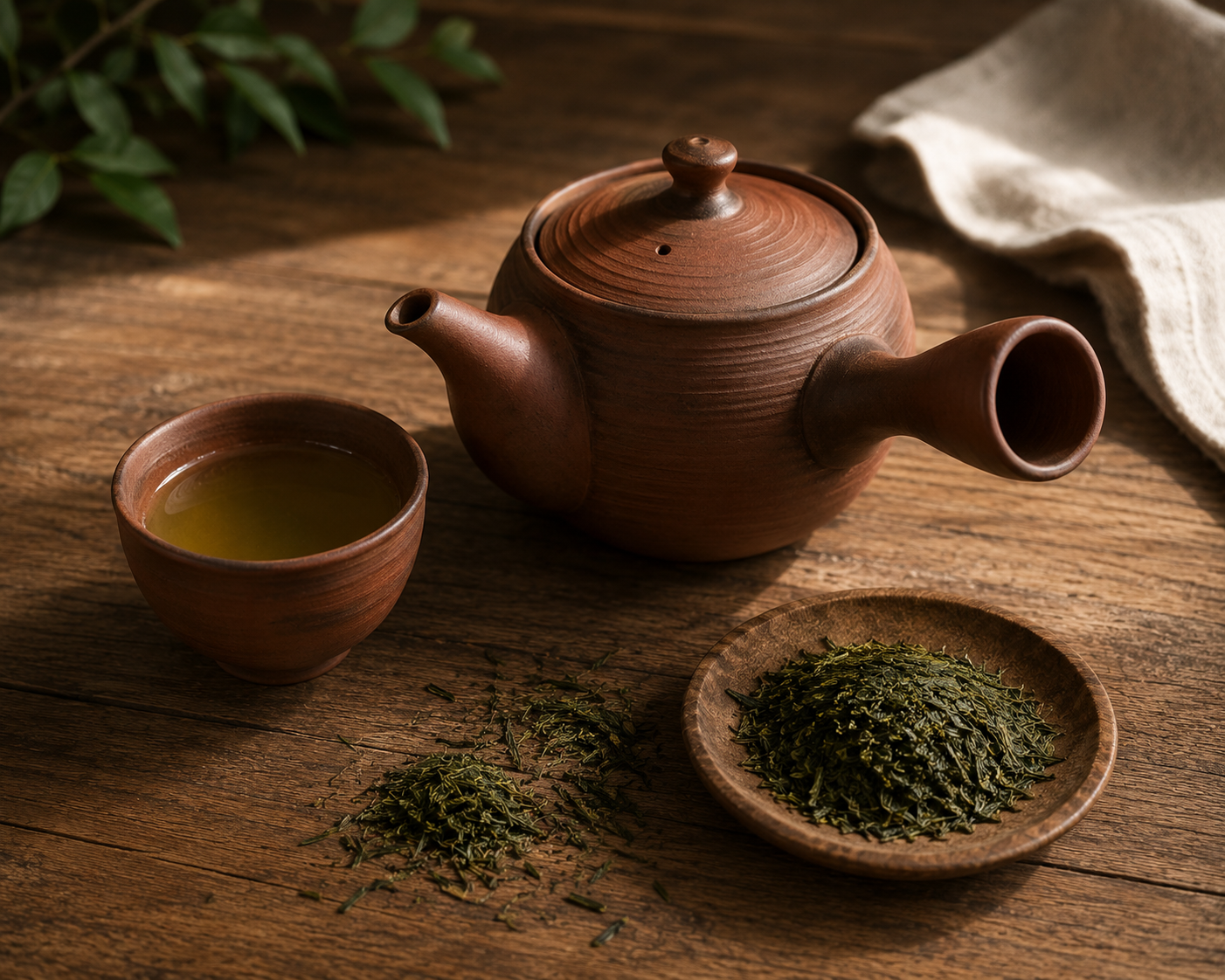
    Yokode, the side handle, sits at a 90-degree angle from the spout, letting you pour one-handed with your thumb resting on the lid. This is the design most associated with kyusu specifically, and it’s built around what tea enthusiasts call the “twist of the wrist” pour — a short, controlled motion that lets you extract the final concentrated drops precisely rather than dribbling out an uneven stream.

    Why it’s usually the right default: For solo or small servings of sencha or gyokuro, this handle style gives you the most control, and it’s genuinely the most intuitive once you’ve used it a few times. If you’re buying your first kyusu and aren’t sure what to get, this is the safe, traditional choice.

    Ushirode, the back handle, sits opposite the spout, similar to a Western teapot. It’s the most familiar shape if you’re coming from typical teapot use, and it tends to come in larger sizes suited to more casual, higher-volume teas like hojicha and genmaicha.

    Why you might prefer it: If the twist-of-the-wrist yokode motion feels unfamiliar or awkward, ushirode requires no adjustment at all — you pour it exactly like any Western teapot you’ve already used.

    Uwade, the top handle, usually a basket-style handle arching over the lid, suits larger pots meant for serving multiple people or multiple rounds at once.

    Why you might prefer it: If you’re regularly brewing for a group rather than a solo cup, the larger typical size and two-handed pour give you more volume per steep than a yokode is built for.

    Houhin, a handleless variant, is designed specifically for delicate, low-temperature teas like gyokuro, where you’re working with small quantities of concentrated, precious leaf and want to control the pour by gripping the body directly.

    Why you might prefer it: If gyokuro or other high-grade delicate teas are your main focus, houhin’s design is purpose-built for exactly that use case in a way general-purpose kyusu aren’t.

    Clay Type

    The two dominant Japanese clay traditions are Tokoname-yaki, from Aichi Prefecture, and Banko-yaki, from Mie Prefecture, and they genuinely produce different results in the cup, not just different colors on a shelf.

    Tokoname clay, typically a red, iron-rich shudei, is prized for smoothing out tannins and softening astringency, which makes it well suited to everyday sencha and most standard green teas.

    Banko clay, typically purple or yellow, is associated with enhancing umami and better heat retention, which makes it a stronger match for gyokuro, kabusecha, and higher-grade sencha where umami is the whole point.

    Why this matters: Unglazed clay pots absorb tea oils over repeated use, gradually building flavor character into the pot itself — which is also why dedicating an unglazed clay kyusu to one general category of tea (rather than switching between wildly different teas in the same pot) actually matters. A strongly roasted or smoky tea can leave lingering flavor in unglazed clay that affects a more delicate tea brewed in it afterward.

    Glazed ceramic, porcelain, or glass kyusu don’t have this absorption property, which means they’re more flexible for brewing different tea types in the same pot without cross-contamination of flavor, at the cost of not developing that same smoothing effect over time. Glass in particular is worth mentioning separately — it adds no mineral character at all and lets you watch the leaves unfurl, which some people genuinely enjoy as part of the ritual, even though it does nothing functional that ceramic doesn’t already do.

    Filter Design

    Most modern kyusu use one of a few common built-in filter styles, usually a fine ceramic mesh built into the body near the spout, sometimes called sasame or ceramesh. Older or cheaper pots may use simpler perforated holes, which tend to clog more easily with fine tea particles and let more sediment through into your cup.

    Why it matters: A well-designed built-in filter is what actually lets loose leaf tea expand fully inside the pot rather than getting compressed against a poor screen, which directly affects how much flavor you extract per steep. This is one area where paying slightly more for a reputable pot genuinely pays off in the cup, not just in durability.

    Which Kyusu Should You Actually Buy

    If you’re buying your first kyusu and brewing mostly for yourself: a 200–350ml Tokoname yokode. It’s the traditional, versatile default for standard sencha and most everyday green tea.

    If you regularly drink hojicha or genmaicha and want something familiar to use: an ushirode in a larger size, since those teas are typically brewed in bigger, more casual batches than delicate sencha or gyokuro.

    If you’re serving tea to a group or brewing multiple rounds at once: an uwade, sized for higher volume without sacrificing too much precision.

    If gyokuro or other high-grade delicate teas are your main focus: a houhin, purpose-built for small, careful, low-temperature brewing.

    If you drink a wide variety of very different teas and don’t want flavor crossover: a glazed ceramic or porcelain kyusu instead of unglazed clay, since it won’t absorb and carry over flavor between different tea types the way unglazed clay does.

    Where to Actually Buy One

    Shop Tokoname kyusu teapots on Amazon →

    Shop Banko kyusu teapots on Amazon →

    Shop houhin (handleless) teapots on Amazon →

    A Few Things People Ask Me

    Do I really need a dedicated kyusu, or can I use a regular teapot with an infuser basket? A regular teapot will technically work, but you lose the built-in filter design that lets loose leaf expand properly, and you lose the handle-and-pour ergonomics that make the final concentrated drops easy to extract cleanly. If you’re already committed to loose leaf Japanese tea, a proper kyusu is a worthwhile upgrade, not just a purist’s preference.

    Can I use the same kyusu for green tea and black tea? Technically yes with a glazed pot, but with unglazed clay specifically, dedicate it to one general tea category. A pot that’s absorbed the character of a smoky black tea will carry some of that into a delicate green tea brewed in it afterward.

    How do I take care of a clay kyusu? Rinse with hot water only after each use, no soap, which would strip the flavor-building patina unglazed clay develops over time. Let it air dry fully with the lid off between uses to avoid trapping moisture and developing odor or mold inside.

    Is a more expensive kyusu actually worth it, or is that just paying for craftsmanship prestige? Both are somewhat true. A well-made filter and quality clay genuinely affect brewing performance, which is worth paying for. Beyond a certain point, though, you are paying for the reputation of a specific potter or region, similar to how a well-known ceramic artist’s work commands more than an equally functional piece from an unknown maker.

    What size kyusu should I get for one or two people? Somewhere around 200–350ml is the standard recommendation for solo or two-person use, and it pairs naturally with the typical 3–5 gram doses used for quality loose leaf tea. Going much larger than that for a single-serving habit just means more leaf and more waiting per pour than you actually need.

    Does the shape of the spout matter as much as the handle? It matters, though less dramatically. A well-tapered spout produces a clean, controlled stream and stops dripping cleanly at the end of a pour, while a poorly shaped one can dribble down the side of the pot. It’s worth checking reviews for spout complaints specifically, since it’s a common quality issue on cheaper mass-produced pots.

    Where I Landed

    If I had to point a total beginner toward exactly one pot, it’d be a mid-range Tokoname yokode kyusu, somewhere in the 250–300ml range. It’s the traditional default for a reason — the handle style is the most intuitive once you’ve used it a few times, the clay is forgiving and well-suited to everyday sencha, and it’s versatile enough to handle most of what a typical home tea routine actually needs.

    Once you know you’re sticking with loose leaf tea as a regular habit, that’s when it’s worth exploring Banko clay for your higher-grade gyokuro, or a houhin if delicate teas become your main focus. Don’t feel pressured to build out a whole collection of specialized pots right away — most people are genuinely well served by one good all-purpose kyusu for years before a second pot starts to make sense. Start simple, and let your own brewing habits tell you where to specialize from there — my green tea brewing temperature guide is a good companion piece once you’ve got the pot itself sorted out.