Tag: Japanese Tea Brewing

  • How Much Tea Leaf to Use in a Kyusu (The Ratio Guide Nobody Measures For)

    How Much Tea Leaf to Use in a Kyusu (The Ratio Guide Nobody Measures For)

    Disclosure: This post contains affiliate links. If you buy through one of them, I may earn a small commission at no extra cost to you.

    For a long time I used the “teaspoon per cup” rule everyone seems to repeat, and my sencha always came out thin, mild, and a little disappointing, like drinking hot water with a faint suggestion of green tea somewhere in the background. When I finally bought a cheap kitchen scale and started actually weighing my leaf instead of eyeballing it, the difference was immediate and honestly a little embarrassing — I’d been using less than half the leaf a properly brewed cup actually calls for.

    Leaf amount is the variable people skip past fastest when learning to brew Japanese tea, mostly because temperature and steep time get all the attention. But getting the ratio wrong undermines everything else. Perfect water temperature and timing can’t fix a cup that’s fundamentally under-leafed or over-leafed for the amount of water you’re using — it’s the foundation the other two variables are built on top of, not an equal third factor you can safely ignore.

    The Problem You’re Actually Trying to Solve

    You’ve searched for how much tea leaf to use in a kyusu because either your homemade sencha or gyokuro tastes weaker or more one-dimensional than what you’ve had elsewhere, or you’re brand new to loose leaf and the “teaspoon” and “tablespoon” measurements you keep seeing feel too vague to trust. Both problems point to the same fix: a proper weight-based ratio, adjusted by tea type, rather than a generic spoon measurement that doesn’t account for how differently teas pack by volume.

    Who This Article Is NOT For

    Let’s save you some scrolling if this isn’t quite your situation.

    • If you’re brewing tea bags rather than loose leaf, ratio isn’t something you control — that’s pre-measured by the manufacturer. This guide is specifically for loose leaf brewing in a kyusu or similar vessel.
    • If water temperature is your actual problem, not leaf amount, my green tea brewing temperature guide is the more relevant resource — a correctly ratioed cup brewed at the wrong temperature will still taste off.
    • If you’re brewing matcha, ratio works completely differently since you’re consuming the whole ground leaf rather than steeping and discarding it — my how to make a matcha latte and matcha whisk buying guide cover that side of things.

    If you’re past that, here’s where the actual guide starts.

    What Actually Determines the Right Ratio

    Three things drive how much leaf you should use, and once you understand them, you can adjust confidently even for a tea not explicitly covered below.

    1. Tea type. Gyokuro, brewed with very little water at a low temperature, needs significantly more leaf per milliliter than sencha, which uses more water and higher heat. More leaf compensates for the shorter extraction window that lower temperatures create, keeping the cup from tasting thin despite the gentler brewing conditions.

    2. Leaf density and shape. Needle-like whole leaves, broken leaf, and deep-steamed (fukamushi) teas all pack differently by volume, which is exactly why weight-based measurement is more reliable than a teaspoon or tablespoon guideline. The same tablespoon of two different senchas can weigh noticeably different amounts, sometimes by close to double.

    3. How concentrated you want the result. Japanese tea culture generally favors small, concentrated infusions over large, diluted ones, which is part of why kyusu are traditionally so much smaller than Western teapots. Adjusting leaf amount up or down from the baseline is a legitimate way to dial in your own preferred strength, not a sign you’re doing it wrong or deviating from some fixed correct answer.

    The Ratio Guide

    Tea TypeLeaf AmountWater AmountApprox. Teaspoons
    Sencha (standard)4–5g150–200ml~1 tablespoon
    Sencha (deep-steamed / fukamushi)4–5g150–200ml~1 tablespoon, slightly compressed
    Gyokuro5–6g60–100ml~2–3 teaspoons
    Genmaicha4–5g200ml~1 tablespoon (rice content adds bulk)
    Hojicha4–5g200ml~1 tablespoon

    These are reliable starting points, not rigid rules — adjust up or down from here once you know your own preference for strength.

    Why Weight Beats Volume

    A teaspoon or tablespoon measurement feels more approachable than a kitchen scale, but it’s genuinely unreliable across different teas. A tightly rolled, dense sencha and a loose, needle-shaped one can weigh quite differently even at the same spoon volume, which is exactly why serious tea drinkers measure by weight rather than volume once they’re brewing regularly.

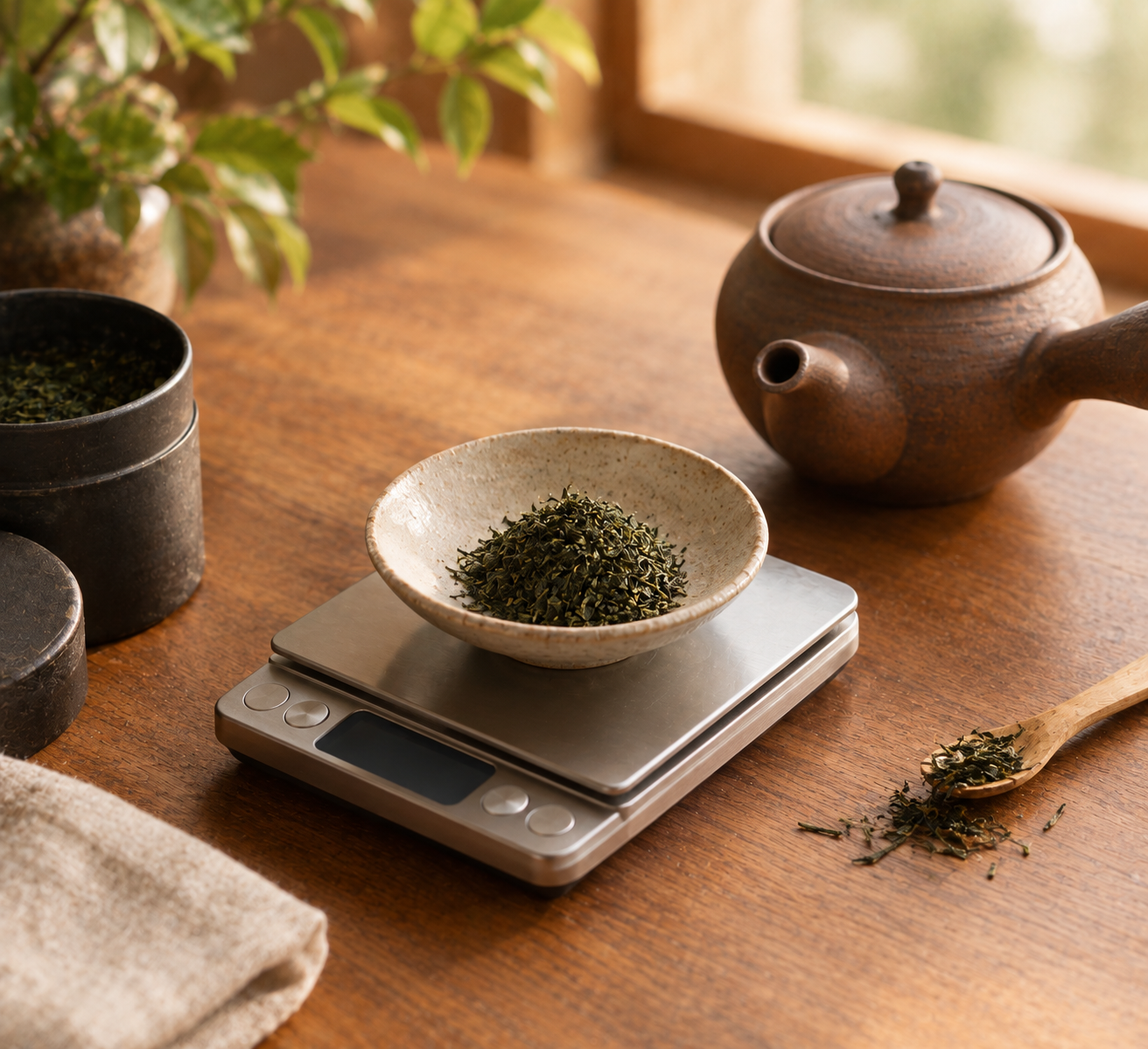
    The practical fix: A basic digital kitchen scale with 0.1g precision removes this guesswork entirely, and it’s a small, inexpensive investment relative to what you’re likely already spending on decent tea. If you don’t have one yet, the tablespoon guidelines above are a reasonable approximation, just know they’ll drift depending on the specific tea’s density.

    Brewing Sencha: The Everyday Ratio

    Sencha is the most forgiving starting point, and its ratio holds up whether you’re brewing a standard asamushi style or a deeper-steamed fukamushi.

    The method: 4 to 5 grams of leaf for 150 to 200ml of water, at 70–80°C, steeped 60 to 90 seconds for the first infusion. Too little leaf produces a thin, hollow cup; too much without adjusting the water makes the tea sharp and overly dense in a way a shorter steep won’t fix.

    Scaling for more servings: Scale both leaf and water together proportionally rather than stretching the same amount of leaf across more water — diluting a fixed amount of leaf into a larger pot of water doesn’t preserve the ratio, it just makes a weaker cup. If you’re brewing for two people instead of one, double both the leaf and the water rather than assuming the same leaf amount will “stretch” to cover the extra volume.

    Brewing Genmaicha and Hojicha: More Forgiving Ratios

    Genmaicha (green tea blended with roasted rice) and hojicha (roasted green tea) are both meaningfully more forgiving of small ratio mistakes than sencha or gyokuro, which makes them a good practice ground if you’re still building confidence with a scale.

    The method: Roughly 4 to 5 grams of leaf for 200ml of water, similar to standard sencha, though genmaicha’s rice content adds bulk without adding much strength, so err toward the higher end of that range if you want a more pronounced flavor. Hojicha’s roasting process makes it noticeably tolerant of both small ratio variations and hotter water, so small measurement errors here rarely produce a genuinely bad cup the way they can with delicate gyokuro.

    Brewing Gyokuro: The Concentrated Ratio

    Gyokuro asks for meaningfully more leaf relative to water than sencha does, which is part of what makes it such a small, deliberate serving rather than a full mug.

    The method: 5 to 6 grams of leaf for just 60 to 100ml of water, at a much cooler 60°C (140°F), steeped for around 2 minutes. The higher leaf-to-water ratio compensates for the lower temperature, ensuring enough flavor compound extraction happens even though the water itself is doing less of the work than boiling water would.

    Why the small volume matters: This isn’t a limitation, it’s the point. Gyokuro is meant to be a small, intensely flavored, savored serving rather than something you gulp down the way you might a larger mug of sencha.

    Tools That Make This Easier

    Shop digital kitchen scales (0.1g precision) on Amazon →

    Shop kyusu teapots on Amazon →

    A Few Things People Ask Me

    Can I just use more leaf if I want a stronger cup, rather than steeping longer? Yes, and it’s often the better move. Increasing leaf while keeping steep time consistent generally produces a fuller, rounder cup, while extending steep time on a correctly ratioed brew tends to pull out more bitterness rather than more genuine flavor.

    Does the ratio change for later infusions (second, third steep)? The leaf amount stays the same across infusions since you’re reusing the same leaves already in the pot — what typically changes is the steep time, which is usually shortened for the second infusion since the leaves are already partially opened, then lengthened again slightly for a third or fourth round as the leaves’ remaining flavor diminishes.

    What if I don’t have a kitchen scale — how close can I get with spoons? Close enough to start, especially for sencha, where 1 tablespoon is a reasonable approximation of 4 to 5 grams for most standard leaf styles. Gyokuro is where spoon measurements get less reliable, since its ratio is more concentrated and small measurement errors matter proportionally more in such a small volume of water.

    Is there a “correct” strength, or is this genuinely just personal preference? The ranges above are reliable starting points based on how these teas are traditionally brewed to showcase their intended flavor profile, but personal preference genuinely matters once you’re past the basics. Some people prefer their Japanese tea notably lighter than tradition suggests, and that’s a legitimate choice, not a mistake, as long as you’re adjusting from an informed baseline rather than guessing blind.

    Does the size of my kyusu limit how much leaf I should use? Yes, indirectly — the leaf needs room to expand and unfurl as it steeps, and a kyusu packed too tightly with dry leaf won’t brew evenly regardless of the water ratio. As a rough guide, dry leaf plus water should fill somewhere around two-thirds to three-quarters of the pot’s total volume, not all the way to the brim.

    Where I Landed

    The single biggest fix, if you only take one thing from this guide, is simple: measure by weight, not by spoon, at least while you’re still dialing in your preferences. A cheap kitchen scale removes almost all the guesswork that made my early sencha attempts taste thin and forgettable for longer than it should have taken me to figure out.

    Once you’ve got a baseline ratio that tastes right to you, the rest is genuinely just fine-tuning — a little more leaf here, a slightly shorter steep there — the same way you’d dial in a pour-over coffee recipe once you know the basic proportions work. It stops being a math problem and starts being intuition fairly quickly, usually within a few weeks of regular brewing.

    If you haven’t sorted out water temperature yet, my green tea brewing temperature guide is the natural next stop to pair with everything covered here, and together the two guides cover the two variables that matter most before steep time or equipment ever come into play.
  • Green Tea Temperature Guide: The Right Water Temp for Every Japanese Tea (With Chart)

    Green Tea Temperature Guide: The Right Water Temp for Every Japanese Tea (With Chart)

    Disclosure: This post contains affiliate links. If you buy through one of them, I may earn a small commission at no extra cost to you.

    For years I made green tea exactly the way I made black tea: kettle to full boil, pour straight over the leaves, done. It tasted bitter and vaguely medicinal every single time, and I quietly assumed that was just what green tea was supposed to taste like. Nobody had ever told me that boiling water is actively wrong for most Japanese green tea, wrong enough that it’s the single most common reason people insist they don’t like sencha when what they actually don’t like is scorched leaves.

    Temperature is not a minor technique detail with green tea the way it might be with coffee. It’s the difference between a smooth, naturally sweet cup and a genuinely unpleasant, astringent one, using the exact same leaves. This guide exists because that one piece of information would have saved me years of thinking green tea just wasn’t for me — I’d occasionally get a good cup somewhere else, assume it was luck or a better tin, and go right back to boiling my own kettle dry over it at home.

    The Problem You’re Actually Trying to Solve

    You’ve searched for a green tea brewing temperature guide because either you’ve had good green tea somewhere and your attempts at home don’t match it, or you’ve had bitter, harsh-tasting green tea and want to know if you’re doing something wrong before giving up on the category. In both cases, the answer is almost always the same: water that’s too hot.

    Unlike black tea, which is fully oxidized and can handle near-boiling water without much consequence, Japanese green tea is unoxidized and steamed rather than withered during processing, which leaves the leaf structure much more delicate. Boiling water pulls out excessive tannins and catechins too fast, producing that sharp, bitter, almost chalky quality that gets mistaken for “how green tea tastes.” Get the temperature right, and the same leaves produce something genuinely sweet and smooth, closer to what people who love matcha and sencha are actually describing when they talk about umami.

    Who This Article Is NOT For

    Let’s save you some scrolling if this isn’t quite your situation.

    • If you’re brewing bottled or bagged supermarket green tea for a quick everyday cup, this level of temperature precision won’t change your life much — mass-market tea bags are generally more forgiving of hotter water than delicate loose-leaf sencha or gyokuro.
    • If you already brew Japanese loose-leaf tea regularly and know your temperatures, this is a beginner-to-intermediate guide, not new information for you.
    • If you’re brewing hojicha specifically, it actually wants hotter water than the other teas covered here — roasting changes its chemistry enough that it behaves differently, and I cover that distinction below rather than treating it like an exception to ignore.

    If you’re past that, here’s where the actual guide starts.

    What Actually Determines the Right Temperature

    Three things drive how you should brew a specific green tea, and once you understand them, you can make a reasonable guess at correct temperature even for a tea not explicitly covered below.

    1. How the tea was shaded and harvested. More shading and more delicate, younger leaves (gyokuro, higher-grade sencha) need cooler water to avoid scorching their more concentrated amino acids into bitterness.

    2. How it was processed afterward. Roasted teas like hojicha have already had a lot of the bitterness-causing compounds broken down by heat, so they tolerate — and actually benefit from — much hotter water than unroasted greens.

    3. Leaf size and cut. Finer, more broken leaves (common in tea bags) extract faster and need either cooler water or a shorter steep than whole, unbroken loose leaves.

    Green Tea Temperature Chart

    Tea TypeWater TempSteep Time (1st Infusion)Notes
    Gyokuro140–158°F (60–70°C)90–120 secMost delicate, needs the coolest water
    Sencha158–176°F (70–80°C)60–90 secThe everyday Japanese green tea
    Fukamushi (deep-steamed sencha)158–176°F (70–80°C)30–45 secBrews faster and darker than standard sencha
    Genmaicha176–203°F (80–95°C)30–60 secRoasted rice tolerates more heat
    Hojicha194–212°F (90–100°C)30–45 secRoasting removes most bitterness risk

    Japanese Tea Brew Calculator

    Pick your tea and how many cups. You’ll get the water temperature, how much leaf to use, and timing for each infusion.

    Cups
    2
    Units

    Starting points, not rules — adjust the leaf amount to taste, and shorten the time first if a cup comes out bitter.

    The Method, Step by Step

    Getting the Water Temperature Right Without a Thermometer

    You don’t strictly need a thermometer, though one makes this easier. The classic method: boil your water fully, then pour it between two cups or a separate vessel before it touches your tea leaves. Each pour drops the temperature roughly 10–20°F, depending on the size of the vessel and how long the water sits in the air. Two or three pours between cups typically gets boiling water down into sencha or gyokuro range.

    Why this works: This isn’t just a workaround — it’s the traditional method used specifically because it also lets you measure out the right amount of water per cup at the same time you’re cooling it, using the cups themselves as your measuring vessels.

    Brewing Sencha, the Everyday Standard

    Sencha is what most people picture when they think “Japanese green tea,” and it’s the most forgiving of the delicate teas, which makes it the right place to start if you’re new to this.

    The method: Water around 158–176°F (70–80°C), roughly 1.5 tablespoons of leaf for two servings, steeped about 60–90 seconds without swirling or agitating the pot. Agitation increases bitterness by extracting compounds faster than a still steep does.

    What changes the result most: Steep time matters almost as much as temperature. A properly cooled cup of water left steeping for three minutes instead of one will still turn out bitter, just more slowly than boiling water would.

    Brewing Gyokuro, the Delicate One

    Gyokuro is shaded longer than sencha before harvest, which concentrates its amino acids and sweetness dramatically — and also makes it the least forgiving of heat out of any tea on this list.

    The method: Cooler water, 140–158°F (60–70°C), a higher leaf-to-water ratio than you’d use for sencha, and a longer steep, 90 to 120 seconds, using less water overall so the result is a small, concentrated, intensely flavorful serving rather than a full mug.

    What changes the result most: Gyokuro rewards patience more than any other tea here. Rushing the cooling step and brewing even 10-15°F too hot will mute the sweetness that’s the entire reason to seek gyokuro out in the first place — you’ll end up with something that tastes like an expensive, slightly better sencha instead of the genuinely different experience gyokuro is supposed to be.

    Brewing Genmaicha

    Genmaicha is green tea blended with roasted brown rice, and that rice content changes its temperature tolerance noticeably compared to a pure leaf tea.

    The method: Hotter than sencha, 176–203°F (80–95°C), steeped 30 to 60 seconds. The roasted rice can handle, and honestly benefits from, more heat than delicate unroasted leaf.

    What changes the result most: Because the rice adds its own toasty flavor regardless of exact temperature, genmaicha is one of the more mistake-tolerant teas on this list — a reasonable place to practice if you’re nervous about getting the more delicate teas wrong.

    Brewing Hojicha

    Hojicha is roasted rather than steamed the way the other teas here are, and that roasting process breaks down a lot of the compounds responsible for bitterness under high heat, which flips the usual green tea rule on its head.

    The method: Close to boiling, 194–212°F (90–100°C), steeped briefly, around 30 seconds. This is the one tea on this list where you genuinely don’t need to worry much about scorching it.

    What changes the result most: If you brew hojicha the same cautious way you’d brew sencha, cooler water and a longer steep, you’ll actually get a weaker, less aromatic cup than the tea is capable of. It wants heat that the other teas here would punish you for using.

    Common Mistakes That Undo Correct Temperature

    Getting the water temperature right is most of the battle, but a few other habits can quietly sabotage a properly cooled cup.

    Swirling or shaking the pot. Agitating the leaves speeds up extraction the same way stirring a cocktail speeds up dilution — it pulls out bitterness faster than a still steep would, even at the correct temperature. Let the leaves sit and unfurl on their own.

    Leaving leaves in the pot after pouring. If any liquid remains sitting on the leaves after you’ve poured your cup, it keeps steeping and turns increasingly bitter, which then throws off your next infusion too. Pour every last drop out before setting the pot down.

    Using the same steep time for every infusion. The first infusion, second, and third all want different timing as the leaves gradually open and extract faster. Using your first infusion’s steep time on the second round is a common way to end up with an unexpectedly harsh second cup.

    Tools That Make This Easier

    You genuinely don’t need special equipment to brew good green tea, but a couple of inexpensive tools remove most of the guesswork.

    A variable-temperature electric kettle. If you brew gyokuro or sencha often, a kettle that holds an exact temperature saves a lot of guesswork – my electric kettle guide explains which features actually matter. Shop variable-temperature kettles on Amazon → These let you set an exact target temperature instead of eyeballing the pour-between-cups method every time. If you drink green tea regularly, this is the single upgrade that saves the most daily effort.

    A kyusu with a built-in strainer. Shop kyusu teapots on Amazon → Not strictly necessary, but it makes pouring out every last drop — which matters for avoiding bitterness on the next infusion — much easier than fishing a loose infuser basket out of a regular mug.

    If matcha is also part of your routine, note that none of the temperature guidance above applies to it — whisking matcha uses different water temperatures entirely, and a good bamboo whisk matters more there than any thermometer.

    A Few Things People Ask Me

    Do I need a kyusu (Japanese teapot) specifically, or can I use any teapot? A kyusu with a built-in strainer makes loose-leaf brewing more convenient, but temperature and steep time matter far more than the vessel itself. A basic infuser in a regular mug will produce a good cup if the water temperature and timing are right.

    Can I reuse the same leaves for a second cup? Yes, and with sencha and especially gyokuro, subsequent infusions are considered part of the experience, not a downgrade. Generally use slightly hotter water and a shorter steep for the second infusion, since the leaves are already partially opened and will extract faster than the first round.

    What if I don’t have a thermometer or the patience to pour water between cups? A rough shortcut: boil your water, then let it sit uncovered for about 3-5 minutes before pouring over sencha, or closer to 8-10 minutes for gyokuro. It’s less precise than active cooling, but it gets you meaningfully closer than pouring straight off a rolling boil.

    Why does my tea taste bitter even when I think I got the temperature right? Steep time is the other half of the equation, and it’s easy to forget about once you’re focused on temperature. Oversteeping correctly-tempered water will still produce bitterness, just more slowly than boiling water would. If bitterness persists after fixing your temperature, start timing your steeps more carefully.

    Does the type of water matter, not just the temperature? It matters more than most people expect. Very hard tap water or heavily chlorinated water can flatten green tea’s more delicate notes regardless of how carefully you control temperature. Filtered water is a worthwhile upgrade if you’re already being this precise about everything else.

    Where I Landed

    The single biggest fix, if you only take one thing from this guide, is simple: stop pouring water straight off a rolling boil onto anything except hojicha. That one change alone would have fixed most of my early bad experiences with green tea, well before I ever thought about leaf-to-water ratios or multiple infusions. Get the temperature right first, let steep time follow from there, and the tea you’ve been drinking out of obligation might turn out to be the tea you actually enjoy once it’s finally brewed the way it was meant to be.

    It’s worth remembering that none of this is about achieving some rigid, unforgiving standard — it’s just about understanding what each tea actually wants, so you’re not fighting against the leaves’ own chemistry every time you make a cup. Once the temperature habit sticks, you’ll stop thinking about it consciously at all, the same way you eventually stop measuring coffee grounds once you’ve made enough pots to know it by feel.

    If you’re ready to put this into practice with something worth brewing carefully, my matcha powder brands comparison and best hojicha brands guides are good next stops — matcha follows different rules entirely since you’re whisking the whole leaf rather than steeping it, but hojicha slots directly into the high-heat brewing method above.