Disclosure: This post contains affiliate links. If you buy through one of them, I may earn a small commission at no extra cost to you.
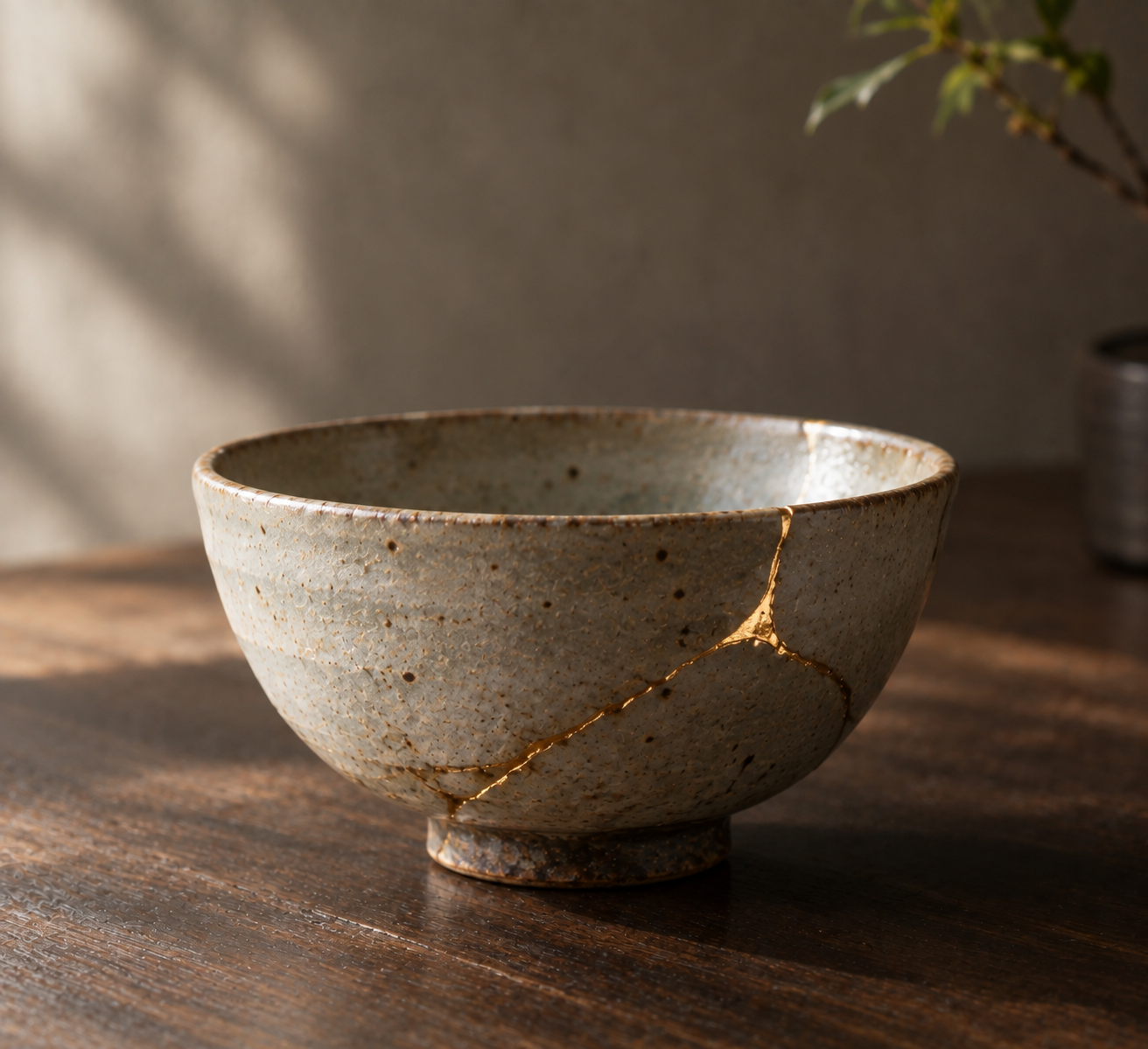
I chipped a chawan I genuinely loved a while back – a small, ugly crack right along the rim, exactly where you’d rest your lip drinking from it. My first instinct was to feel like the bowl was ruined. It took learning about kintsugi to realize that in a different tradition, that crack wouldn’t be treated as damage to disguise. It would be highlighted, in gold, as part of the bowl’s story going forward.
Kintsugi – literally “golden joinery” – is the Japanese practice of repairing broken pottery with lacquer dusted or mixed with powdered gold, silver, or platinum. It’s not a trick to make a repair invisible. It does the opposite: it makes the repair the most visually striking part of the piece.
The Problem You’re Actually Trying to Solve
Kintsugi gets referenced a lot in a loose, motivational-poster way – “your scars are beautiful,” “brokenness makes you stronger” – without much explanation of what the actual craft involves, or the real difference between traditional kintsugi and the gold-glue DIY kits sold under the same name. If you’ve broken a piece of teaware you actually care about and are wondering whether kintsugi is something you could realistically do yourself, that distinction matters more than the philosophy does.
Who This Article Is NOT For
- If you’re looking for a quick, cheap way to just glue a broken mug back together without any interest in the craft or philosophy behind it, regular ceramic adhesive will do that faster and for less money than either traditional or kit-based kintsugi.
- If you’re shopping for a chawan and haven’t broken one yet, my matcha whisk buying guide, which also covers choosing a bowl, is the more relevant read before this one.
- If you want to actually learn hands-on lacquer technique rather than just understand what kintsugi is and how it’s done, this is a general explainer, not a step-by-step tutorial – the traditional process genuinely benefits from in-person instruction.
Where Kintsugi Actually Comes From
The most commonly told origin story dates to the late 15th century: the shōgun Ashikaga Yoshimasa reportedly sent a damaged Chinese tea bowl back to China for repair, and it came back mended with ugly, purely functional metal staples. Dissatisfied, Japanese craftsmen are said to have developed a more visually considered repair method of their own – which became kintsugi.
There’s a competing, and arguably more interesting, account too: some historical pieces with visible staple repairs – like the famous “bakōhan” bowl, whose staples resemble a locust – were actually prized specifically for that visible damage, treated as a kind of accidental Zen beauty. Either way, the underlying idea predates the polished, luxury-object version of kintsugi you’ll see marketed today: breakage and repair were treated as part of an object’s history rather than something to erase.
How Traditional Kintsugi Actually Works
The material at the center of real kintsugi is urushi, Japanese lacquer, used in several forms depending on the stage of repair – ki-urushi (pure lacquer), bengara urushi (mixed with iron-red pigment), mugi urushi (mixed with wheat flour as an adhesive filler for cracks), and sabi urushi (mixed with clay for filling larger gaps). Metallic powder – traditionally real gold, silver, or platinum – is dusted onto the final lacquer layer while it’s still tacky, which is what creates the signature golden seam.
The part that surprises people most is the timeline. After the lacquer is applied, the piece has to cure in a humidity-controlled space called a furo, kept at roughly 90% humidity, for anywhere from two days to two weeks depending on the repair. This isn’t optional or something you can rush with a hair dryer – urushi cures through a humidity-dependent chemical process, not simple drying, so an authentic repair is measured in days and weeks, not an afternoon.
Kintsugi Kits vs. the Real Thing
Modern kintsugi kits, widely sold online, use a fundamentally different approach: two-part epoxy or fast-curing industrial adhesive instead of urushi, kneadable chemical putty instead of natural wood and clay powders, and bronze or mica-based “gold-look” pigment instead of real gold or silver powder.
This matters for more than just authenticity. Epoxy-based kits finish the repair as soon as the adhesive sets, while traditional urushi lacquer begins a longer sequential process that bonds differently with the ceramic. And critically, the bronze or mica pigments in budget kits are generally not food-safe – if you’re repairing something you intend to actually eat or drink from again, that’s worth verifying before use, since it’s a real difference and not just a purist’s quibble.
None of this makes kits illegitimate for what they’re good for: a one-off decorative repair on something you won’t use for food, done reasonably quickly and cheaply. It’s just a genuinely different practice from traditional kintsugi, closer to an aesthetic imitation than the craft itself – useful to know going in so you’re not expecting kit results to match traditional ones, or vice versa.
The Philosophy Behind the Gold
Kintsugi is closely tied to two Japanese concepts. Wabi-sabi is the aesthetic appreciation of imperfection, age, and transience – finding something worth valuing in an object precisely because it shows wear rather than despite it. Mushin refers to a mental state of non-attachment and acceptance of change, including the idea that breakage isn’t a tragedy to resist but simply something that happened, worth acknowledging rather than hiding.
Practically, this shows up as a specific choice: kintsugi doesn’t try to make a repair invisible or color-matched to blend in. It illuminates the crack, in a metal that draws the eye directly to where the damage was. The philosophy holds that this makes the piece more interesting and more genuinely its own, not less valuable, than it was before it broke.
A Few Things People Ask Me
Is traditional kintsugi something I can realistically learn to do myself? With patience and the right supplies, yes, though it’s a slower and more involved craft than most DIY projects – securing real urushi lacquer, managing a humidity chamber, and working across a multi-day or multi-week timeline is a real commitment compared to a gold-glue kit. A beginner kintsugi repair kit on Amazon is a reasonable low-stakes way to try the aesthetic before committing to sourcing real urushi and metal powder.
Are kintsugi kits actually bad, or just different? Just different, not bad outright – they’re a reasonable choice for a decorative, non-food-contact repair done quickly, but they’re not the same craft or material system as traditional kintsugi, and shouldn’t be marketed or understood as interchangeable with it.
Can I use a kintsugi-repaired chawan for actual matcha again? With a traditional urushi-and-real-gold repair, generally yes, once fully cured – that’s part of why the traditional materials matter for teaware specifically. With a kit repair, verify the specific materials are food-safe before using it with anything you’ll drink from, since many budget kits explicitly aren’t. If the crack is bad enough that repair isn’t realistic, Nio Teas’ matcha bowls and my Nio Teas teaware guide are worth a look for a replacement.
Does kintsugi only apply to bowls, or can other ceramics be repaired this way? Any broken ceramic can technically be repaired with kintsugi – bowls, plates, vases, cups – though it’s most commonly associated with teaware specifically, largely because tea culture is where the aesthetic tradition originally developed and where broken pieces were historically valuable enough to be worth repairing this carefully rather than replacing.
Where I Landed
What changed my mind about that chipped chawan wasn’t really the craft technique – it was the underlying idea that a repair doesn’t have to be a cover-up. Whether or not I ever get around to learning traditional kintsugi myself, the philosophy behind it reframed a broken bowl from “ruined” to “has a history now,” which is a genuinely different way to think about the things you use daily and eventually damage. If you’re going to attempt a repair on something you actually care about, it’s worth deciding upfront whether you want the visible-history version (traditional urushi and real metal) or the quick-fix version (a kit) – they’re solving the same problem in philosophically different ways.