Disclosure: This post contains affiliate links. If you buy through one of them, I may earn a small commission at no extra cost to you.
I once found an unfinished bag of sencha shoved behind a spice rack, six months forgotten, and when I finally brewed it, the color had faded and the flavor was thin and papery, closer to hot water with a vague grassy suggestion than the tea I remembered buying. Nothing was wrong with that tea when I bought it. Everything went wrong after, because loose leaf green tea degrades under the same conditions matcha does, just with a slightly longer runway before it becomes noticeable, which is exactly what let it slip out of my rotation and out of my mind for half a year.
If you’ve read my guide to storing matcha, the core principles here will feel familiar, since the same enemies, oxygen, light, heat, and moisture, are at work. But loose leaf tea behaves differently enough from powder that it deserves its own specific approach rather than a copy-pasted version of the matcha rules — whole leaves and fine powder simply age at different speeds and respond to different fixes.
The Problem You’re Actually Trying to Solve
You’ve searched for how to store green tea because you’ve either just bought a bag of sencha or gyokuro and want to protect it properly, or you’ve had the same experience I did, a tea that tasted great initially and went flat or stale well before you expected. Both come down to a handful of avoidable habits that most people never think about until the tea itself starts tasting disappointing.
Who This Article Is NOT For
Let’s save you some scrolling if this isn’t quite your situation.
- If you’re storing matcha specifically, my matcha storage guide covers that separately, since fine powder behaves differently from whole leaf.
- If you finish a bag within a few weeks of opening anyway, most of the anxiety below won’t apply to you — you’re already moving through tea fast enough that degradation isn’t a real risk.
- If you want a hard expiration date, loose leaf tea degrades gradually in quality rather than becoming unsafe, so this is about flavor, not food safety.
If you’re past that, here’s where the actual guide starts.
What Actually Degrades Loose Leaf Tea
Oxygen. Tea oxidizes on contact with air, which dulls both color and flavor over time. This is the single most avoidable factor, since it’s purely a function of how well-sealed your storage actually is, and it’s also the factor most people get wrong simply by leaving a bag folded over rather than properly resealed.
Light. Light breaks down the chlorophyll responsible for green tea’s color and some of its flavor compounds. A clear jar on an open shelf is one of the worst places you could realistically keep it, however nice it looks sitting out for guests to admire.
Heat. Warm environments speed up every other degradation process on this list. A cool, stable pantry temperature slows things down meaningfully compared to a spot near a stove or a sunny window, even if the temperature difference feels minor day to day.
Moisture and odor absorption. Dried tea leaves are porous enough to pick up ambient smells from your kitchen, and any moisture introduced can encourage mold in more severe cases, not just staleness. This is part of why a container that smells faintly of coffee or spices is a genuinely bad neighbor for your tea, even in a sealed cabinet.
How Long Different Green Teas Actually Last
| Tea | Opened Shelf Life | Unopened Shelf Life |
|---|---|---|
| Sencha | 1–2 months for peak flavor, up to 6 usable | Up to a year, sealed and cool |
| Gyokuro | 1–2 months for peak flavor | Up to a year, sealed and cool |
| Genmaicha | 2–3 months (rice content adds some stability) | Up to a year |
| Hojicha | 3–6 months (roasting adds stability) | Up to a year or more |
These numbers are about quality, not safety — tea past these windows won’t make you sick, it will simply taste flatter, more one-dimensional, and less vibrant than it did fresh.
The Actual Storage Method
Keep It in an Opaque, Airtight Container
A tin, a traditional chazutsu (Japanese tea caddy), or a resealable multi-ply bag lined with foil or glassine all work. Clear glass jars look nice on a shelf and are genuinely one of the worst choices for exactly that reason, since they let light straight through to the compounds light is busy destroying.
Store Somewhere Cool and Dark, Not on a Sunny Counter
A kitchen cabinet away from the stove is usually sufficient for daily-use tea. Avoid decorative open shelving near a window, however good it looks for the aesthetic.
Portion Larger Quantities Into Smaller Containers
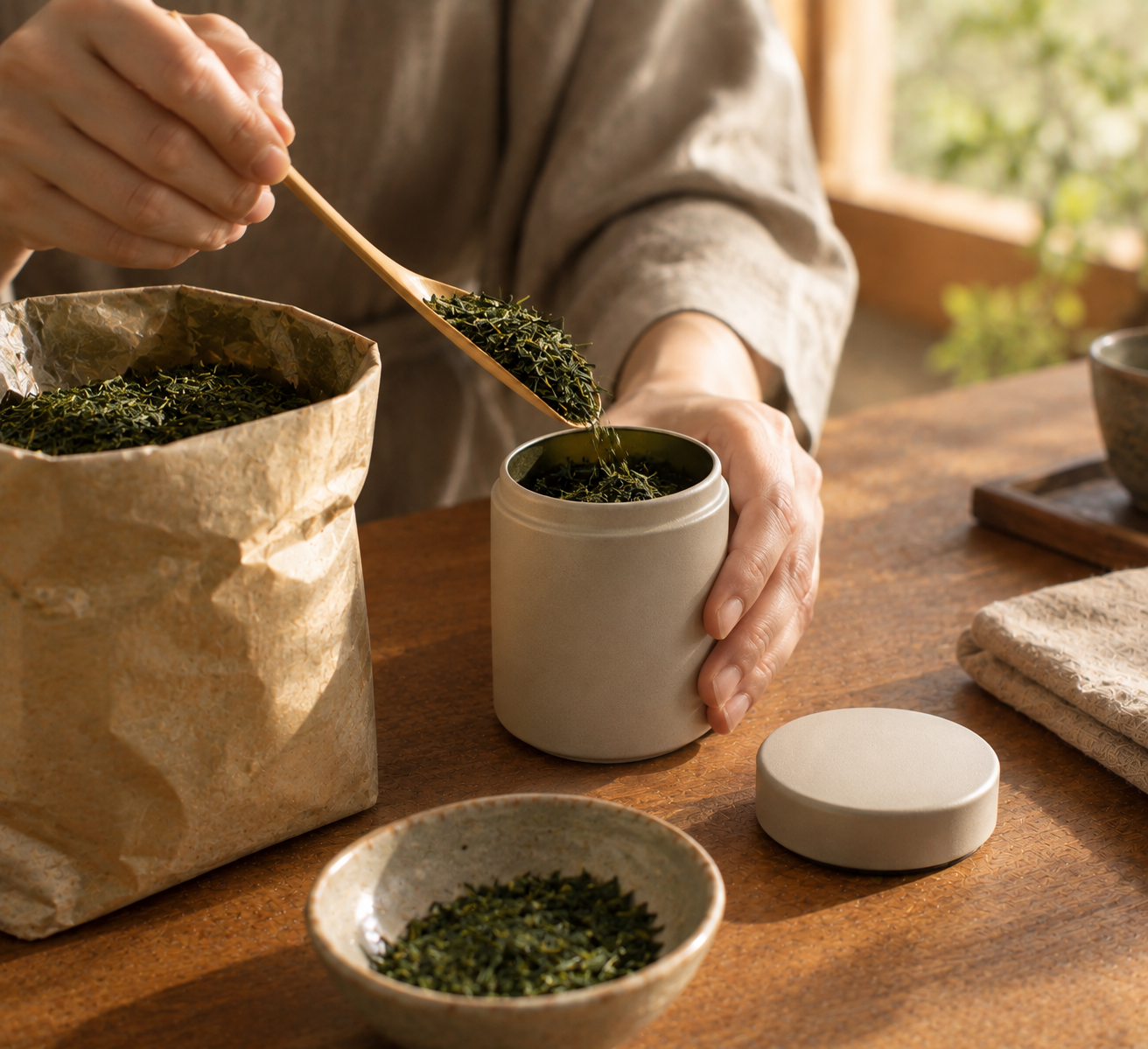
This is one of the more overlooked tips, and it matters more than people expect. A half-full large container leaves your tea sitting in a growing pocket of air every time you dip in, and that air-to-tea ratio worsens as you work through the supply. If you buy a larger bag, split off a smaller daily-use portion and keep the rest sealed separately, untouched until you actually need it. A 50-gram daily container finished within a few weeks will consistently outperform a 200-gram bag left half-open on the counter for months, even if the total amount of tea and the storage location are otherwise identical.
Should You Refrigerate or Freeze It?
This is genuinely more nuanced for loose leaf than it is for matcha. Opened, daily-use tea is generally better kept out of the fridge, since the humidity and risk of condensation each time you open the container can do more harm than the cooler temperature helps. Unopened, factory-sealed tea, especially delicate shincha (first-flush spring tea), freezes well and can extend shelf life considerably, as long as you let it return to room temperature while still sealed before opening it, to avoid condensation hitting the leaves directly. The rule of thumb worth remembering: the fridge and freezer are for protecting tea you haven’t opened yet, not for extending the life of tea you’re actively working through day to day.
Tools That Make This Easier
Shop airtight tea storage canisters on Amazon →
Shop traditional Japanese tea caddies (chazutsu) on Amazon →
A Few Things People Ask Me
Does hojicha really last longer than sencha, or is that just a rule of thumb? It’s a genuine, mechanism-based difference, not just a rule of thumb. Roasting breaks down many of the delicate compounds responsible for sencha’s fragile freshness, which is exactly what makes hojicha both more heat-tolerant to brew and more forgiving to store over time.
How can I tell if my tea has actually gone stale versus just being a milder variety? Compare a fresh sample if you have one, or trust a few signals: faded color, a flat or dusty smell rather than fresh and grassy, and a thin, hollow taste that lacks the umami depth the tea had when you first opened it. None of these mean it’s unsafe, just past its best.
Is it worth buying vacuum-sealed storage containers specifically for tea? If you go through tea slowly or buy in bulk, yes. A dedicated airtight canister, ideally one designed to compress out excess air as the contents shrink, genuinely extends usable freshness longer than a standard container with a loose-fitting lid.
Can I store different types of green tea in the same container to save space? It’s better not to, since different teas can transfer aroma to each other in close proximity, particularly anything roasted stored near something delicate like gyokuro. Keep them in separate sealed containers even if they’re sitting in the same cabinet.
Does the size of the tea leaf itself affect how fast it degrades? Somewhat — finely broken or cut leaf, common in some tea bag blends, has more surface area exposed to air relative to its volume than whole, unbroken leaf, which means it can degrade somewhat faster under otherwise identical storage conditions. Whole-leaf sencha and gyokuro generally hold up a bit better over time than a more processed, broken-leaf product.
Where I Landed
If you only change one habit after reading this, make it portioning. Splitting a larger bag into a smaller daily-use container and keeping the rest sealed and untouched solves more of the slow, invisible degradation than any other single change, more than the container material, more than fridge-versus-cabinet debates, more than anything else on this list.
The tea I found forgotten behind the spice rack didn’t go bad because of one dramatic mistake. It went bad slowly, from sitting half-exposed to air in an oversized bag for months. A little more intention about where and how you keep tea between cups is a small amount of effort for protecting something you presumably bought because you actually wanted it to taste good, not just to have it quietly fade away in a cabinet you forgot to check.