Disclosure: This post contains affiliate links. If you buy through one of them, I may earn a small commission at no extra cost to you.
For my first year of drinking good sencha, I kept it in the bag it came in, folded over and clipped shut. Then I left a half-finished bag on the counter for three weeks and opened it to tea that smelled like cardboard. That’s when I bought my first chazutsu – a plain Japanese tea canister – and noticed the difference within a single bag. Tea doesn’t need anything fancy to stay fresh, but it does need a container that keeps out air, light and moisture, and the traditional Japanese canister is very good at exactly that.
The Problem You’re Actually Trying to Solve
Green tea loses its aroma quickly once opened. The four things that damage it are oxygen, light, heat and moisture, and a resealable bag only handles some of those, imperfectly. A good chazutsu handles all four. The tricky part is that “Japanese tea canister” covers everything from a few-dollar washi-covered tin to a hand-made copper heirloom, and the difference in price doesn’t always match the difference in how well they keep tea.
Who This Article Is NOT For
- If you want the full storage rules – how long sencha and gyokuro last, and whether to use the fridge – my green tea storage guide covers that in detail.
- If you’re mainly storing matcha, the rules are a bit stricter because the powder oxidizes faster. My matcha storage guide explains what changes.
- If you’re looking for the lacquered natsume used in tea ceremony, that’s a different object made for serving matcha, not for storing it long-term.
What Makes a Good Chazutsu
Before choosing a material, check three things:
- An airtight lid. The best canisters have either a very precisely fitted lid or a double lid – an inner lid (nakabuta) under the outer one. Both reduce the amount of air that reaches the tea.
- Opaque walls. Light fades green tea’s color and aroma. Clear glass jars look nice on a shelf, but they’re one of the worst places to keep it.
- The right size. A canister that’s mostly empty holds a lot of air. Match it to how you buy – most loose-leaf tea comes in 50g, 80g, 100g or 200g bags – and pick a canister that holds one bag.
The Four Main Types
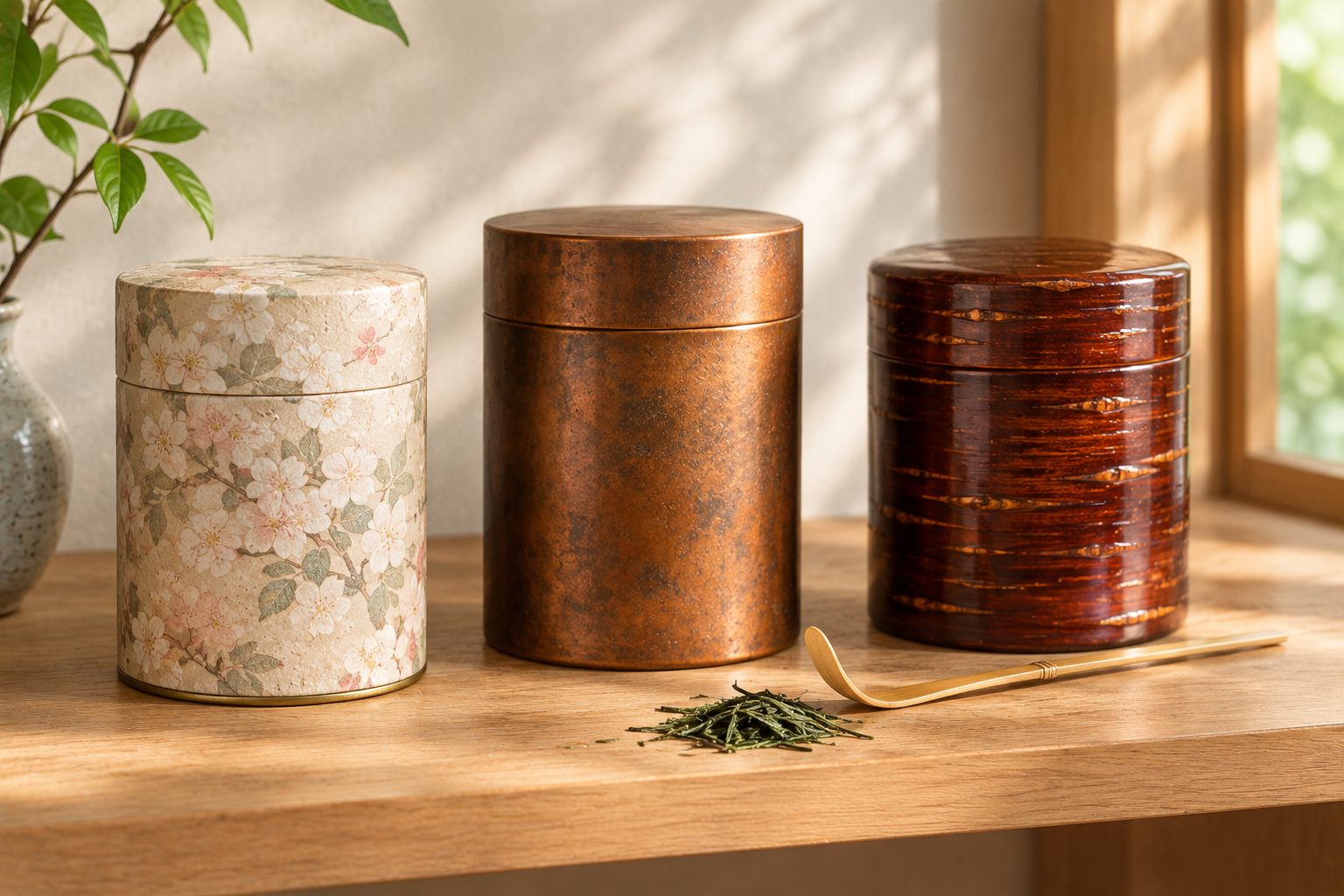
| Type | Made from | Airtightness | Price | Best for |
|---|---|---|---|---|
| Washi-covered tin | Tin-plated steel wrapped in Japanese paper | Good, usually with an inner lid | Low | Everyday use, first canister |
| Hand-made metal (e.g. Kaikado) | Copper, brass or tin | Excellent | High | A long-term, lifetime piece |
| Kabazaiku | Wild cherry bark over wood | Good | Mid to high | Beauty, craft and humidity buffering |
| Plain stainless or tin | Metal | Varies a lot | Low to mid | Function first |
Washi-Covered Tins: The Sensible First Canister
This is the canister most Japanese households actually use: a tin body wrapped in printed washi paper, usually with an inner lid under the outer cap. It’s inexpensive, light, opaque and does a good job of keeping air out. The paper comes in hundreds of patterns, which makes them a popular, affordable gift too.
The downsides are durability and moisture. The paper can wear or stain over years of daily handling, and it shouldn’t get wet. Wipe it with a dry cloth rather than washing it.
Pick one if: you want a reliable canister for everyday tea without spending much.
Kaikado: The Canister That Lasts a Lifetime
Kaikado has been making hand-made tea canisters in Kyoto since 1875, and its process – around 130 to 140 steps, essentially unchanged since then – is the reason these canisters are famous. They’re made from copper, brass or tin, with a double-walled construction and a lid machined so precisely that, once you line it up, it slides down smoothly by itself, gently pushing excess air out as it closes.
The other thing people love about them is how they age. With handling, the surface slowly darkens and gains character: copper changes in a matter of months, brass over a year or two, and tin over several years. Many owners treat them as heirlooms.
They are expensive, and they’re an investment in craftsmanship as much as in storage. But if you drink tea every day and want one canister for decades, this is the benchmark.
Pick one if: you want the best seal available and a piece you’ll keep for life.
Kabazaiku: Cherry Bark From Akita
Kabazaiku is a craft from Kakunodate in Akita Prefecture, where wild cherry bark is applied over a shaped wooden form to make boxes, trays and especially tea canisters. It began more than 200 years ago as a side occupation for lower-ranking samurai of the Satake clan, and it’s still made in local workshops today.
Beyond its deep red-brown gloss, cherry bark has a practical advantage: it acts as a natural buffer against changes in humidity, which is why it was traditionally prized for storing tea and tobacco. Each curved surface needs its own piece of bark, so good kabazaiku is labor-intensive and priced accordingly, though usually below hand-made metal.
Avoid getting it wet, keep it away from direct sun, and handle it with dry hands.
Pick one if: you want a canister that’s as much a craft object as a container, and you like natural materials.
Plain Metal Canisters
Simple stainless steel or tin canisters work well if the lid fits tightly – and that’s the catch, because quality varies enormously. Check for an inner lid or a snug outer lid with no rattle. A cheap canister with a loose lid is barely better than a clipped bag.
How to Use a Chazutsu Properly
- Keep the tea in its inner bag inside the canister if you can, for an extra layer of protection – especially with a large canister and a small amount of tea.
- Use a dry scoop. Moisture is the fastest way to ruin a canister of tea.
- Store it somewhere cool and away from the stove, sunny windows and strong-smelling spices. Tea absorbs odors easily.
- Don’t store multiple teas in one canister – and if you switch teas, wipe it out first so aromas don’t carry over.
- Avoid the fridge for a canister you open daily. Taking a cold canister in and out invites condensation. If you refrigerate tea for long-term storage, keep it sealed and let it reach room temperature before opening.
A Few Things People Ask Me
Can I use a chazutsu for matcha? Yes, as long as it seals well. Matcha oxidizes faster than leaf tea, so a smaller canister that you’ll empty quickly works best.
Is a Kaikado canister really worth the price? For most people, a good washi tin keeps tea fresh enough. Kaikado’s advantage is a better seal, durability over decades, and craftsmanship you’ll enjoy every day. If those matter to you, it’s worth it; if not, a well-made tin is fine.
How big should my canister be? Big enough for one bag of the tea you usually buy. For most loose-leaf sencha, a canister that holds around 100g is a good, versatile size.
Where should I start? A double-lid washi tea canister on Amazon is the easy, inexpensive first step. If you want a craft piece, kabazaiku cherry bark tea canisters on Amazon are worth a look.
Where I Landed
The best chazutsu is simply the one that seals well, keeps light out and is the right size for how you buy tea. A washi tin does all of that for very little money, and it’s what I’d buy first. Kabazaiku and Kaikado add something different: a natural material that softens humidity, or a metal canister that seals beautifully and grows more handsome every year. Once your tea is in something airtight and opaque, though, the most important storage rule is the same as ever – drink it while it’s fresh.