Disclosure: This post contains affiliate links. If you buy through one of them, I may earn a small commission at no extra cost to you.
The first time I read about chanoyu, the traditional Japanese tea ceremony, I assumed it was permanently out of reach for anyone without years of formal training, a tatami room, and a teacher to correct every hand movement. What I didn’t understand yet was that chanoyu at its most formal, the multi-hour chaji with a full meal and thick tea, is genuinely a serious, disciplined practice, but a simplified version, focused on the spirit rather than the exact choreography, is something anyone can do at home with a few basic tools and about twenty minutes, without pretending to have mastered something that takes years to actually learn properly.
This isn’t a substitute for real training under a tea master, and I want to be upfront about that distinction from the start. What follows is a respectful, simplified home version built around the same core spirit, hospitality, mindfulness, and a deliberate pause from everything else, without requiring a formal tea room or years of study to attempt. Think of it as an honest introduction, not a shortcut to expertise.
The Problem You’re Actually Trying to Solve
You’ve searched for a simplified home tea ceremony guide because you’re drawn to the idea, maybe from a trip to Japan, a documentary, or simply an interest in matcha itself, but the formal version feels intimidatingly out of reach for a casual home attempt. That gap between curiosity and feeling qualified to try is exactly what this guide is meant to close, without pretending a home version is the same thing as the real, deeply trained tradition.
Who This Article Is NOT For
Let’s save you some scrolling if this isn’t quite your situation.
- If you’re looking for formal instruction to actually study chanoyu, this isn’t that resource, and it shouldn’t be treated as one. Formal study happens under a qualified teacher, often through a specific school like Urasenke, over years, not from a blog post.
- If you want the full, traditional chaji experience with kaiseki meal, koicha, and the complete multi-hour structure, this covers a simplified usucha-only home version, not the formal long-form gathering.
- If you’re looking to recreate this for a large group, this guide is built around one host serving one or two guests, which is the more manageable starting point for a home setting.
If you’re past that, here’s where the actual guide starts.
The Spirit Behind It, Briefly
Chanoyu is traditionally grounded in four principles, harmony, respect, purity, and tranquility, articulated by the 16th-century tea master Sen no Rikyu. In a simplified home version, you don’t need the formal vocabulary to honor the spirit: create a calm space, treat your guest and your tools with genuine care, and let the twenty minutes be genuinely undistracted rather than rushed.
What You’ll Need
- A chawan (matcha bowl)
- A chasen (bamboo whisk)
- A chashaku (bamboo scoop) or a small spoon
- Good ceremonial-grade matcha
- A clean cloth or small linen for the table
- Hot water, cooled slightly below boiling
My matcha whisk buying guide covers choosing these tools in more depth if you don’t already have them.
The Simplified Steps
1. Prepare the Space
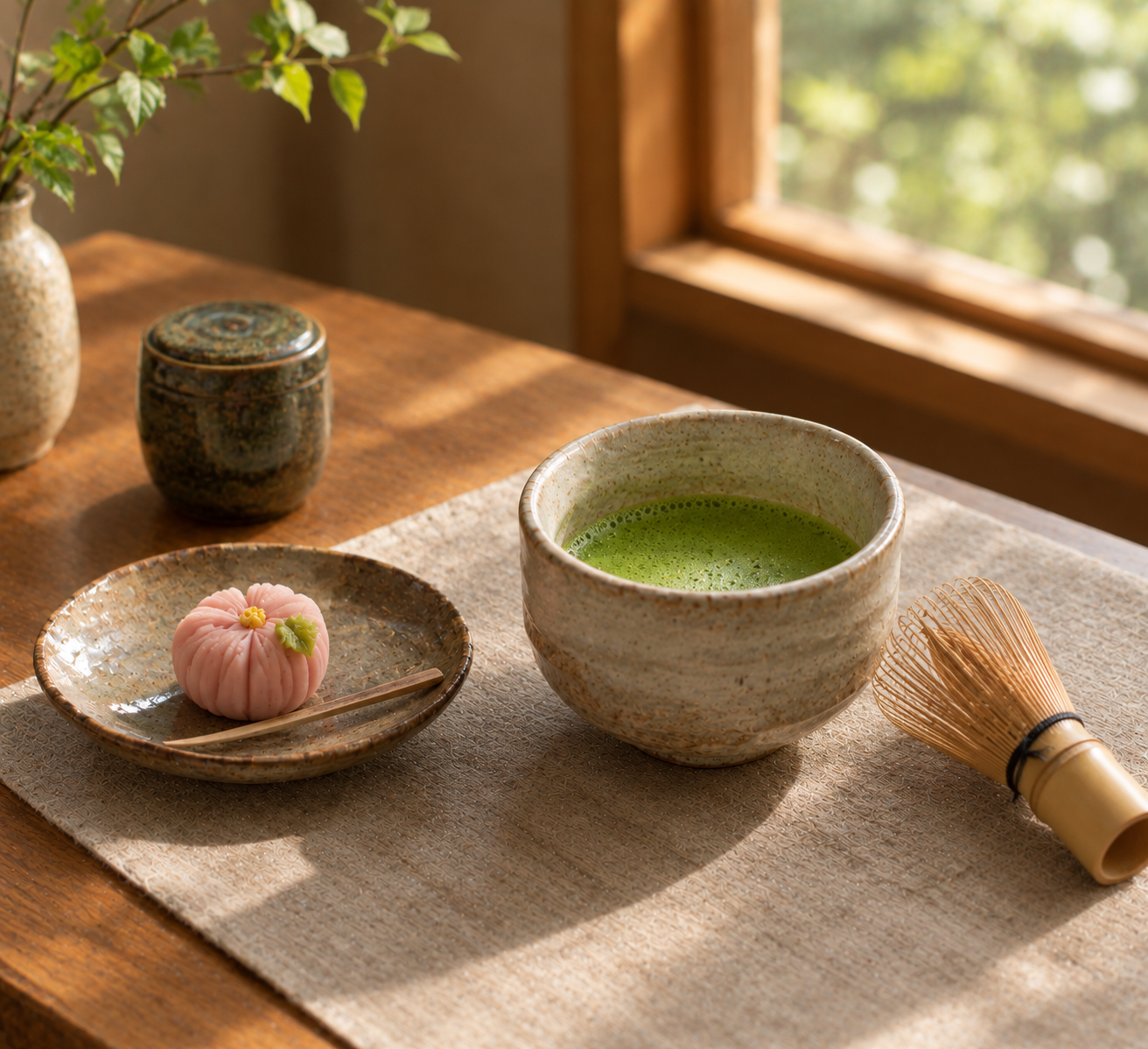
Clear a low table, lay a clean cloth, and set out your bowl, whisk, scoop, and matcha caddy in order. Turn off music, and put phones, both yours and your guest’s, in another room. The point of the ritual is a genuinely uninterrupted twenty minutes, not a photo opportunity.
2. Welcome Your Guest
Greet your guest and invite them to sit. A small bow, even an informal one, sets the tone for the rest of the interaction as something deliberate rather than casual.
3. Serve a Small Sweet First
Offer a small sweet, traditionally wagashi, before the tea itself. This isn’t just sequencing, it’s practical, since the sweetness balances matcha’s natural bitterness in the cup that follows. My wagashi beginner guide is a good resource if you want something authentic and approachable for this step.
4. Sift and Measure the Matcha
Sift roughly 2 grams (about one to one and a half teaspoons) of matcha into the bowl. This isn’t a step to skip for convenience, since unsifted clumps will show up in the finished tea.
5. Add Water and Whisk
Add a small amount of water, cooled to roughly 70–80°C, not boiling. Whisk in a brisk back-and-forth “W” or “M” motion, letting your wrist do the work rather than your whole arm. The chasen’s tip should barely brush the bottom of the bowl rather than pressing into it, which protects the whisk and produces a better, more even foam.
6. Lift and Present
Once the foam looks even, lift the whisk straight up through the center in one smooth motion. Rotate the bowl slightly so its most decorated side faces your guest, then present it with both hands and a small bow.
7. Receive and Drink
Your guest receives the bowl with both hands, turns it slightly before drinking as a small gesture of respect, and drinks in a few unhurried sips rather than gulping. At home, the full formal etiquette (specific rotation direction, wiping the rim with a special paper) is genuinely optional. Keeping it simple, both hands, unhurried sips, is enough to honor the spirit of the thing.
8. Close Gently
Once finished, gather the utensils calmly rather than rushing to clean up the moment the last sip is taken. The pause at the end is as much a part of the ritual as the pause at the beginning.
What to Skip vs. What to Keep
Worth keeping even in a simplified version: the phone-free environment, the deliberate slowness, serving a sweet before the tea, and presenting the bowl with both hands rather than setting it down casually.
Reasonable to skip at home: kneeling in formal seiza posture if it’s uncomfortable, precise bowl-rotation direction and degree, the kaishi paper for wiping the rim, and any expectation of achieving temae-level whisking technique on your first attempt.
Where to Get the Basics
Shop chawan (matcha bowls) on Amazon →
Shop matcha starter kits (whisk, bowl, scoop) on Amazon →
A Few Things People Ask Me
Do I need special equipment, or can I use what I already have? A proper chasen and chawan genuinely help, since a regular whisk and mug won’t produce the same texture or presentation, but you don’t need an elaborate or expensive set to get the spirit of this right.
Is it disrespectful to do a simplified version without formal training? Approached with genuine care and respect rather than as a costume or gimmick, a simplified home version is generally seen as a sincere, welcoming way to engage with the tradition, not an appropriation of it. The distinction lies in treating it as an introduction to something deeper, not a claim to have mastered or replicated formal chanoyu.
How long should the whole thing take? A simplified version for one host and one guest reasonably takes about twenty to twenty-five minutes from setup to close, considerably shorter than a formal chaji, which can run several hours with a full meal included. Resist the urge to rush through it faster than that just because it’s a home version — the unhurried pace is a central part of the point, not an incidental detail.
Can I do this alone, without a guest, just for myself? Absolutely, and many people who practice a simplified version at home do exactly that as a personal ritual rather than a hosted event. The core value, an undistracted, deliberate pause built around preparing tea carefully, doesn’t require a second person to be meaningful, and a solo version removes any pressure to get the “presenting to a guest” steps exactly right.
What if I make a mistake in front of a guest — does that ruin the experience? Not remotely. Even in formal training, mistakes happen regularly and are handled calmly rather than treated as failures. At home, a spilled bit of matcha or an uneven whisk is far less important than the overall spirit of care and attention you’re bringing to the moment.
Where I Landed
The gap between “I find this beautiful and want to try it” and “I need years of formal training before I’m allowed to attempt any version of this” is smaller than it first appears, as long as you’re honest with yourself and anyone you serve about what you’re actually doing: a respectful, simplified home version inspired by a much deeper tradition, not a recreation of it. That honesty is really the whole safeguard against turning something meaningful into a costume — approach it with genuine care, and the simplification itself isn’t the problem.
If the idea genuinely resonates with you beyond a single attempt, seeking out actual instruction, many cities have tea ceremony schools or occasional beginner workshops, is a meaningful next step, and this home version can become a genuine on-ramp toward that rather than a substitute for it. In the meantime, my green tea brewing temperature guide and matcha powder brands comparison are good companions for getting the practical fundamentals right while you build toward it.