Disclosure: This post contains affiliate links. If you buy through one of them, I may earn a small commission at no extra cost to you.
Not owning a chasen shouldn’t mean giving up on matcha – but it’s also where most people go wrong, reaching for a regular spoon or a dinner fork and ending up with a cup full of green clumps floating in water. The actual fix isn’t finding something that moves exactly like a bamboo whisk; it’s understanding why a chasen works in the first place, then picking a substitute that recreates the part that actually matters.
The Problem You’re Actually Trying to Solve
Matcha clumps because it’s an extremely fine powder that resists dissolving in water on its own – it needs real mechanical agitation to break up. A chasen’s dozens of thin bamboo tines create a lot of fast, repeated motion in a small space, which is what breaks up the clumps and incorporates air for foam. Most without-a-whisk failures happen because people skip the paste step and try to dissolve dry matcha directly into a full cup of water, where there’s too much liquid and not enough agitation to catch the clumps before they settle.
Who This Article Is NOT For
- If you already have a chasen and just want to get more out of it, my matcha whisk buying and care guide is the better read.
- If you’re making a matcha latte specifically and don’t care about ceremonial foam, my matcha latte guide already covers a simple method using what most kitchens already have.
- If you want the full traditional whisking experience rather than a quick substitute, none of what follows replicates that – it’s aimed at getting a decent, clump-free cup without the ceremony.
The One Step That Matters More Than the Tool
Whatever you use, make a small, concentrated paste first: 1 teaspoon (about 1g) of matcha with just 1-2 tablespoons of water, mixed aggressively until completely smooth with no visible lumps, before adding the rest of your water or milk. Skipping straight to a full cup of liquid is the single most common reason any of these methods fail – there’s simply too much volume for whatever tool you’re using to catch and break up the clumps once they’ve already spread out.
Four Real Alternatives, Ranked by How Well They Actually Work
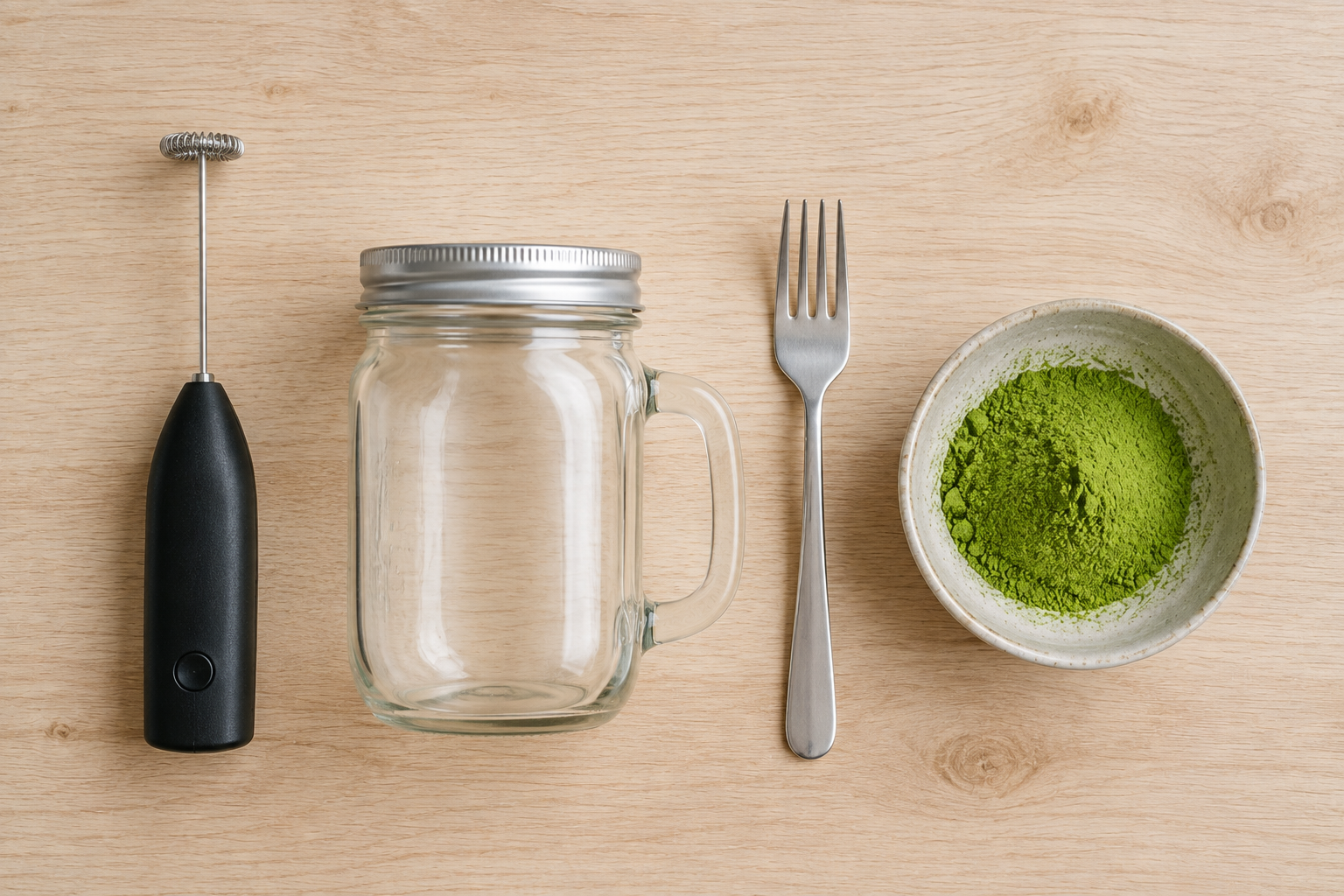
1. Electric milk frother (best overall). Sift the matcha into your cup, add 2 tablespoons of room-temperature water, submerge the frother head and run it for about 10 seconds until smooth, then add your remaining hot water (75-80°C) or milk and froth again for 15-20 seconds. A small handheld frother creates a fast spinning agitation that’s genuinely comparable to a chasen’s W-shaped motion, and it’s the closest thing to matching both the smoothness and the foam of a traditional whisk with none of the technique.
2. Blender. Add the matcha with a small amount of water first and pulse for a few seconds to break up the paste, then add the rest of your liquid and blend another 10-15 seconds. This produces excellent, genuinely smooth results and can even edge out a chasen for pure lump-free texture – the tradeoff is more cleanup, and you shouldn’t blend very hot liquid in a sealed blender due to steam pressure building up.
3. Shaker bottle or wide-mouth mason jar. Make the paste directly in the jar, add your water (warm rather than boiling), seal tightly, and shake vigorously for 15-20 seconds. This works well for cold or iced matcha specifically – a wide-mouth jar froths noticeably better than a narrow bottle – and it’s the most practical option if you’re making matcha somewhere without an outlet, like while traveling.
4. A regular fork, in a genuine pinch. Mash and mix the matcha with a small amount of cold water using the fork tines for about 30 seconds until it’s a reasonably smooth paste, then stir in hot water vigorously for another minute. Being honest about this one: it’s passable, not good. You’ll likely get a few small remaining clumps and essentially no foam, but it beats drinking gritty matcha water, and it requires nothing you don’t already own.
A Few Things People Ask Me
Does the health value of matcha change depending on how I prepare it? No – the antioxidants, L-theanine, and caffeine content come from the powder itself, not the whisking method. A frother or blender doesn’t give you “less” matcha than a chasen does.
Is a hand whisk (like a mini metal whisk) worth trying instead? It’s a middle option – better than a fork, meaningfully more effort than a frother. Whisk in an M or W pattern rather than circles, which more closely mimics how a chasen actually breaks up clumps, and expect to spend closer to a minute working at it rather than the 15-20 seconds a frother needs.
Which of these is worth actually buying if I don’t want a chasen at all? A handheld milk frother on Amazon is inexpensive and does the best job of any non-chasen tool here. If you decide you’d rather go the traditional route after all, Nio Teas’ matcha tools is where I’d start looking for a real chasen instead.
Will my matcha taste worse made this way? Flavor itself won’t change meaningfully – what changes is texture and foam. A frother or blender actually gets you closer to a chasen’s result than a fork or spoon ever will, so “no whisk” doesn’t have to mean “worse matcha,” just a different-looking cup.
Where I Landed
The chasen isn’t doing anything mystical – it’s just an efficient tool for fast agitation in a small space, and once you understand that’s the actual job, it’s easy to see why an electric frother gets remarkably close with a fraction of the effort. I still reach for my chasen most mornings because I like the process, but on days I don’t feel like washing bamboo tines, the frother isn’t a downgrade so much as a different tool doing the same job faster.