Disclosure: This post contains affiliate links. If you buy through one of them, I may earn a small commission at no extra cost to you.
I’ll say the quiet part out loud: the first time someone handed me a piece of yokan, dense red bean jelly, sweet in a way I wasn’t expecting from something that texturally resembled a fruit gummy, I didn’t love it. It took me a few different wagashi, in a specific order, before anko clicked for me instead of feeling like an obstacle. I think a lot of people give up one bite too early, on the wrong wagashi, and decide the whole category isn’t for them.
That’s really the honest starting point for this guide. Anko, sweetened red bean paste, is the backbone of most traditional Japanese sweets, and it’s also the single biggest reason Western newcomers bounce off wagashi entirely. The texture is unfamiliar — a sweet bean paste isn’t a flavor concept most people grew up with — and if your first experience is something anko-forward like a dense slice of yokan, it’s easy to write off the whole category before giving it a fair shot. Nobody tells you there’s actually a natural order to work through, one that lets you build up tolerance and appreciation the way you might work up to darker roast coffee or spicier food.
The Problem You’re Actually Trying to Solve
You’ve searched for a wagashi guide, maybe because you’re pairing something with matcha and want to do it properly, maybe because you’re just curious about Japanese sweets and don’t know where to start. Either way, you’ve probably run into the same wall I did: most wagashi guides list fifteen types in one long, undifferentiated block, with zero acknowledgment that some of these are a much easier on-ramp than others if you didn’t grow up eating sweetened bean paste.
This guide sorts wagashi by how approachable they are for a first-timer, specifically around anko intensity, so you can actually build up to the deeper end of the category instead of getting thrown into it and deciding you don’t like any of it.
Who This Article Is NOT For
Let’s save you some scrolling if this isn’t quite your situation.
- If you already love anko and eat wagashi regularly, this beginner-focused ordering will feel too cautious — you probably already know your way around yokan and monaka.
- If you want a full historical and cultural breakdown of every wagashi category (namagashi, han-namagashi, higashi, and all their sub-classifications), this is a practical tasting guide, not an academic deep dive into Japanese confectionery classification.
- If you’re gluten-free or have a peanut allergy specifically, most wagashi are naturally free of both, but always check ingredient labels individually — I’m not covering allergen specifics item by item here.
If you’re past that, here’s where the actual guide starts.
What Actually Determines How Approachable a Wagashi Is
Three things, and once you know them, you can predict pretty accurately whether a wagashi you’ve never tried will feel easy or challenging on a first bite.
1. How much anko is actually present, and how concentrated it is. A dollop tucked inside a pancake-like shell reads very differently than a solid block of nothing but bean paste.
2. Texture familiarity. Anything chewy, gooey, or jelly-like (mochi, kanten-based jellies) asks more of an unfamiliar palate than something crisp or cake-like, which reads closer to Western baked goods.
3. Sweetness balance. Some wagashi lean quite sweet on their own; others are deliberately restrained specifically because they’re meant to be eaten alongside bitter matcha, which changes how they taste in isolation versus with tea. A wagashi that seems too sweet eaten alone can taste perfectly balanced once you actually put it next to a bowl of whisked matcha, which is worth keeping in mind before writing anything off based on a solo bite.
Comparison Table
| Wagashi | Anko Level | Texture | Beginner Friendliness | Pairs Well With |
|---|---|---|---|---|
| Rakugan | None | Dry, crumbly, hard candy-like | Very easy | Usucha (thin matcha) |
| Castella | None | Soft, sponge cake-like | Very easy | Sencha, hojicha |
| Senbei | None (savory) | Crisp, crunchy | Very easy | Any tea, especially hojicha |
| Dorayaki | Moderate, contained | Soft pancake exterior, smooth filling | Easy | Hojicha, mild sencha |
| Daifuku | Moderate, contained | Chewy mochi exterior | Moderate | Sencha, usucha |
| Monaka | High, but crisp shell | Crisp wafer, dense paste filling | Moderate-challenging | Usucha, koicha |
| Yokan | Very high, solid form | Dense, jelly-like | Most challenging | Koicha (thick matcha) |
The Wagashi, One by One
Rakugan
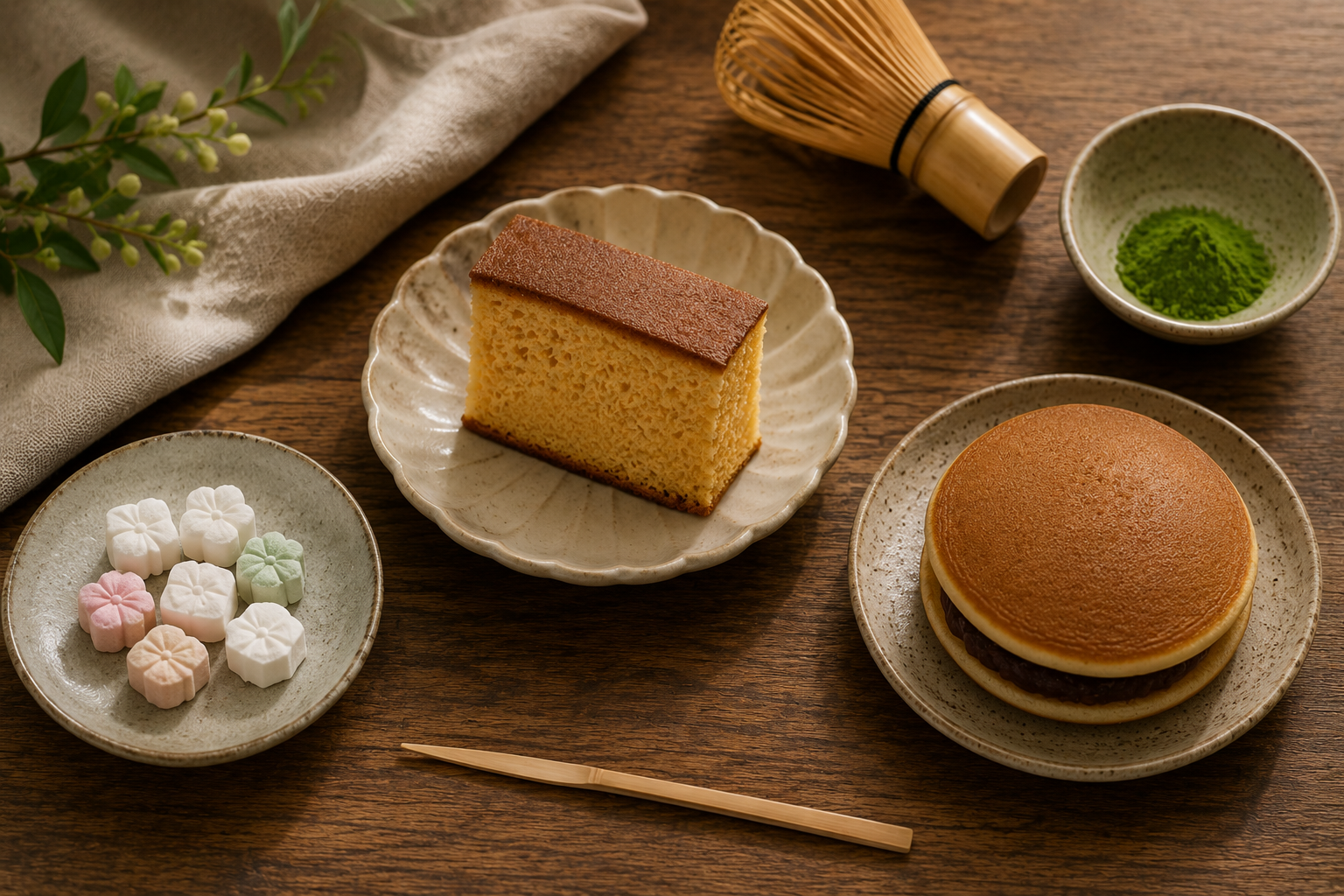
Rakugan is a dry, pressed sweet made from rice flour, sugar, and a liquid sweetener called mizuame, shaped into intricate molded forms, often flowers or seasonal motifs. It contains no anko at all.
Why it’s a good starting point: The texture is closer to a firm sugar candy than anything unfamiliar, and the flavor is straightforwardly sweet without the bean paste element that trips people up. It’s also traditionally served specifically with usucha, thin matcha, in tea ceremony settings, so it’s a historically correct pairing, not just a beginner workaround.
The tradeoff: It’s quite sweet and quite dry on its own, meant to be eaten in small pieces alongside tea rather than as a standalone snack. Don’t expect much complexity — this is about pure, simple sweetness, and it can feel a little chalky if you eat it without tea to wash it down.
Castella
Shop castella cake on Amazon →
Castella is a soft, honey-sweetened sponge cake, baked rather than steamed or pressed, and while purists debate whether it technically counts as wagashi versus a Portuguese-influenced import, it’s sold and eaten alongside other traditional sweets throughout Japan.
Why it’s a good starting point: This is the easiest entry point on the entire list, because it tastes almost exactly like a Western sponge cake. No anko, no unfamiliar texture, nothing to adjust to. If you want proof that Japanese sweets aren’t universally challenging for a Western palate, this is it.
The tradeoff: Because it’s so close to something you already know, it doesn’t really teach you anything new about wagashi as a category. Think of it as the on-ramp, not the destination.
Senbei
Shop senbei rice crackers on Amazon →
Senbei are savory or lightly sweet rice crackers, often brushed with soy sauce, and while they sit slightly outside the sweet-wagashi conversation, they’re a traditional higashi-category pairing for tea and worth knowing about specifically because they sidestep the sweetness question entirely.
Why it’s a good starting point: If you’re someone who generally prefers savory over sweet, this is your entry point into the tea-pairing world without touching anko or heavy sugar at all.
The tradeoff: If what you actually wanted was a sweet treat to go with your tea, senbei won’t scratch that itch — it’s a genuinely different category of pairing.
Dorayaki
Dorayaki is two small, fluffy castella-style pancakes sandwiched around a filling of sweetened anko. This is where anko actually enters the picture, but in a contained, moderate way.
Why it’s a good starting point: The pancake exterior is instantly familiar, and the anko filling is portioned rather than dominant, so you get a genuine introduction to the flavor without it overwhelming the bite. This is often the wagashi I’d recommend as someone’s actual first anko experience — it asks the least of you while still being the real thing, not a workaround.
The tradeoff: The filling does have that distinct sweetened bean texture, slightly grainy, quite sweet, and if that specific mouthfeel isn’t for you, dorayaki will make that clear quickly, even in a small dose.
Daifuku
Shop daifuku mochi on Amazon →
Daifuku is a soft mochi ball wrapped around a filling, most commonly anko, though strawberry and other fruit variations are common too and often easier for a first-timer than the plain red bean version.
Why it’s worth trying next: The chewy mochi exterior is a genuinely different texture experience than anything in Western desserts, and it’s worth getting comfortable with on its own before combining it with anko. Starting with a fruit-filled daifuku lets you adjust to the mochi texture first before tackling mochi and anko together.
The tradeoff: Mochi’s stickiness and chew is polarizing even independent of the anko question — some people love it immediately, others need a few tries before it stops feeling unusual.
Monaka
Monaka is anko sandwiched between two thin, crisp wafers made from mochi rice, often shaped like flowers, leaves, or the moon. Despite the crisp wafer shell, the anko filling itself is usually dense and largely unmodified — this is closer to the real thing.
Why it’s worth trying next: The crisp wafer gives you a textural anchor that’s easy to like immediately, which makes the anko filling underneath feel more approachable than it would completely on its own.
The tradeoff: The anko-to-shell ratio is much higher than dorayaki, so if you weren’t sold on the bean paste texture there, monaka will ask more of you, not less.
Yokan
Yokan is a dense, jelly-like block made almost entirely of sweetened bean paste set with agar (kanten). There’s no shell, no pancake, no wafer to soften the experience — it’s anko in its most concentrated, unaccompanied form.
Why it’s worth trying last, not first: This is the wagashi that most directly tests whether you actually enjoy anko’s flavor and texture on their own terms, without any supporting structure to ease you in. In my experience, people who’ve built up to yokan through the other wagashi on this list tend to genuinely enjoy it, appreciating the concentrated flavor rather than being ambushed by it; people who start here often don’t, and end up assuming the problem is wagashi as a whole rather than just this one especially intense entry point.
The tradeoff: It’s the most likely wagashi to end someone’s wagashi journey prematurely if it’s their first exposure. Save it for later, once you already know anko works for you.
Which One Should You Actually Start With
If you want zero risk and guaranteed enjoyment: Castella. It’s essentially cake, and it pairs beautifully with any tea you already like.
If you want the traditional tea ceremony pairing without any anko involved: Rakugan alongside usucha (thin matcha).
If you’re ready for your actual first anko experience: Dorayaki. Contained, familiar shell, moderate filling.
If you’ve enjoyed dorayaki and want to go further: Daifuku, ideally a fruit-filled version first, then a plain anko version once you’re comfortable with the mochi texture itself.
If you’re confident anko is for you and want the real, concentrated experience: Monaka, then yokan, in that order.
A Few Things People Ask Me
What tea should I actually pair with wagashi? Sweeter, richer wagashi like yokan and monaka traditionally pair with koicha, thick matcha, because the tea’s intensity balances the concentrated sweetness. Lighter wagashi like rakugan and castella pair well with usucha or a simple sencha, since neither the tea nor the sweet needs to compete with the other.
Is there a wagashi with no sugar or minimal sweetness at all? Senbei is your best bet if you want something to pair with tea without leaning sweet at all. Beyond that, most wagashi are built around sweetness as the whole point, so a genuinely low-sugar option within the sweet category is hard to find authentically.
Can I make anko more approachable at home, or does it always taste the same? Anko varies more than people expect — koshian (smooth, strained paste) and tsubuan (chunkier, with whole beans left in) have noticeably different textures, and some brands sweeten more aggressively than others. If your first anko experience was overly sweet or grainy, it’s worth trying a different preparation before writing off the flavor entirely.
Is wagashi always this small and delicate, or are there bigger portions? Traditional wagashi are intentionally small — they’re meant to be a few refined bites alongside tea, not a full dessert course. If you’re craving a bigger portion, dorayaki and daifuku tend to come in more substantial single servings than something like rakugan or monaka.
Where I Landed
I’ll be honest: yokan still isn’t my favorite, even now, and that’s fine. The point of this guide was never to convert you into loving every single wagashi — it’s to make sure you actually give the category a fair trial instead of judging all of wagashi off one dense, anko-heavy first impression. Start with castella or rakugan, work your way through dorayaki and daifuku, and see where your own preference actually lands before deciding anko isn’t for you. Some people stop happily at dorayaki and never look back, and that’s a completely legitimate place to land — you don’t owe the category a full commitment to yokan just because it exists.
If you’re building this into an actual matcha routine at home, pair the lighter sweets with a usucha-style whisked matcha, and save the richer, anko-forward ones for when you’ve got a proper thick koicha to stand up to them — my matcha powder brands comparison is a good next stop if you’re still figuring out which matcha to keep on hand for exactly that.