Disclosure: This post contains affiliate links. If you buy through one of them, I may earn a small commission at no extra cost to you.
For a long time I drank matcha and ate wagashi as two separate things that happened to show up at the same tea time, without really thinking about why they’re almost always served together in Japan rather than apart. It’s not just tradition for tradition’s sake – matcha’s bitterness and wagashi’s gentle sweetness are doing real work on each other, softening the tea’s sharper edges while the tea keeps the sweet from feeling cloying. And because wagashi itself changes with the seasons, that pairing looks different depending on the time of year.
The Problem You’re Actually Trying to Solve
Most explanations of matcha and wagashi either treat the pairing as a vague cultural fact (“they’re traditionally served together”) without explaining the actual flavor logic, or they cover wagashi as a static category without acknowledging that what counts as “the” wagashi to pair with matcha changes meaningfully across spring, summer, autumn, and winter. If you’re trying to build an actual seasonal tea routine rather than just picking whatever wagashi happens to be in stock, that distinction matters.
Who This Article Is NOT For
- If you want a general introduction to wagashi as a category rather than a seasonal pairing guide, my wagashi guide is the more foundational read.
- If you’re specifically choosing which matcha brand or grade to buy rather than what to pair it with, my matcha powder brands comparison covers that separately.
- If you can’t access fresh seasonal wagashi where you live and want substitutes rather than the traditional pairings themselves, most of what’s below assumes at least some access to Japanese confectionery, whether local, imported, or homemade.
Why This Pairing Actually Works
The logic isn’t just “sweet plus bitter is nice” – it’s more specific than that. Matcha carries deep umami along with a real astringency, especially with a stronger or more ceremonial-grade preparation. Wagashi’s gentle, refined sweetness – built from ingredients like red bean paste, rice flour, and agar rather than the concentrated sugar and fat of most Western desserts – softens that astringency without overwhelming it the way a rich, buttery dessert would. The tea, in turn, keeps the sweetness from feeling cloying or one-note. Neither element fully dominates the other, which is the entire point of the pairing rather than an accident of tradition.
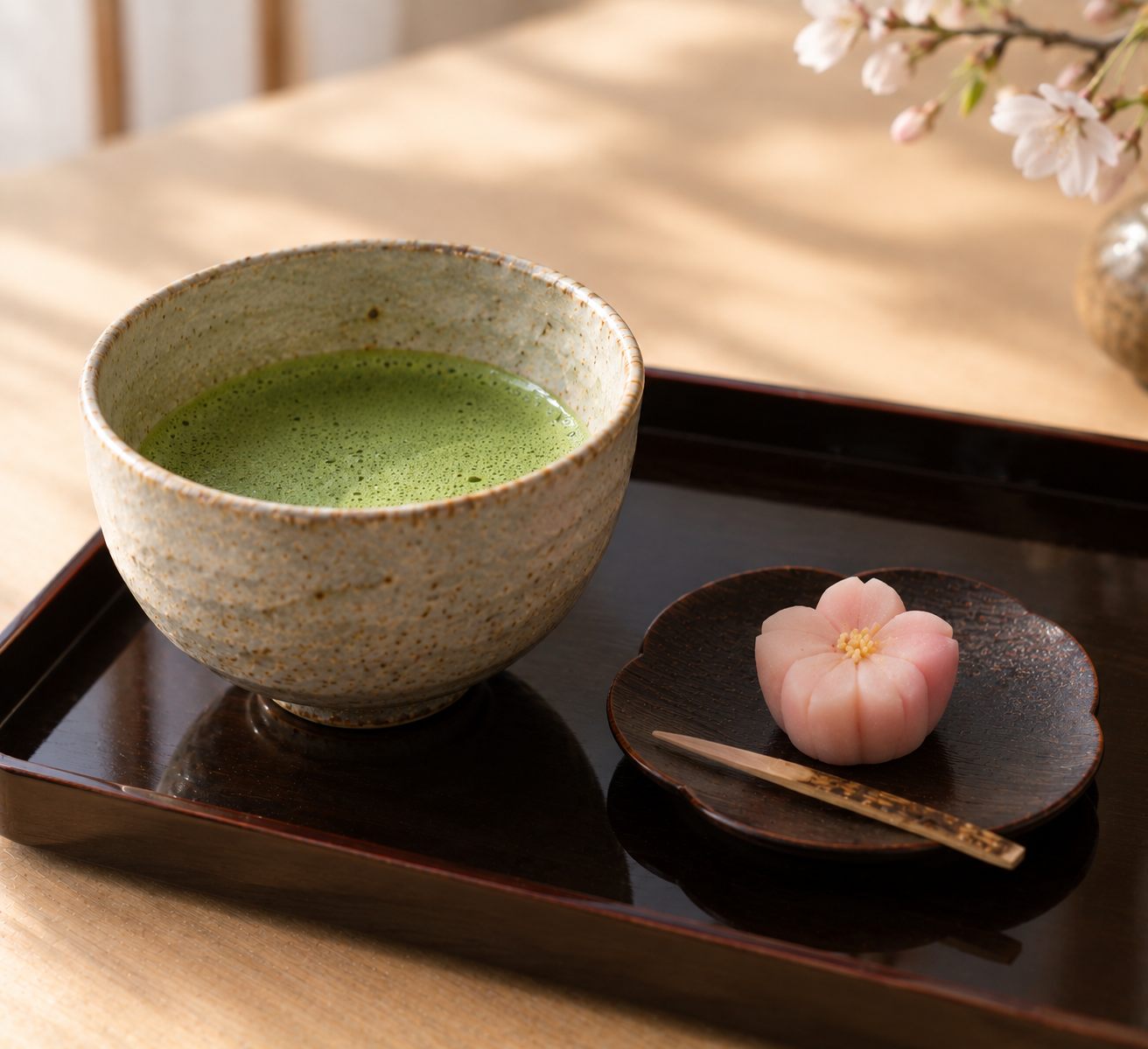
Traditional nerikiri – wagashi hand-shaped into seasonal motifs, like a maple leaf in autumn or a cherry blossom in spring – is often held up as an ideal match for exactly this reason: its delicate sweetness and soft texture complement matcha’s intensity without a fight for dominance.
Spring: Sakura Mochi and Hishimochi
Spring wagashi leans heavily on cherry blossom themes and soft pink-white-green color palettes marking the change of season.
Sakura mochi – a pink-tinted mochi wrapped around red bean filling, often wrapped again in a pickled cherry blossom leaf – is probably the most recognizable spring wagashi, and its salty-sweet edge from the pickled leaf plays especially well against matcha’s vegetal bitterness.
Hishimochi, a diamond-shaped layered mochi in pink, white, and green, is more visual celebration than intense flavor experience, making it a lighter counterpart to a stronger matcha if you want the tea itself to carry more of the flavor weight.
Summer: Mizu Yokan and Kudzukiri
Summer wagashi shifts toward cooling, often chilled or jelly-like textures, since the goal is refreshment as much as sweetness.
Mizu yokan, a lighter, more delicate version of standard yokan (a firm red bean jelly), is served chilled and pairs particularly well with a cooler-brewed matcha or even iced matcha, since both are leaning into the same seasonal need for something refreshing rather than warming.
Kudzukiri, translucent arrowroot starch noodles typically served cold with a sweet syrup, brings a genuinely different texture to the pairing – almost more textural experience than intensely sweet, which keeps it from competing with matcha’s own flavor.
Autumn: Kuri Manju and Tsukimi Dango
Autumn wagashi turns toward chestnut, harvest themes, and the full moon.
Kuri manju, a steamed bun filled with sweetened chestnut, is heartier and more filling than the lighter spring and summer options, and its warm, nutty sweetness pairs particularly well with a richer, more full-bodied matcha rather than a delicate, high-grade ceremonial one that might get lost against it.
Tsukimi dango, round mochi balls traditionally eaten during moon-viewing celebrations, are simpler and less sweet, which makes them a good match if you want the matcha itself to be the more assertive flavor in the pairing.
Winter: Kagami Mochi and New Year Sweets
Winter wagashi is tied closely to New Year traditions rather than being a broad seasonal category the way the other three seasons are.
Kagami mochi, ceremonial stacked mochi placed out during New Year celebrations for good fortune, is traditionally eaten afterward in a sweet red bean soup rather than paired directly with tea in the moment – but the same red bean sweetness that defines it works well alongside matcha whenever it’s actually served as a sweet on its own, following the same basic logic as the other seasonal pairings.
A Few Things People Ask Me
Does the pairing logic change based on matcha grade, or just wagashi type? Both matter, but if you’re only adjusting one side, adjusting matcha grade to match wagashi intensity is usually the more practical move – a delicate, high-grade ceremonial matcha suits lighter, subtler wagashi (tsukimi dango, hishimochi), while a more robust culinary-adjacent matcha holds up better against heartier options like kuri manju.
Can I pair matcha with non-Japanese sweets using the same logic? To some extent, yes – the underlying principle (a refined, not-too-rich sweetness that doesn’t fight matcha’s bitterness) applies to some Western pastries too, though most Western desserts run richer and sweeter than wagashi, which can genuinely overwhelm matcha rather than balance it.
Where can I actually source wagashi outside Japan? Specialty Japanese grocery stores and some Japanese bakeries carry at least mochi-based options regularly; more delicate seasonal items like fresh nerikiri are harder to find outside Japan and are sometimes worth making at home if you’re committed to trying the full seasonal range.
What matcha would you recommend keeping on hand for pairing with wagashi generally? Nio Teas’ matcha is a reasonable mid-range option that works across most of the pairings above without needing to buy a different grade for every season. If you want to try making your own simple wagashi at home, a wagashi mold set on Amazon is a low-cost way to start shaping mochi-based sweets yourself.
Where I Landed
What changed how I think about this pairing wasn’t the tradition itself – it was realizing the seasonal rotation isn’t decorative, it’s functional. Wagashi’s texture and sweetness genuinely shift with the seasons in ways that either lighten or deepen how matcha reads against it, so the “right” wagashi for a cup of matcha really does depend on the time of year, not just personal taste. Once I started matching intensity – lighter sweets with delicate matcha, heartier sweets with more robust matcha – the pairing stopped being background tradition and started being something I actually thought about each season.