Disclosure: This post contains affiliate links. If you buy through one of them, I may earn a small commission at no extra cost to you.
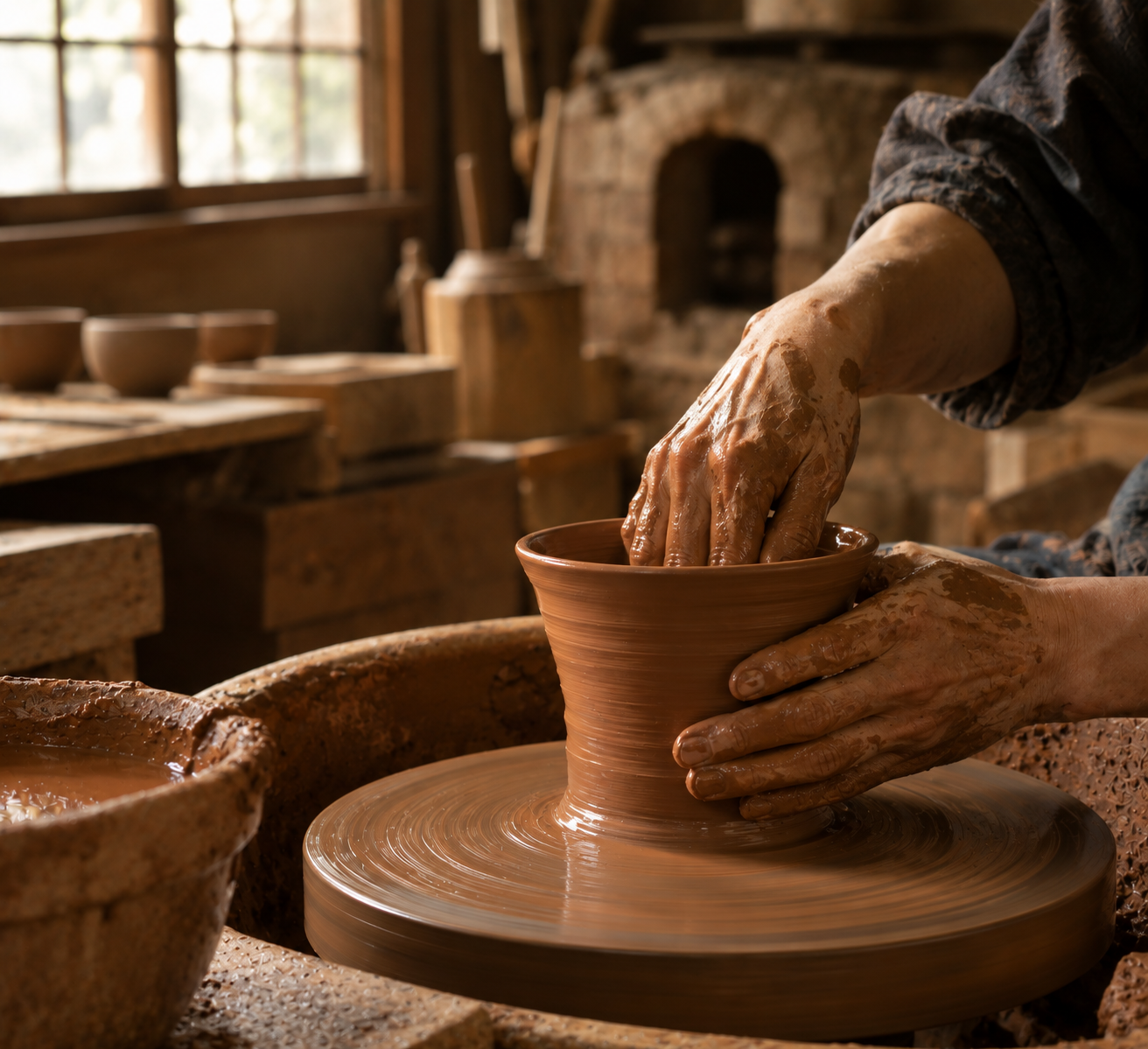
Every time I pick up my Tokoname kyusu, I’m using a shape and clay tradition that predates the printing press, refined by a specific chain of potters whose names are actually recorded, not lost to vague “ancient craft” marketing language. Knowing that history doesn’t change how the pot brews tea, but it changes how you hold it, and it’s worth actually knowing rather than treating “traditional Japanese teapot” as an unexamined phrase on a product listing that could just as easily be describing something made last month.
The Problem You’re Actually Trying to Solve
You’ve searched for the history behind kyusu pottery because you own one, are about to buy one, or you’ve simply noticed “Tokoname” or “Banko” on product listings and want to understand what those names actually represent beyond a vague sense of authenticity.
Who This Article Is NOT For
Let’s save you some scrolling if this isn’t quite your situation.
- If you want current brand and product recommendations rather than history, my Japanese kyusu brands compared guide covers that ground directly.
- If you’re deciding what to actually buy rather than learning the background, my kyusu buying guide is the more practical resource.
If you’re past that, here’s where the actual history starts.
Tokoname: Nearly a Thousand Years Before the Teapot Arrived
Tokoname’s pottery tradition traces back to the late Heian period, the end of the 12th century, making it one of Japan’s Six Ancient Kilns, a group of historic pottery centers, alongside Seto, Shigaraki, Echizen, Tamba, and Bizen, that have operated continuously since medieval times. For its first several centuries, Tokoname had nothing to do with tea at all. Potters produced large storage jars, cooking vessels, and eventually, by the Kamakura period, the region hosted an extraordinary concentration of kilns, reportedly over 3,000 at its historical peak, all working the region’s distinctive iron-rich clay dug from the Chita Peninsula’s hills.
The shift toward what Tokoname is known for today didn’t happen until the early 19th century, deep into the Edo period. A potter named Sugie Jumon began crafting Chinese-style teapots from the local red clay, timed almost perfectly with a cultural shift: sencha, steeped loose leaf tea, was gaining popularity among the merchant class as a less formal alternative to the powdered matcha associated with traditional tea ceremony. Tokoname’s iron-rich clay turned out to genuinely soften tea’s astringency, a real chemical property, not just a nice legend, and that discovery cemented the region’s shift toward teapot production. By the Meiji era, Tokoname had become Japan’s premier teapot production center, and in 1961, Tokoname ware received official designation as a Traditional Japanese Craft, a formal recognition protecting the techniques passed down through its potting families.
Banko: A Merchant’s Wish for Something Eternal
Banko ware’s origin story is more personal and more precisely dated. Around 1736 to 1740, a wealthy merchant named Nunami Rozan, deeply devoted to tea ceremony since childhood, built his own kiln in what’s now Asahi, Mie Prefecture. Rozan stamped his creations with the seal “Banko Fueki,” meaning “eternal and unchanging,” expressing his wish that his work would be passed down through generations. That stamp is quite literally where the name Banko comes from.
The story doesn’t run in a straight line from there. Production ceased entirely after Rozan’s death, and Banko ware might have simply ended as a historical footnote if two antique dealer brothers, Mori Yusetsu and Mori Senshu, hadn’t revived it roughly thirty years later in the late Edo period, using wooden-mold techniques called “Kata-Banko” to bring the style back. The tradition found its lasting home not in Rozan’s original location but in nearby Yokkaichi, where, in 1853, a local landowner named Yamanaka Chuzaemon began teaching flood-affected villagers pottery techniques as a form of economic relief, spending twenty years perfecting mass-production methods for what became known as Yokkaichi Banko ware. What started as disaster recovery became a defining regional industry, now specifically associated with distinctive purple-toned shidei clay teapots.
The Craft Continues Through Named Makers, Not Just Anonymous Tradition
One detail worth knowing: both traditions carry their history forward through actual named artisans, not an anonymous, faceless “traditional craft” label. Tokoname has produced recognized masters, including at least one recipient of Japan’s Living National Treasure designation for ceramics, a formal government honor reserved for practitioners preserving genuinely significant traditional techniques. Banko ware similarly carries forward through specific workshops, some now on their third or fourth generation of the same family continuing a craft that itself was interrupted and revived generations before them. When a modern kyusu brand names a specific kiln or maker rather than simply printing “Tokoname” or “Banko” as a generic label, that specificity is meaningful — it connects a piece you can actually buy today to a living, traceable lineage rather than a vague regional association.
Why This History Actually Matters When You’re Drinking Tea
Tokoname’s story explains its red-clay character. The centuries of iron-rich clay work that preceded teapot production gave Tokoname potters an unusually deep understanding of that specific clay’s properties, which is part of why the tannin-softening effect feels so refined rather than accidental. This wasn’t a material discovered for tea; it was a material perfected for centuries before tea gave it a new purpose.
Banko’s story explains its association with resilience and reinvention. A tradition that was essentially reborn twice, once by antique dealers reviving a dead kiln, once by a landowner teaching flood victims a trade, carries a genuinely different cultural weight than a tradition that simply continued unbroken. Banko ware’s more purple-toned clay and reputation for heat resistance and umami enhancement both trace back to techniques developed across that discontinuous, rebuilt history.
Both traditions predate their most famous product by centuries. Neither Tokoname nor Banko began as “teapot towns.” Both were general ceramics centers for hundreds of years before a specific cultural shift, sencha’s rise in Tokoname’s case, one devoted merchant’s passion project in Banko’s, redirected an already-mature craft toward the specific object we now associate with each name.
Owning a Piece of Either Tradition
Shop Tokoname and Banko kyusu teapots on Amazon →
A Few Things People Ask Me
Is one tradition genuinely older than the other? Yes, considerably — Tokoname’s pottery roots stretch back roughly 900 years to the late Heian period, while Banko ware dates to the mid-18th century, making it a few centuries younger, though still a genuinely historic craft in its own right.
Does a kyusu’s price reflect which tradition it comes from? Not directly by tradition alone — price within each tradition varies enormously based on the individual maker’s reputation and whether a piece is hand-thrown versus mold-assisted, more than by Tokoname versus Banko as categories.
Are there other historic kyusu-producing regions beyond these two? Yes, though Tokoname and Banko are the two most commonly encountered in Western retail specifically. Other regions produce teaware within Japan’s broader ceramic tradition, but these two dominate the kyusu category most buyers outside Japan actually encounter.
Why did sencha’s popularity specifically drive kyusu development in both traditions? Matcha, prepared with a whisk directly in a bowl, never needed a teapot at all. Sencha, being steeped loose leaf, created genuine demand for a vessel designed specifically around infusion and filtering, which is precisely the gap both Tokoname and Banko potters stepped in to fill once the merchant class embraced the less formal tea style.
Did Tokoname or Banko ware ever serve purposes completely unrelated to tea? Yes, extensively. Tokoname’s earlier centuries produced storage jars, and later, in the Meiji era, large quantities of industrial ceramic pipes for Tokyo and Osaka’s developing sewage systems, even architectural tiles used on Frank Lloyd Wright’s Imperial Hotel in Tokyo. Both traditions were genuinely utilitarian industries long before, and even alongside, their reputation for fine teaware.
Does the “Living National Treasure” designation apply to entire regions or to individual people? It’s an individual honor, awarded by the Japanese government to specific master craftspeople recognized for preserving culturally significant techniques, not a blanket designation covering an entire pottery region. A Tokoname piece from a Living National Treasure-designated maker carries a different level of recognition than a standard piece from the same region.
Where I Landed
What strikes me most about both stories is how much accident and interruption shaped traditions that now feel inevitable and timeless on a product page. Tokoname spent 700 years making storage jars before a single potter’s decision redirected centuries of clay expertise toward tea. Banko ware nearly vanished entirely, twice, before flood relief and antique dealers’ curiosity brought it back.
Neither craft was preordained to become synonymous with tea. Both are the result of specific people, Sugie Jumon experimenting with Chinese-style teapots, Nunami Rozan chasing a personal obsession with tea ceremony, Yamanaka Chuzaemon trying to help flood victims survive, making decisions that had nothing to do with guaranteeing a legacy and everything to do with solving a problem or pursuing a passion in front of them at the time.
None of that changes how either clay performs in your cup, but it’s worth knowing the next time you see “Tokoname” or “Banko” printed on a listing, treated as a simple authenticity stamp, that the actual history behind those two words is a lot messier, and a lot more interesting, than the marketing usually lets on.