Disclosure: This post contains affiliate links. If you buy through one of them, I may earn a small commission at no extra cost to you. Etiquette differs between tea schools – the steps below are the common basics, and your host’s instructions always come first.
The first time I sat in on a tea ceremony as a guest, I spent most of it worrying. Which way do I turn the bowl? Do I eat the sweet now or later? Is it rude to finish everything? I was so focused on not making a mistake that I barely tasted the tea. Later, the host told me something I wish I’d known before I walked in: nobody expects a first-time guest to know the steps. What matters is attention and respect – and a few basic gestures, which are easy to learn in advance.
The Problem You’re Actually Trying to Solve
Most people reading this have booked a tea ceremony experience in Kyoto, Tokyo or Kamakura, or have been invited to one, and want to avoid embarrassing themselves. Online guides tend to either overwhelm you with every movement of a formal ceremony or skip the practical questions: what to wear, what to say, and what to actually do when the bowl is placed in front of you.
Who This Article Is NOT For
- If you want to host a simple tea ceremony yourself, my guide to a tea ceremony you can do at home covers the host’s side.
- If you want to know what all the tools in the room are, my tea ceremony utensils guide explains each one.
- If you’re formally studying with a school, follow your teacher. The Urasenke, Omotesenke and Mushakōjisenke schools – and many others – differ in details, and your instructor’s way is the right way.
Before You Go: What to Wear and Bring
Clothing. You don’t need a kimono. For tourist experiences, clean, comfortable clothes are fine. Choose loose trousers or a skirt long enough to cover your knees when kneeling, since you’ll likely sit in seiza on tatami. Avoid very short skirts and tight jeans.
Socks. Wear or bring clean socks – white is traditional. Bare feet on tatami are generally considered inappropriate, and some hosts ask guests to change into fresh socks before entering, so a spare pair is a good idea.
Jewelry and watches. Take off rings, bracelets and watches before entering. Tea bowls can be old and valuable, and metal can scratch them.
Perfume. Skip it. Strong scents interfere with the aroma of the tea and incense.
What to bring (for more formal gatherings): kaishi, a small pad of folded paper used as a plate for sweets and for wiping, and a kashikiri, a small pick for cutting sweets. Tourist experiences usually provide these.
The Sweets Come First
You’ll be served a Japanese sweet (wagashi) before the tea. Eat it before the matcha arrives – its sweetness is meant to balance the tea’s bitterness, and it’s considered part of the experience, not a dessert afterward.
- Say “Osaki ni” (“excuse me for going first”) with a small bow to the guest next to you before you start.
- Place the sweet on your kaishi, hold it in your left hand, and cut soft sweets into small pieces with the pick.
- Fold any used paper and take it home with you rather than leaving it behind.
Receiving and Drinking the Tea
This is the part people worry about most. A common sequence looks like this:
- Acknowledge the next guest. Before drinking, a small bow and “Osaki ni” to the person after you.
- Thank the host. Bow and say “Otemae chōdai itashimasu” (“I gratefully receive your tea”), or simply a respectful “Itadakimasu.”
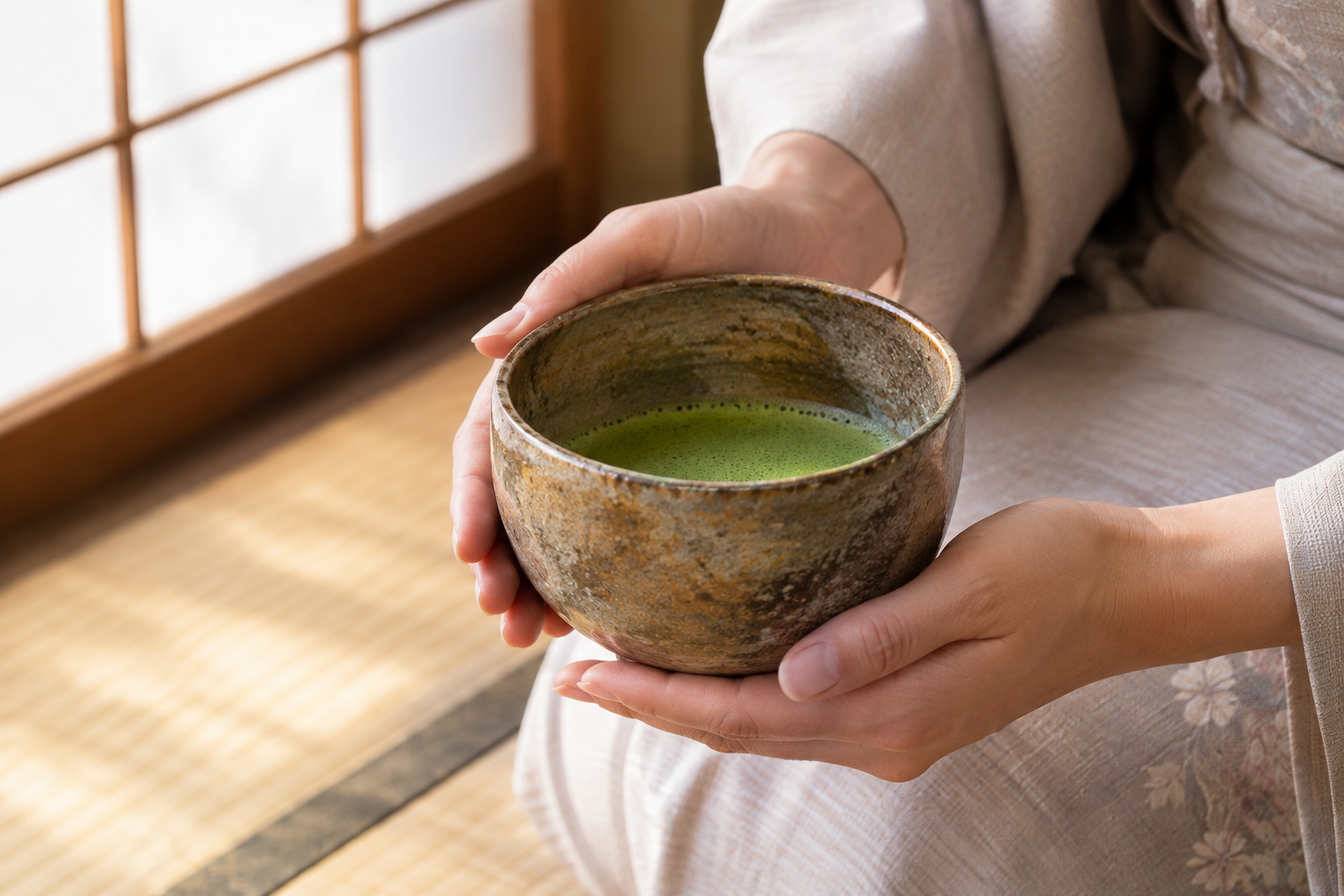
- Pick up the bowl with your right hand and place it on your left palm. Rest your right hand lightly on its side. Always use two hands.
- Turn the bowl clockwise, usually twice. The bowl is served with its most beautiful side – the “front” – facing you. Turning it means you don’t drink from the front, a gesture of humility and respect for the host and the bowl.
- Drink in a few sips. Three to four sips is typical for thin tea. In some schools, the last sip is drawn in with a light, audible slurp to show you’ve finished and enjoyed it.
- Wipe the rim. Gently wipe where your lips touched with your right thumb and finger, then wipe your fingers on your kaishi.
- Turn the bowl back. Rotate it in the opposite direction so the front faces the host again, and set it down in front of you.
If you lose track of the turns, don’t panic. Turning the bowl in roughly the right direction, with care, is what counts.
Admiring the Bowl and the Room
After drinking, it’s polite to look at the bowl before it’s returned. Place it in front of you, bow slightly, and lift it low – keeping your elbows on your knees, close to the tatami, so it can’t fall far. Look at its shape, glaze and the base, then set it down and turn it so the front faces the host.
The same goes for the hanging scroll, the flowers and the other utensils: they’re chosen for the season and the occasion, and noticing them is part of being a good guest. Admire them with your eyes, and touch nothing unless invited.
Things First-Time Guests Worry About Too Much
- Sitting in seiza. Hosts know it’s hard. Many tourist experiences offer chairs (ryūrei style) or let you shift your legs. Ask if you need to.
- Getting the words wrong. A sincere bow and “thank you” (arigatō gozaimasu) cover almost everything.
- Not liking the taste. Matcha can be bitter. Finishing the bowl is polite, but no one will judge your face.
- Doing it “wrong.” Different schools do things differently. Watch the guest before you, and follow your host.
A Few Things to Avoid
- Taking photos without asking first – ask on arrival what’s allowed
- Talking loudly or checking your phone
- Touching or picking up utensils unless invited
- Stepping on the edges of the tatami mats, if you can avoid it
- Leaving food or paper behind
A Few Things People Ask Me
Do I need to know Japanese? No. Tourist experiences usually explain everything in English, and a few phrases – osaki ni, itadakimasu, arigatō gozaimasu – are more than enough.
Which way do I turn the bowl? Clockwise before drinking, usually twice, and back again afterward. Some schools differ slightly; follow the host’s demonstration.
Do I have to finish the tea? Finishing it is the polite norm, and the portions of thin tea are small. If you truly can’t, that’s understandable – just drink what you can with care.
How can I practice before I go? Making matcha at home a few times helps more than anything – you’ll know what the bowl and whisk feel like. Nio Teas’ matcha tools have a good starter set, and a pad of kaishi paper on Amazon is useful if you’re attending a more formal gathering.
Where I Landed
The rules of a tea ceremony look complicated from the outside, but most of them come down to the same few ideas: respect for the host, care for the utensils, and attention to the moment. Learn the basic steps – sweets first, a word to the next guest, turn the bowl, drink, wipe, turn it back – and then let go of worrying. My best tea ceremony was the one where I stopped thinking about the rules and actually tasted the tea.