Disclosure: This post contains affiliate links. If you buy through one of them, I may earn a small commission at no extra cost to you.
A kyusu is genuinely the best tool for brewing Japanese green tea, but it’s not the only one, and most people outside Japan who want to try sencha or gyokuro don’t own one yet and aren’t sure it’s worth buying before they know they’ll actually keep drinking it regularly. The good news is that a kyusu’s whole job – controlling temperature, giving the leaf room to unfurl, and separating leaf from liquid cleanly – can be approximated well enough with things most kitchens already have.
None of the methods below will match a good kyusu exactly, but several of them get close enough that the difference matters far less than getting the temperature and timing right in the first place.
The Problem You’re Actually Trying to Solve
A lot of beginner advice for Japanese green tea assumes you already own a kyusu, which leaves people either buying one before they know if they’ll stick with the habit, or giving up on Japanese green tea because they don’t have “the right equipment.” The actual requirements are simpler than a dedicated teapot: correct water temperature, a way to give the leaf room to expand, and a clean way to separate leaf from liquid once it’s done steeping. Several household items handle that well enough to get you a genuinely good cup.
Who This Article Is NOT For
- If you’re ready to commit to Japanese green tea as a regular habit, my kyusu buying guide is worth reading before you invest – a proper kyusu genuinely does brew a better cup once you’re past the “just trying it out” stage.
- If you’re brewing matcha rather than steeped loose-leaf tea, none of this applies – matcha is whisked, not steeped, and needs a chasen and bowl rather than any of the vessels below.
- If you already have reliable access to a kyusu and are just looking for brewing parameters, my guide to brewing green tea temperature covers that more directly.
The Core Principles, Regardless of Vessel
Whatever you brew in, three things matter more than the vessel itself: matching water temperature to the specific tea (generally 60-80°C for most sencha, cooler for gyokuro), keeping steep time controlled rather than letting the leaf sit indefinitely, and cleanly separating the leaf from the liquid once it’s done so the tea doesn’t keep over-extracting in the cup. Every method below is really just a different way of solving those same three problems.
Five Ways to Brew Without a Kyusu
1. Mug With a Built-In or Clip-On Strainer
The simplest option for a single cup. Add loose leaf directly to a mug fitted with a fine mesh strainer basket, pour water at the appropriate temperature over it, and steep for the recommended time before lifting the strainer out. It’s quick, easy to clean, and needs no special technique – the only real downside is that a strainer with too-large mesh holes can let smaller leaf particles through into your cup.
2. A Heat-Safe Glass or Jar
A simple glass or heat-safe jar works well for one or two servings, and it has a genuine advantage over an opaque mug: you can actually watch the color develop as the tea steeps, which makes it easier to judge doneness by eye once you’ve done it a few times. Just be careful with hot glass, and strain the leaves out through a fine mesh sieve when pouring into your cup.
3. French Press
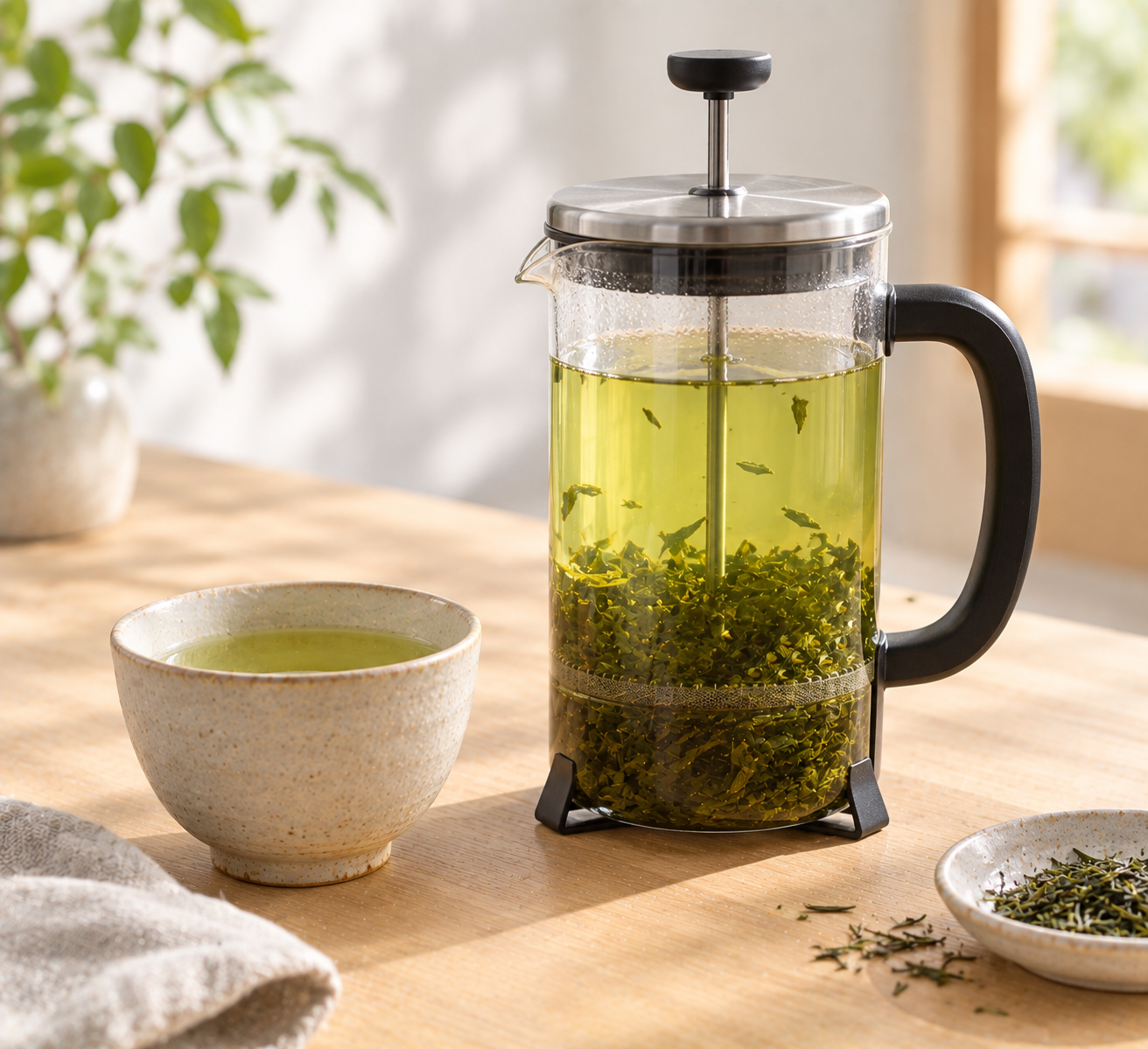
A French press handles loose-leaf green tea surprisingly well, and it’s a good option if you’re making more than a single cup at once. Use roughly 2-3 grams of tea (about a teaspoon) per 200ml of water, and let boiled water cool for 3-4 minutes before pouring over the leaves if you don’t have a thermometer – this gets you into the right general temperature range for green tea without needing to measure exactly. Steep for 2-3 minutes, then press down slowly and pour immediately. The one real risk is leaving the tea sitting in contact with the leaves too long after pressing, since a French press’s mesh doesn’t fully separate the two the way a proper strainer does – pour it all out right after pressing rather than letting it sit in the carafe.
4. A Small Saucepan
Useful specifically when you’re making tea for more than one or two people at once. Add leaves directly to appropriately-cooled water in the saucepan, let it steep briefly, then pour carefully through a fine strainer into cups. It takes a bit more attention to pour cleanly without leaves ending up in the cup, but it scales up more easily than most of the other methods here.
5. A Bowl and Spoon (In a Pinch)
Genuinely a last-resort setup rather than something to reach for regularly, but worth knowing: loose leaf steeped directly in a bowl of appropriately cooled water, then strained by holding a spoon or your fingers against the rim while pouring, will produce drinkable tea when nothing else is available. Harder to control heat and filtration precisely, but it works when you’re traveling or in someone else’s kitchen without proper tea equipment.
A Few Things People Ask Me
Which of these methods comes closest to what a kyusu actually does? The French press is arguably the closest functional match, since it handles larger leaf volumes and separates leaf from liquid in one motion the way a kyusu’s built-in strainer does, just less precisely.
Can I reuse the same leaves for a second steep with any of these methods? Yes, for most of them – a second infusion works with mug-and-strainer, glass, French press, or saucepan methods the same way it would with a kyusu, generally at a slightly higher temperature and shorter time than the first steep.
Do I need different equipment for gyokuro specifically, given how sensitive it is to temperature? Not different equipment, just extra care with temperature and ratio, since gyokuro uses notably cooler water and less liquid relative to leaf than sencha does – any of the vessels above work, but gyokuro leaves less room for temperature error regardless of what you’re brewing it in.
Is it worth buying an inexpensive tea infuser to start, before committing to a full kyusu setup? Yes, genuinely – a mesh tea infuser on Amazon is a low-cost way to get a cleaner strain than a bowl-and-spoon setup while you figure out whether Japanese green tea is a habit worth investing further in.
Where I Landed
The kyusu earns its reputation – it really does make brewing Japanese green tea easier and more consistent once you have one. But treating it as a hard requirement before you can even try sencha or gyokuro properly gets the order backwards. Get the temperature and timing right first, with whatever’s already in your kitchen, and let the tea itself tell you whether it’s worth the dedicated equipment. If you decide it is, Nio Teas’ kyusu selection is a reasonable next step once you’re past the experimentation stage.