Disclosure: This post contains affiliate links. If you buy through one of them, I may earn a small commission at no extra cost to you.
I used to assume all sencha looked and tasted roughly the same – a pale yellow-green cup, grassy and a little sharp. Then I brewed a bag labeled “fukamushi” without knowing what it meant, and got something cloudy, dark green, and noticeably smoother than any sencha I’d had before. It looked almost like I’d made a mistake. I hadn’t – fukamushi is a real, deliberate style of sencha, and once you know what to look for, it’s easy to tell apart from the regular kind.
Fukamushi sencha – “deep-steamed tea” – is simply sencha that’s been steamed for a longer period during processing. That one change in production time cascades into differences in flavor, appearance, and even how you should brew it.
The Problem You’re Actually Trying to Solve
A lot of people run into fukamushi sencha without realizing it’s a distinct category – they just notice their tea looks cloudier or tastes different from what they expected from “sencha” and assume something went wrong, either in the brewing or in the tea itself. Understanding that fukamushi is intentional, and brewing it slightly differently than standard sencha, solves both problems at once.
Who This Article Is NOT For
- If you’re deciding between sencha and gyokuro generally rather than between two styles of sencha specifically, my sencha vs. gyokuro comparison covers that broader comparison.
- If you actively prefer a lighter, clearer, more classically “grassy” green tea, standard (asamushi) sencha will suit you better than fukamushi – this isn’t a strictly “better” version, just a different one.
- If you’re brewing with a kyusu that has a wide-mesh strainer, fukamushi’s fine particles can clog it more than standard sencha would – worth knowing before you brew a pot and end up straining tea dust into your cup.
What Actually Makes Fukamushi Different
The entire distinction comes down to one variable: steaming time during processing. Standard sencha is steamed briefly to halt oxidation in the freshly picked leaf. Fukamushi sencha gets a notably longer steam – commonly in the range of one to three minutes rather than the shorter time used for regular sencha.
That extra steaming time breaks down the leaf’s cell structure more thoroughly, which has a few knock-on effects:
The leaf particles end up smaller. Extended steaming makes the leaf more fragile, so it breaks into finer pieces during the later rolling and drying stages. Fukamushi sencha often looks almost powdery compared to the more intact, needle-like leaves of standard sencha.
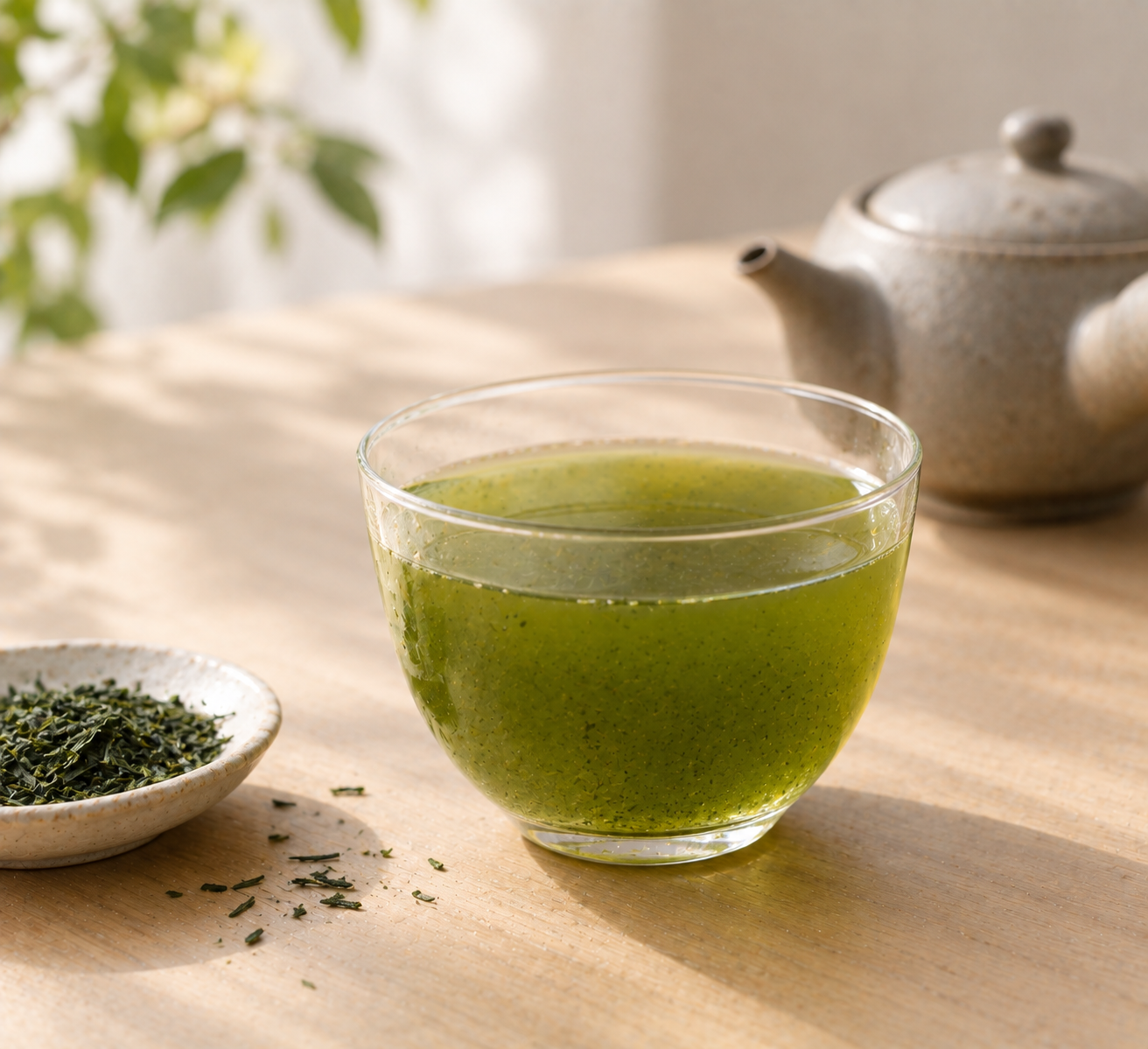
The infusion turns cloudier and darker green. Because more of the leaf’s structure has broken down, more fine particulate ends up suspended in the brewed tea rather than settling to the bottom, giving fukamushi its characteristic cloudy, deep green cup – especially noticeable on a second steep. Standard sencha, by contrast, produces a clearer yellowish-green infusion.
The flavor gets richer and less bitter. The extended steaming softens fukamushi’s flavor into something rounder and more vegetal-sweet, often described as having pronounced spinach-like notes, with less of the sharper astringency you’d get from a standard, more lightly steamed sencha.
A Bit of History
Fukamushicha isn’t an ancient traditional style – it’s a relatively modern development, emerging around 1960 in Shizuoka Prefecture. Several towns in the region (Kikugawa, Makinohara, Kakegawa, and Shimada among them) claim a role in its origin. The style was developed partly as a response to a period of low tea exports, with producers experimenting with longer steaming times to create a smoother, more immediately appealing product for a domestic market that wanted less bitterness in everyday tea. It worked well enough that fukamushicha now makes up a substantial share of Japan’s total sencha production.
How to Brew Fukamushi Sencha
Because the leaf particles are smaller and more fragile, fukamushi infuses faster than standard sencha at the same temperature – which means it needs a shorter steep time to avoid over-extracting into bitterness.
- Standard sencha: 60°C (140°F), about 1 minute
- Fukamushi sencha: 60°C (140°F), about 45 seconds
Some guidance suggests fukamushi can also work well at a slightly wider range, around 70-90°C for roughly 30 seconds, depending on the specific tea – but the shorter steep relative to standard sencha holds either way. If you’re using a kyusu, pick one with a finer built-in mesh strainer if you drink a lot of fukamushi specifically, since its small particles pass through a coarser strainer more easily than standard sencha’s larger leaf pieces do – my kyusu buying guide covers strainer types in more detail.
A Few Things People Ask Me
Is fukamushi sencha lower quality because it looks cloudier? No – the cloudiness is a direct, expected result of the processing method, not a sign of poor quality or an over-brewed cup. A cloudy fukamushi infusion is doing exactly what it’s supposed to do.
Which one should I buy if I’ve never had sencha before? Fukamushi is arguably the more forgiving starting point specifically because it’s less bitter and more approachable – it was originally developed to appeal to a broader domestic audience for exactly that reason.
Can I brew fukamushi the same way I brew standard sencha? You can, but it’ll likely turn out slightly more bitter than intended, since fukamushi’s finer particles extract faster – cutting the steep time down by about 15 seconds relative to standard sencha is a simple adjustment that makes a real difference.
Does fukamushi sencha have different caffeine content than regular sencha? Not meaningfully – the steaming time difference affects flavor, appearance, and particle size, not caffeine content, since both are made from the same type of leaf material rather than different leaf grades. If you want a tea thermometer on Amazon to keep both styles at the correct 60°C consistently, it’s a useful small purchase for anyone brewing multiple sencha styles regularly.
Where I Landed
What sold me on fukamushi, once I understood what it actually was, wasn’t really the history – it was realizing that “cloudier and darker” wasn’t a flaw I’d introduced by brewing it wrong, but the entire point of the style. If standard sencha has ever felt a touch too sharp or grassy for your taste, fukamushi is worth trying specifically because it was built to solve that exact complaint. Nio Teas carries fukamushi sencha alongside their standard sencha if you want to brew both side by side and actually taste the difference yourself.