Disclosure: This post contains affiliate links. If you buy through one of them, I may earn a small commission at no extra cost to you. This article discusses general skincare information and is not medical advice – see a dermatologist for concerns about your specific skin.
Matcha shows up in a lot of skincare marketing with some fairly dramatic promises attached – reverses wrinkles, clears acne, evens out skin tone, all from one green powder. Having looked into what’s actually behind those claims, the honest answer is more modest than the marketing: matcha does have real, evidence-supported properties relevant to skin, but most of the more dramatic claims come from lab studies using concentrations far higher than what a face mask or a cup of matcha actually delivers to your skin.
That gap between “shown in a petri dish” and “shown on an actual face” is worth understanding before you build a skincare routine around it.
The Problem You’re Actually Trying to Solve
Most matcha-and-skin content either oversells the science (treating a single in-vitro study as proof matcha will transform your skin) or ignores it almost entirely in favor of “it’s natural, so it’s good for you” reasoning. Neither is that useful if you’re actually trying to decide whether adding matcha to your skincare routine, in whatever form, is worth doing.
Who This Article Is NOT For
- If you’re dealing with a diagnosed skin condition (acne, rosacea, eczema, or anything else) that needs treatment, this is general information, not a substitute for seeing a dermatologist – please don’t use a DIY mask in place of actual treatment for anything beyond very mild, occasional skin concerns.
- If you want matcha’s health benefits from drinking it rather than skin-specific effects, green tea’s health benefits covers that separately and in more depth.
- If you’re expecting dramatic, fast results, this isn’t going to deliver that framing – the realistic case for matcha and skin is “modest supporting effect,” not “transformation.”
What the Evidence Actually Supports
Matcha’s relevant compound here is EGCG, its primary catechin, and there’s real research behind a few specific effects:
Antioxidant activity. EGCG neutralizes free radicals that contribute to oxidative stress and skin aging – this is one of the better-supported claims, though most of the strongest evidence comes from lab studies on isolated skin cells rather than from measuring visible changes on real faces over time.
Anti-inflammatory effects. Some studies show EGCG can reduce redness and inflammation, which is part of why matcha shows up in products aimed at sensitive or reactive skin.
Modest UV resilience. With regular consumption, EGCG may somewhat enhance skin’s resilience to UV damage – but this is a supporting effect at best, not a substitute for sunscreen, and nothing here should be read as “matcha protects you from sun damage.”
Possible sebum reduction. There’s preliminary evidence that EGCG may help reduce sebum production in acne-prone skin, though the human-subject evidence for this specific effect is still fairly thin and inconclusive rather than settled.
Where the Claims Get Overstated
The gap between marketing and evidence comes down to two things. First, most of the more dramatic claims – reversing wrinkles, eliminating acne outright, dramatically evening skin tone – are based on in-vitro (lab dish) or animal studies, not human trials measuring real-world results on skin. Second, the concentrations used in those lab studies are far higher than what reaches your skin through either drinking matcha or applying a homemade mask a couple of times a week.
It’s also worth knowing that the strongest topical research on green tea’s skin effects generally involves direct application of concentrated green tea extract – not matcha powder mixed into a mask at home, and not matcha you’ve had to drink. Drinking matcha may offer some modest systemic antioxidant and anti-inflammatory support as part of an overall diet, but it’s a different (and more diluted) pathway than direct topical application.
The realistic takeaway: matcha, used either as a mask ingredient or as something you drink regularly, is a reasonable small addition to a skincare routine – not a standalone treatment, and not something that replaces sunscreen, a dermatologist, or an evidence-based skincare regimen for an actual condition.
Three Matcha Face Masks Worth Trying
If you want to try matcha topically, sifted culinary-grade matcha works fine here – there’s no reason to use expensive ceremonial-grade matcha on your face.
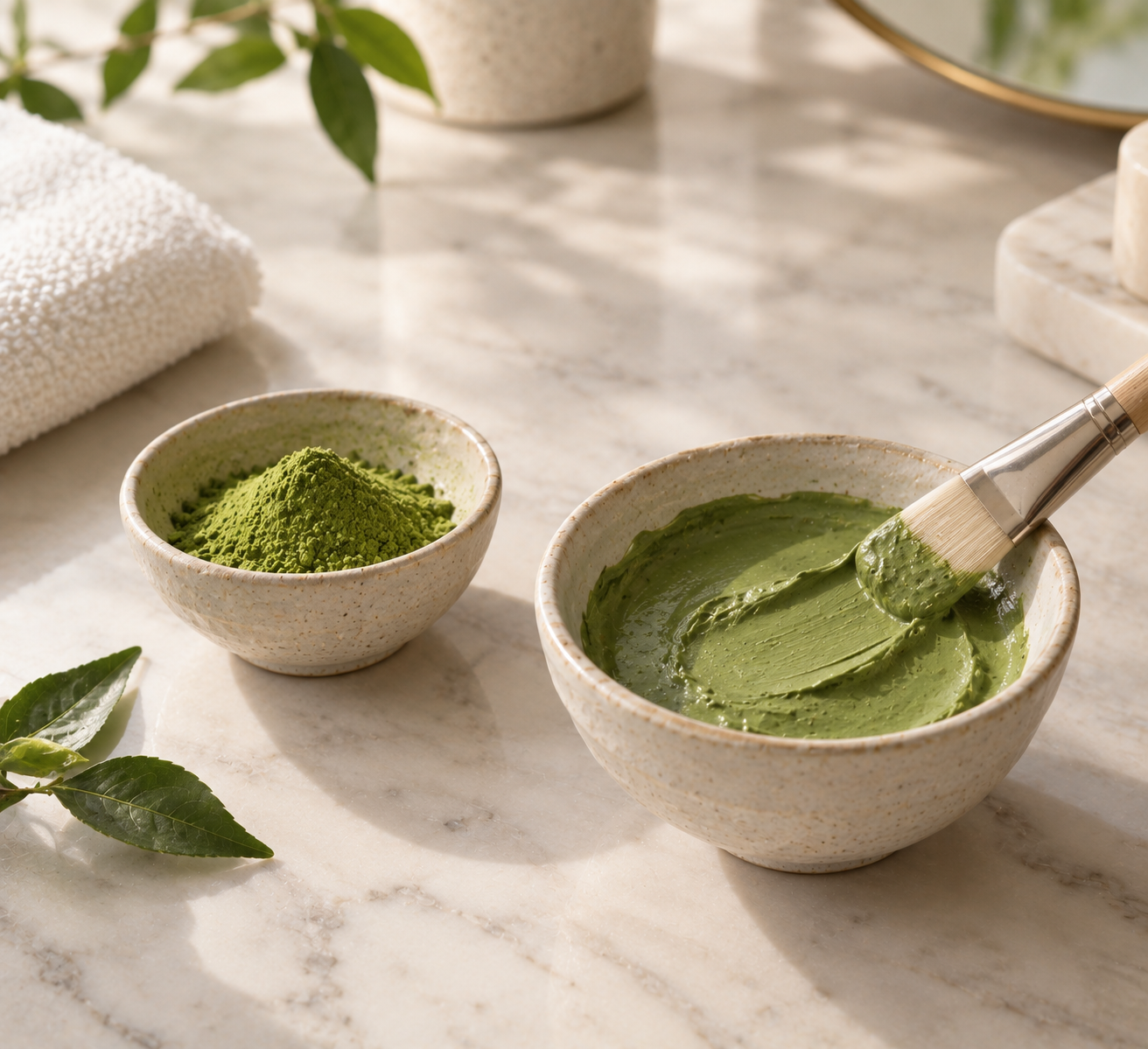
For dry skin: Mix 1 tsp matcha powder with 1 tbsp coconut oil until well blended. Apply, focusing on dry areas, and leave on for 15-20 minutes before rinsing with warm water.
For oiliness or blackhead-prone skin: Combine 1 tsp matcha powder, 1 tbsp raw honey, and (optionally) 1 tsp lemon juice. Apply to areas prone to blackheads and leave on for about 15 minutes before rinsing with lukewarm water. Skip the lemon juice if you have sensitive skin, since citrus can irritate it.
For sensitive skin: Mix 1 tsp matcha powder with 2 tbsp pureed cucumber (plain yogurt is an optional addition here). Apply and leave on for 15-20 minutes, then rinse with cool water – the cucumber has a calming effect that pairs well with matcha’s gentler anti-inflammatory properties.
As with any new skincare ingredient, patch-test on a small area first, particularly if you’re adding lemon juice or trying this for the first time.
A Few Things People Ask Me
Does drinking matcha do anything for skin, or does it have to be applied topically? Both have some evidence behind them, but they’re not equivalent – topical application delivers a more concentrated, direct dose to skin, while drinking matcha offers a more diffuse, systemic antioxidant effect as part of your overall diet rather than a targeted skin treatment.
Can matcha actually replace sunscreen if it has UV-resilience properties? No – the UV-resilience evidence is modest and supportive at best, and nothing in the current research suggests matcha is anywhere close to a substitute for actual sun protection.
Is ceremonial-grade matcha worth using on skin instead of culinary-grade? Not really – for a face mask, you’re not trying to preserve a delicate flavor profile the way you would for drinking it, so culinary-grade matcha on Amazon is the more sensible (and cheaper) choice to keep on hand for masks specifically. If you’re deciding between brands generally, my matcha powder brands comparison covers that in more depth.
How often can I realistically use a matcha face mask? A couple of times a week is a reasonable starting point for most skin types; daily use isn’t necessary and, with ingredients like lemon juice in the mix, could be more irritating than helpful for some skin.
Where I Landed
The honest version of this topic is less exciting than the marketing, but I think it’s more useful: matcha has real, modest, evidence-supported properties relevant to skin – antioxidant, mildly anti-inflammatory, possibly UV-supportive – and none of them are dramatic enough to build a whole skincare identity around. Used reasonably, as an occasional mask or as part of a diet that already includes it, it’s a fine small addition. Used as a replacement for sunscreen or actual dermatological treatment, it isn’t, and no amount of “it’s natural” framing changes that. If you want Nio Teas’ matcha for both drinking and the occasional mask, one tin covers both uses without needing to buy separately for each.