Disclosure: This post contains affiliate links. If you buy through one of them, I may earn a small commission at no extra cost to you. This article is for general information and isn’t a substitute for advice from a registered dietitian or your doctor about your individual nutrition needs.
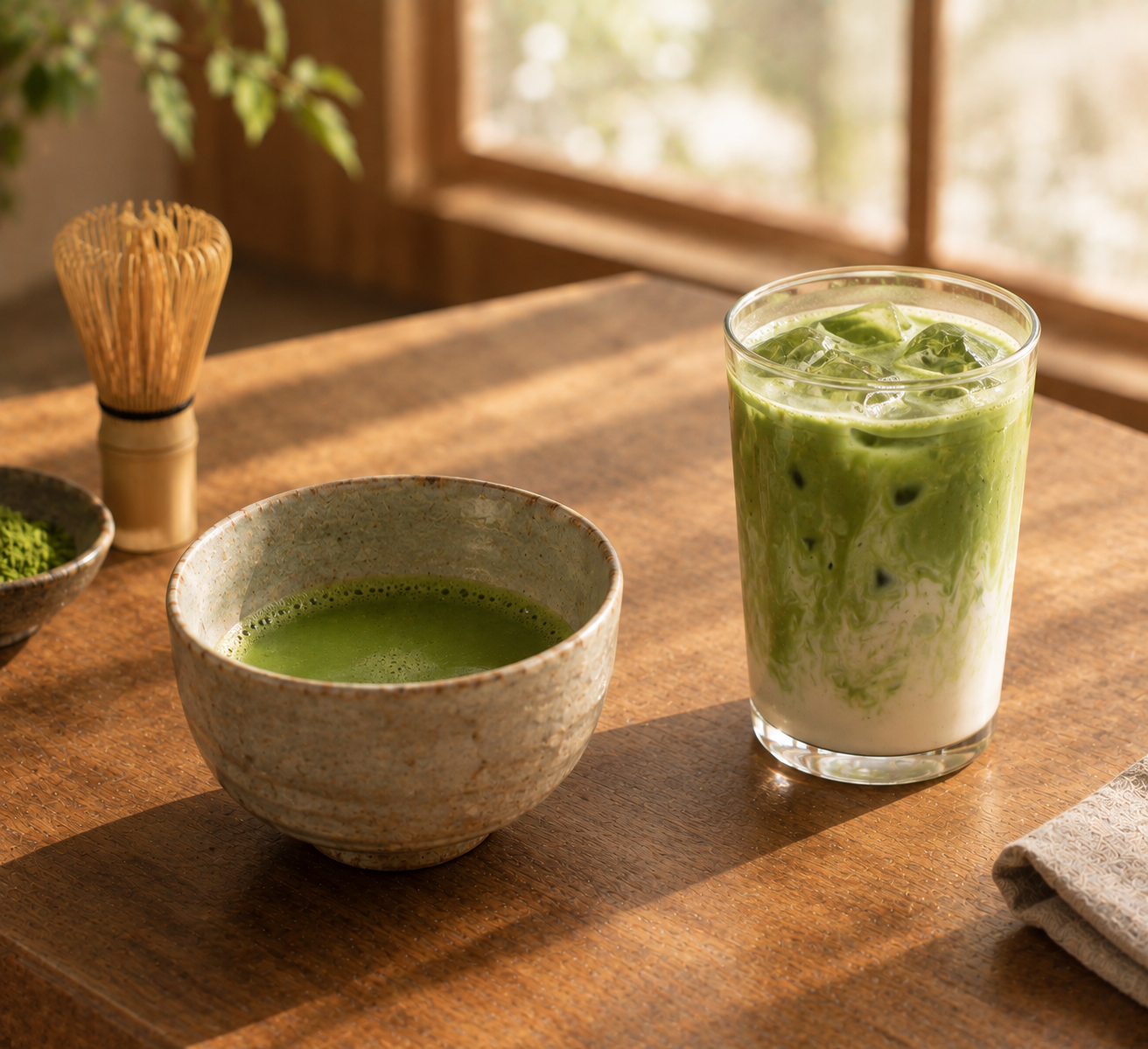
Plain matcha, just powder whisked into water, is essentially a non-issue calorically, somewhere around 6 calories for a typical 2-gram serving. A café matcha latte can run anywhere from under 50 calories to well over 300, and the gap between those numbers has almost nothing to do with the matcha itself. It’s entirely about what gets added to it, which is exactly the part most people never think to question when they assume “matcha” automatically means “light.”
The Problem You’re Actually Trying to Solve
You’ve searched for a matcha versus matcha latte calorie comparison because you’re trying to understand where the calories in your daily matcha habit are actually coming from, whether that’s out of general curiosity or because you’re paying attention to your overall intake and want accurate numbers rather than vague assumptions about matcha being automatically “healthy” or “light.”
Who This Article Is NOT For
Let’s save you some scrolling if this isn’t quite your situation.
- If you’re looking for specific calorie targets or a restrictive eating plan, this article isn’t that resource, and general information here shouldn’t be treated as individualized dietary guidance — a registered dietitian is the right resource for that.
- If you already know your preferred preparation and aren’t questioning the calories, there’s nothing here that changes what you’re already doing.
If you’re past that, here’s where the actual comparison starts.
The Numbers, Side by Side
| Preparation | Approximate Calories |
|---|---|
| Plain matcha (2g, whisked in water) | ~6 |
| Matcha latte, unsweetened almond milk | 40–65 |
| Matcha latte, unsweetened whole milk | 150–155 |
| Matcha latte, oat milk + 1 tbsp syrup | 180–220 |
| Café matcha latte (pre-sweetened powder, dairy milk, grande-sized) | 220–290 |
These are general ranges pulled from typical recipes and published café nutrition data, not exact figures for every product — actual numbers vary by brand, milk choice, and portion size.
Where the Calories Actually Come From
Plain Matcha Is Nearly Calorie-Free
Matcha itself, prepared traditionally with just water, is close to negligible calorically, similar to plain steeped green tea. This makes sense once you remember what matcha actually is: dried, ground tea leaf, with essentially no fat, sugar, or significant caloric content on its own.
Milk Is the First Major Variable
Once milk enters the picture, calories climb according to fat content. Unsweetened almond milk adds relatively little, often under 50 calories for a full serving, while whole dairy milk can add well over 100 calories on its own before any sweetener is considered. Oat milk tends to land in the middle, with its own naturally occurring sugars contributing a bit more than almond milk without reaching dairy’s fat-driven calorie count. Skim or low-fat dairy sits closer to the plant-based options than whole milk does, which is worth knowing if you prefer dairy’s flavor but still want to keep the number down.
Shop unsweetened almond and oat milk barista blends on Amazon →
Sweetener Is Usually the Biggest Swing Factor
A tablespoon of honey, maple syrup, or simple syrup typically adds somewhere between 48 and 70 calories on its own, and many café recipes use more than one serving’s worth. This is frequently the single largest calorie contributor in the whole drink, often outweighing the milk itself, and it’s also the easiest variable to control at home since you decide exactly how much, if any, goes in.
Pre-Sweetened Café Matcha Powder Changes the Math Entirely
This is the detail that surprises a lot of people. Some major coffee chains use a matcha powder that’s pre-blended with sugar as a base ingredient, meaning even an “unsweetened” order still carries built-in sugar you can’t fully opt out of. A grande-sized version of this kind of drink can land in the same calorie range as a plain milk-based espresso latte, which runs counter to matcha’s general reputation as the lighter option. Published nutrition data for one major chain’s grande matcha latte with whole milk shows roughly 220 to 240 calories and around 29 to 32 grams of sugar, almost identical to that same chain’s plain coffee latte at an equivalent size. My how to order a matcha latte at a café guide covers how to actually ask about this before you order, rather than finding out after the fact.
How It Stacks Up Against Other Popular Drinks
Context helps here, since “matcha latte” alone doesn’t tell you much without something to compare it against.
| Drink (roughly equivalent size) | Approximate Calories |
|---|---|
| Plain matcha or plain green tea | 2–6 |
| Black coffee or espresso shot | 2–5 |
| Unsweetened matcha latte, almond milk | 40–65 |
| Café matcha latte, dairy milk, pre-sweetened | 220–290 |
| Vanilla latte (espresso-based) | 250–320 |
| Blended matcha “cream” frappé-style drink | 350–450+ |
The pattern that shows up repeatedly: the base tea or coffee itself is nearly weightless calorically in every row of this table. What separates a 6-calorie cup from a 400-calorie one is entirely the dairy, sugar, and any blended or whipped additions layered on top, regardless of which base ingredient started the drink.
Ordering a Lighter Version Without Losing the Flavor
If you’re specifically trying to keep the calorie count down while still ordering out rather than making it yourself, a few adjustments make a real difference without asking you to give up the drink entirely.
Ask for the matcha “shots” or scoops reduced, not eliminated. Some cafés use a set number of matcha scoops per size, each carrying its own share of sugar if the powder is pre-sweetened. Asking for one fewer scoop trims both calories and sugar together, though it will also reduce the matcha flavor and caffeine somewhat.
Request sweetener on the side rather than mixed in. This single change gives you the ability to add exactly as little as you want, rather than trusting a default recipe amount that’s often more generous than necessary.
Choose unsweetened almond or oat milk over whole dairy. This is consistently one of the larger, easier swaps, often saving 50 to 100 calories depending on the size ordered.
Consider a smaller size rather than assuming you need the largest available. A tall matcha latte with the same recipe as a venti can carry less than half the calories simply due to portion size, which is an easy lever that has nothing to do with the recipe itself.
Where to Get Ingredients for a Lighter Build at Home
Shop unsweetened premium matcha powder on Amazon →
What This Means in Practice
If you’re drinking plain matcha: calories are essentially not a meaningful factor, similar to plain tea or black coffee.
If you’re making a latte at home: you have full control over milk type and sweetener amount, which is the single biggest lever for adjusting the calorie count in either direction, using ratios similar to what’s covered in my how to make a matcha latte guide.
If you’re ordering at a café: ask whether the base matcha powder is pre-sweetened before assuming “unsweetened” fully removes added sugar, since some blends carry sugar as a built-in ingredient rather than an optional add-on.
A Few Things People Ask Me
Does a matcha latte have fewer calories than a regular coffee latte? Not automatically. Because some café matcha powders are pre-sweetened, a matcha latte can land in a similar or even higher calorie range than a plain milk-based coffee latte at an equivalent size, depending on the specific chain and recipe.
Is oat milk or almond milk the lower-calorie choice for a matcha latte? Unsweetened almond milk is generally the lower-calorie option of the two, since oat milk carries somewhat more natural sugar and calories on its own, though both are meaningfully lighter than whole dairy milk.
Do the health benefits of matcha offset the calories in a latte? That’s a different question from calorie counting specifically — matcha’s catechin and L-theanine content doesn’t change based on how many calories are in the milk and sweetener surrounding it. The two are worth thinking about separately rather than assuming one cancels out the other.
Is it possible to get the flavor of a sweet matcha latte with meaningfully fewer calories? Reducing sweetener gradually, using a bolder culinary or latte-grade matcha (which needs less dressing up to taste satisfying), and choosing a lighter milk are the three most effective adjustments, roughly in that order of impact.
Does iced versus hot change the calorie count at all? Not meaningfully on its own — ice itself carries no calories, so an iced and hot version of the same recipe, same milk, same sweetener amount, will land at essentially the same total. Any difference you notice between a café’s iced and hot versions usually comes down to a different recipe or portion size, not the temperature itself.
Are “protein matcha” or other fortified café versions actually lower in calories? Not usually, and sometimes the opposite. Added protein powder or collagen typically increases the total calorie count even when sugar is reduced, since protein itself carries calories too. These drinks are better understood as a different nutritional tradeoff, more protein for a similar or higher calorie cost, rather than a straightforwardly “lighter” option.
Does the size of the matcha serving itself (not the milk) meaningfully change calories? Barely. Even doubling the matcha powder in a drink adds only a handful of calories, since matcha itself is so close to negligible. If a “stronger” or “double matcha” version of a drink costs noticeably more calories, that’s almost always because it also comes with more milk or sweetener, not because of the matcha increase itself.
Where I Landed
The calorie story here really isn’t about matcha at all — it’s about milk and sugar, the same two variables that determine the calorie count of nearly every espresso-based drink too. Plain matcha is about as close to calorie-free as a satisfying beverage gets. What you build around it is entirely up to you, and knowing where the calories actually come from means you can make that choice deliberately rather than assuming the word “matcha” on a menu automatically means “light.”
If you want full control over that build, twenty minutes with the right ratios is all it takes to make your own.