Disclosure: This post contains affiliate links. If you buy through one of them, I may earn a small commission at no extra cost to you.
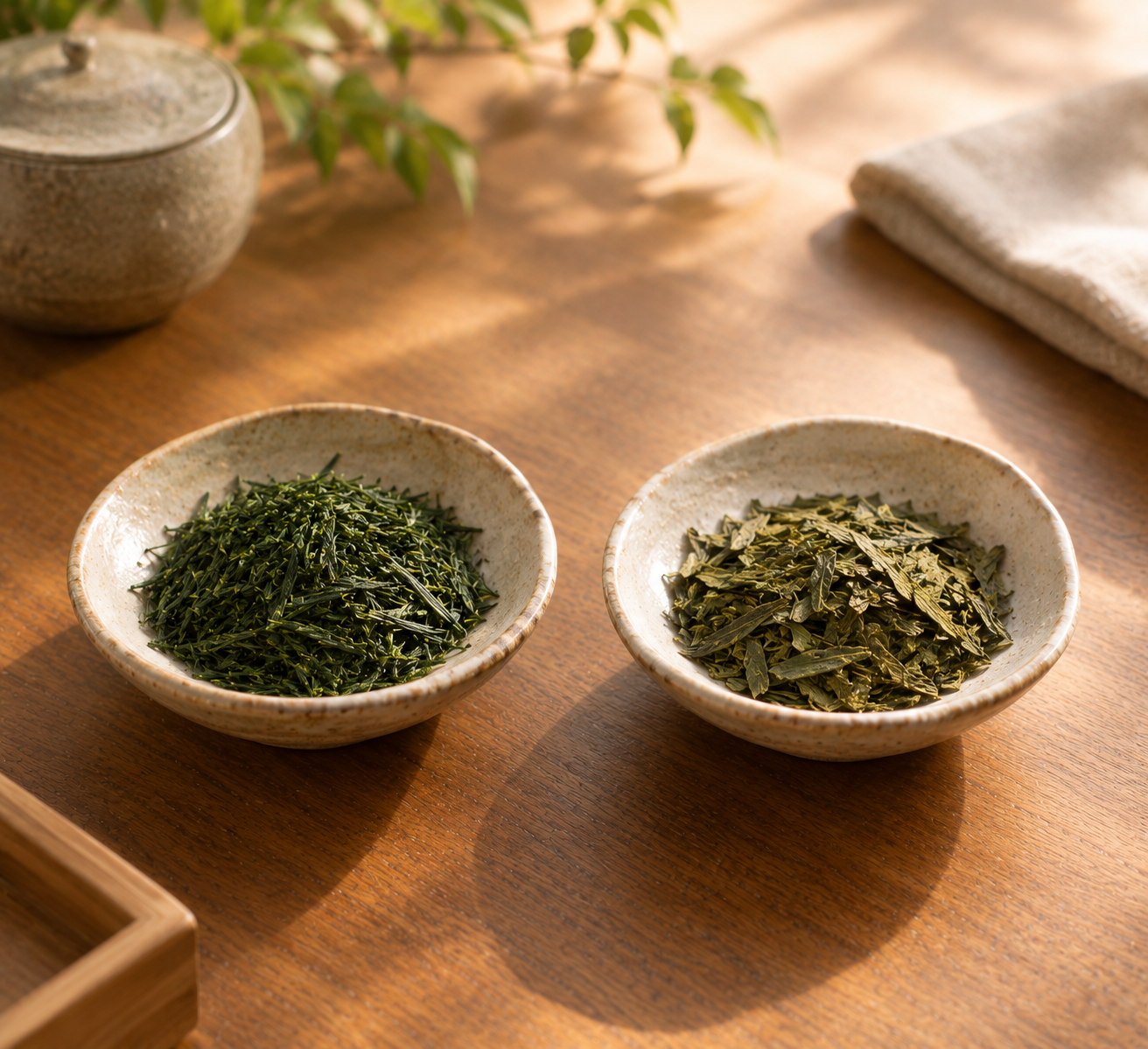
I spent a while assuming Japanese and Chinese green tea were basically the same thing with different packaging, until I brewed a Longjing and a sencha side by side and realized they barely tasted like they belonged to the same category. One was toasty, nutty, almost chestnut-like. The other was bright, grassy, and distinctly vegetal, closer to steamed spinach than anything I’d associate with a nutty roast. Same plant. Wildly different result, and not the kind of difference that a shared “green tea” label prepares you for.
The reason for that gap comes down almost entirely to one processing decision made in the first minute or two after the leaves are picked, and once you understand that single choice, most of the other differences between Japanese and Chinese tea start making sense as downstream consequences of it, rather than a random grab bag of unrelated facts you have to memorize separately.
The Problem You’re Actually Trying to Solve
You’ve searched for an explanation of Japanese versus Chinese tea because you’ve noticed they taste genuinely different and want to understand why, or you’re trying to decide which tradition to explore first and want to know what actually separates them beyond country of origin. Both are reasonable things to want clarified, since a lot of general “tea guide” content treats both traditions as a single undifferentiated category, which undersells just how distinct they actually are.
Who This Article Is NOT For
Let’s save you some scrolling if this isn’t quite your situation.
- If you’re looking for a comparison of black or oolong tea traditions specifically, this article focuses on green tea, since that’s where the processing divide between Japan and China is most pronounced and most relevant to what most readers are actually asking about.
- If you already know the steaming-versus-pan-firing distinction well, this is a foundational explainer, not new information for someone already deep into tea processing knowledge.
- If you want a ranking of which tradition is “better”, that’s a matter of personal taste, not an objective fact — this article explains the differences rather than declaring a winner.
If you’re past that, here’s where the actual guide starts.
The Core Difference: Steaming vs. Pan-Firing
Both Japanese and Chinese green tea come from the same plant, Camellia sinensis, and both need to stop oxidation quickly after harvest to preserve that green color and fresh character. How each tradition accomplishes that single goal is where everything else diverges.
Japan steams its leaves. Freshly picked leaves are steamed for roughly 15 to 60 seconds (sometimes up to 120 for a deep-steamed style called fukamushi), a process that halts oxidation almost instantly, locks in chlorophyll, and preserves high levels of the compounds responsible for that bright green color and vegetal, sometimes described as “oceanic,” flavor. This steaming tradition dates back to a technique introduced over a thousand years ago and has remained the defining processing choice for Japanese green tea ever since.
China pan-fires its leaves. Fresh leaves are tossed in a dry, extremely hot wok or drum, reaching temperatures well above what steaming involves, for several minutes rather than seconds. This method also halts oxidation, but produces a noticeably toastier, nuttier flavor profile with less of the grassy vegetal character steaming preserves. The extended dry heat also develops more complex aromatic compounds than the faster, moist-heat steaming process does.
Neither method is more “correct” than the other — they’re simply different technical choices that lead to genuinely different sensory results, the tea equivalent of a light roast versus a dark roast in coffee.
Comparison Table
| Japanese Green Tea | Chinese Green Tea | |
|---|---|---|
| Oxidation-stopping method | Steaming (15–60+ seconds) | Pan-firing (several minutes, high heat) |
| Typical flavor | Grassy, vegetal, sometimes oceanic | Toasty, nutty, sometimes chestnut-like |
| Typical color | Bright, vivid green | Lighter yellow-green to pale green |
| Brewing temperature | Cooler (roughly 70–80°C / 158–175°F) | Slightly hotter tolerance (roughly 77–90°C / 170–195°F) |
| Common forms | Sencha, gyokuro, matcha (machine-processed, uniform) | Longjing, Biluochun, many hand-shaped, artisanal forms |
Why the Flavor Difference Is So Noticeable
Steaming is a fast, moist-heat process that locks in the leaf’s fresh, vegetal character before much can change. Pan-firing is a slower, dry-heat process, and that extended heat exposure is what develops the toasted, nutty notes Chinese green teas are known for. It’s a genuinely similar relationship to how steaming versus roasting vegetables produces different flavors from the same starting ingredient, even though both methods are considered “cooking.”
This is also why brewing temperature guidance differs between the two traditions. Japanese green teas, especially delicate styles like gyokuro, are more sensitive to heat during brewing and can turn harshly bitter above roughly 80°C, while Chinese pan-fired teas are somewhat more forgiving of hotter water, since the pan-firing process itself already modifies some of the compounds responsible for that bitterness.
Why the Appearance Differs Too
Japanese tea’s steaming process helps preserve a notably higher water content in the leaf immediately after processing, and the leaves are typically machine-rolled into uniform needle shapes (as with sencha) or ground into a fine powder (matcha), producing a fairly standardized, utilitarian look across a given tea type.
Chinese green tea, by contrast, often comes in a wider range of hand-finished shapes and forms, reflecting a longer history of regional, artisanal shaping techniques, from the flat pressed leaves of Longjing to the tightly curled leaves of Biluochun. If you’re someone who enjoys the visual and tactile side of loose leaf tea, Chinese green tea generally offers more variety to explore there.
Is One Actually Healthier Than the Other?
Both traditions offer genuinely beneficial compounds, and it’s worth being careful not to overstate the gap. Japanese green tea’s steaming method does tend to preserve somewhat higher levels of certain catechins, including EGCG, along with L-theanine, compared to the higher-heat pan-firing process, which can break down a portion of these compounds during the longer, hotter processing. That said, Chinese green teas retain their own beneficial compound profile, shaped by different cultivars and regional growing conditions, and “different” isn’t the same as “worse.”
If you’re choosing based on health considerations specifically, both are reasonable choices within a balanced diet, and the difference in compound concentration, while measurable, isn’t dramatic enough to make one an obviously superior everyday choice over the other. Personal enjoyment and how likely you are to actually drink it consistently probably matters more for real-world benefit than a modest difference in catechin concentration between two genuinely healthy beverages.
Where to Explore Both
Shop Japanese sencha on Amazon →
Shop Chinese Longjing (Dragon Well) tea on Amazon →
Which Tradition to Start Exploring
If you’re drawn to bright, vegetal, grassy flavors: Japanese sencha is the natural starting point, and it’s also the most common everyday Japanese green tea, making it easy to find good options.
If you prefer toasty, nutty, more mellow flavors: a Chinese Longjing (Dragon Well) is one of the most widely available and well-regarded starting points into that tradition.
If you want the most concentrated, ritual-heavy experience: Japanese gyokuro or matcha, both built around more intensive shading and preparation than most everyday Chinese green teas.
If you want variety in shape, form, and regional character within a single visit to a tea shop: Chinese green tea’s wider range of hand-finished styles gives you more to explore in that specific dimension.
A Few Things People Ask Me
Does matcha have a Chinese equivalent? Not really in the same form. While powdered tea has historical roots in China (and was actually the origin of the practice before it developed further in Japan), the specific shade-grown, stone-ground matcha tradition as it exists today is distinctly Japanese. Chinese tea culture developed in a different direction, favoring loose leaf brewing over powdered preparation.
Is oolong tea part of this comparison? Not directly — oolong is a partially oxidized tea, distinct from the fully unoxidized green teas covered in this guide, and it’s a category where Chinese and Taiwanese tea traditions are especially prominent rather than Japanese ones specifically.
Can I brew Chinese green tea the same way I’d brew Japanese green tea? You can start with similar principles, avoiding boiling water and oversteeping, but Chinese pan-fired teas generally tolerate slightly hotter water and can be a bit more forgiving of small timing errors than delicate Japanese teas like gyokuro. My green tea brewing temperature guide covers the Japanese side of this in detail if you want the more precise version.
Why does Japanese tea seem more standardized while Chinese tea has so many named regional varieties? Japanese tea production is more centralized around a smaller number of well-established styles (sencha, gyokuro, matcha, hojicha) with more standardized machine processing, while China’s much larger and more geographically spread tea industry has developed a wider range of regional specialties and hand-processing traditions over a longer history. Neither approach is better, they just reflect different scales and histories of production.
Is it fair to say Chinese tea culture is “older” than Japanese tea culture? In terms of tea’s origin as a beverage, yes — tea drinking has a longer documented history in China, and Japan’s tea tradition developed later, initially influenced by Chinese practices before evolving into its own distinct culture, most visibly through the Japanese tea ceremony. That said, “older” doesn’t mean more refined or more advanced; both traditions developed genuine depth and sophistication on their own separate timelines.
Do Japanese and Chinese teas use different tea plant varieties, or is it purely a processing difference? Both primarily use the same species, Camellia sinensis, though different cultivars within that species are favored regionally in each country, shaped by local climate and centuries of selective cultivation. Processing remains the more dominant factor in the flavor difference, but cultivar selection does add its own layer of regional character on top of that.
Where I Landed
The steaming-versus-pan-firing distinction really is the single thread that explains almost everything else — flavor, color, brewing temperature tolerance, and even how the leaves end up shaped. Once that clicks, the rest of the comparison stops feeling like a list of disconnected facts and starts feeling like the logical consequence of one early decision made within seconds of harvest, the same way understanding roast level unlocks most of what differentiates one coffee from another.
Neither tradition needs to be your only tradition, either. Plenty of tea drinkers keep both a Japanese sencha and a Chinese Longjing in rotation, reaching for one or the other depending on mood, rather than treating this as a permanent allegiance to pick once and never revisit.
If Japanese tea is where your curiosity is currently pointed, my green tea brewing temperature guide and how much tea leaf to use in a kyusu guides are good next stops for actually brewing it well once you’ve decided which tradition to explore first.