Disclosure: This post contains affiliate links. If you buy through one of them, I may earn a small commission at no extra cost to you.
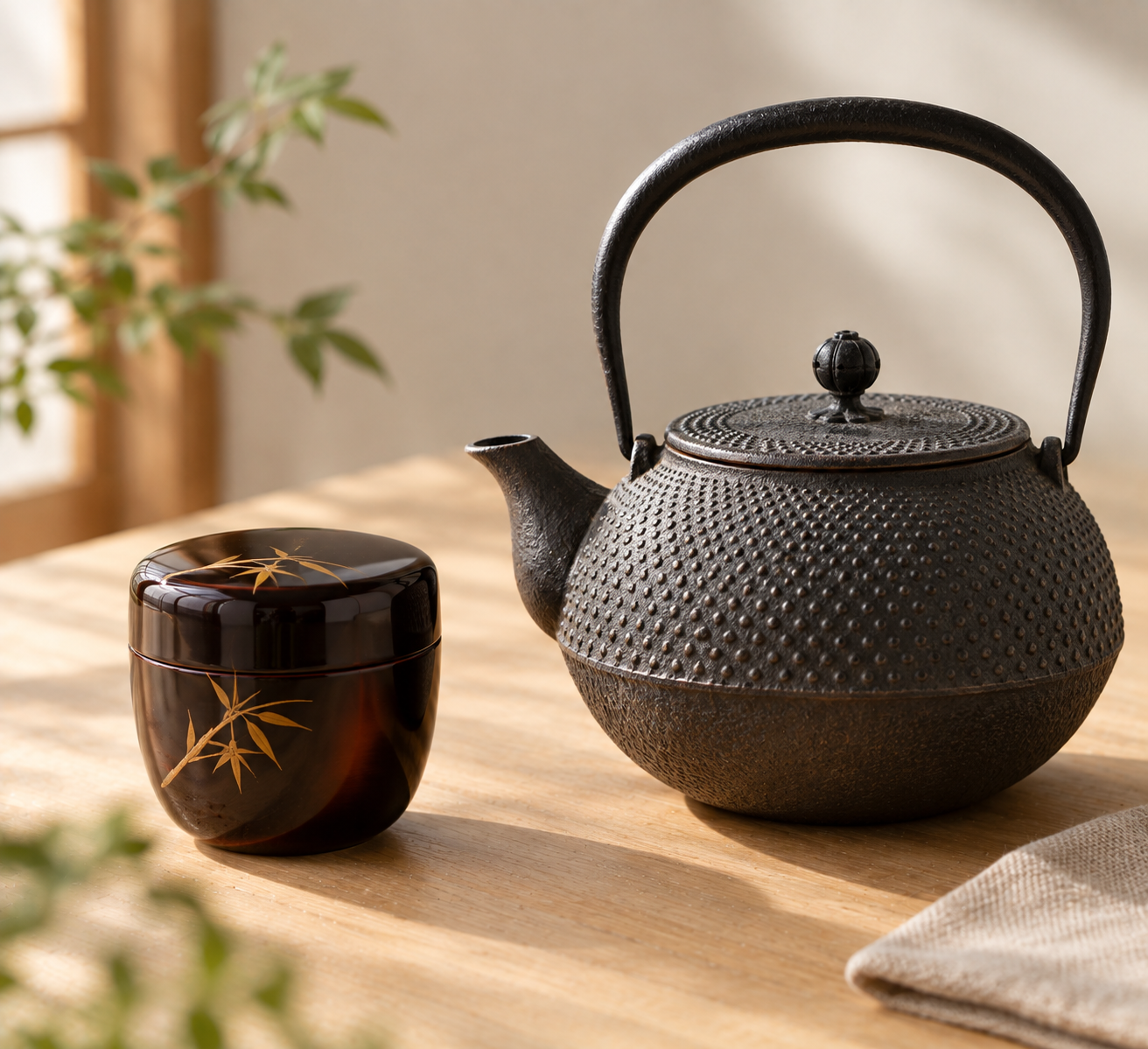
I made two mistakes early on with Japanese teaware, and they were opposite mistakes. I left water sitting in a tetsubin overnight, thinking cast iron was tough enough not to care – it rusted. Then, worried about damaging a lacquered natsume I’d bought, I stored it in a sealed plastic bag “to protect it” – which turned out to be exactly the wrong move, since sealed damp storage is one of the things that actually damages lacquerware.
Urushi lacquerware and tetsubin cast iron are both durable in their own right, but they fail in specific, predictable ways when handled like ordinary ceramic or stainless steel. Knowing what each one actually needs (and doesn’t need) is most of the battle.
The Problem You’re Actually Trying to Solve
Both of these materials get treated too cautiously in some ways and not carefully enough in others. People baby lacquerware by sealing it away rather than using it, when it’s actually meant for regular use and improves with handling. Meanwhile, people treat cast iron as basically indestructible, when moisture left sitting inside a tetsubin for even a single evening can start visible rust. The care routines for each are simple once you know them, but they’re not intuitive if you’re coming from caring for ordinary dishware.
Who This Article Is NOT For
- If you’re looking for chasen (bamboo whisk) care specifically, my chasen care guide covers that separately – bamboo has entirely different failure points than iron or lacquer.
- If your tetsubin has a fully enameled interior (common on many modern, budget-friendly versions), the rust-prevention section below matters less to you, since enamel coating largely protects against the bare-iron rust issue.
- If you’re buying your first kyusu rather than caring for lacquerware or cast iron you already own, my kyusu buying guide is the more relevant read.
Caring for a Tetsubin (Cast Iron Teapot)
Never leave water sitting inside it. This is the single most important rule, and the one I broke first. Empty the tetsubin while it’s still hot right after use – the residual heat helps dry the interior almost instantly, whereas water left to cool and sit inside is exactly what starts rust forming on bare cast iron.
Skip the dish soap. Traditional (non-enameled) cast iron is porous, and soap strips away the seasoning that protects the interior surface. Clean with hot water only, using a soft brush – a bamboo sasara brush is the traditional tool – rather than reaching for detergent out of habit.
Dry it actively, not just by air. After washing, place the tetsubin over low heat for a minute or two until all surface moisture has fully evaporated. Air-drying alone often isn’t thorough enough, especially inside the spout and lid areas where water likes to linger.
If rust spots do appear, treat them right away. Small orange rust spots can be addressed by scrubbing gently with a stiff brush or fine sandpaper. A more traditional fix: boil green tea leaves inside the tetsubin – the tannins react with the exposed iron to form a protective black film over the rusted area.
Store it dry, in an open, airy spot. Avoid leaving it in a damp sink, a closed cabinet with poor airflow, or anywhere humidity tends to build up. The combination of thorough drying after each use and airy storage is really the entire rust-prevention strategy.
Caring for Urushi Lacquerware (Natsume and Beyond)
Hand-wash only, and do it gently. Use lukewarm water, a soft sponge, and a neutral, non-abrasive soap – never steel wool or a stiff scouring pad, which will scratch through the lacquer finish. Rinse thoroughly and dry immediately with a soft cloth rather than letting it air-dry, since sitting wet is part of what damages the finish over time.
Keep it away from the dishwasher and the microwave, unless the specific piece is explicitly labeled as safe for either – most traditional urushi lacquerware isn’t, and the heat and washing action in a dishwasher will damage the finish. The same caution applies to sudden contact with boiling-hot liquid; let things cool slightly before they touch lacquerware if the piece doesn’t specifically say it can handle high heat.
Store it out of direct sunlight. UV exposure fades and degrades lacquer finish over time, so a shaded cabinet is the right home for it rather than an open shelf that gets direct sun for part of the day. If fading has already started, moving it out of light going forward is the first step – a professional restorer can advise from there if the piece is valuable enough to warrant it.
Don’t seal it away damp, and don’t over-protect it either. Ironically, both extremes cause problems: sealing a piece into an airtight bag or box while it’s even slightly damp encourages mold, while treating lacquerware as too precious to actually use denies it the handling that genuine urushi is designed for – well-made lacquerware actually grows more lustrous and durable with regular use over years, not less. If you’re storing multiple pieces stacked together, separate them with soft cloth or thin paper to avoid pressure marks on the finish, and check on stored pieces occasionally for any sign of moisture or pest damage.
A Few Things People Ask Me
Can I use dish soap on my tetsubin if it’s really stuck with residue? For traditional bare cast iron, it’s better to avoid soap even then – hot water and a gentle brush, repeated if necessary, is the safer approach. If a tetsubin has an enameled interior, ordinary dish soap is generally fine, since the enamel isn’t porous the way bare iron is.
Is it normal for a well-used tetsubin to develop a black coating inside over time? Yes – that’s the seasoning building up, similar to a cast iron skillet, and it’s a sign of good care rather than something to scrub away. It’s part of what protects the interior from rust in the first place.
How do I know if my lacquerware piece is safe for the dishwasher or microwave? Only assume it is if the manufacturer or seller explicitly says so – traditional handmade urushi lacquerware almost never is, and treating it as dishwasher-safe by default is one of the more common ways people damage a piece they didn’t realize was more delicate than it looked.
What’s a reasonable first cast iron teapot if I don’t already own one? A tetsubin on Amazon with an enameled interior is the more forgiving starting point if you’re worried about the rust-prevention routine above – it gives you most of the aesthetic and heat-retention benefits with a lower risk of a beginner mistake turning into visible rust.
Where I Landed
The pattern across both materials, once I actually understood it, was less about fragility and more about moisture and timing. Cast iron fails when water sits too long; lacquerware fails when it’s either mistreated with heat and abrasion or, just as often, oversealed away out of misplaced caution. Neither one needs to be treated like fine china sitting behind glass – they need specific, fairly simple habits, done consistently, and both genuinely reward regular use over being kept for best. If you’re building out a small collection of Japanese teaware pieces, Nio Teas’ teaware selection is worth a look alongside whatever tetsubin or lacquerware you already have.