Disclosure: This post contains affiliate links. If you buy through one of them, I may earn a small commission at no extra cost to you.
Most people think of Japanese tea as fresh, green and grassy – the opposite of fermented. And for nearly all Japanese tea, that’s true: sencha, gyokuro and matcha are steamed precisely to stop any fermentation. But in a few remote mountain villages, mostly on the island of Shikoku, farmers have been making something completely different for centuries: teas fermented with bacteria, like pickles, that taste sour, earthy and unlike anything else in Japanese tea.
These are Japan’s post-fermented teas. They’re rare, a few of them very nearly disappeared, and they’re one of the most fascinating corners of Japanese tea culture. This guide covers the four you’re most likely to hear about, how they’re made, and how to brew them.
The Problem You’re Actually Trying to Solve
If you’ve seen “goishicha” or “awa bancha” in a specialty tea shop, you probably had questions: Is it green tea? Is it like pu-erh? Why does it smell sour? Is it supposed to? English information is limited, and many descriptions mix these teas up with ordinary bancha or with kombucha.
Who This Article Is NOT For
- If you’re looking for the general difference between Japanese and Chinese tea processing, my Japanese vs. Chinese tea comparison explains why most Japanese tea is steamed instead.
- If you’re interested in fermented tea for health reasons, I’m not going to make medical claims here. Some research on these teas is ongoing, but treat them as a fascinating drink, not a remedy. For what’s actually known about green tea and health, see my careful look at green tea health benefits.
- If you want a fizzy fermented drink, that’s kombucha – made by fermenting sweetened tea with a culture, not by fermenting the leaves themselves.
What “Post-Fermented” Actually Means
Tea people use the word “fermentation” in two very different ways, which causes a lot of confusion.
- Oxidation (often loosely called fermentation) is what turns leaves dark in black tea and oolong. It’s driven by the leaf’s own enzymes – no microbes involved.
- True fermentation, or post-fermentation, uses microorganisms – molds and bacteria – to transform the leaves after they’ve been heated. That’s how Chinese pu-erh and other dark teas are made, and it’s how Japan’s fermented teas are made too.
What makes Japan’s fermented teas special is that most of them rely on lactic acid bacteria, the same kind of microbes that ferment pickles, sauerkraut and yogurt. That’s where their distinctive sourness comes from.
In 2018, the traditional fermented tea techniques of Shikoku – goishicha, awa bancha and Ishizuchi kurocha – were recognized by Japan’s national government as folk cultural properties worth recording and preserving.
Goishicha (Kochi): The “Go Stone” Tea
Where: Otoyo Town, in the mountains of Kochi Prefecture
Goishicha (碁石茶) is probably the most famous Japanese fermented tea, and it has the most elaborate process. It’s fermented twice:
- Steaming. Tea branches with their leaves are harvested in early summer (roughly mid-June to early August) and steamed in a large cauldron for about two hours.
- First fermentation (aerobic). The leaves are stripped from the branches and spread on straw mats in a closed room for about a week, where molds grow on them.
- Second fermentation (anaerobic). The leaves are packed into wooden barrels with the steaming liquid, covered, and weighted down with stones for about two weeks. Without air, lactic acid bacteria take over.
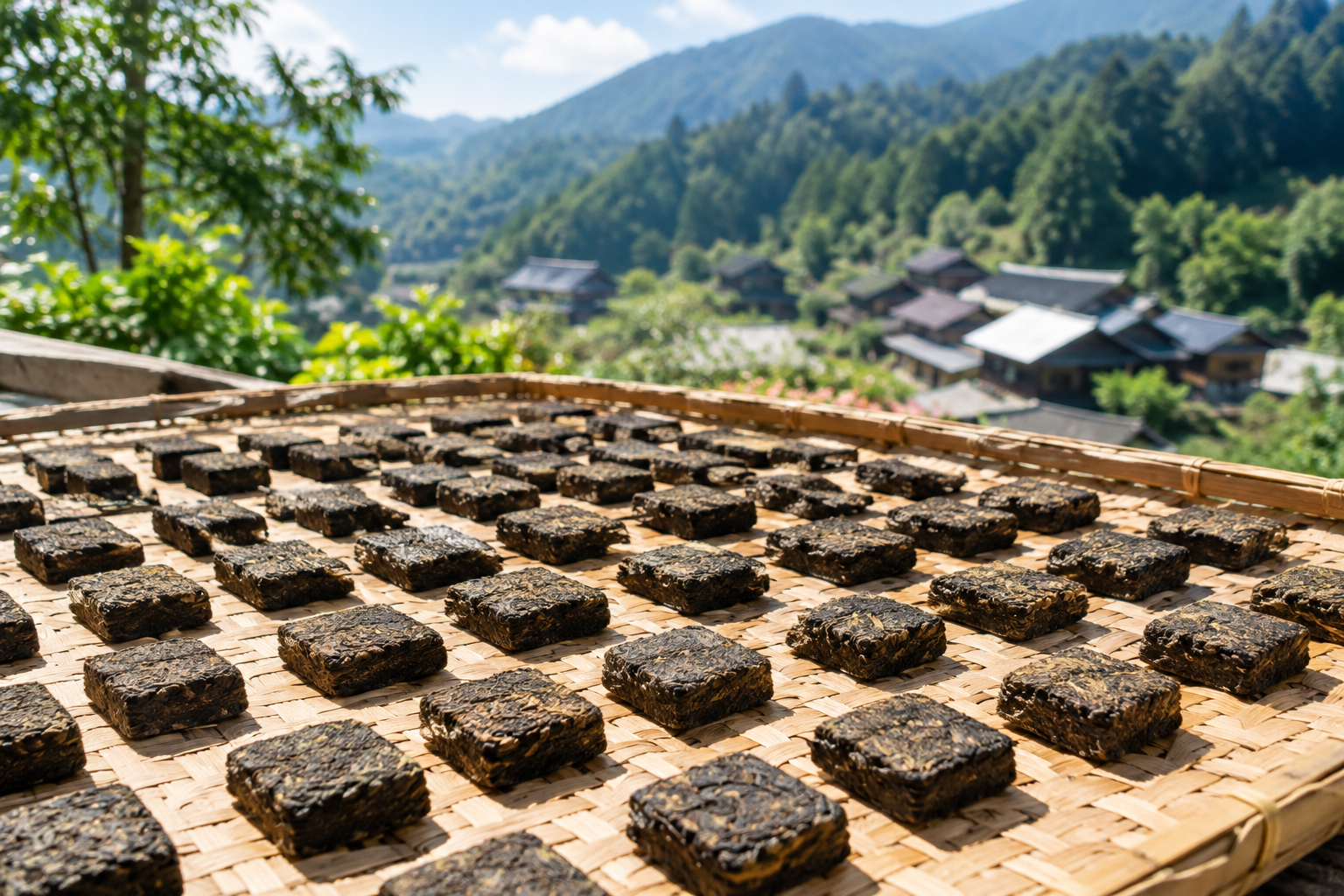
- Cutting and drying. The pressed leaves are cut into small squares about 3-4cm across and dried in the sun for several days.
The name comes from that final step: the dark squares lying on straw mats look like stones on a Go board.
Flavor: sharply sour and tangy, with an earthy depth. It’s often compared to a mild vinegar or pickled plum – not what you’d expect from a cup of tea.
Tradition: in parts of Japan’s Seto Inland Sea region, goishicha was historically used to make chagayu, rice porridge cooked in tea, which created a market for this small mountain town’s product.
Awa Bancha (Tokushima): The Pickled Summer Tea
Where: Kamikatsu and Naka towns in Tokushima Prefecture
Awa bancha (阿波晩茶) is the most approachable of Japan’s fermented teas, and the one people in its home region actually drink every day. The “ban” in its name is written with the character for “late” (晩), because it’s made from mature leaves picked late in the season, from about July to August – the opposite of delicate spring sencha.
How it’s made:
- Boiling. Instead of steaming, the leaves are boiled.
- Rolling. They’re rolled or rubbed, by machine or by hand, to break them down.
- Fermentation (anaerobic). The leaves are packed tightly into barrels, covered with the cooking liquid and weighted to keep out air. Lactic acid fermentation runs for about two weeks to a month.
- Sun-drying. Finally, they’re dried outdoors on mats for a few days.
Because it relies on the local bacteria in each farm’s barrels, no two batches taste exactly alike.
Flavor: gently sour, with a soft, slightly savory sweetness and almost no bitterness. Tasters often describe hints of pickles, olives or umeboshi. It’s much milder than goishicha and is an excellent introduction to fermented tea.
Caffeine: generally considered low, because it’s made from mature summer leaves and fermented – though it isn’t caffeine-free.
Ishizuchi Kurocha (Ehime): The Tea That Nearly Vanished
Where: the area around Mount Ishizuchi, Ehime Prefecture
Ishizuchi kurocha (“Ishizuchi black tea”) is made with a double fermentation similar to goishicha: a first, aerobic fermentation with molds, then an anaerobic lactic acid fermentation, before the leaves are dried in the sun.
Its story is a near-miss. Production declined so much in the 20th century that, at one point, only one elderly couple was still making it. A local group learned the method from them to keep the tradition alive, and today it’s produced again in small amounts. In 2023, its production method was designated an Important Intangible Folk Cultural Property of Japan.
Flavor: strongly sour and acidic when young. Like some wines, it’s said to mellow with a few years of careful storage.
Batabata-cha (Toyama): The Whisked Fermented Tea
Where: Asahi Town, Toyama Prefecture, on the Japan Sea coast
The last one is different in both place and style. In Asahi, a dark fermented tea, made from mature leaves, is boiled, poured into a bowl with a pinch of salt and whipped with a special double-headed bamboo whisk until frothy. The custom – named after the brisk “bata bata” whisking – is a social one: neighbors gather to share batabata-cha at community gatherings and religious occasions.
Flavor: mild, slightly salty and gently earthy, with a soft foam.
How the Four Compare
| Tea | Region | Fermentation | Flavor |
|---|---|---|---|
| Goishicha | Otoyo, Kochi | Two-stage (mold, then lactic acid) | Sharp, sour, earthy |
| Awa bancha | Kamikatsu / Naka, Tokushima | Lactic acid (anaerobic) | Mild, gently sour, savory |
| Ishizuchi kurocha | Mount Ishizuchi area, Ehime | Two-stage (mold, then lactic acid) | Strongly sour, mellows with age |
| Batabata-cha | Asahi, Toyama | Microbial fermentation | Mild, salted, whisked frothy |
How to Brew Japan’s Fermented Teas
These teas are brewed hotter and longer than green tea. They’re forgiving – there’s little bitterness to worry about.
Awa bancha:
- About 5g of leaf per 300ml of boiling water
- Steep for 2-3 minutes, or simmer briefly for a stronger cup
- Can be re-steeped several times, lengthening the time each round
- Excellent cold: brew hot, then chill
Goishicha:
- Simmer one or two squares in about 1-1.5 liters of water for around 10 minutes
- Drink hot, or chill it for a refreshing, tangy summer drink
- Some people blend it with other teas to soften the sourness
Ishizuchi kurocha: brew like goishicha, starting with a small amount since it’s quite sour.
Tip: if the sourness surprises you, try a little less leaf, or mix the brewed tea half and half with hojicha or roasted barley tea.
Buying and Storing
These teas are produced in small amounts, so they’re mostly found at specialty tea shops, regional shops or online. A few tips:
- Check the region on the label. Real goishicha comes from Otoyo, awa bancha from Kamikatsu or Naka.
- Expect variation. Small-batch fermentation means flavor changes from year to year and farm to farm – that’s part of the charm.
- Store it dry and dark. Keep it in an airtight container, away from moisture and strong smells.
A Few Things People Ask Me
Is this the same as pu-erh? They’re related – both are post-fermented with microbes – but Japan’s versions mostly use lactic acid fermentation, which makes them noticeably sour. Pu-erh tends to be earthy rather than tangy.
Is awa bancha the same as regular bancha? No. Ordinary bancha is an everyday green tea made from later-harvest leaves, and it isn’t fermented. Awa bancha shares the name because it’s also made from mature leaves, but its fermentation makes it a completely different drink.
Is it the same as kombucha? No. Kombucha is sweetened tea fermented with a culture after brewing. These teas are fermented as leaves, before brewing.
Where can I buy them? Look for awa bancha on Amazon – the easiest one to find and the best first try. If you want to go further, goishicha on Amazon is the classic, more intense version.
Where I Landed
Japan’s fermented teas are a reminder that “Japanese tea” isn’t only about bright spring greens. In a handful of mountain villages, people found a way to preserve summer leaves with bacteria, wooden barrels and sunshine – and created teas that taste like nothing else. Start with a cup of awa bancha. If its gentle tang wins you over, goishicha is waiting.