Disclosure: This post contains affiliate links. If you buy through one of them, I may earn a small commission at no extra cost to you.
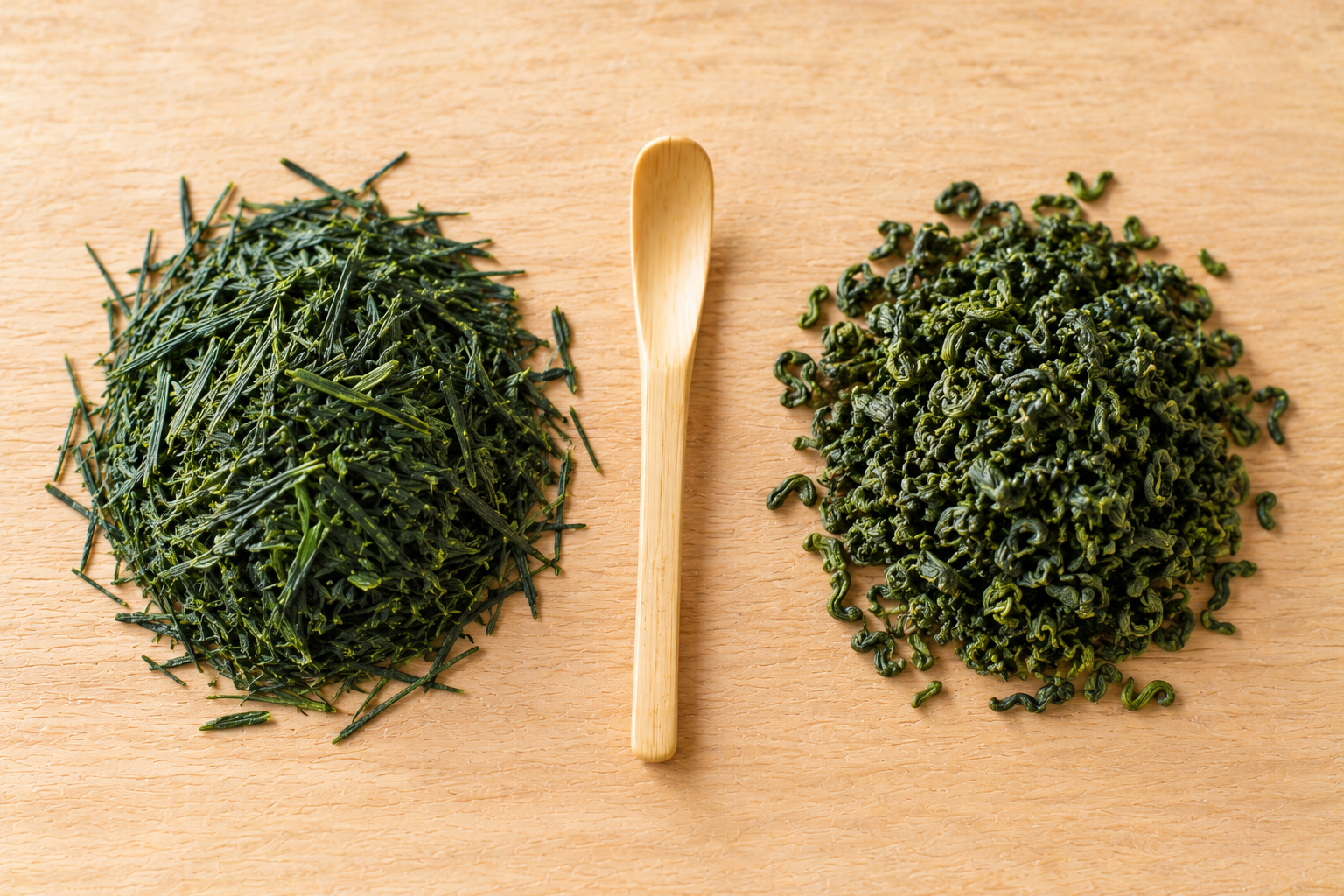
Pour a spoonful of sencha onto a plate and you’ll see fine, straight, dark-green needles. Pour out a spoonful of tamaryokucha next to it and the difference is obvious: the leaves are curled into little commas and coils, like tiny green question marks. They look almost like a Chinese tea. In the cup, they taste softer and rounder than sencha, with less bite and a gentle, almost fruity sweetness.
Tamaryokucha (玉緑茶, “jade green tea”) – also called guricha, “curly tea” – is one of Japan’s lesser-known green teas. It makes up only around 3% of the country’s production, mostly in Kyushu, and its curly shape has a surprisingly interesting history involving the Soviet Union.
The Problem You’re Actually Trying to Solve
Most people come across tamaryokucha on a specialty tea list and wonder whether it’s just sencha with a different name, or a different kind of tea altogether. The confusion is understandable: some tamaryokucha is steamed like sencha, and some is pan-fired like Chinese green tea. Knowing which is which – and what that does to the flavor – is the key to choosing one you’ll like.
Who This Article Is NOT For
- If you love sencha’s bright, grassy edge, tamaryokucha is deliberately gentler. It may feel a little soft at first.
- If you want rich, savory umami, a shaded tea like gyokuro is the better choice.
- If you’re looking for the deep green, cloudy, full-bodied cup of deep-steamed tea, my fukamushi sencha guide covers that style instead.
What Makes It Tamaryokucha: The Missing Step
To understand tamaryokucha, it helps to know how sencha gets its shape. Sencha goes through several rolling stages, ending with a final shaping step (seijū) that presses the leaves into straight, thin needles.
Tamaryokucha skips that final straight-rolling step. Instead, the leaves are dried while being tumbled, often in a rotating drum, and they naturally curl into comma and spiral shapes – the “jade” or magatama (curved bead) shape that gives the tea its name.
That one difference in processing changes both how the tea looks and how it brews: curled leaves unfold more slowly in the pot, giving a gentler, rounder extraction.
Two Kinds: Steamed and Pan-Fired
There are two main types of tamaryokucha, and it’s worth knowing which one you’re buying:
Mushisei tamaryokucha (steamed). The leaves are steamed like sencha, then curled and dried. Often shortened to mushiguri (“steamed curly”) in Kyushu. It tastes closest to sencha, but milder and rounder. This is the type most people mean by “tamaryokucha” or “guricha” today.
Kamairisei tamaryokucha (pan-fired). The leaves are heated in an iron pan instead of steamed. This is usually just called kamairicha, and it has a light, toasty aroma and a golden cup.
If the label says “kamairi,” it’s pan-fired. If it says “mushisei,” “mushiguri” or simply “guricha,” it’s almost always steamed.
A Tea Made for Export
The steamed version has an unusual origin story. Around 1930, Japanese tea makers wanted to sell more tea to the Soviet Union, where drinkers were used to curly, pan-fired Chinese green tea. Straight Japanese sencha didn’t look right to them. So Japanese producers developed a steamed tea shaped to resemble Chinese tea, and steamed it longer than usual to soften its bitterness.
It worked. Exports grew quickly, and the name tamaryokucha was chosen through an industry call for names in 1932, during that export boom. After the war, it was also exported to North Africa and Central Asia. As those export markets faded, producers began selling it at home, where it found a following of its own.
The nickname guricha comes from the swirling, scroll-like “guri” pattern found in traditional Japanese lacquerwork, which the curled leaves resemble. The name started in the Izu area of Shizuoka and has since spread more widely.
Sencha vs. Steamed vs. Pan-Fired at a Glance
| Sencha | Steamed tamaryokucha (guricha) | Pan-fired tamaryokucha (kamairicha) | |
|---|---|---|---|
| Kill-green step | Steaming | Steaming (often longer) | Hot iron pan |
| Final shaping | Rolled into straight needles | Final straight rolling skipped; leaves curl | Leaves curl |
| Leaf look | Thin, straight, dark green | Comma-shaped curls, deep green | Comma-shaped curls, slightly duller green |
| Cup color | Yellow-green | Clear yellow-green | Golden yellow |
| Taste | Bright, grassy, some astringency | Round, mild, gently sweet | Light, toasty, low astringency |
| Main regions | Shizuoka, Kagoshima and most of Japan | Ureshino, Sonogi, Izu | Miyazaki, Kumamoto |
The table shows why tamaryokucha is easy to confuse with both its neighbors: it shares the steaming of sencha (or the pan-firing of Chinese-style tea) but has its own curled shape and softer character.
Where It’s Made
Tamaryokucha is mainly a Kyushu tea:
- Ureshino (Saga) – the best-known region, with a long tea-growing history and a reputation for round, sweet, smooth teas
- Sonogi (Nagasaki) – a strong competitor to Ureshino, known for steamed tamaryokucha that has won national awards
- Kumamoto and Miyazaki – associated especially with pan-fired versions
- Fukuoka and Oita – smaller amounts
- Izu (Shizuoka) – outside Kyushu, where the “guricha” name originated
What It Tastes Like
Compared with sencha, steamed tamaryokucha is usually:
- Rounder and smoother, with less astringency
- Gently sweet, sometimes with a light berry-like or citrusy note
- Softer on the finish, often with an almond-like aftertaste
- Clear, yellow-green in the cup
Because its leaves are curled and unfold gradually, it’s also more forgiving to brew. It’s hard to make it harsh unless you use very hot water or steep it much too long.
How to Brew Tamaryokucha
- Leaf: about 4-5g (weigh it if you can – curled leaves take up more space than sencha, so teaspoon measurements can mislead)
- Water: 70-80°C (158-176°F); pan-fired versions can take a little hotter, around 80-85°C
- First infusion: 60-90 seconds – a little longer than sencha, since the curled leaves need time to open
- Second infusion: slightly hotter water, 30-45 seconds
- Third infusion: hotter again, about 60 seconds
As with all Japanese tea, pour out every last drop between infusions so the leaves don’t keep steeping in the pot. My green tea temperature guide explains why getting the water temperature right matters so much.
Cold brew also works well: about 4-5g of leaf in 500ml of cold water, refrigerated for 4-8 hours, gives a smooth, sweet iced tea.
Tamaryokucha With Food
Its soft, round character makes tamaryokucha an easy tea to drink with meals. It doesn’t overpower delicate flavors the way a sharp sencha can, so it works well with:
- Fish and seafood, from sashimi to simply grilled fish – a natural pairing in coastal Nagasaki and Saga
- Rice dishes and onigiri
- Light Japanese sweets such as castella or yokan, where its gentle sweetness complements rather than competes
A good everyday habit is to brew a pot at the start of a meal and refill it as you go – the curled leaves give several pleasant infusions, and the later cups stay smooth.
Storing It
Treat tamaryokucha like any good green tea: keep it in an airtight, opaque container, away from heat, light and strong smells, and finish an opened bag within a couple of months. The curled leaves are a little sturdier than fine sencha needles, but the aroma still fades once the bag is open.
How to Choose a Good One
- Check the method. Decide whether you want steamed (mild, sencha-like) or pan-fired (toasty, golden).
- Look for origin. Ureshino and Sonogi are reliable signs for steamed tamaryokucha; Miyazaki and Kumamoto for pan-fired.
- Look at the leaves. Good tamaryokucha has evenly sized, clearly curled leaves with a vivid, consistent green color.
- Check freshness. As with any green tea, a recent harvest and an airtight package make a big difference. Spring-harvested shincha versions are especially aromatic.
A Few Things People Ask Me
Is tamaryokucha the same as kamairicha? Not exactly. Kamairicha is one type of tamaryokucha – the pan-fired kind. Most tamaryokucha sold today is steamed (mushisei), which tastes closer to sencha.
Is tamaryokucha the same as fukamushi sencha? No. Both may involve longer steaming, but fukamushi is rolled into straight needles and brews cloudy and deep green. Tamaryokucha is curled and brews clearer and milder.
Why is it so hard to find outside Japan? It’s a small part of Japan’s production and mostly made by Kyushu producers for the domestic market, so fewer exporters carry it.
Where can I buy it? For a pan-fired version, Nio Teas’ Pan Fired Kamairicha from Miyazaki Sabou is a good example of the curly, toasty style. For steamed guricha and Ureshino teas, try tamaryokucha on Amazon.
Where I Landed
Tamaryokucha is a good reminder that small changes in processing make big changes in the cup. Skip one rolling step, and you get curled leaves, a rounder flavor and a tea that’s far more forgiving to brew. Its odd history – a Japanese tea shaped to look Chinese for Soviet buyers – makes it even more fun to drink. If you like sencha but sometimes find it a little sharp, a cup of Ureshino or Sonogi tamaryokucha is well worth trying.