Disclosure: This post contains affiliate links. If you buy through one of them, I may earn a small commission at no extra cost to you. Specs below come from manufacturer pages and published reviews; check the current model before buying, since kettles get updated often.
I spent years making Japanese green tea with a regular boil-only kettle and the “pour it between cups to cool it down” trick. It works, but it’s guesswork, and on a busy morning I’d skip it and end up with bitter sencha. A variable-temperature kettle fixed that overnight. What I didn’t expect was how many kettles sold as “tea kettles” can’t actually reach the temperatures Japanese green tea needs – several popular models don’t go below 175°F (80°C), which is already too hot for gyokuro and the upper limit for good sencha.
The Problem You’re Actually Trying to Solve
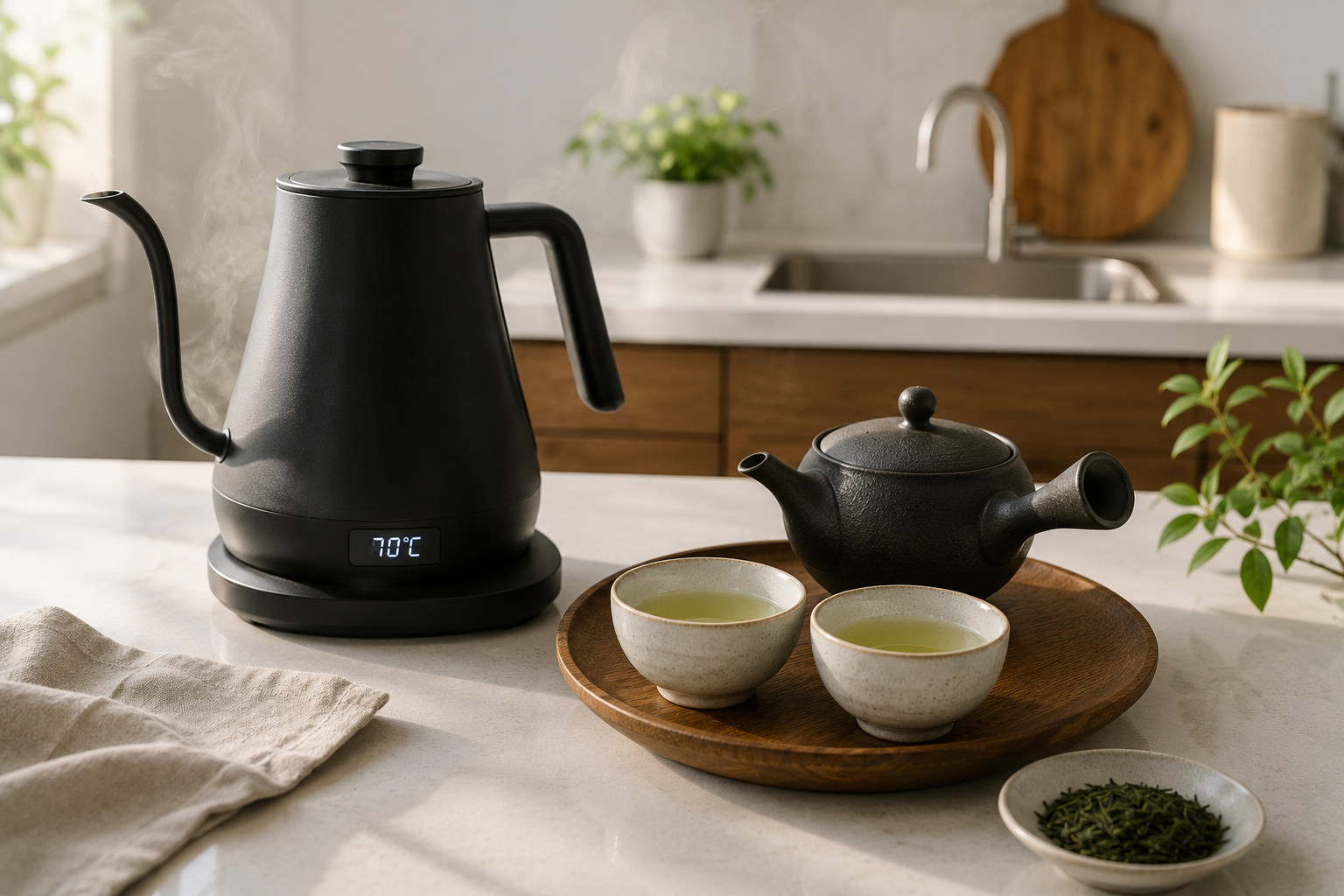
Japanese green teas want very different water temperatures. Roughly: gyokuro at 60-70°C (140-158°F), sencha at 70-80°C (158-176°F), genmaicha at 80-95°C, and hojicha near boiling. (My temperature guide covers why in detail.) So the real question isn’t “which kettle is best?” but “which kettle can hit the low end of that range, reliably, without fuss?” – and that’s where kettles differ most.
Who This Article Is NOT For
- If you only drink hojicha, genmaicha or black tea, a basic boil-only kettle is fine. Those teas take near-boiling water anyway.
- If you’re happy with the cooling-between-cups method and don’t mind the extra minute, you don’t need new equipment.
- If you mainly want a kettle for pour-over coffee, the picks overlap, but the priorities below are for tea.
The One Spec That Matters Most: How Low Does It Go?
Before anything else, check the lowest temperature a kettle can hold:
| Kettle | Temperature control | Lowest setting | Capacity | Keep warm |
|---|---|---|---|---|
| Fellow Stagg EKG | Any temperature, 1° steps | 57°C / 135°F | 0.9L | Up to 60 min |
| OXO Brew Adjustable Gooseneck | Any temperature, 1° steps | 60°C / 140°F | 1L | 30 min |
| Cuisinart PerfecTemp CPK-17 | 6 presets: 160, 175, 185, 190, 200, 212°F | 71°C / 160°F | 1.7L | 30 min |
| Zojirushi VE Hybrid Water Boiler | 4 settings: 160, 175, 195, 208°F | 71°C / 160°F | 4L or 5L | All day |
| Breville IQ Kettle BKE820XL | 5 presets, starting at 175°F | 80°C / 175°F | 1.8L | 20 min |
That last column is the trap. The Breville is a well-made kettle, but its lowest preset is 175°F (80°C) – the very top of the sencha range and too hot for gyokuro. The Cuisinart and Zojirushi bottom out at 160°F (about 71°C), which suits sencha and fukamushi well but is still a little warm for gyokuro. Only the degree-by-degree kettles cover the whole range.
Fellow Stagg EKG: Best If You Drink Gyokuro or Want Exact Control
The Stagg EKG sets any temperature from 57°C to 100°C (135-212°F) in one-degree steps and can hold it for up to an hour. That full range is what makes it the most complete option for Japanese tea: gyokuro at 60°C, sencha at 75°C and hojicha at boiling are all one dial-turn away. The hold mode is also handy for multiple infusions, since your second and third steeps can come from water that’s already at the right temperature.
The trade-offs are price – it’s one of the most expensive kettles here – and capacity. At 0.9L it’s built for a few cups, not for a household.
Pick it if: you drink gyokuro, care about precise temperatures, or want one kettle that handles every Japanese tea.
OXO Brew Adjustable Gooseneck: Precise Control for Less
The OXO also adjusts by the degree, from 140°F (60°C) up to boiling – just low enough for gyokuro – holds temperature for 30 minutes, and has a built-in timer, which is genuinely useful for short Japanese steeping times. It covers the same practical ground as the Fellow for most tea drinkers, usually for noticeably less money, with a slightly more utilitarian look.
Pick it if: you want degree-by-degree control without paying for the Fellow’s design.
Cuisinart PerfecTemp CPK-17: Best Preset Kettle for Sencha Drinkers
If you don’t want to think about exact numbers, a preset kettle is easier, and the Cuisinart’s presets happen to fit Japanese tea better than most. Its lowest setting is 160°F (71°C), with 175°F (80°C) right above it – effectively a “sencha” button and a “genmaicha” button. It’s 1.7L, so it suits a household, and the 30-minute keep-warm covers a second pot.
Pick it if: you mainly drink sencha or fukamushi and want one-touch simplicity.
Zojirushi VE Hybrid Water Boiler: The Japanese Household Option
This is what you’ll find in a lot of Japanese kitchens and offices: not a kettle but a hot water dispenser that keeps 4 or 5 liters at a set temperature all day. The four settings – 160, 175, 195 and 208°F – line up neatly with sencha, sencha/matcha, genmaicha and hojicha, and the display shows the actual water temperature. It’s made in Japan, uses vacuum insulation to save energy, and has a timer.
It’s large and it’s an investment, but if several people in your home drink tea throughout the day, it removes the step of boiling and waiting entirely.
Pick it if: tea is an all-day habit, or you’re making it for more than one or two people.
Breville IQ Kettle BKE820XL: Good Kettle, Wrong Lowest Temperature
The Breville is fast, well built and has a nice soft-opening lid. I include it because it’s often recommended as a “tea kettle,” and it’s worth knowing its limit: five presets starting at 175°F (80°C). That’s fine for genmaicha, hojicha, and black tea, and borderline for sencha. For gyokuro, you’d be back to cooling the water yourself.
Pick it if: you drink more black tea or hojicha than delicate green tea.
Do You Need a Gooseneck?
For pour-over coffee, a gooseneck spout matters. For Japanese tea, much less so – you’re filling a kyusu, not pouring slowly over a coffee bed. The two degree-by-degree kettles above happen to be goosenecks, but don’t buy one for the spout alone. Temperature control is what changes the taste of your tea.
A Few Things People Ask Me
Is a variable-temperature kettle really worth it for green tea? If you drink sencha or gyokuro regularly, yes. Water that’s too hot is the most common reason Japanese green tea tastes bitter, and a kettle that sets the temperature for you removes that mistake every single time.
Can I use a preset kettle for gyokuro? You can, with a small extra step: heat to the lowest preset, pour it into your cups or a yuzamashi (cooling bowl), and wait a minute before pouring into the kyusu. Each transfer drops the temperature a few degrees.
What about matcha? Matcha does well at roughly 70-80°C, so any kettle with a 160°F or 175°F setting covers it.
Which one would you buy first? If you drink gyokuro or want to brew everything precisely, the Fellow Stagg EKG on Amazon is the most complete. For a household that drinks sencha all day, the Zojirushi water boiler on Amazon is the more practical choice.
Where I Landed
The best kettle for green tea is the one that can reach the low temperatures your tea actually needs. Check the lowest setting before anything else: if you drink gyokuro, go degree-by-degree with the Fellow or OXO; if you mainly drink sencha, the Cuisinart’s 160°F preset is enough; and if tea runs all day in your home, the Zojirushi does it the Japanese way. Then put the money you saved toward better tea – my sencha brand comparison is a good place to start.